DNA
(Deoxyribonucleic acid)
Mr. Sagar Kishor Savale
[Department of Pharmacy (Pharmaceutics)]
2015-016
avengersagar16@gmail.com
Department of Pharmacy (Pharmaceutics) | Sagar savale
20-12-2015 1
History Of DNA
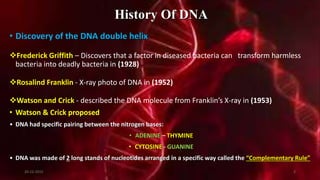
• Discovery of the DNA double helix
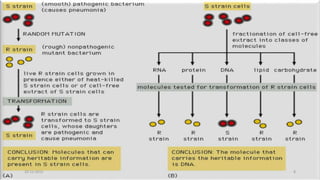
Frederick Griffith – Discovers that a factor in diseased bacteria can transform harmless
bacteria into deadly bacteria in (1928)
Rosalind Franklin - X-ray photo of DNA in (1952)
Watson and Crick - described the DNA molecule from Franklin’s X-ray in (1953)
• Watson & Crick proposed
• DNA had specific pairing between the nitrogen bases:
• ADENINE – THYMINE
• CYTOSINE - GUANINE
• DNA was made of 2 long stands of nucleotides arranged in a specific way called the “Complementary Rule”
20-12-2015 2
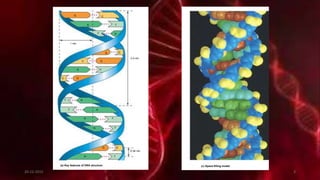
C
T
A
A
T
CG
GC
A
C G
AT
AT
A T
TA
C
TA
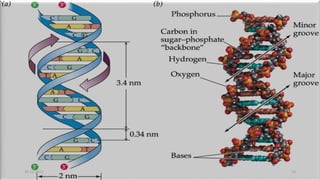
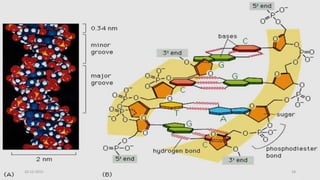
0.34 nm
3.4 nm
(a) Key features of DNA structure
G
1 nm
G
(c) Space-filling model
T
20-12-2015 3
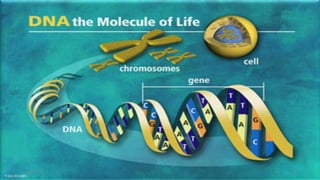
DNA
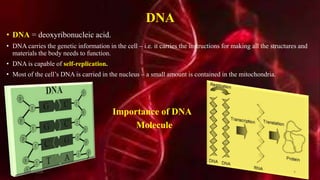
• DNA = deoxyribonucleic acid.
• DNA carries the genetic information in the cell – i.e. it carries the instructions for making all the structures and
materials the body needs to function.
• DNA is capable of self-replication.
• Most of the cell’s DNA is carried in the nucleus – a small amount is contained in the mitochondria.
•
• Importance of DNA
• Molecule
20-12-2015 4
20-12-2015 5
20-12-2015 6
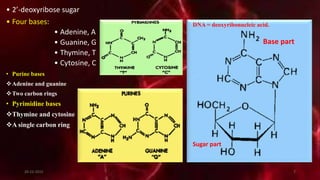
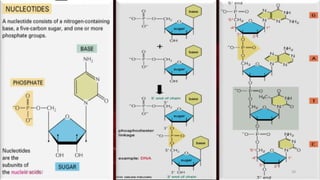
• 2’-deoxyribose sugar
• Four bases:
• Adenine, A
• Guanine, G
• Thymine, T
• Cytosine, C
• Purine bases
Adenine and guanine
Two carbon rings
• Pyrimidine bases
Thymine and cytosine
A single carbon ring
Base part
Sugar part
DNA = deoxyribonucleic acid.
20-12-2015 7
20-12-2015 8
20-12-2015 9
20-12-2015 10
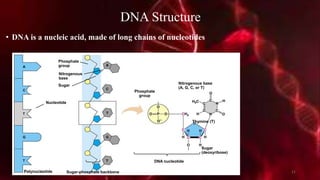
DNA Structure
• DNA is a nucleic acid, made of long chains of nucleotides
Nucleotide
Phosphate
group
Nitrogenous
base
Sugar
Polynucleotide Sugar-phosphate backbone
DNA nucleotide
Phosphate
group
Nitrogenous base
(A, G, C, or T)
Thymine (T)
Sugar
(deoxyribose)
20-12-2015 11
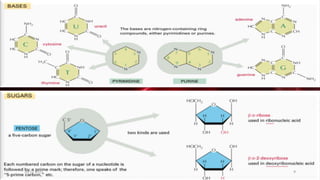
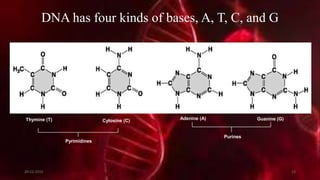
DNA has four kinds of bases, A, T, C, and G
Pyrimidines
Thymine (T) Cytosine (C)
Purines
Adenine (A) Guanine (G)
20-12-2015 12
20-12-2015 13
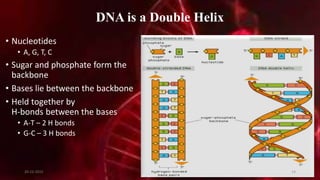
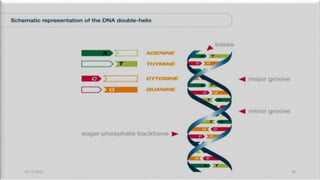
DNA is a Double Helix
• Nucleotides
• A, G, T, C
• Sugar and phosphate form the
backbone
• Bases lie between the backbone
• Held together by
H-bonds between the bases
• A-T – 2 H bonds
• G-C – 3 H bonds
20-12-2015 14
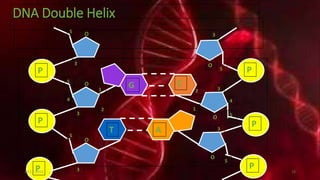
DNA Double Helix
P
P
P
O
O
O
1
2
3
4
5
5
3
3
5
P
P
P
O
O
O
1
2 3
4
5
5
3
5
3
G C
T A
20-12-2015 15
H - Bonds
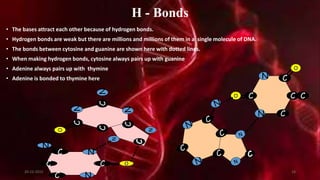
• The bases attract each other because of hydrogen bonds.
• Hydrogen bonds are weak but there are millions and millions of them in a single molecule of DNA.
• The bonds between cytosine and guanine are shown here with dotted lines.
• When making hydrogen bonds, cytosine always pairs up with guanine
• Adenine always pairs up with thymine
• Adenine is bonded to thymine here
C
C
C
C
N
N
O
N
C
C
C
C
N
N
O
N
N
N
C
C
C
C
C
N
N
O
O
C
20-12-2015 16
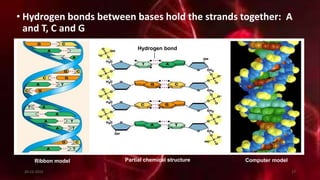
• Hydrogen bonds between bases hold the strands together: A
and T, C and G
Ribbon model Partial chemical structure Computer model
Hydrogen bond
20-12-2015 17
20-12-2015 18
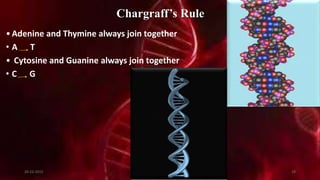
Chargraff’s Rule
•Adenine and Thymine always join together
• A T
• Cytosine and Guanine always join together
• C G
20-12-2015 19
20-12-2015 20
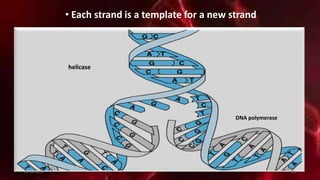
• Each strand is a template for a new strand
helicase
DNA polymerase
20-12-2015 21
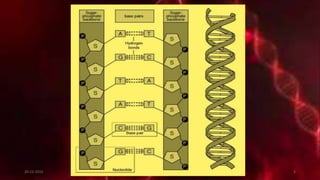
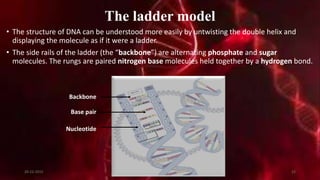
The ladder model
• The structure of DNA can be understood more easily by untwisting the double helix and
displaying the molecule as if it were a ladder.
• The side rails of the ladder (the “backbone”) are alternating phosphate and sugar
molecules. The rungs are paired nitrogen base molecules held together by a hydrogen bond.
Nucleotide
Base pair
Backbone
20-12-2015 22
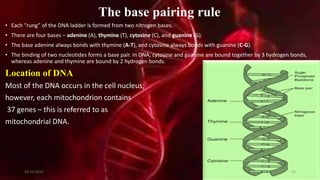
The base pairing rule
• Each “rung” of the DNA ladder is formed from two nitrogen bases.
• There are four bases – adenine (A), thymine (T), cytosine (C), and guanine (G).
• The base adenine always bonds with thymine (A-T), and cytosine always bonds with guanine (C-G).
• The binding of two nucleotides forms a base pair. In DNA, cytosine and guanine are bound together by 3 hydrogen bonds,
whereas adenine and thymine are bound by 2 hydrogen bonds.
Location of DNA
Most of the DNA occurs in the cell nucleus;
however, each mitochondrion contains
37 genes – this is referred to as
mitochondrial DNA.
20-12-2015 23
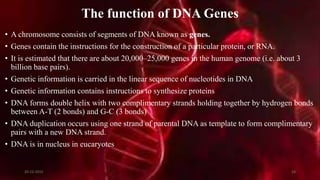
The function of DNA Genes
• A chromosome consists of segments of DNA known as genes.
• Genes contain the instructions for the construction of a particular protein, or RNA.
• It is estimated that there are about 20,000–25,000 genes in the human genome (i.e. about 3
billion base pairs).
• Genetic information is carried in the linear sequence of nucleotides in DNA
• Genetic information contains instructions to synthesize proteins
• DNA forms double helix with two complimentary strands holding together by hydrogen bonds
between A-T (2 bonds) and G-C (3 bonds)
• DNA duplication occurs using one strand of parental DNA as template to form complimentary
pairs with a new DNA strand.
• DNA is in nucleus in eucaryotes
20-12-2015 24
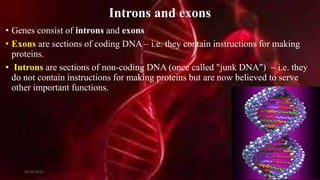
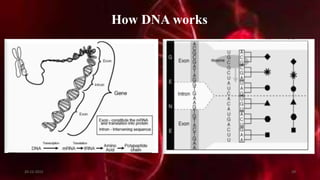
Introns and exons
• Genes consist of introns and exons
• Exons are sections of coding DNA – i.e. they contain instructions for making
proteins.
• Introns are sections of non-coding DNA (once called "junk DNA") – i.e. they
do not contain instructions for making proteins but are now believed to serve
other important functions.
20-12-2015 25
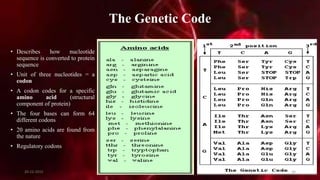
The Genetic Code
• Describes how nucleotide
sequence is converted to protein
sequence
• Unit of three nucleotides = a
codon
• A codon codes for a specific
amino acid (structural
component of protein)
• The four bases can form 64
different codons
• 20 amino acids are found from
the nature
• Regulatory codons
20-12-2015 26
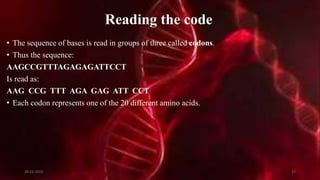
Reading the code
• The sequence of bases is read in groups of three called codons.
• Thus the sequence:
AAGCCGTTTAGAGAGATTCCT
Is read as:
AAG CCG TTT AGA GAG ATT CCT
• Each codon represents one of the 20 different amino acids.
20-12-2015 27
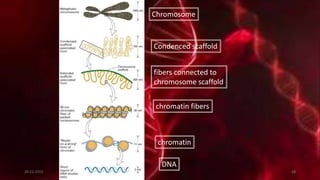
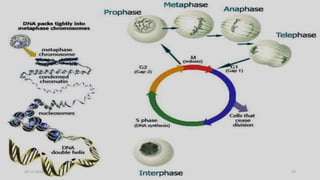
DNA
chromatin
chromatin fibers
fibers connected to
chromosome scaffold
Condenced scaffold
Chromosome
20-12-2015 28
How DNA works
20-12-2015 29
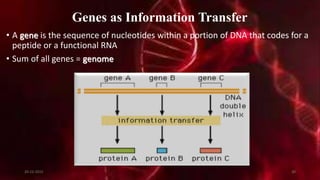
Genes as Information Transfer
• A gene is the sequence of nucleotides within a portion of DNA that codes for a
peptide or a functional RNA
• Sum of all genes = genome
20-12-2015 30
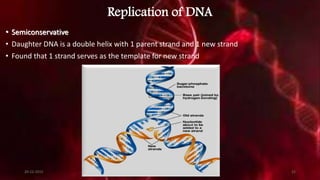
Replication of DNA
• Semiconservative
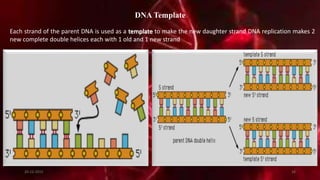
• Daughter DNA is a double helix with 1 parent strand and 1 new strand
• Found that 1 strand serves as the template for new strand
20-12-2015 31
20-12-2015 32
20-12-2015 33
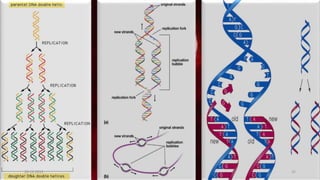
DNA Template
Each strand of the parent DNA is used as a template to make the new daughter strand DNA replication makes 2
new complete double helices each with 1 old and 1 new strand
20-12-2015 34
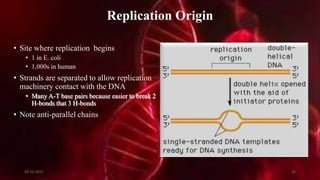
Replication Origin
• Site where replication begins
• 1 in E. coli
• 1,000s in human
• Strands are separated to allow replication
machinery contact with the DNA
• Many A-T base pairs because easier to break 2
H-bonds that 3 H-bonds
• Note anti-parallel chains
20-12-2015 35
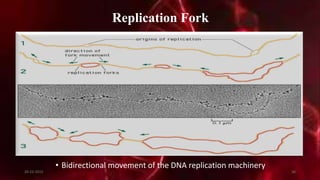
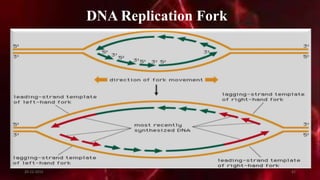
Replication Fork
• Bidirectional movement of the DNA replication machinery
20-12-2015 36
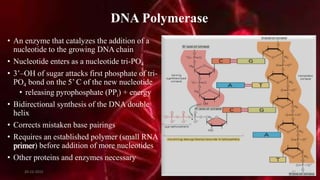
DNA Polymerase
• An enzyme that catalyzes the addition of a
nucleotide to the growing DNA chain
• Nucleotide enters as a nucleotide tri-PO4
• 3’–OH of sugar attacks first phosphate of tri-
PO4 bond on the 5’ C of the new nucleotide
• releasing pyrophosphate (PPi) + energy
• Bidirectional synthesis of the DNA double
helix
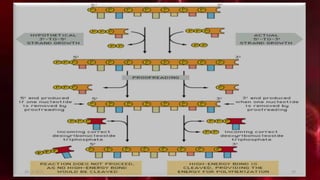
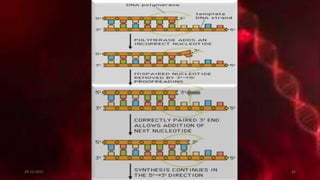
• Corrects mistaken base pairings
• Requires an established polymer (small RNA
primer) before addition of more nucleotides
• Other proteins and enzymes necessary
20-12-2015 37
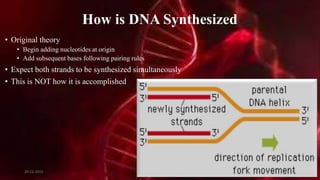
How is DNA Synthesized
• Original theory
• Begin adding nucleotides at origin
• Add subsequent bases following pairing rules
• Expect both strands to be synthesized simultaneously
• This is NOT how it is accomplished
20-12-2015 38
20-12-2015 39
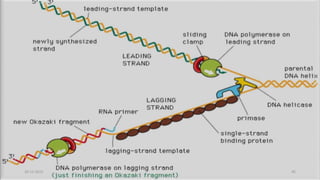
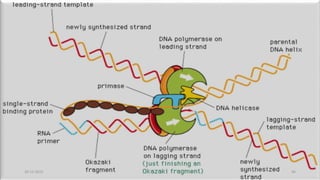
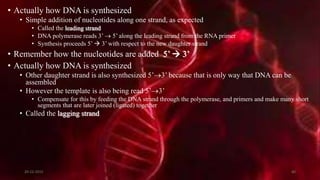
• Actually how DNA is synthesized
• Simple addition of nucleotides along one strand, as expected
• Called the leading strand
• DNA polymerase reads 3’  5’ along the leading strand from the RNA primer
• Synthesis proceeds 5’  3’ with respect to the new daughter strand
• Remember how the nucleotides are added 5’  3’
• Actually how DNA is synthesized
• Other daughter strand is also synthesized 5’3’ because that is only way that DNA can be
assembled
• However the template is also being read 5’3’
• Compensate for this by feeding the DNA strand through the polymerase, and primers and make many short
segments that are later joined (ligated) together
• Called the lagging strand
20-12-2015 40
DNA Replication Fork
20-12-2015 41
20-12-2015 42
Starting Synthesis
• DNA polymerase can only ADD nucleotides
to a growing polymer
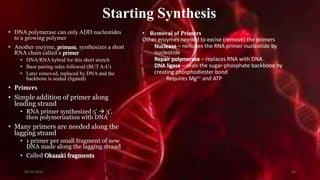
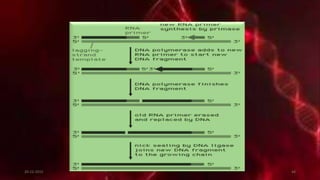
• Another enzyme, primase, synthesizes a short
RNA chain called a primer
• DNA/RNA hybrid for this short stretch
• Base pairing rules followed (BUT A-U)
• Later removed, replaced by DNA and the
backbone is sealed (ligated)
• Primers
• Simple addition of primer along
leading strand
• RNA primer synthesized 5’  3’,
then polymerization with DNA
• Many primers are needed along the
lagging strand
• 1 primer per small fragment of new
DNA made along the lagging strand
• Called Okazaki fragments
• Removal of Primers
Other enzymes needed to excise (remove) the primers
Nuclease – removes the RNA primer nucleotide by
nucleotide
Repair polymerase – replaces RNA with DNA
DNA ligase – seals the sugar-phosphate backbone by
creating phosphodiester bond
Requires Mg2+ and ATP
20-12-2015 43
20-12-2015 44
20-12-2015 45
20-12-2015 46
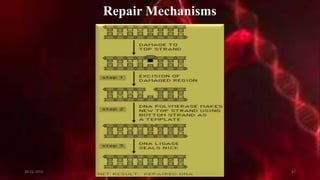
Repair Mechanisms
20-12-2015 47
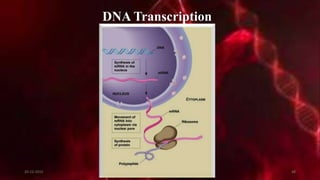
DNA Transcription
20-12-2015 48
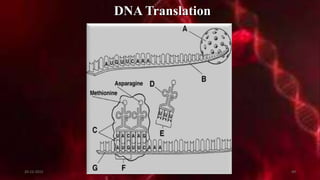
DNA Translation
20-12-2015 49
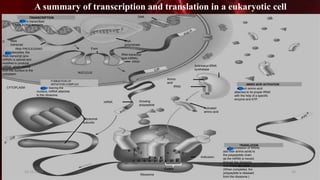
A summary of transcription and translation in a eukaryotic cell
TRANSCRIPTION
RNA is transcribed
from a DNA template.
DNA
RNA
polymerase
RNA
transcript
RNA PROCESSING
In eukaryotes, the
RNA transcript (pre-
mRNA) is spliced and
modified to produce
mRNA, which moves
from the nucleus to the
cytoplasm.
Exon
RNA transcript
(pre-mRNA)
Intron
NUCLEUS
FORMATION OF
INITIATION COMPLEX
After leaving the
nucleus, mRNA attaches
to the ribosome.
CYTOPLASM
mRNA Growing
polypeptide
Ribosomal
subunits
Aminoacyl-tRNA
synthetase
Amino
acid
tRNA
AMINO ACID ACTIVATION
Each amino acid
attaches to its proper tRNA
with the help of a specific
enzyme and ATP.
Activated
amino acid
TRANSLATION
A succession of tRNAs
add their amino acids to
the polypeptide chain
as the mRNA is moved
through the ribosome
one codon at a time.
(When completed, the
polypeptide is released
from the ribosome.)
AnticodonA A A
U G G U U U A U G
E A
Ribosome
1
5
5
3
Codon
2
3 4
5
20-12-2015 50
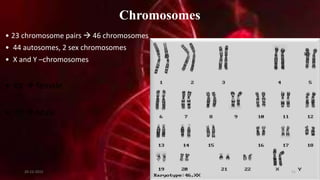
Chromosomes
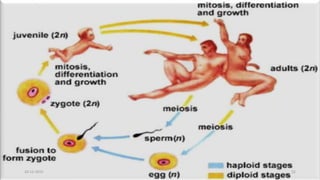
• 23 chromosome pairs  46 chromosomes
• 44 autosomes, 2 sex chromosomes
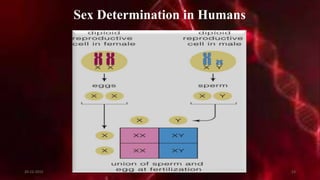
• X and Y –chromosomes
• XX  female
• XY  Male
20-12-2015 51
20-12-2015 52
Sex Determination in Humans
20-12-2015 53
References
• www.wikipedia.org
• www.sciencedirect.com
• www.medscape.com
• www.biolife.com
• www.nature.com
• www.Googlescoler.com
• www.pubmed.com
20-12-2015 54
20-12-2015 55

DNA (Deoxyribonucleic acid)

  • 1.
    DNA (Deoxyribonucleic acid) Mr. SagarKishor Savale [Department of Pharmacy (Pharmaceutics)] 2015-016 avengersagar16@gmail.com Department of Pharmacy (Pharmaceutics) | Sagar savale 20-12-2015 1
  • 2.
    History Of DNA •Discovery of the DNA double helix Frederick Griffith – Discovers that a factor in diseased bacteria can transform harmless bacteria into deadly bacteria in (1928) Rosalind Franklin - X-ray photo of DNA in (1952) Watson and Crick - described the DNA molecule from Franklin’s X-ray in (1953) • Watson & Crick proposed • DNA had specific pairing between the nitrogen bases: • ADENINE – THYMINE • CYTOSINE - GUANINE • DNA was made of 2 long stands of nucleotides arranged in a specific way called the “Complementary Rule” 20-12-2015 2
  • 3.
    C T A A T CG GC A C G AT AT A T TA C TA 0.34nm 3.4 nm (a) Key features of DNA structure G 1 nm G (c) Space-filling model T 20-12-2015 3
  • 4.
    DNA • DNA =deoxyribonucleic acid. • DNA carries the genetic information in the cell – i.e. it carries the instructions for making all the structures and materials the body needs to function. • DNA is capable of self-replication. • Most of the cell’s DNA is carried in the nucleus – a small amount is contained in the mitochondria. • • Importance of DNA • Molecule 20-12-2015 4
  • 5.
  • 6.
  • 7.
    • 2’-deoxyribose sugar •Four bases: • Adenine, A • Guanine, G • Thymine, T • Cytosine, C • Purine bases Adenine and guanine Two carbon rings • Pyrimidine bases Thymine and cytosine A single carbon ring Base part Sugar part DNA = deoxyribonucleic acid. 20-12-2015 7
  • 8.
  • 9.
  • 10.
  • 11.
    DNA Structure • DNAis a nucleic acid, made of long chains of nucleotides Nucleotide Phosphate group Nitrogenous base Sugar Polynucleotide Sugar-phosphate backbone DNA nucleotide Phosphate group Nitrogenous base (A, G, C, or T) Thymine (T) Sugar (deoxyribose) 20-12-2015 11
  • 12.
    DNA has fourkinds of bases, A, T, C, and G Pyrimidines Thymine (T) Cytosine (C) Purines Adenine (A) Guanine (G) 20-12-2015 12
  • 13.
  • 14.
    DNA is aDouble Helix • Nucleotides • A, G, T, C • Sugar and phosphate form the backbone • Bases lie between the backbone • Held together by H-bonds between the bases • A-T – 2 H bonds • G-C – 3 H bonds 20-12-2015 14
  • 15.
  • 16.
    H - Bonds •The bases attract each other because of hydrogen bonds. • Hydrogen bonds are weak but there are millions and millions of them in a single molecule of DNA. • The bonds between cytosine and guanine are shown here with dotted lines. • When making hydrogen bonds, cytosine always pairs up with guanine • Adenine always pairs up with thymine • Adenine is bonded to thymine here C C C C N N O N C C C C N N O N N N C C C C C N N O O C 20-12-2015 16
  • 17.
    • Hydrogen bondsbetween bases hold the strands together: A and T, C and G Ribbon model Partial chemical structure Computer model Hydrogen bond 20-12-2015 17
  • 18.
  • 19.
    Chargraff’s Rule •Adenine andThymine always join together • A T • Cytosine and Guanine always join together • C G 20-12-2015 19
  • 20.
  • 21.
    • Each strandis a template for a new strand helicase DNA polymerase 20-12-2015 21
  • 22.
    The ladder model •The structure of DNA can be understood more easily by untwisting the double helix and displaying the molecule as if it were a ladder. • The side rails of the ladder (the “backbone”) are alternating phosphate and sugar molecules. The rungs are paired nitrogen base molecules held together by a hydrogen bond. Nucleotide Base pair Backbone 20-12-2015 22
  • 23.
    The base pairingrule • Each “rung” of the DNA ladder is formed from two nitrogen bases. • There are four bases – adenine (A), thymine (T), cytosine (C), and guanine (G). • The base adenine always bonds with thymine (A-T), and cytosine always bonds with guanine (C-G). • The binding of two nucleotides forms a base pair. In DNA, cytosine and guanine are bound together by 3 hydrogen bonds, whereas adenine and thymine are bound by 2 hydrogen bonds. Location of DNA Most of the DNA occurs in the cell nucleus; however, each mitochondrion contains 37 genes – this is referred to as mitochondrial DNA. 20-12-2015 23
  • 24.
    The function ofDNA Genes • A chromosome consists of segments of DNA known as genes. • Genes contain the instructions for the construction of a particular protein, or RNA. • It is estimated that there are about 20,000–25,000 genes in the human genome (i.e. about 3 billion base pairs). • Genetic information is carried in the linear sequence of nucleotides in DNA • Genetic information contains instructions to synthesize proteins • DNA forms double helix with two complimentary strands holding together by hydrogen bonds between A-T (2 bonds) and G-C (3 bonds) • DNA duplication occurs using one strand of parental DNA as template to form complimentary pairs with a new DNA strand. • DNA is in nucleus in eucaryotes 20-12-2015 24
  • 25.
    Introns and exons •Genes consist of introns and exons • Exons are sections of coding DNA – i.e. they contain instructions for making proteins. • Introns are sections of non-coding DNA (once called "junk DNA") – i.e. they do not contain instructions for making proteins but are now believed to serve other important functions. 20-12-2015 25
  • 26.
    The Genetic Code •Describes how nucleotide sequence is converted to protein sequence • Unit of three nucleotides = a codon • A codon codes for a specific amino acid (structural component of protein) • The four bases can form 64 different codons • 20 amino acids are found from the nature • Regulatory codons 20-12-2015 26
  • 27.
    Reading the code •The sequence of bases is read in groups of three called codons. • Thus the sequence: AAGCCGTTTAGAGAGATTCCT Is read as: AAG CCG TTT AGA GAG ATT CCT • Each codon represents one of the 20 different amino acids. 20-12-2015 27
  • 28.
    DNA chromatin chromatin fibers fibers connectedto chromosome scaffold Condenced scaffold Chromosome 20-12-2015 28
  • 29.
  • 30.
    Genes as InformationTransfer • A gene is the sequence of nucleotides within a portion of DNA that codes for a peptide or a functional RNA • Sum of all genes = genome 20-12-2015 30
  • 31.
    Replication of DNA •Semiconservative • Daughter DNA is a double helix with 1 parent strand and 1 new strand • Found that 1 strand serves as the template for new strand 20-12-2015 31
  • 32.
  • 33.
  • 34.
    DNA Template Each strandof the parent DNA is used as a template to make the new daughter strand DNA replication makes 2 new complete double helices each with 1 old and 1 new strand 20-12-2015 34
  • 35.
    Replication Origin • Sitewhere replication begins • 1 in E. coli • 1,000s in human • Strands are separated to allow replication machinery contact with the DNA • Many A-T base pairs because easier to break 2 H-bonds that 3 H-bonds • Note anti-parallel chains 20-12-2015 35
  • 36.
    Replication Fork • Bidirectionalmovement of the DNA replication machinery 20-12-2015 36
  • 37.
    DNA Polymerase • Anenzyme that catalyzes the addition of a nucleotide to the growing DNA chain • Nucleotide enters as a nucleotide tri-PO4 • 3’–OH of sugar attacks first phosphate of tri- PO4 bond on the 5’ C of the new nucleotide • releasing pyrophosphate (PPi) + energy • Bidirectional synthesis of the DNA double helix • Corrects mistaken base pairings • Requires an established polymer (small RNA primer) before addition of more nucleotides • Other proteins and enzymes necessary 20-12-2015 37
  • 38.
    How is DNASynthesized • Original theory • Begin adding nucleotides at origin • Add subsequent bases following pairing rules • Expect both strands to be synthesized simultaneously • This is NOT how it is accomplished 20-12-2015 38
  • 39.
  • 40.
    • Actually howDNA is synthesized • Simple addition of nucleotides along one strand, as expected • Called the leading strand • DNA polymerase reads 3’  5’ along the leading strand from the RNA primer • Synthesis proceeds 5’  3’ with respect to the new daughter strand • Remember how the nucleotides are added 5’  3’ • Actually how DNA is synthesized • Other daughter strand is also synthesized 5’3’ because that is only way that DNA can be assembled • However the template is also being read 5’3’ • Compensate for this by feeding the DNA strand through the polymerase, and primers and make many short segments that are later joined (ligated) together • Called the lagging strand 20-12-2015 40
  • 41.
  • 42.
  • 43.
    Starting Synthesis • DNApolymerase can only ADD nucleotides to a growing polymer • Another enzyme, primase, synthesizes a short RNA chain called a primer • DNA/RNA hybrid for this short stretch • Base pairing rules followed (BUT A-U) • Later removed, replaced by DNA and the backbone is sealed (ligated) • Primers • Simple addition of primer along leading strand • RNA primer synthesized 5’  3’, then polymerization with DNA • Many primers are needed along the lagging strand • 1 primer per small fragment of new DNA made along the lagging strand • Called Okazaki fragments • Removal of Primers Other enzymes needed to excise (remove) the primers Nuclease – removes the RNA primer nucleotide by nucleotide Repair polymerase – replaces RNA with DNA DNA ligase – seals the sugar-phosphate backbone by creating phosphodiester bond Requires Mg2+ and ATP 20-12-2015 43
  • 44.
  • 45.
  • 46.
  • 47.
  • 48.
  • 49.
  • 50.
    A summary oftranscription and translation in a eukaryotic cell TRANSCRIPTION RNA is transcribed from a DNA template. DNA RNA polymerase RNA transcript RNA PROCESSING In eukaryotes, the RNA transcript (pre- mRNA) is spliced and modified to produce mRNA, which moves from the nucleus to the cytoplasm. Exon RNA transcript (pre-mRNA) Intron NUCLEUS FORMATION OF INITIATION COMPLEX After leaving the nucleus, mRNA attaches to the ribosome. CYTOPLASM mRNA Growing polypeptide Ribosomal subunits Aminoacyl-tRNA synthetase Amino acid tRNA AMINO ACID ACTIVATION Each amino acid attaches to its proper tRNA with the help of a specific enzyme and ATP. Activated amino acid TRANSLATION A succession of tRNAs add their amino acids to the polypeptide chain as the mRNA is moved through the ribosome one codon at a time. (When completed, the polypeptide is released from the ribosome.) AnticodonA A A U G G U U U A U G E A Ribosome 1 5 5 3 Codon 2 3 4 5 20-12-2015 50
  • 51.
    Chromosomes • 23 chromosomepairs  46 chromosomes • 44 autosomes, 2 sex chromosomes • X and Y –chromosomes • XX  female • XY  Male 20-12-2015 51
  • 52.
  • 53.
    Sex Determination inHumans 20-12-2015 53
  • 54.
    References • www.wikipedia.org • www.sciencedirect.com •www.medscape.com • www.biolife.com • www.nature.com • www.Googlescoler.com • www.pubmed.com 20-12-2015 54
  • 55.