NUCLEIC
 ACIDS
Topic Outline:

 History of Nucleic Acids
 Structure and Function
 Types of Nucleic Acids
    1. DNA
    2. RNA
 Central Dogma of Life
Friedrich Miescher in
 1869
 isolated what he called nuclein from the
  nuclei of pus cells
Richard Altmann in 1889

 Nuclein was shown to have acidic
  properties, hence it became called nucleic
  acid
1920s

 the tetranucleotide hypothesis was
  introduced
The Tetranucleotide
 hypothesis
 Up to 1940 researchers were convinced
  that hydrolysis of nucleic acids yielded the
  four bases in equal amounts.
 Nucleic acid was postulated to contain
  one of each of the four nucleotides, the
  tetranucleotide hypothesis.
 Takahashi (1932) proposed a structure of
  nucleotide bases connected by
  phosphodiester linkages.
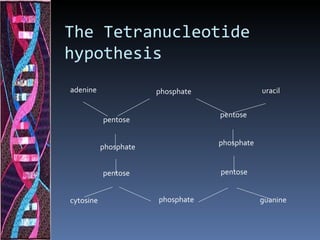
The Tetranucleotide
hypothesis
adenine                phosphate               uracil


                                   pentose
           pentose

                                   phosphate
           phosphate


           pentose                 pentose


cytosine               phosphate               guanine
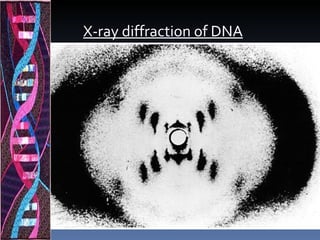
Astbury and Bell in 1938

 First X-ray diffraction pattern of DNA is
  published.
 The pattern indicates a helical
  structure, indicated periodicity.
X-ray diffraction of DNA
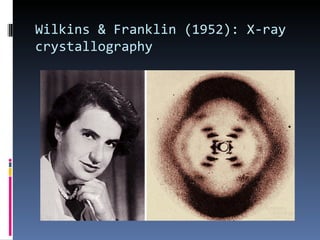
Wilkins & Franklin (1952): X-ray
crystallography
Avery, MacLeod, and Mc
 Carty in 1944
 demonstrate DNA could “transform”
  cells.
 Supporters of the tetranucleotide
  hypothesis did not believe nucleic acid
  was variable enough to be a molecule
  of heredity and store genetic
  information.
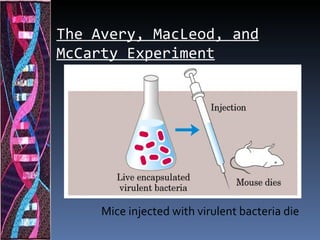
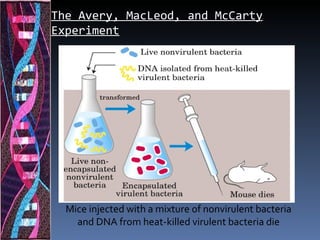
The Avery, MacLeod, and
McCarty Experiment


     Mice injected with virulent bacteria die
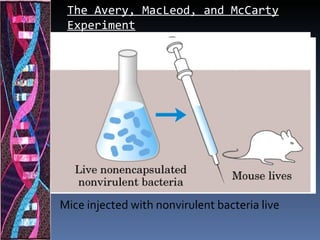
The Avery, MacLeod, and McCarty
 Experiment


Mice injected with nonvirulent bacteria live
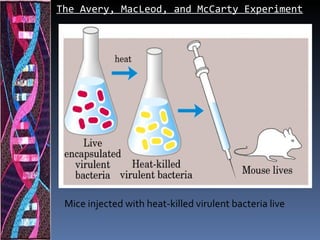
The Avery, MacLeod, and McCarty Experiment


 Mice injected with heat-killed virulent bacteria live
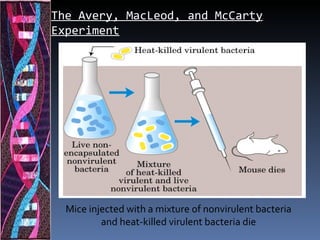
The Avery, MacLeod, and McCarty
Experiment


  Mice injected with a mixture of nonvirulent bacteria
          and heat-killed virulent bacteria die
The Avery, MacLeod, and McCarty
Experiment


  Mice injected with a mixture of nonvirulent bacteria
    and DNA from heat-killed virulent bacteria die
Erwin Chargaff in late
 1940s
 used paper chromatography for
      separation of DNA hydrolysates.
 Amount of adenine is equal to amount
  of thymine and amount of guanine is
  equal to amount of cytosine.
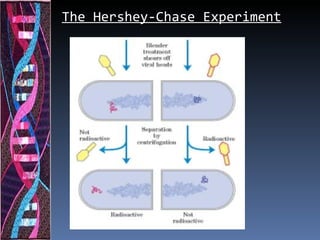
Hershey and Chase in
 1952
 confirm DNA is a molecule of heredity.
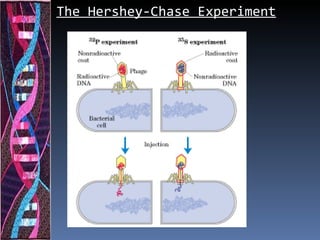
The Hershey-Chase Experiment
Watson and Crick in 1953

 determine the structure of DNA
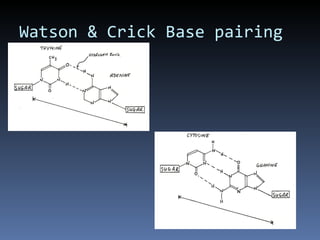
Watson & Crick Base pairing
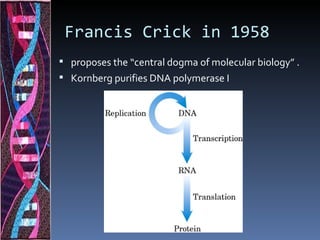
Francis Crick in 1958
 proposes the “central dogma of molecular biology” .
 Kornberg purifies DNA polymerase I
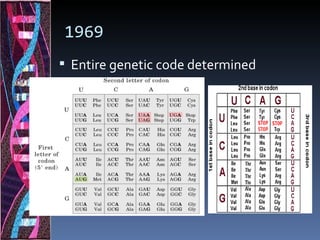
1969
 Entire genetic code determined
Important Developments
 1972 – First recombinant DNA molecule
            constructed Lambda phage DNA
            inserted into SV40 virus
      - Restriction enzyme EcoRI used to
           create a recombinant plasmid
           containing penicillin and
           tetracycline resistance
 1982 – Tetrahymena ribosomal RNA
           splicing shown to be self- splicing
Important Developments
 1986 – RNA is shown to act as an enzyme
       - The polymerase chain reaction
           (PCR) was developed by
       Kari Mullis at Cetus Corporation.
 1995 – First complete genome
           sequenced of the bacterium
           Haemophilus influenzae at TIGR
 2001 – Human genome sequenced by
           NIH and Celera Genomics
Nucleic Acids

• Nucleic Acids are very long, thread-like
polymers, made up of a linear array of monomers
called nucleotides.

• Nucleic acids vary in size in nature

• tRNA molecules contain as few as 80 nucleotides

• Eukaryotic chromosomes contain as many as
100,000,000 nucleotides.
Two types of nucleic acid
are found
 Deoxyribonucleic acid (DNA)
 Ribonucleic acid (RNA)
DNA and RNA
DNA
deoxyribonucleic acid
nucleic acid that stores genetic information
found in the nucleus of a mammalian cell.

RNA
ribonucleic acid
3 types of RNA in a cell
Ribosomal RNAs (rRNA) are components of ribosomes
Messenger RNAs (mRNA) carry genetic information
Transfer RNAs (tRNA) are adapter molecules in translation
The distribution of nucleic
acids in the eukaryotic
cell is found in the nucleus
  DNA
   with small amounts in mitochondria and
   chloroplasts
 RNA is found throughout the cell
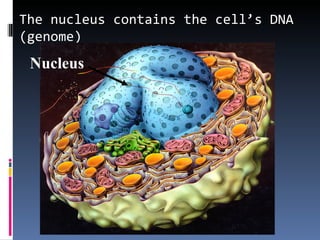
The nucleus contains the cell’s DNA
(genome)
 Nucleus
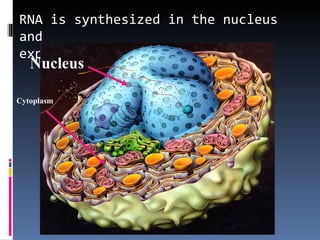
RNA is synthesized in the nucleus
and
exported to the cytoplasm
   Nucleus

Cytoplasm
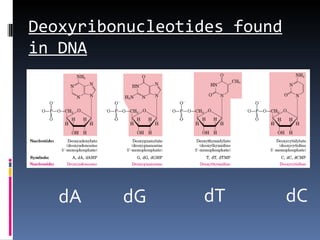
Deoxyribonucleotides found
in DNA


   dA    dG      dT          dC
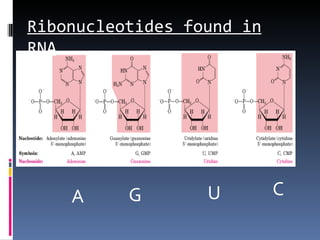
Ribonucleotides found in
RNA


    A     G       U        C
DNA as genetic material:
The circumstantial evidence
1.   Present in all cells and virtually restricted to the nucleus
2.   The amount of DNA in somatic cells (body cells) of any
     given species is constant (like the number of
     chromosomes)
3.   The DNA content of gametes (sex cells) is half that of
     somatic cells.
     In cases of polyploidy (multiple sets of chromosomes)
     the DNA content increases by a proportional factor
4.   The mutagenic effect of UV light peaks at 253.7nm. The
     peak for the absorption of UV light by DNA
NUCLEIC ACID STRUCTURE

 Nucleic acids are polynucleotides
 Their building blocks are nucleotides
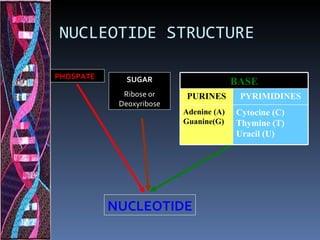
NUCLEOTIDE STRUCTURE

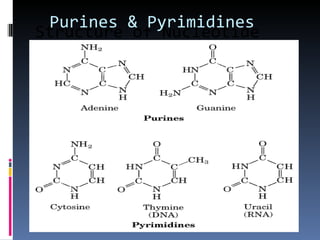
PHOSPATE      SUGAR                     BASE
             Ribose or     PURINES       PYRIMIDINES
            Deoxyribose
                          Adenine (A)   Cytocine (C)
                          Guanine(G)    Thymine (T)
                                        Uracil (U)


           NUCLEOTIDE
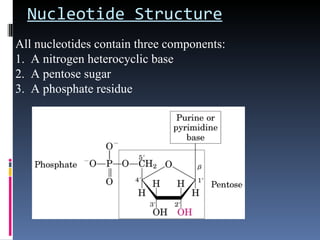
Nucleotide Structure
All nucleotides contain three components:
1. A nitrogen heterocyclic base
2. A pentose sugar
3. A phosphate residue
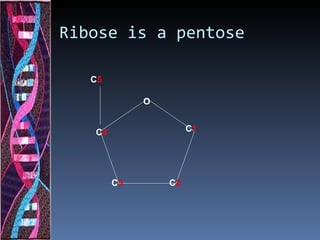
Ribose is a pentose

   C5

             O


   C4                 C1


        C3       C2
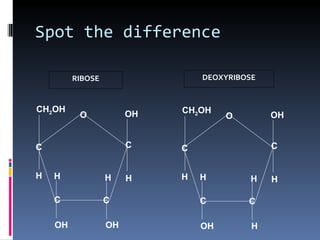
Spot the difference

         RIBOSE                 DEOXYRIBOSE


CH2OH                       CH2OH
          O            OH            O        OH


C                      C    C                 C


H   H             H    H    H   H        H    H

    C             C             C        C

    OH            OH            OH        H
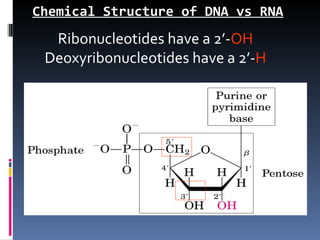
Chemical Structure of DNA vs RNA
  Ribonucleotides have a 2’-OH
 Deoxyribonucleotides have a 2’-H
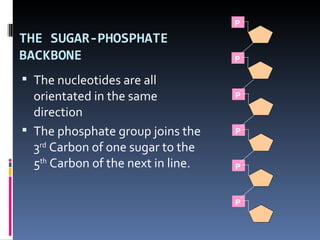
P

THE SUGAR-PHOSPHATE
BACKBONE                            P

 The nucleotides are all
  orientated in the same            P

  direction
 The phosphate group joins the     P

  3rd Carbon of one sugar to the
  5th Carbon of the next in line.   P


                                    P
P
                               G

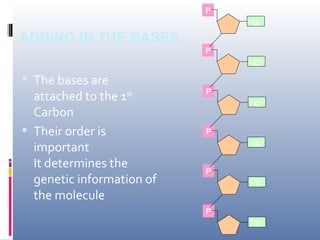
ADDING IN THE BASES
                           P
                               C

 The bases are
                           P
  attached to the 1
                  st
                               C
  Carbon
 Their order is           P

  important                    A

  It determines the        P
  genetic information of       T
  the molecule
                           P
                               T
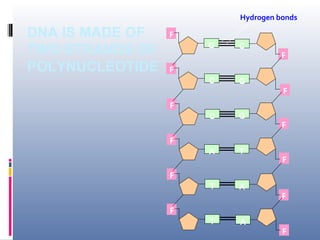
Hydrogen bonds

DNA IS MADE OF   P
                     G
TWO STRANDS OF           C
                                   P
POLYNUCLEOTIDE   P
                     C   G
                                   P
                 P
                     C   G
                                   P
                 P
                     A   T
                                   P
                 P
                     T   A
                                   P
                 P
                     T   A
                                   P
DNA IS MADE OF TWO STRANDS OF
POLYNUCLEOTIDE
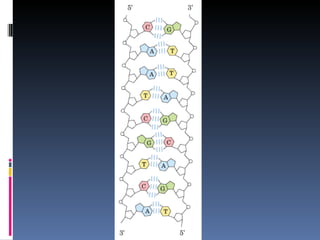
 The sister strands of the DNA molecule run in opposite
    directions (antiparallel)
   They are joined by the bases
   Each base is paired with a specific partner:
        A is always paired with T
        G is always paired with C
        “Purine with Pyrimidine”
   The sister strands are complementary but not identical
   The bases are joined by hydrogen bonds, individually
    weak but collectively strong
 There are 10 base pairs per turn
Purines & Pyrimidines
Structure of Nucleotide
Bases
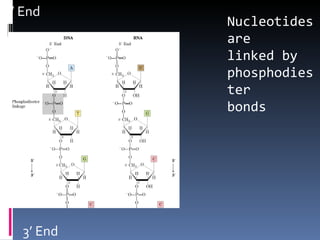
5’ End
            Nucleotides
            are
            linked by
            phosphodies
            ter
            bonds


   3’ End
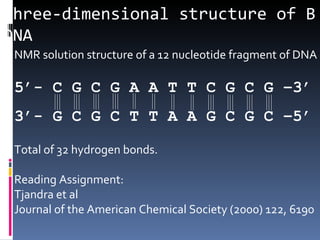
Three-dimensional structure of B
DNA
 NMR solution structure of a 12 nucleotide fragment of DNA

 5’- C G C G A A T T C G C G –3’
 3’- G C G C T T A A G C G C –5’

 Total of 32 hydrogen bonds.

 Reading Assignment:
 Tjandra et al
 Journal of the American Chemical Society (2000) 122, 6190
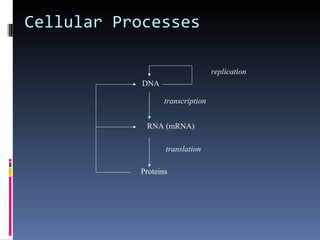
Cellular Processes

                                  replication
            DNA

                  transcription


            RNA (mRNA)

                  translation

           Proteins
RNA and Transcription
DNA is in the nucleus

Proteins are synthesized on ribosomes in the
cytoplasm

RNA carries the genetic information from the
nucleus to the cytoplasm

This RNA is called messenger RNA (mRNA)
RNA Structure

Transcription of a DNA molecule results in a mRNA
      molecule that is single-stranded.

RNA molecules do not have a regular structure like DNA.

The structures of RNA molecules are complex and unique.

RNA molecules can base pair with complementary DNA
     or RNA sequences.

G pairs with C, A pairs with U, and G pairs with U.
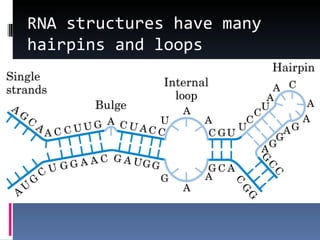
RNA structures have many
hairpins and loops
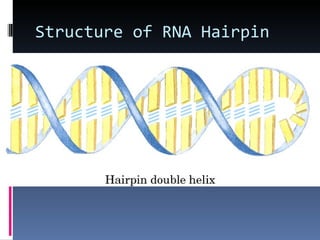
Structure of RNA Hairpin

Nucleic acids 1

  • 1.
  • 2.
    Topic Outline:  Historyof Nucleic Acids  Structure and Function  Types of Nucleic Acids 1. DNA 2. RNA  Central Dogma of Life
  • 3.
    Friedrich Miescher in 1869  isolated what he called nuclein from the nuclei of pus cells
  • 4.
    Richard Altmann in1889  Nuclein was shown to have acidic properties, hence it became called nucleic acid
  • 5.
    1920s  the tetranucleotidehypothesis was introduced
  • 6.
    The Tetranucleotide hypothesis Up to 1940 researchers were convinced that hydrolysis of nucleic acids yielded the four bases in equal amounts.  Nucleic acid was postulated to contain one of each of the four nucleotides, the tetranucleotide hypothesis.  Takahashi (1932) proposed a structure of nucleotide bases connected by phosphodiester linkages.
  • 7.
    The Tetranucleotide hypothesis adenine phosphate uracil pentose pentose phosphate phosphate pentose pentose cytosine phosphate guanine
  • 8.
    Astbury and Bellin 1938  First X-ray diffraction pattern of DNA is published.  The pattern indicates a helical structure, indicated periodicity.
  • 9.
  • 10.
    Wilkins & Franklin(1952): X-ray crystallography
  • 11.
    Avery, MacLeod, andMc Carty in 1944  demonstrate DNA could “transform” cells.  Supporters of the tetranucleotide hypothesis did not believe nucleic acid was variable enough to be a molecule of heredity and store genetic information.
  • 12.
    The Avery, MacLeod,and McCarty Experiment Mice injected with virulent bacteria die
  • 13.
    The Avery, MacLeod,and McCarty Experiment Mice injected with nonvirulent bacteria live
  • 14.
    The Avery, MacLeod,and McCarty Experiment Mice injected with heat-killed virulent bacteria live
  • 15.
    The Avery, MacLeod,and McCarty Experiment Mice injected with a mixture of nonvirulent bacteria and heat-killed virulent bacteria die
  • 16.
    The Avery, MacLeod,and McCarty Experiment Mice injected with a mixture of nonvirulent bacteria and DNA from heat-killed virulent bacteria die
  • 17.
    Erwin Chargaff inlate 1940s  used paper chromatography for separation of DNA hydrolysates.  Amount of adenine is equal to amount of thymine and amount of guanine is equal to amount of cytosine.
  • 18.
    Hershey and Chasein 1952  confirm DNA is a molecule of heredity.
  • 19.
  • 20.
  • 21.
    Watson and Crickin 1953  determine the structure of DNA
  • 22.
    Watson & CrickBase pairing
  • 23.
    Francis Crick in1958  proposes the “central dogma of molecular biology” .  Kornberg purifies DNA polymerase I
  • 24.
    1969  Entire geneticcode determined
  • 25.
    Important Developments  1972– First recombinant DNA molecule constructed Lambda phage DNA inserted into SV40 virus - Restriction enzyme EcoRI used to create a recombinant plasmid containing penicillin and tetracycline resistance  1982 – Tetrahymena ribosomal RNA splicing shown to be self- splicing
  • 26.
    Important Developments  1986– RNA is shown to act as an enzyme - The polymerase chain reaction (PCR) was developed by Kari Mullis at Cetus Corporation.  1995 – First complete genome sequenced of the bacterium Haemophilus influenzae at TIGR  2001 – Human genome sequenced by NIH and Celera Genomics
  • 27.
    Nucleic Acids • NucleicAcids are very long, thread-like polymers, made up of a linear array of monomers called nucleotides. • Nucleic acids vary in size in nature • tRNA molecules contain as few as 80 nucleotides • Eukaryotic chromosomes contain as many as 100,000,000 nucleotides.
  • 28.
    Two types ofnucleic acid are found  Deoxyribonucleic acid (DNA)  Ribonucleic acid (RNA)
  • 29.
    DNA and RNA DNA deoxyribonucleicacid nucleic acid that stores genetic information found in the nucleus of a mammalian cell. RNA ribonucleic acid 3 types of RNA in a cell Ribosomal RNAs (rRNA) are components of ribosomes Messenger RNAs (mRNA) carry genetic information Transfer RNAs (tRNA) are adapter molecules in translation
  • 30.
    The distribution ofnucleic acids in the eukaryotic cell is found in the nucleus  DNA with small amounts in mitochondria and chloroplasts  RNA is found throughout the cell
  • 31.
    The nucleus containsthe cell’s DNA (genome) Nucleus
  • 32.
    RNA is synthesizedin the nucleus and exported to the cytoplasm Nucleus Cytoplasm
  • 33.
  • 34.
  • 35.
    DNA as geneticmaterial: The circumstantial evidence 1. Present in all cells and virtually restricted to the nucleus 2. The amount of DNA in somatic cells (body cells) of any given species is constant (like the number of chromosomes) 3. The DNA content of gametes (sex cells) is half that of somatic cells. In cases of polyploidy (multiple sets of chromosomes) the DNA content increases by a proportional factor 4. The mutagenic effect of UV light peaks at 253.7nm. The peak for the absorption of UV light by DNA
  • 36.
    NUCLEIC ACID STRUCTURE Nucleic acids are polynucleotides  Their building blocks are nucleotides
  • 37.
    NUCLEOTIDE STRUCTURE PHOSPATE SUGAR BASE Ribose or PURINES PYRIMIDINES Deoxyribose Adenine (A) Cytocine (C) Guanine(G) Thymine (T) Uracil (U) NUCLEOTIDE
  • 38.
    Nucleotide Structure All nucleotidescontain three components: 1. A nitrogen heterocyclic base 2. A pentose sugar 3. A phosphate residue
  • 39.
    Ribose is apentose C5 O C4 C1 C3 C2
  • 40.
    Spot the difference RIBOSE DEOXYRIBOSE CH2OH CH2OH O OH O OH C C C C H H H H H H H H C C C C OH OH OH H
  • 41.
    Chemical Structure ofDNA vs RNA Ribonucleotides have a 2’-OH Deoxyribonucleotides have a 2’-H
  • 42.
    P THE SUGAR-PHOSPHATE BACKBONE P  The nucleotides are all orientated in the same P direction  The phosphate group joins the P 3rd Carbon of one sugar to the 5th Carbon of the next in line. P P
  • 43.
    P G ADDING IN THE BASES P C  The bases are P attached to the 1 st C Carbon  Their order is P important A It determines the P genetic information of T the molecule P T
  • 44.
    Hydrogen bonds DNA ISMADE OF P G TWO STRANDS OF C P POLYNUCLEOTIDE P C G P P C G P P A T P P T A P P T A P
  • 45.
    DNA IS MADEOF TWO STRANDS OF POLYNUCLEOTIDE  The sister strands of the DNA molecule run in opposite directions (antiparallel)  They are joined by the bases  Each base is paired with a specific partner: A is always paired with T G is always paired with C “Purine with Pyrimidine”  The sister strands are complementary but not identical  The bases are joined by hydrogen bonds, individually weak but collectively strong  There are 10 base pairs per turn
  • 47.
  • 48.
    5’ End Nucleotides are linked by phosphodies ter bonds 3’ End
  • 49.
    Three-dimensional structure ofB DNA NMR solution structure of a 12 nucleotide fragment of DNA 5’- C G C G A A T T C G C G –3’ 3’- G C G C T T A A G C G C –5’ Total of 32 hydrogen bonds. Reading Assignment: Tjandra et al Journal of the American Chemical Society (2000) 122, 6190
  • 50.
    Cellular Processes replication DNA transcription RNA (mRNA) translation Proteins
  • 51.
    RNA and Transcription DNAis in the nucleus Proteins are synthesized on ribosomes in the cytoplasm RNA carries the genetic information from the nucleus to the cytoplasm This RNA is called messenger RNA (mRNA)
  • 52.
    RNA Structure Transcription ofa DNA molecule results in a mRNA molecule that is single-stranded. RNA molecules do not have a regular structure like DNA. The structures of RNA molecules are complex and unique. RNA molecules can base pair with complementary DNA or RNA sequences. G pairs with C, A pairs with U, and G pairs with U.
  • 53.
    RNA structures havemany hairpins and loops
  • 54.

Editor's Notes

  • #32 The nucleus contains the cell’s DNA, which makes up the genome. The nucleus is surrounded by a nuclear envelope, two membrane bilayers Molecules come into and out of the nucleus through nuclear pores The inside of the nucleus is called the nucleoplasm. Chromatin is the name given to DNA complexed with proteins (histones) The nucleolus is a region where the DNA is concentrated for replication
  • #33 The nucleus contains the cell’s DNA, which makes up the genome. The nucleus is surrounded by a nuclear envelope, two membrane bilayers Molecules come into and out of the nucleus through nuclear pores The inside of the nucleus is called the nucleoplasm. Chromatin is the name given to DNA complexed with proteins (histones) The nucleolus is a region where the DNA is concentrated for replication