LATTHE EDUCATION SOCIETY’S
SMT. KASTURBAI WALCHAND COLLEGE, SANGLI
DEPARTMENT OF BOTANY
ORGANIZED
ONE DAY WORKSHOP
ON
REVISED SYLLABUS OF B. SC.-III (PRACTICAL)
PRACTICAL-I &II
IN ASSOCIATION
WITH
SHIVAJI UNIVERSITY, KOLHAPUR
DATE: 11TH FEBRUARY, 2021
S
m
t
.
K
A
S
T
U
R
BAI WALCHAN
D
C
O
L
L
E
G
E
SANGLI
DEMONSTRATION
ON
EXPERIMENTS FROM PRACTICAL-I
➢ 10. Isolation of Plant genomic DNA and its spooling.
➢ 11. Estimation of DNA by using Diphenyl amine
➢ 16. Study of steps in Genetic Engineering for the Production of Golden Rice
with the help of photographs
By
Dr. S. G. Khadke
Assistant Professor,
Department of Botany,
Smt. Kasturbai Walchand College, Sangli
Email ID: sgkhadke@kwcsangli.in
EXPT. NO.10. ISOLATION OF PLANT GENOMIC DNA
AND ITS SPOOLING.
Introduction:
➢ Nucleic acids (DNA & RNA)are vital macromolecules in all living
cells.
➢ In eukaryotic (Plant) cell Genomic DNA is located in Nucleus while
Cellular DNA located in Mitochondria and Chloroplast.
➢ Most of the DNA (80%) exists in Nuclei and remaining DNA in the
self duplicating Organelles.
➢ Nuclear DNA combines with histone proteins in an orderly manner
to form Chromatin.
➢ Extraction of DNA is done by number of methods.
➢ The efficiency and recovery of extraction depends on the sample
material, ionic conditions of extraction medium, type of lysing
agent used etc.
➢ The procedure described below is essentially that of Murmur’s
method
 Aim:-To isolate DNA from different plant samples by Phenol-
Chloroform method.
 Principle:- Plant cells are surrounded by cell wall. Treatment
with detergent (Sodium Dodecyl Sulfate, SDS) is an effective
way of breaking of cells and their nuclei to release the content,
For this, Lysis buffer containing Tris-EDTA and SDS is used.
The DNA is associated with a number of proteins. These can be
removed by adding Phenol-Chloroform and isoamyl alcohol. The
Phenol is removed by washing the DNA with Chloroform.
Finally, cold ethanol precipitates out the crude DNA in the form
of Spool. Saline sodium citrate (SSC) buffer is used to dissolve
DNA.
Materials and Method:
1. Lysis buffer containing:
2. 10mM Tris-HCL (pH 8.0), 5mM EDTA (Ethylene diamine tetra
acetic acid) pH-8.0, 0.5% SDS (Sodium dodecyl sulphate)
3. Phenol-Chloroform- isoamyl alcohol. (ratio 25:24:1)
4. Coconut endosperm/Pea/Onion/Cauliflower etc.
5. 3M sodium acetate
6. SSC buffer: Dissolve 0.015M sodium citrate and 0.15M NaCl
in distilled water.
7. Chilled absolute ethanol.
8. Mortar and Pestle, Water bath, Centrifuge, Centrifuge tubes and
Micropipette.
Procedure:
1. Take 200mg of coconut endosperm/pea/onion and make
small pieces and homogenize.
2. The homogenate is made up to5 ml with lysis buffer stir
the mixer.
3. Add 5ml of Phenol-Chloroform- iso-amyl alcohol and
0.5 ml of 3M Sodium acetate (1/20th of the total volume)
incubate in water bath at 500C for 15 minutes.
4. Centrifuge the mixture at 3000 rpm for 10 minutes.
5. Now carefully collect the supernatant and pour a layer
of ice-cold ethanol on top of the mixture, leave to
stand for few minutes.
6. The precipitate DNA should form web of tangled fibers
known as spool, which can be drawn up from the tube
by carefully rotating the glass rod at the interface
between the two layers.
Ref. : Plummer, D. T. 2013. An Introduction to Practical Biochemistry. 3rd edition. McGraw Hill Education (India)
Pvt. Ltd. New Delhi. 332p.
DNA Spool
EXPT. NO. 11. CALORIMETRIC ESTIMATION OF DNA
BY DIPHENYL AMINE METHOD
• Aim- To estimate the amount of DNA present in the
sample
• Principle-When DNA is treated with diphenylamine
under acid conditions; a blue compound is formed
with a sharp absorption maximum at 595nm. This
reaction is given by 2-deoxypentoses in general and
is not specific for DNA. In acid solution, the straight
chain form of deoxypentose is converted to the
highly reactive β-hydroxylevulinaldehyde which
reacts with diphenylamine to give a blue complex. In
DNA, only the deoxyribose of the purine nucleotides
reacts, so that the value obtained represents half of
the total deoxyribose present.
Materials:
➢ Standard DNA(0.5mg/mL)
➢ Sample expected to contain DNA
➢ saline citrate (0.15M NaCl, 0.015 M Na3
Citrate) solution
➢ Diphenylamine reagent.
➢ Mix 5g fresh or recrystallized
Diphenylamine , 500mL glacial acetic acid
and 13.75mL of conc. sulphuric acid. (This
solution must be freshly prepared)
PROCEDURE:
1. Prepare separate marked tubes containing 1mL,2mL and
3mL aliquots of the isolated DNA dissolved in standard
saline citrate and similar aliquots of a 0.5mg DNA/mL
standard.
2. Make all sample tubes, and separate blank up to 3mL with
H2O.
3. Add 6mL of diphenylamine reagent to each tube and after
mixing heat the tubes in boiling water bath for 10 min.
4. Read the absorbance of blue solution at 600nm against the
blank.
5. Construct a standard graph A 600(ordinate) versus
quantity of DNA (abscissa) and then calculate the
concentration of DNA dissolved in the saline citrate
solution.
Ref. :
1. Burton,K(1956)Biochem J 62 315
2. Ashwell.G (1957) In:Methods in Enzymol 3 (Eds colowick,S P Kalpan,N O) Academic press New york p 99.
3. Sadasivam,S,Radhashanmugasundaram and Shanmugasundaram,ERB(1975) Arogya- J health Sci 1 125
EXPT. NO. 16. STUDY OF STEPS IN GENETIC ENGINEERING FOR THE
PRODUCTION OF GOLDEN RICE WITH THE HELP OF PHOTOGRAPHS
• The Golden Rice project, which began in the early 1990’s, was a result of
a collaborative effort between the Swiss Federal Institute of Technology
(ETH-Zurich) and the University of Freiburg, Germany.
• Ingo Potrykus and Peter Byer are its key developers. Funding was
obtained from ETH-Zurich itself, the European Commission’s agricultural
research program, and the Rockefeller Foundation.
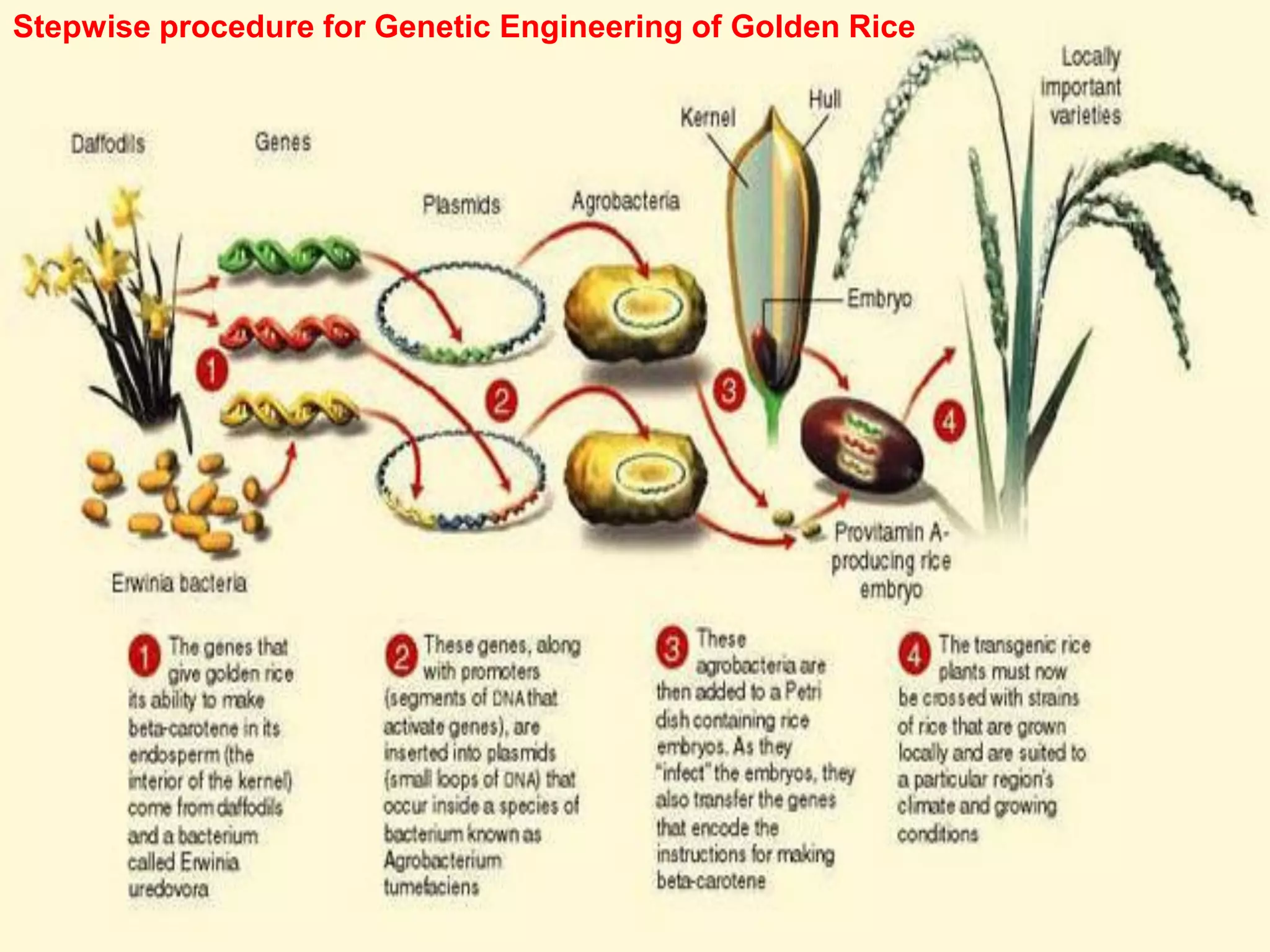
• A Japonica variety of rice was engineered with three genes necessary for
the rice grain to produce and store beta-carotene. These included
two genes from the daffodil plant and a third from a bacterium.
Researchers used a plant microbe to ferry in the genes into the plant cells.
• The incorporation of these genes allows the rice plant to modify certain
metabolic pathways in its cells to produce precursors of Vitamin A, which
was previously not possible. This was considered a technical milestone, as
most agronomic traits engineered to date have only required the
introduction of a single gene
Steps involved
in the
development
of Golden rice
Steps involved in the development of transgenic plant
Stepwise procedure for Genetic Engineering of Golden Rice
Difference
between
normal rice
and Golden
rice
Thank you

Isolation of plant genomic DNA

  • 1.
    LATTHE EDUCATION SOCIETY’S SMT.KASTURBAI WALCHAND COLLEGE, SANGLI DEPARTMENT OF BOTANY ORGANIZED ONE DAY WORKSHOP ON REVISED SYLLABUS OF B. SC.-III (PRACTICAL) PRACTICAL-I &II IN ASSOCIATION WITH SHIVAJI UNIVERSITY, KOLHAPUR DATE: 11TH FEBRUARY, 2021 S m t . K A S T U R BAI WALCHAN D C O L L E G E SANGLI
  • 2.
    DEMONSTRATION ON EXPERIMENTS FROM PRACTICAL-I ➢10. Isolation of Plant genomic DNA and its spooling. ➢ 11. Estimation of DNA by using Diphenyl amine ➢ 16. Study of steps in Genetic Engineering for the Production of Golden Rice with the help of photographs By Dr. S. G. Khadke Assistant Professor, Department of Botany, Smt. Kasturbai Walchand College, Sangli Email ID: sgkhadke@kwcsangli.in
  • 3.
    EXPT. NO.10. ISOLATIONOF PLANT GENOMIC DNA AND ITS SPOOLING. Introduction: ➢ Nucleic acids (DNA & RNA)are vital macromolecules in all living cells. ➢ In eukaryotic (Plant) cell Genomic DNA is located in Nucleus while Cellular DNA located in Mitochondria and Chloroplast. ➢ Most of the DNA (80%) exists in Nuclei and remaining DNA in the self duplicating Organelles. ➢ Nuclear DNA combines with histone proteins in an orderly manner to form Chromatin. ➢ Extraction of DNA is done by number of methods. ➢ The efficiency and recovery of extraction depends on the sample material, ionic conditions of extraction medium, type of lysing agent used etc. ➢ The procedure described below is essentially that of Murmur’s method
  • 4.
     Aim:-To isolateDNA from different plant samples by Phenol- Chloroform method.  Principle:- Plant cells are surrounded by cell wall. Treatment with detergent (Sodium Dodecyl Sulfate, SDS) is an effective way of breaking of cells and their nuclei to release the content, For this, Lysis buffer containing Tris-EDTA and SDS is used. The DNA is associated with a number of proteins. These can be removed by adding Phenol-Chloroform and isoamyl alcohol. The Phenol is removed by washing the DNA with Chloroform. Finally, cold ethanol precipitates out the crude DNA in the form of Spool. Saline sodium citrate (SSC) buffer is used to dissolve DNA.
  • 5.
    Materials and Method: 1.Lysis buffer containing: 2. 10mM Tris-HCL (pH 8.0), 5mM EDTA (Ethylene diamine tetra acetic acid) pH-8.0, 0.5% SDS (Sodium dodecyl sulphate) 3. Phenol-Chloroform- isoamyl alcohol. (ratio 25:24:1) 4. Coconut endosperm/Pea/Onion/Cauliflower etc. 5. 3M sodium acetate 6. SSC buffer: Dissolve 0.015M sodium citrate and 0.15M NaCl in distilled water. 7. Chilled absolute ethanol. 8. Mortar and Pestle, Water bath, Centrifuge, Centrifuge tubes and Micropipette.
  • 6.
    Procedure: 1. Take 200mgof coconut endosperm/pea/onion and make small pieces and homogenize. 2. The homogenate is made up to5 ml with lysis buffer stir the mixer. 3. Add 5ml of Phenol-Chloroform- iso-amyl alcohol and 0.5 ml of 3M Sodium acetate (1/20th of the total volume) incubate in water bath at 500C for 15 minutes. 4. Centrifuge the mixture at 3000 rpm for 10 minutes. 5. Now carefully collect the supernatant and pour a layer of ice-cold ethanol on top of the mixture, leave to stand for few minutes. 6. The precipitate DNA should form web of tangled fibers known as spool, which can be drawn up from the tube by carefully rotating the glass rod at the interface between the two layers. Ref. : Plummer, D. T. 2013. An Introduction to Practical Biochemistry. 3rd edition. McGraw Hill Education (India) Pvt. Ltd. New Delhi. 332p.
  • 7.
  • 8.
    EXPT. NO. 11.CALORIMETRIC ESTIMATION OF DNA BY DIPHENYL AMINE METHOD • Aim- To estimate the amount of DNA present in the sample • Principle-When DNA is treated with diphenylamine under acid conditions; a blue compound is formed with a sharp absorption maximum at 595nm. This reaction is given by 2-deoxypentoses in general and is not specific for DNA. In acid solution, the straight chain form of deoxypentose is converted to the highly reactive β-hydroxylevulinaldehyde which reacts with diphenylamine to give a blue complex. In DNA, only the deoxyribose of the purine nucleotides reacts, so that the value obtained represents half of the total deoxyribose present.
  • 9.
    Materials: ➢ Standard DNA(0.5mg/mL) ➢Sample expected to contain DNA ➢ saline citrate (0.15M NaCl, 0.015 M Na3 Citrate) solution ➢ Diphenylamine reagent. ➢ Mix 5g fresh or recrystallized Diphenylamine , 500mL glacial acetic acid and 13.75mL of conc. sulphuric acid. (This solution must be freshly prepared)
  • 10.
    PROCEDURE: 1. Prepare separatemarked tubes containing 1mL,2mL and 3mL aliquots of the isolated DNA dissolved in standard saline citrate and similar aliquots of a 0.5mg DNA/mL standard. 2. Make all sample tubes, and separate blank up to 3mL with H2O. 3. Add 6mL of diphenylamine reagent to each tube and after mixing heat the tubes in boiling water bath for 10 min. 4. Read the absorbance of blue solution at 600nm against the blank. 5. Construct a standard graph A 600(ordinate) versus quantity of DNA (abscissa) and then calculate the concentration of DNA dissolved in the saline citrate solution. Ref. : 1. Burton,K(1956)Biochem J 62 315 2. Ashwell.G (1957) In:Methods in Enzymol 3 (Eds colowick,S P Kalpan,N O) Academic press New york p 99. 3. Sadasivam,S,Radhashanmugasundaram and Shanmugasundaram,ERB(1975) Arogya- J health Sci 1 125
  • 12.
    EXPT. NO. 16.STUDY OF STEPS IN GENETIC ENGINEERING FOR THE PRODUCTION OF GOLDEN RICE WITH THE HELP OF PHOTOGRAPHS • The Golden Rice project, which began in the early 1990’s, was a result of a collaborative effort between the Swiss Federal Institute of Technology (ETH-Zurich) and the University of Freiburg, Germany. • Ingo Potrykus and Peter Byer are its key developers. Funding was obtained from ETH-Zurich itself, the European Commission’s agricultural research program, and the Rockefeller Foundation. • A Japonica variety of rice was engineered with three genes necessary for the rice grain to produce and store beta-carotene. These included two genes from the daffodil plant and a third from a bacterium. Researchers used a plant microbe to ferry in the genes into the plant cells. • The incorporation of these genes allows the rice plant to modify certain metabolic pathways in its cells to produce precursors of Vitamin A, which was previously not possible. This was considered a technical milestone, as most agronomic traits engineered to date have only required the introduction of a single gene
  • 14.
  • 15.
    Steps involved inthe development of transgenic plant
  • 16.
    Stepwise procedure forGenetic Engineering of Golden Rice
  • 17.
  • 18.