Mr. Dev Kumar Arya
(Lecturer)
Department of Genetics and Plant Breeding
O.P. Agriculture College Budhwal, Behror, Alwar (Raj..),India
Affiliated to Sri Karan Narendra Agriculture University,
Jobner,(Rajasthan),India
Gmail:devkumararya59@gmail.com
DNA REPLICATION
Outline
Introduction of DNA.
What is the DNA replication?
Models of DNA replication.
-Semi-Conservative DNA replication.
-Conservative DNA replication.
-Dispersive DNA replication.
Direction of DNA replication.
Replication of DNA in Prokaryotes.
Difference between Eukaryotes and
prokaryotes DNA replication.
Artificial DNA replication.
References
Introduction of DNA
In 1865 given by G.J. Mendel characters controled by particulate factors and DNA was
discovered in 1868.
DNA was discovered in 1869 by a Swiss medical student named Johann Friedrich
Miescher,(1844-95) obseved the first time this chemical name used Nuclien.
The term nucleic acid first time used by Altman in 1889.
After 40 years,in 1930 A.Kossel demostrated that nucleic acid on hydrolysis gave four
nitrogen-containing compounds(ATGC).
In 1920-28. Frederick Griffith conducted transformation experiments,which on Mouse.
Polynucleotide chains were discovered by Levene in 1931.
The double-helix model of DNA structure was first published in the
journal Nature by James Watson and Francis Crick in 1953.
The Nobel Prize in Physiology or Medicine 1962 was awarded jointly to Francis Harry
Compton Crick, James Dewey Watson and Maurice Hugh Frederick Wilkins.
20 July 1822 Austrian 6 January 1884 and 13 August 1844-26 August 1895,Switzerland
DNA- DNA is genetic material in humans and almost all other
organisms(But not some viruses).which gene are composed and capable
of storing huge amount Of genetic information,and self replicable.
Watson and Crick 1953 Article in nature
DNA Replication
DNA replication is the biological process of production of new copies of
DNA molecule from original DNA molecule.
( DNA DNA)
The original DNA strands are used as templates for the synthesis of new
strands
 It occurs very quickly, very accurately and at the appropriate time in the life of
the cell
DNA to DNA replication
is autocatalytic.
DNA to RNA replication
is hetrocatalytic.
STRUCTURAL OVERVIEW OF DNA
REPLICATION
• DNA replication relies on the complementarity of
DNA strands
– The AT/GC rule or Chargaff’s rule
• The process can be summarized as such
– The two DNA strands come apart
– Each serves as a template strand for the synthesis of
new strands
– The two newly-made strands = daughter strands
– The two original ones = parental strands
Chargaff's rules states that DNA from
any cell of all organisms should have a 1:1
ratio (base Pair Rule) of pyrimidine and
purine bases and, more specifically, that
the amount of guanine is equal to cytosine
and the amount of adenine is equal to
thymine.
Chargaff's rules
11 August 1905 to 20
June 2002
Semi-conservative replication of DNA
The semi-conservative mode of DNA replication was
postulated by Watson and Crick in 1953 along with the
double-helix model of DNA.
Evidence for semiconservative replication of DNA was first
presented by Meselson and Stahl in 1958.
They grew E.Coli on 15N (a heavy isotope of 14N) for 14
generations so that the nitrogen present in DNA bases of
these cells was 15N DNA having 15N has a dectebably
higher density (1.724 g/cm3) than that having 14N (1.710
g/cm3).
In 1958 reported the results of an experiment which was
degined to test whether double stranded DNA replicates
in a semiconservative manner.
Model of replication of DNA
24 May 1930 (age 86) and 8 October 1929 (age 87)
Conservative DNA replication
In this process the two newly synthesized strands
obtained by
Replication of a DNA molecule would associate to
form one double-helix DNA.
Both parental strands stay together after DNA
replication
Dispersive DNA replication
In this section the old DNA molecule would break
into several piece,each fragment would
replicate,and the old and new segement would
recombine to yield to progeny DNA molecules.
Direction of replication of DNA
The presence of replication forks
in E.Coli chromosomes was first
time shown by J. Cairns in 1963
using the technique of
autoradiography.
Mostly replication of DNA is
unidirectional.
Studies with small viruses have
convincingly demostrated the
bidirectional replication of DNA.
One of the simplest and most
convincing evidences comes from
the E.Coli phageT 7.
21 November 1922 He is a British physician and molecular biologist.
Helicase- unwind/open the DNA helix by the breaking hydrogen bonds.
Topoisomerase-An enzyme that can induce or relax supercoils of DNA by cut
the DNA e.g. change the linking numbers of a DNA molecule.
Gyrase-In E.Coli removal of super coiling at DNA replication.this is 2nd type
topoisomerase.
Single Strand Binding Proteins-Responsible for holding the replication fork of
DNA open while polymerases read the templates and prepare for synthesis.
Ligase-An enzyme ,which seals and joining of DNA fragement.
DNA Polymerase I- Removal of primer and filling the gap.
Primase-This enzyme catalyzes synthesis of the primers,which are small
segments of RNA for initiation of DNA replication.
DNA dependent RNA polymerase
Some enzyme
DNA Polymerase III-In charge of synthesizing nucleotides onto the
leading end in the classic 5' to 3' direction.which have three
Alpha sub units –catalytic (synthesizes DNA)
Epsilon subunit-proofreading(remove the mismatched nucleotides)
Beta2-clump protein which allows DNA polymerase to slide along
the DNA without falling off.
Phasphorylase-It is function addition of phosphate.
The RNA primer is removed and replaced with DNA polymerase I,
and the gap is sealed with DNA ligase.
Nuclease-This enzyme is help in proofreading in DNA
replication.
Telomerase-It is the enzyme responsible for maintenance of the
length of telomeres by addition of guanine-rich repetitive
sequences.
DNA replication in prokaryotes
Replication Initiation-
The start point of DNA
replication is called
initation. Enzymes
known as helicases
unwind the double
helix by breaking the
hydrogen bonds
between
complementary base
pairs.
With the primer as the
starting point for the leading
strand, a new DNA strand
grows one base at a time.
The existing strand is a
template for the new strand.
For example, if the next base
on the existing strand is an A,
the new strand receives a T.
The enzyme DNA polymerase
controls elongation, which can
occur only in the leading
direction.
Replication elongation-
After elongation is complete,
two new double helices have
replaced the original helix.
During termination, the last
primer sequence must be
removed from the end of the
lagging strand.
This last portion of the lagging
strand is the telomere
section.
Termination of DNA replication
Several prokaryotes replicons have a specific site called
terminus.
which stops replication fork.
E.Coli chromosome has two termini called ter E,ter D,ter
A and ter C,ter B.
All ter sequences contain a short (23 bp) sequence
5’ AATTAGTATGTTGTAACTAAAGT 3’ which functions in only
one direction.
Termination requires tus gene product which
recongnizes the ter sequence bind to it and stops the
progress of replication fork.
Tus protein provides a contra-helicase activity and stops
DNaB from unwinding DNA duplex.
 DNA replication exhibits a high degree of fidelity
Mistakes during the process are extremely rare
DNA pol III makes only one mistake per 108 bases made
 There are several reasons why fidelity is high
 1. Instability of mismatched pairs
 Complementary base pairs have much higher stability than mismatched
pairs
 This feature only accounts for part of the fidelity
 It has an error rate of 1 per 1,000 nucleotides
 2. Configuration of the DNA polymerase active site
 DNA polymerase is unlikely to catalyze bond formation between
mismatched pairs
 This induced-fit phenomenon decreases the error rate to a range of 1 in
100,000 to 1 million
Proofreading Mechanisms
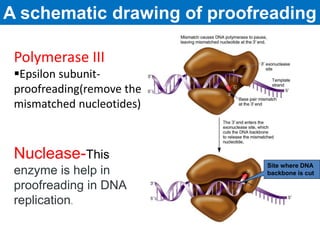
A schematic drawing of proofreading
Site where DNA
backbone is cut
Polymerase III
Epsilon subunit-
proofreading(remove the
mismatched nucleotides)
Nuclease-This
enzyme is help in
proofreading in DNA
replication.
 3. Proofreading function of DNA polymerase
 DNA polymerases can identify a mismatched nucleotide
and remove it from the daughter strand
 The enzyme uses its 3’ to 5’ exonuclease activity to
remove the incorrect nucleotide
 It then changes direction and resumes DNA synthesis in
the 5’ to 3’ direction
Proofreading Mechanisms
Polymerase Polymerization (5’-3’) Exonuclease (3’-5’) Exonuclease (5’-3’) #Copies
I Yes Yes Yes 400
II Yes Yes No ?
III Yes Yes No 10-20
 3’ to 5’ exonuclease activity
 Ability to remove nucleotides from the 3’ end of the chain
 Important proofreading ability
 Without proofreading error rate (mutation rate) is 1 x 10⁻⁶
 With proofreading error rate is 1 x 10⁻⁹ (1000-fold decrease)
 5’ to 3’ exonuclease activity functions in DNA replication & repair.
In prokaryotes, three main types of DNA polymerase
DNA REPLICATION IN EUKARYOTIC
 Eukaryotic DNA replication is not as well understood as bacterial replication
• The two processes do have extensive similarities,
• The bacterial enzymes have also been found in eukaryotes
 Nevertheless, DNA replication in eukaryotes is more complex
• Large linear chromosomes
• Tight packaging within nucleosomes
• More complicated cell cycle regulation
 Multiple Origins of Replication
 Eukaryotes have long linear chromosomes
 They therefore require multiple origins of replication
 To ensure that the DNA can be replicated in a reasonable time
 In 1968, Huberman and Riggs provided evidence for the multiple origins of
replication
 DNA replication proceeds bidirectionally from many origins of replication
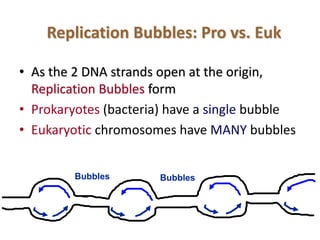
Replication Bubbles: Pro vs. Euk
• As the 2 DNA strands open at the origin,
Replication Bubbles form
• Prokaryotes (bacteria) have a single bubble
• Eukaryotic chromosomes have MANY bubbles
Bubbles Bubbles
Bidrectional
DNA synthesis
Replication
forks will
merge
 The origins of replication found in eukaryotes have some similarities to
those of bacteria
 Origins of replication in Saccharomyces cerevisiae are termed ARS
elements (Autonomously Replicating Sequence)
 They are 100-150 bp in length
 They have a high percentage of A and T
 They have three or four copies of a specific sequence
 Similar to the bacterial DnaA boxes
 Origin recognition complex (ORC)
 A six-subunit complex that acts as the initiator of eukaryotic DNA
replication
 It appears to be found in all eukaryotes
 Requires ATP to bind ARS elements
 Single-stranded DNA stimulates ORC to hydrolyze ATP
Multiple Origins of Replication
 Mammalian cells contain well over a dozen different DNA polymerase
 Four
 alpha (a), delta (d), epsilon (e) and gamma (g) have the primary
function of replicating DNA
 a, d and e  Nuclear DNA
 g  Mitochondrial DNA
 DNA pol a is the only polymerase to associate with primase
 The DNA pol a/primase complex synthesizes a short RNA-DNA
hybrid
 10 RNA nucleotides followed by 20 to 30 DNA nucleotides
 This is used by DNA pol d or e for the processive elongation of the
leading and lagging strands
 Current evidence suggests a greater role for DNA pol d
 The exchange of DNA pol a for d or e is called a polymerase switch
 It occurs only after the RNA-DNA hybrid is made
Different DNA Polymerases
 DNA polymerases also play a role in DNA
repair
 DNA pol b is not involved in DNA replication
 It plays a role in base-excision repair
 Removal of incorrect bases from damaged DNA
 Recently, more DNA polymerases have been
identified
 Lesion-replicating polymerases
 Involved in the replication of damaged DNA
 They can synthesize a complementary strand over the
abnormal region
 Replication doubles the amount of DNA
 Therefore the cell must synthesize more histones to accommodate this
increase
 Synthesis of histones occurs during the S phase
 Histones assemble into octamer structures
 They associate with the newly made DNA very near the replication fork
 Thus following DNA replication, each daughter strand has a mixture of “old” and
“new” histones
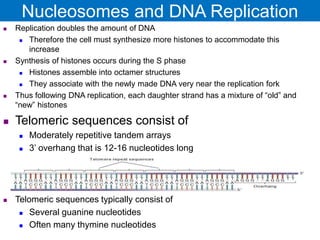
 Telomeric sequences consist of
 Moderately repetitive tandem arrays
 3’ overhang that is 12-16 nucleotides long
Nucleosomes and DNA Replication
 Telomeric sequences typically consist of
 Several guanine nucleotides
 Often many thymine nucleotides
 DNA polymerases possess two unusual features
 1. They synthesize DNA only in the 5’ to 3’ direction
 2. They cannot initiate DNA synthesis
 These two features pose a problem at the 3’ end of
linear chromosomes
Eukaryotic DNA Replication
1. It occurs inside the nucleus.
2. Origin of replications are
numerous.
3. Initiation is carried out by DNA
polymerase α while elongation by
DNA polymerase δ and ε.
4. The same are performed by DNA
polymerase β.
5. RNA primer is removed by DNA
polymerase β.
6. Okazaki fragments are very large
200-300 nucleotides bp long.
7. Replication is slow, some 100
nucleotides per second.
8. DNA gyrase is not needed.
9.In eukaryotes cells have linear DNA
which is very complicated.
Prokaryotic DNA Replication
1.It occurs inside the cytoplasm.
2.There is single origin of replication.
3. DNA polymerase III carries out both
initiation and elongation.
4. DNA repair and gap filling are done by
DNA polymerase I.
5. RNA primer is removed by DNA
polymerase I.
6. Okazaki fragments are very short 25-
30 nucleotides bp long.
7. Replication is very rapid, some 2000
bp per second.
8. DNA gyrase is needed.
9.In prokaryotes cells have circular DNA.
Differences between Prokaryotic and Eukaryotic DNA Replication
Polymerase chain reaction
PCR uses a pair of primers to span a
target region in template DNA, and then
polymerizes partner strands in each
direction from these primers using a
thermostable DNA polymerase.
This technique given by kary mulies in
1985.
Repeating this process through
multiple cycles amplifies the targeted
DNA region.
This technique is based on temperature.
Artificial replication of DNA
December 28, 1944 (age 72)
Reference
 Singh B.D.2009,Genetics, Kalyani Publications, Ludhiana, Punjab, India.
 Gupta P.K.2015,Genetics,Rastogi Publication, Meerut, Uttar Pradesh,
India.
 Prasad B.K. 2006,Fundamental Genetics,Kalyani Publications, Ludhiana,
Punjab, India.
 Singh Phundan.2005,Genetics,Kalyani Publications, Ludhiana, Punjab,
India.
 Sir-Kumar Sachin,2017,Powerpoint Presentation, CCS University, Meerut,
Uttar Pradesh, India.
 By Google.
Thank You for listening
Any question
for me

Genetics: DNA replication or Replication of Genetic Material | DNA Replication | Dev Kumar Arya

  • 1.
    Mr. Dev KumarArya (Lecturer) Department of Genetics and Plant Breeding O.P. Agriculture College Budhwal, Behror, Alwar (Raj..),India Affiliated to Sri Karan Narendra Agriculture University, Jobner,(Rajasthan),India Gmail:devkumararya59@gmail.com DNA REPLICATION
  • 2.
    Outline Introduction of DNA. Whatis the DNA replication? Models of DNA replication. -Semi-Conservative DNA replication. -Conservative DNA replication. -Dispersive DNA replication. Direction of DNA replication. Replication of DNA in Prokaryotes. Difference between Eukaryotes and prokaryotes DNA replication. Artificial DNA replication. References
  • 3.
    Introduction of DNA In1865 given by G.J. Mendel characters controled by particulate factors and DNA was discovered in 1868. DNA was discovered in 1869 by a Swiss medical student named Johann Friedrich Miescher,(1844-95) obseved the first time this chemical name used Nuclien. The term nucleic acid first time used by Altman in 1889. After 40 years,in 1930 A.Kossel demostrated that nucleic acid on hydrolysis gave four nitrogen-containing compounds(ATGC). In 1920-28. Frederick Griffith conducted transformation experiments,which on Mouse. Polynucleotide chains were discovered by Levene in 1931. The double-helix model of DNA structure was first published in the journal Nature by James Watson and Francis Crick in 1953. The Nobel Prize in Physiology or Medicine 1962 was awarded jointly to Francis Harry Compton Crick, James Dewey Watson and Maurice Hugh Frederick Wilkins.
  • 4.
    20 July 1822Austrian 6 January 1884 and 13 August 1844-26 August 1895,Switzerland
  • 5.
    DNA- DNA isgenetic material in humans and almost all other organisms(But not some viruses).which gene are composed and capable of storing huge amount Of genetic information,and self replicable.
  • 6.
    Watson and Crick1953 Article in nature
  • 7.
    DNA Replication DNA replicationis the biological process of production of new copies of DNA molecule from original DNA molecule. ( DNA DNA) The original DNA strands are used as templates for the synthesis of new strands  It occurs very quickly, very accurately and at the appropriate time in the life of the cell DNA to DNA replication is autocatalytic. DNA to RNA replication is hetrocatalytic.
  • 8.
    STRUCTURAL OVERVIEW OFDNA REPLICATION • DNA replication relies on the complementarity of DNA strands – The AT/GC rule or Chargaff’s rule • The process can be summarized as such – The two DNA strands come apart – Each serves as a template strand for the synthesis of new strands – The two newly-made strands = daughter strands – The two original ones = parental strands
  • 9.
    Chargaff's rules statesthat DNA from any cell of all organisms should have a 1:1 ratio (base Pair Rule) of pyrimidine and purine bases and, more specifically, that the amount of guanine is equal to cytosine and the amount of adenine is equal to thymine. Chargaff's rules 11 August 1905 to 20 June 2002
  • 10.
    Semi-conservative replication ofDNA The semi-conservative mode of DNA replication was postulated by Watson and Crick in 1953 along with the double-helix model of DNA. Evidence for semiconservative replication of DNA was first presented by Meselson and Stahl in 1958. They grew E.Coli on 15N (a heavy isotope of 14N) for 14 generations so that the nitrogen present in DNA bases of these cells was 15N DNA having 15N has a dectebably higher density (1.724 g/cm3) than that having 14N (1.710 g/cm3). In 1958 reported the results of an experiment which was degined to test whether double stranded DNA replicates in a semiconservative manner. Model of replication of DNA
  • 11.
    24 May 1930(age 86) and 8 October 1929 (age 87)
  • 13.
    Conservative DNA replication Inthis process the two newly synthesized strands obtained by Replication of a DNA molecule would associate to form one double-helix DNA. Both parental strands stay together after DNA replication Dispersive DNA replication In this section the old DNA molecule would break into several piece,each fragment would replicate,and the old and new segement would recombine to yield to progeny DNA molecules.
  • 15.
    Direction of replicationof DNA The presence of replication forks in E.Coli chromosomes was first time shown by J. Cairns in 1963 using the technique of autoradiography. Mostly replication of DNA is unidirectional. Studies with small viruses have convincingly demostrated the bidirectional replication of DNA. One of the simplest and most convincing evidences comes from the E.Coli phageT 7.
  • 16.
    21 November 1922He is a British physician and molecular biologist.
  • 17.
    Helicase- unwind/open theDNA helix by the breaking hydrogen bonds. Topoisomerase-An enzyme that can induce or relax supercoils of DNA by cut the DNA e.g. change the linking numbers of a DNA molecule. Gyrase-In E.Coli removal of super coiling at DNA replication.this is 2nd type topoisomerase. Single Strand Binding Proteins-Responsible for holding the replication fork of DNA open while polymerases read the templates and prepare for synthesis. Ligase-An enzyme ,which seals and joining of DNA fragement. DNA Polymerase I- Removal of primer and filling the gap. Primase-This enzyme catalyzes synthesis of the primers,which are small segments of RNA for initiation of DNA replication. DNA dependent RNA polymerase Some enzyme
  • 18.
    DNA Polymerase III-Incharge of synthesizing nucleotides onto the leading end in the classic 5' to 3' direction.which have three Alpha sub units –catalytic (synthesizes DNA) Epsilon subunit-proofreading(remove the mismatched nucleotides) Beta2-clump protein which allows DNA polymerase to slide along the DNA without falling off. Phasphorylase-It is function addition of phosphate. The RNA primer is removed and replaced with DNA polymerase I, and the gap is sealed with DNA ligase. Nuclease-This enzyme is help in proofreading in DNA replication. Telomerase-It is the enzyme responsible for maintenance of the length of telomeres by addition of guanine-rich repetitive sequences.
  • 19.
    DNA replication inprokaryotes
  • 20.
    DNA replication inprokaryotes Replication Initiation- The start point of DNA replication is called initation. Enzymes known as helicases unwind the double helix by breaking the hydrogen bonds between complementary base pairs.
  • 21.
    With the primeras the starting point for the leading strand, a new DNA strand grows one base at a time. The existing strand is a template for the new strand. For example, if the next base on the existing strand is an A, the new strand receives a T. The enzyme DNA polymerase controls elongation, which can occur only in the leading direction. Replication elongation-
  • 22.
    After elongation iscomplete, two new double helices have replaced the original helix. During termination, the last primer sequence must be removed from the end of the lagging strand. This last portion of the lagging strand is the telomere section. Termination of DNA replication
  • 23.
    Several prokaryotes repliconshave a specific site called terminus. which stops replication fork. E.Coli chromosome has two termini called ter E,ter D,ter A and ter C,ter B. All ter sequences contain a short (23 bp) sequence 5’ AATTAGTATGTTGTAACTAAAGT 3’ which functions in only one direction. Termination requires tus gene product which recongnizes the ter sequence bind to it and stops the progress of replication fork. Tus protein provides a contra-helicase activity and stops DNaB from unwinding DNA duplex.
  • 24.
     DNA replicationexhibits a high degree of fidelity Mistakes during the process are extremely rare DNA pol III makes only one mistake per 108 bases made  There are several reasons why fidelity is high  1. Instability of mismatched pairs  Complementary base pairs have much higher stability than mismatched pairs  This feature only accounts for part of the fidelity  It has an error rate of 1 per 1,000 nucleotides  2. Configuration of the DNA polymerase active site  DNA polymerase is unlikely to catalyze bond formation between mismatched pairs  This induced-fit phenomenon decreases the error rate to a range of 1 in 100,000 to 1 million Proofreading Mechanisms
  • 25.
    A schematic drawingof proofreading Site where DNA backbone is cut Polymerase III Epsilon subunit- proofreading(remove the mismatched nucleotides) Nuclease-This enzyme is help in proofreading in DNA replication.
  • 26.
     3. Proofreadingfunction of DNA polymerase  DNA polymerases can identify a mismatched nucleotide and remove it from the daughter strand  The enzyme uses its 3’ to 5’ exonuclease activity to remove the incorrect nucleotide  It then changes direction and resumes DNA synthesis in the 5’ to 3’ direction Proofreading Mechanisms
  • 27.
    Polymerase Polymerization (5’-3’)Exonuclease (3’-5’) Exonuclease (5’-3’) #Copies I Yes Yes Yes 400 II Yes Yes No ? III Yes Yes No 10-20  3’ to 5’ exonuclease activity  Ability to remove nucleotides from the 3’ end of the chain  Important proofreading ability  Without proofreading error rate (mutation rate) is 1 x 10⁻⁶  With proofreading error rate is 1 x 10⁻⁹ (1000-fold decrease)  5’ to 3’ exonuclease activity functions in DNA replication & repair. In prokaryotes, three main types of DNA polymerase
  • 29.
    DNA REPLICATION INEUKARYOTIC  Eukaryotic DNA replication is not as well understood as bacterial replication • The two processes do have extensive similarities, • The bacterial enzymes have also been found in eukaryotes  Nevertheless, DNA replication in eukaryotes is more complex • Large linear chromosomes • Tight packaging within nucleosomes • More complicated cell cycle regulation  Multiple Origins of Replication  Eukaryotes have long linear chromosomes  They therefore require multiple origins of replication  To ensure that the DNA can be replicated in a reasonable time  In 1968, Huberman and Riggs provided evidence for the multiple origins of replication  DNA replication proceeds bidirectionally from many origins of replication
  • 30.
    Replication Bubbles: Provs. Euk • As the 2 DNA strands open at the origin, Replication Bubbles form • Prokaryotes (bacteria) have a single bubble • Eukaryotic chromosomes have MANY bubbles Bubbles Bubbles
  • 31.
  • 32.
     The originsof replication found in eukaryotes have some similarities to those of bacteria  Origins of replication in Saccharomyces cerevisiae are termed ARS elements (Autonomously Replicating Sequence)  They are 100-150 bp in length  They have a high percentage of A and T  They have three or four copies of a specific sequence  Similar to the bacterial DnaA boxes  Origin recognition complex (ORC)  A six-subunit complex that acts as the initiator of eukaryotic DNA replication  It appears to be found in all eukaryotes  Requires ATP to bind ARS elements  Single-stranded DNA stimulates ORC to hydrolyze ATP Multiple Origins of Replication
  • 33.
     Mammalian cellscontain well over a dozen different DNA polymerase  Four  alpha (a), delta (d), epsilon (e) and gamma (g) have the primary function of replicating DNA  a, d and e  Nuclear DNA  g  Mitochondrial DNA  DNA pol a is the only polymerase to associate with primase  The DNA pol a/primase complex synthesizes a short RNA-DNA hybrid  10 RNA nucleotides followed by 20 to 30 DNA nucleotides  This is used by DNA pol d or e for the processive elongation of the leading and lagging strands  Current evidence suggests a greater role for DNA pol d  The exchange of DNA pol a for d or e is called a polymerase switch  It occurs only after the RNA-DNA hybrid is made Different DNA Polymerases
  • 35.
     DNA polymerasesalso play a role in DNA repair  DNA pol b is not involved in DNA replication  It plays a role in base-excision repair  Removal of incorrect bases from damaged DNA  Recently, more DNA polymerases have been identified  Lesion-replicating polymerases  Involved in the replication of damaged DNA  They can synthesize a complementary strand over the abnormal region
  • 36.
     Replication doublesthe amount of DNA  Therefore the cell must synthesize more histones to accommodate this increase  Synthesis of histones occurs during the S phase  Histones assemble into octamer structures  They associate with the newly made DNA very near the replication fork  Thus following DNA replication, each daughter strand has a mixture of “old” and “new” histones  Telomeric sequences consist of  Moderately repetitive tandem arrays  3’ overhang that is 12-16 nucleotides long Nucleosomes and DNA Replication  Telomeric sequences typically consist of  Several guanine nucleotides  Often many thymine nucleotides
  • 37.
     DNA polymerasespossess two unusual features  1. They synthesize DNA only in the 5’ to 3’ direction  2. They cannot initiate DNA synthesis  These two features pose a problem at the 3’ end of linear chromosomes
  • 38.
    Eukaryotic DNA Replication 1.It occurs inside the nucleus. 2. Origin of replications are numerous. 3. Initiation is carried out by DNA polymerase α while elongation by DNA polymerase δ and ε. 4. The same are performed by DNA polymerase β. 5. RNA primer is removed by DNA polymerase β. 6. Okazaki fragments are very large 200-300 nucleotides bp long. 7. Replication is slow, some 100 nucleotides per second. 8. DNA gyrase is not needed. 9.In eukaryotes cells have linear DNA which is very complicated. Prokaryotic DNA Replication 1.It occurs inside the cytoplasm. 2.There is single origin of replication. 3. DNA polymerase III carries out both initiation and elongation. 4. DNA repair and gap filling are done by DNA polymerase I. 5. RNA primer is removed by DNA polymerase I. 6. Okazaki fragments are very short 25- 30 nucleotides bp long. 7. Replication is very rapid, some 2000 bp per second. 8. DNA gyrase is needed. 9.In prokaryotes cells have circular DNA. Differences between Prokaryotic and Eukaryotic DNA Replication
  • 39.
    Polymerase chain reaction PCRuses a pair of primers to span a target region in template DNA, and then polymerizes partner strands in each direction from these primers using a thermostable DNA polymerase. This technique given by kary mulies in 1985. Repeating this process through multiple cycles amplifies the targeted DNA region. This technique is based on temperature. Artificial replication of DNA December 28, 1944 (age 72)
  • 40.
    Reference  Singh B.D.2009,Genetics,Kalyani Publications, Ludhiana, Punjab, India.  Gupta P.K.2015,Genetics,Rastogi Publication, Meerut, Uttar Pradesh, India.  Prasad B.K. 2006,Fundamental Genetics,Kalyani Publications, Ludhiana, Punjab, India.  Singh Phundan.2005,Genetics,Kalyani Publications, Ludhiana, Punjab, India.  Sir-Kumar Sachin,2017,Powerpoint Presentation, CCS University, Meerut, Uttar Pradesh, India.  By Google.
  • 41.
    Thank You forlistening Any question for me