Unit 2:
Digestion in The
Mouth &
Esophagus
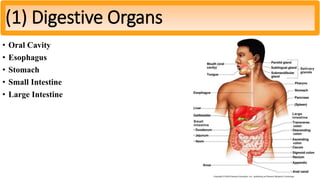
(1) Digestive Organs
• Oral Cavity
• Esophagus
• Stomach
• Small Intestine
• Large Intestine
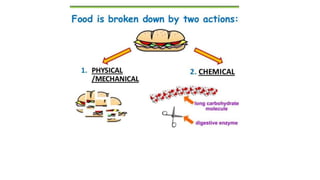
• Food is digested in the mouth both mechanically and chemically.
• Mechanically  Teeth chew and physically break down food into smaller units.|
• Chemically  Enzymes in your saliva help to break down biomolecules in food.
(2) What happens in the mouth?
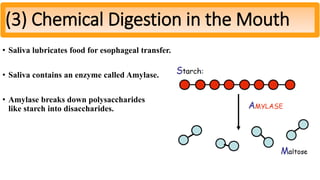
• Saliva lubricates food for esophageal transfer.
• Saliva contains an enzyme called Amylase.
• Amylase breaks down polysaccharides
like starch into disaccharides.
(3) Chemical Digestion in the Mouth
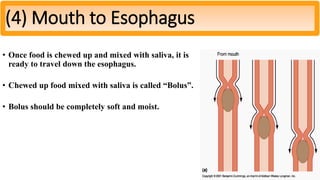
• Once food is chewed up and mixed with saliva, it is
ready to travel down the esophagus.
• Chewed up food mixed with saliva is called “Bolus”.
• Bolus should be completely soft and moist.
(4) Mouth to Esophagus
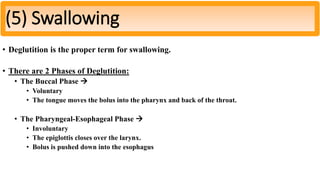
• Deglutition is the proper term for swallowing.
• There are 2 Phases of Deglutition:
• The Buccal Phase 
• Voluntary
• The tongue moves the bolus into the pharynx and back of the throat.
• The Pharyngeal-Esophageal Phase 
• Involuntary
• The epiglottis closes over the larynx.
• Bolus is pushed down into the esophagus
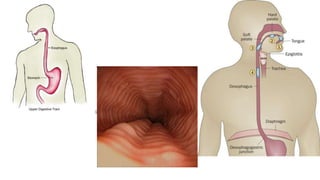
(5) Swallowing
• The esophagus is the highway between the mouth and stomach.
• Food is pushed through the esophagus using Peristalsis.
• Peristalsis  Involuntary, wave-like contraction of muscle used to push softer /
more liquid-like substances through an organ.
(6) Traveling thru the Esophagus
Unit 2:
Digestion in
The Stomach
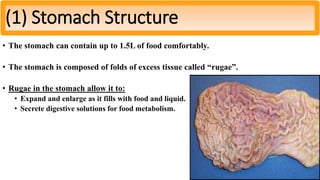
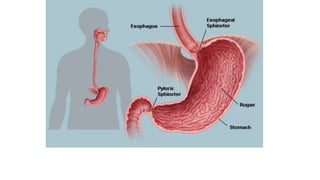
• The stomach can contain up to 1.5L of food comfortably.
• The stomach is composed of folds of excess tissue called “rugae”.
• Rugae in the stomach allow it to:
• Expand and enlarge as it fills with food and liquid.
• Secrete digestive solutions for food metabolism.
(1) Stomach Structure
• Food is broken down both mechanically and chemically in the stomach.
• Mechanical Digestion:
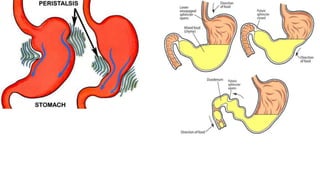
• Stomach muscles use peristalsis to break down bolus.
• Peristalsis is triggered by the release of a neurotransmitter called serotonin (from within the
rugae).
• Chemical Digestion:
• Gastric Juice is secreted from the rugae, to break down the bolus using enzymes and acid.
(2) Digestion in the Stomach
• Hydrochloric Acid
• Pepsin (an Enzyme that metabolizes Protein)
• Rennin (an Enzyme that metabolizes Protein)
• Muccin (an Enzyme that lubricates the food mass)
(3) Gastric Juice Composition
• The hormone Gastrin is released from the G-Cells in between the Rugae folds:
• Triggered by smell and taste.
• Triggered by the increase in pH when food drops into the stomach.
• Gastrin stimulates the release of Hydrochloric Acid from the rugae in the stomach:
• HCl decreases the pH in the stomach.
• HCl metabolizes proteins and carbohydrates.
• Gastrin stimulates peristaltic movement in the stomach, and small and large intestine.
(4) Gastric Juice Secretion
• Proteins are complex molecules which require a lot to be broken down.
• When proteins are metabolized, a large concentration of Hydrogen ions are
released (which decreases the pH of the stomach).
• The decrease in pH signals to the brain that the food is digested, and the G-Cells
in the stomach stop releasing gastrin.
(5) Protein Metabolism
• Once food is digested, the stomach stops churning and secreting gastric juice.
• Food them moves into small intestine.
• The liquefied mass leaving the stomach is called “Chyme”.
• Chyme exits out the Pyloric Sphincter into the small intestine.
(6) Leaving the Stomach
Unit 2:
Digestion in
The Small Intestine
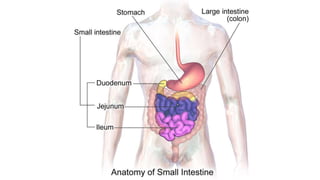
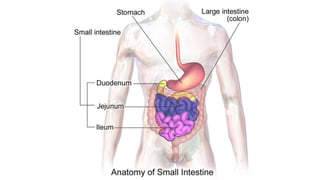
• First Chamber = Duodenum (~10in long)
• Second Chamber = Jejunum (~7-8ft long)
• Third Chamber = Ileum (~12ft long)
(1) Small Intestine Regions
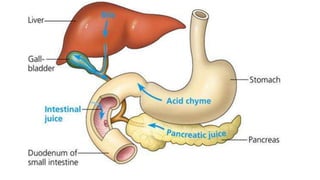
• The duodenum contains a solution used to metabolize any remaining
biomolecules from the stomach.
• The solution contains: Bile, Pancreatic Juice and Bicarbonate.
(2) The Duodenum
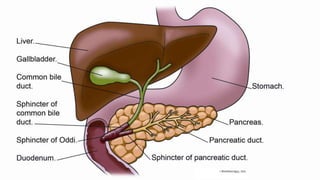
• Bile is a yellow-green solution produced by the liver, and stored in
the gallbladder.
• Bile contains salt compounds, lipids, and waste pigments from blood
cells.
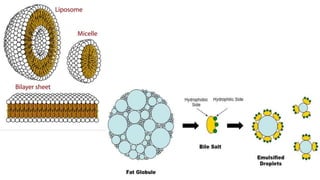
• The function of bile is to emulsify lipids for better absorption…
• Lipids form micelles since they are polarized molecules.
• Bile helps break apart the micelles into individual lipids.
• This allows our bodies to more easily absorb them.
(3) Bile
• Pancreatic Juice is produced by and stored in the Pancreas.
• Contains:
• Carboxypeptidase and Chymotrypsin enzymes for metabolizing
protein.
• Amylase enzyme for further carbohydrate metabolism.
• Lipase enzymes for lipid metabolism.
• Nuclease enzymes for nucleic acid metabolism.
(4) Pancreatic Juice
• The presence of metabolized proteins and lipids in the duodenum
triggers the release of CCK (Cholecystokinin) into the blood stream.
• CCK stimulates the release of bile and pancreatic juice into the
duodenum.
• The solutions secrete out of an opening called the “Sphincter of
Oddi”.
(5) Releasing Bile & Pancreatic Juice
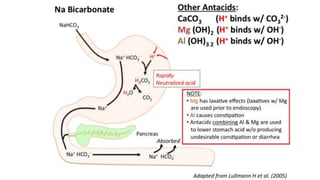
• Bicarbonate is a compound which balances out a solution’s pH by
absorbing and releasing hydrogen ions.
• The chyme that leaves the stomach is extremely acidic.
• Bicarbonate neutralizes the low pH.
• Bicarbonate is secreted from glands in the duodenum called
“Brunner’s Glands”.
(6) Bicarbonate
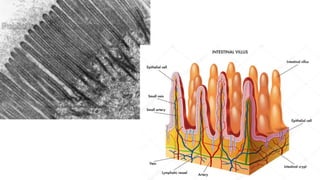
• Used to absorb all nutrients from food and liquid.
• Both contain microvilli:
• Microvilli are small finger-like projections used to absorb nutrients.
• They are directly connected to capillaries and the blood stream.
• Folds in between the microvilli are called the “Crypts of
Lieberkuhn”:
• These folds secrete Lysozymes to kill bacterial cells.
• The folds also secrete Muccin to further lubricate food.
(7) The Jejunum & Ileum
Anatomy-Bad Fish Unit: Digestion Notes

Anatomy-Bad Fish Unit: Digestion Notes

  • 1.
    Unit 2: Digestion inThe Mouth & Esophagus
  • 2.
    (1) Digestive Organs •Oral Cavity • Esophagus • Stomach • Small Intestine • Large Intestine
  • 3.
    • Food isdigested in the mouth both mechanically and chemically. • Mechanically  Teeth chew and physically break down food into smaller units.| • Chemically  Enzymes in your saliva help to break down biomolecules in food. (2) What happens in the mouth?
  • 5.
    • Saliva lubricatesfood for esophageal transfer. • Saliva contains an enzyme called Amylase. • Amylase breaks down polysaccharides like starch into disaccharides. (3) Chemical Digestion in the Mouth
  • 6.
    • Once foodis chewed up and mixed with saliva, it is ready to travel down the esophagus. • Chewed up food mixed with saliva is called “Bolus”. • Bolus should be completely soft and moist. (4) Mouth to Esophagus
  • 7.
    • Deglutition isthe proper term for swallowing. • There are 2 Phases of Deglutition: • The Buccal Phase  • Voluntary • The tongue moves the bolus into the pharynx and back of the throat. • The Pharyngeal-Esophageal Phase  • Involuntary • The epiglottis closes over the larynx. • Bolus is pushed down into the esophagus (5) Swallowing
  • 9.
    • The esophagusis the highway between the mouth and stomach. • Food is pushed through the esophagus using Peristalsis. • Peristalsis  Involuntary, wave-like contraction of muscle used to push softer / more liquid-like substances through an organ. (6) Traveling thru the Esophagus
  • 10.
  • 11.
    • The stomachcan contain up to 1.5L of food comfortably. • The stomach is composed of folds of excess tissue called “rugae”. • Rugae in the stomach allow it to: • Expand and enlarge as it fills with food and liquid. • Secrete digestive solutions for food metabolism. (1) Stomach Structure
  • 12.
    • Food isbroken down both mechanically and chemically in the stomach. • Mechanical Digestion: • Stomach muscles use peristalsis to break down bolus. • Peristalsis is triggered by the release of a neurotransmitter called serotonin (from within the rugae). • Chemical Digestion: • Gastric Juice is secreted from the rugae, to break down the bolus using enzymes and acid. (2) Digestion in the Stomach
  • 14.
    • Hydrochloric Acid •Pepsin (an Enzyme that metabolizes Protein) • Rennin (an Enzyme that metabolizes Protein) • Muccin (an Enzyme that lubricates the food mass) (3) Gastric Juice Composition
  • 15.
    • The hormoneGastrin is released from the G-Cells in between the Rugae folds: • Triggered by smell and taste. • Triggered by the increase in pH when food drops into the stomach. • Gastrin stimulates the release of Hydrochloric Acid from the rugae in the stomach: • HCl decreases the pH in the stomach. • HCl metabolizes proteins and carbohydrates. • Gastrin stimulates peristaltic movement in the stomach, and small and large intestine. (4) Gastric Juice Secretion
  • 16.
    • Proteins arecomplex molecules which require a lot to be broken down. • When proteins are metabolized, a large concentration of Hydrogen ions are released (which decreases the pH of the stomach). • The decrease in pH signals to the brain that the food is digested, and the G-Cells in the stomach stop releasing gastrin. (5) Protein Metabolism
  • 17.
    • Once foodis digested, the stomach stops churning and secreting gastric juice. • Food them moves into small intestine. • The liquefied mass leaving the stomach is called “Chyme”. • Chyme exits out the Pyloric Sphincter into the small intestine. (6) Leaving the Stomach
  • 19.
    Unit 2: Digestion in TheSmall Intestine
  • 20.
    • First Chamber= Duodenum (~10in long) • Second Chamber = Jejunum (~7-8ft long) • Third Chamber = Ileum (~12ft long) (1) Small Intestine Regions
  • 22.
    • The duodenumcontains a solution used to metabolize any remaining biomolecules from the stomach. • The solution contains: Bile, Pancreatic Juice and Bicarbonate. (2) The Duodenum
  • 24.
    • Bile isa yellow-green solution produced by the liver, and stored in the gallbladder. • Bile contains salt compounds, lipids, and waste pigments from blood cells. • The function of bile is to emulsify lipids for better absorption… • Lipids form micelles since they are polarized molecules. • Bile helps break apart the micelles into individual lipids. • This allows our bodies to more easily absorb them. (3) Bile
  • 26.
    • Pancreatic Juiceis produced by and stored in the Pancreas. • Contains: • Carboxypeptidase and Chymotrypsin enzymes for metabolizing protein. • Amylase enzyme for further carbohydrate metabolism. • Lipase enzymes for lipid metabolism. • Nuclease enzymes for nucleic acid metabolism. (4) Pancreatic Juice
  • 27.
    • The presenceof metabolized proteins and lipids in the duodenum triggers the release of CCK (Cholecystokinin) into the blood stream. • CCK stimulates the release of bile and pancreatic juice into the duodenum. • The solutions secrete out of an opening called the “Sphincter of Oddi”. (5) Releasing Bile & Pancreatic Juice
  • 29.
    • Bicarbonate isa compound which balances out a solution’s pH by absorbing and releasing hydrogen ions. • The chyme that leaves the stomach is extremely acidic. • Bicarbonate neutralizes the low pH. • Bicarbonate is secreted from glands in the duodenum called “Brunner’s Glands”. (6) Bicarbonate
  • 31.
    • Used toabsorb all nutrients from food and liquid. • Both contain microvilli: • Microvilli are small finger-like projections used to absorb nutrients. • They are directly connected to capillaries and the blood stream. • Folds in between the microvilli are called the “Crypts of Lieberkuhn”: • These folds secrete Lysozymes to kill bacterial cells. • The folds also secrete Muccin to further lubricate food. (7) The Jejunum & Ileum