DNA Extraction
Principle
• DNA extraction is a method to purify DNA by using physical and/or chemical methods from a
sample separating DNA from cell membranes, proteins, and other cellular components.
• Friedrich Miescher in 1869 did DNA isolation for the first time.
• The use of DNA isolation technique should lead to efficient extraction with good quantity and
quality of DNA, which is pure and is devoid of contaminants, such as RNA and proteins.
• The basic principle of DNA isolation is disruption of the cell wall, cell membrane, and nuclear
membrane to release the highly intact DNA into solution followed by precipitation of DNA and
removal of the contaminating biomolecules such as the proteins, polysaccharides, lipids, phenols,
and other secondary metabolites by enzymatic or chemical methods.
• The plant DNA is extracted by either CTAB-based or sodium dodecyl sulfate (SDS)-based
methods. The majority of the protocols developed for DNA extraction are modified versions of
cetyltrimethylammonium bromide (CTAB) extraction.
Chemicals Required
• Tris-EDTA
• Phenol
• Chloroform
• Iso-amyl alcohol
• Isopropanol
• RNase
• CTAB
• β mercaptoethanol
Tris-EDTA (TE)
• TE buffer contains Tris (10 mM) and EDTA (1 mM), where Tris is the
buffering component and EDTA the chelating component.
• Tris maintains the pH of the solution.
• It interacts with the lipo-polysaccharides present on the outer
membrane of the cell, which help to permeabilize the membrane.
• This effect is enhanced with the addition of EDTA (Ethylene Diamine
Tetra Acetic acid), a molecule chelating cations like Mg2+.
• The purpose of TE buffer is to protect DNA from degradation
Phenol
• Phenol is an organic solvent, so it is not miscible with water and is
used along with chloroform and isoamyl alcohol for purification of the
DNA to remove proteins and polysaccharide contaminants.
• When phenol is shaken with cell extract, the nonpolar components of
the cell will be fractionated in phenol, leaving polar ones in water.
• DNA is insoluble in phenol because phenol is a nonpolar solution.
Chloroform
• Chloroform (CHCl3) or trichloromethane is a nonpolar (hydrophobic)
solvent, in which nonpolar proteins and lipids get dissolved to promote
the partitioning of lipids and cellular debris into the organic phase,
leaving isolated DNA protected in the aqueous phase.
Iso-amyl alcohol
• It is used to prevent phosgene (CoCl2) from the reaction of chloroform
(CH3Cl) with air.
• Chloroform comes in contact with the air and forms gas phosgene
(COCl2, carbonyl chloride), which is harmful.
• If we simply use chloroform only, the gas entrapment causes foaming
or frothing, it foams up between interphase during extraction process
and makes it difficult to properly purify the DNA, which is prevented
when chloroform is used along with isoamyl alcohol or isopentanol
{(CH3)2CHCH2CH2OH} or octanol {CH3(CH2)7OH} by preventing
the emulsification of a solution.
Isopropanol
• Alcohol is used to precipitate the DNA out of the extraction solution,
so we can wash all those salts and chemicals away and then dissolve it
in our final solvent—usually water or some variant of Tris-EDTA
solution.
• DNA remains dissolved in aqueous solution because DNA has
phosphodiester backbone, which is hydrophilic in nature.
• Water molecule forms hydration shell around DNA by forming
hydrogen bonds.
• Isopropanol/ethanol is used in precipitation of DNA, which breaks the
hydration shell.
RNase
• RNase is an enzyme that breakdown a RNA molecule.
• It is added to the final solution to ensure that no RNA is in the solution
as it may interfere with the DNA in the solution when trying to extract.
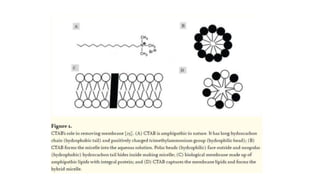
CTAB (Cetyltrimethylammonium bromide)
• CTAB is the best detergent to use during the extraction of highly
polymerized DNA from the plant material.
• This detergent simultaneously solubilizes the plant cell and lipid
membranes of internal organelles and denature proteins.
• CTAB, a cationic detergent, constitutes a long hydrophobic
hydrocarbon chain and a hydrophilic head. It forms micelle in water
because of the amphipathic nature.
• During DNA extraction, under aqueous condition, CTAB comes in
contact with the biological membrane, captures the lipids, and results
in the release of nucleus, which is devoid of membrane.
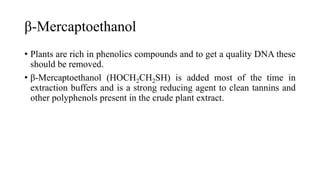
β-Mercaptoethanol
• Plants are rich in phenolics compounds and to get a quality DNA these
should be removed.
• β-Mercaptoethanol (HOCH2CH2SH) is added most of the time in
extraction buffers and is a strong reducing agent to clean tannins and
other polyphenols present in the crude plant extract.
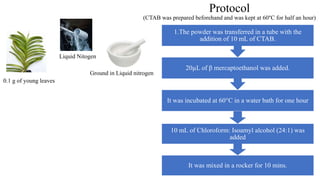
Protocol
(CTAB was prepared beforehand and was kept at 60°C for half an hour)
It was incubated at 60°C in a water bath for one hour
20µL of β mercaptoethanol was added.
1.The powder was transferred in a tube with the
addition of 10 mL of CTAB.
0.1 g of young leaves
Ground in Liquid nitrogen
Liquid Nitogen
10 mL of Chloroform: Isoamyl alcohol (24:1) was
added
It was mixed in a rocker for 10 mins.
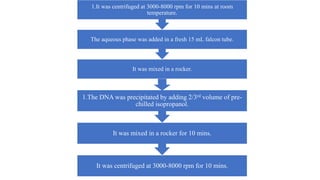
It was mixed in a rocker.
The aqueous phase was added in a fresh 15 mL falcon tube.
1.It was centrifuged at 3000-8000 rpm for 10 mins at room
temperature.
It was centrifuged at 3000-8000 rpm for 10 mins.
It was mixed in a rocker for 10 mins.
1.The DNA was precipitated by adding 2/3rd volume of pre-
chilled isopropanol.
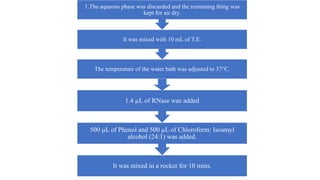
The temperature of the water bath was adjusted to 37°C.
It was mixed with 10 mL of T.E.
1.The aqueous phase was discarded and the remaining thing was
kept for air dry.
It was mixed in a rocker for 10 mins.
500 µL of Phenol and 500 µL of Chloroform: Isoamyl
alcohol (24:1) was added.
1.4 µL of RNase was added
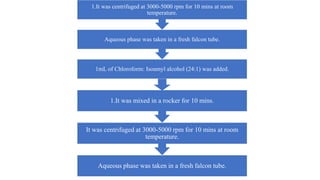
1mL of Chloroform: Isoamyl alcohol (24:1) was added.
Aqueous phase was taken in a fresh falcon tube.
1.It was centrifuged at 3000-5000 rpm for 10 mins at room
temperature.
Aqueous phase was taken in a fresh falcon tube.
It was centrifuged at 3000-5000 rpm for 10 mins at room
temperature.
1.It was mixed in a rocker for 10 mins.
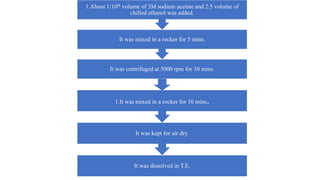
It was centrifuged at 5000 rpm for 10 mins.
It was mixed in a rocker for 5 mins.
1.About 1/10th volume of 3M sodium acetate and 2.5 volume of
chilled ethanol was added.
It was dissolved in T.E.
It was kept for air dry.
1.It was mixed in a rocker for 10 mins.
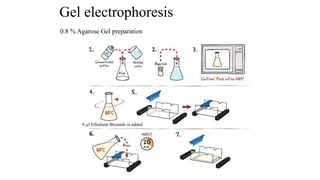
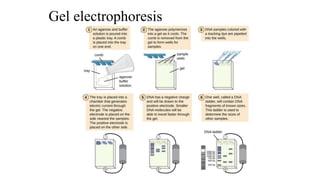
Gel electrophoresis
0.8 % Agarose Gel preparation
6 µl Ethidium Bromide is added
Gel electrophoresis
Assessing the quality and yield of DNA
• The quality and yield of DNA are assessed by spectrophotometry or by
gel electrophoresis.
• Spectrophotometry involves estimation of the DNA concentration by
measuring the amount of light absorbed by the sample at specific
wavelengths.
• Absorption peak for nucleic acids is at ~260 nm. The A260/A280 ratio is
~1.8 for dsDNA.
• A ratio of less than 1.7 indicates protein contamination.
Applications
1. Forensics
• You likely know that DNA is a key component in many criminal investigations.
DNA extraction can happen from samples such as hair, skin, or blood.
• Forensic teams often use DNA to determine if a person is a suspect or if they
should be eliminated as a suspect. DNA can sometimes prove a person’s
innocence or guilt, or, at least, it can prove whether a person was in the vicinity of
the crime scene.
2. Paternity Tests
• DNA extraction is also helpful for determining the paternity of a child. Whether a
person wants to prove they are or are not the father, DNA from both the potential
father and the baby can help prove or disprove a person’s claims to paternity.
Applications
• 3. Ancestry Tracking
• Besides helping a person know who their immediate ancestors are, DNA
extraction can also help a person understand the places their ancestors further back
came from. With modern DNA kits, a person can know all the countries where
their foreparents are from, as well as any living relatives who might still be living
and even some medical or food conditions a person is pre-disposed too.
• 4. Medical Tests
• For some medical conditions, DNA extraction is necessary to officially diagnose
it, especially if the medical condition is genetic. Common examples include cystic
fibrosis, Huntington’s disease, or Down syndrome. DNA extraction also is helpful
in identifying if a person is a carrier of the disease.
Applications
• 5. Genetic Engineering
• DNA extraction can be helpful for genetically engineering both plants and animals. For
plants, DNA can be useful in identifying, isolating, and extracting the wanted gene to
replicate in successive generations of plants. For animals, DNA extraction is helpful for
anything from cloning animals to transferring one animal’s DNA to another.
• 6. Vaccines
• Vaccines are very important in helping to control and stop disease. DNA can help in
creating some of these. While outright DNA vaccines are not completely approved for use
on people, DNA vaccines are often used in various animal vaccines and general
development of some human vaccines. For example, DNA extraction helps with the
Hepatitis B vaccine, specifically through recombinant DNA.
Applications
• 7. Hormones
• Hormones are vital for helping people grow and develop. DNA extraction
helps with developing these through recombinant DNA technology. Two
major examples of hormones that use DNA extraction include:
• Human growth hormones: These hormones help a large number of people
with various conditions. For example, people with growth issues, renal
carcinoma, or Tumer’s syndrome can benefit from human growth hormones.
• Insulin: People with diabetes often need insulin, specifically people with
type I diabetes. DNA extraction can help with insulin production via
recombinant DNA.

DNA Extraction.pptx

  • 1.
  • 2.
    Principle • DNA extractionis a method to purify DNA by using physical and/or chemical methods from a sample separating DNA from cell membranes, proteins, and other cellular components. • Friedrich Miescher in 1869 did DNA isolation for the first time. • The use of DNA isolation technique should lead to efficient extraction with good quantity and quality of DNA, which is pure and is devoid of contaminants, such as RNA and proteins. • The basic principle of DNA isolation is disruption of the cell wall, cell membrane, and nuclear membrane to release the highly intact DNA into solution followed by precipitation of DNA and removal of the contaminating biomolecules such as the proteins, polysaccharides, lipids, phenols, and other secondary metabolites by enzymatic or chemical methods. • The plant DNA is extracted by either CTAB-based or sodium dodecyl sulfate (SDS)-based methods. The majority of the protocols developed for DNA extraction are modified versions of cetyltrimethylammonium bromide (CTAB) extraction.
  • 3.
    Chemicals Required • Tris-EDTA •Phenol • Chloroform • Iso-amyl alcohol • Isopropanol • RNase • CTAB • β mercaptoethanol
  • 4.
    Tris-EDTA (TE) • TEbuffer contains Tris (10 mM) and EDTA (1 mM), where Tris is the buffering component and EDTA the chelating component. • Tris maintains the pH of the solution. • It interacts with the lipo-polysaccharides present on the outer membrane of the cell, which help to permeabilize the membrane. • This effect is enhanced with the addition of EDTA (Ethylene Diamine Tetra Acetic acid), a molecule chelating cations like Mg2+. • The purpose of TE buffer is to protect DNA from degradation
  • 5.
    Phenol • Phenol isan organic solvent, so it is not miscible with water and is used along with chloroform and isoamyl alcohol for purification of the DNA to remove proteins and polysaccharide contaminants. • When phenol is shaken with cell extract, the nonpolar components of the cell will be fractionated in phenol, leaving polar ones in water. • DNA is insoluble in phenol because phenol is a nonpolar solution.
  • 6.
    Chloroform • Chloroform (CHCl3)or trichloromethane is a nonpolar (hydrophobic) solvent, in which nonpolar proteins and lipids get dissolved to promote the partitioning of lipids and cellular debris into the organic phase, leaving isolated DNA protected in the aqueous phase.
  • 7.
    Iso-amyl alcohol • Itis used to prevent phosgene (CoCl2) from the reaction of chloroform (CH3Cl) with air. • Chloroform comes in contact with the air and forms gas phosgene (COCl2, carbonyl chloride), which is harmful. • If we simply use chloroform only, the gas entrapment causes foaming or frothing, it foams up between interphase during extraction process and makes it difficult to properly purify the DNA, which is prevented when chloroform is used along with isoamyl alcohol or isopentanol {(CH3)2CHCH2CH2OH} or octanol {CH3(CH2)7OH} by preventing the emulsification of a solution.
  • 8.
    Isopropanol • Alcohol isused to precipitate the DNA out of the extraction solution, so we can wash all those salts and chemicals away and then dissolve it in our final solvent—usually water or some variant of Tris-EDTA solution. • DNA remains dissolved in aqueous solution because DNA has phosphodiester backbone, which is hydrophilic in nature. • Water molecule forms hydration shell around DNA by forming hydrogen bonds. • Isopropanol/ethanol is used in precipitation of DNA, which breaks the hydration shell.
  • 9.
    RNase • RNase isan enzyme that breakdown a RNA molecule. • It is added to the final solution to ensure that no RNA is in the solution as it may interfere with the DNA in the solution when trying to extract.
  • 10.
    CTAB (Cetyltrimethylammonium bromide) •CTAB is the best detergent to use during the extraction of highly polymerized DNA from the plant material. • This detergent simultaneously solubilizes the plant cell and lipid membranes of internal organelles and denature proteins. • CTAB, a cationic detergent, constitutes a long hydrophobic hydrocarbon chain and a hydrophilic head. It forms micelle in water because of the amphipathic nature. • During DNA extraction, under aqueous condition, CTAB comes in contact with the biological membrane, captures the lipids, and results in the release of nucleus, which is devoid of membrane.
  • 12.
    β-Mercaptoethanol • Plants arerich in phenolics compounds and to get a quality DNA these should be removed. • β-Mercaptoethanol (HOCH2CH2SH) is added most of the time in extraction buffers and is a strong reducing agent to clean tannins and other polyphenols present in the crude plant extract.
  • 13.
    Protocol (CTAB was preparedbeforehand and was kept at 60°C for half an hour) It was incubated at 60°C in a water bath for one hour 20µL of β mercaptoethanol was added. 1.The powder was transferred in a tube with the addition of 10 mL of CTAB. 0.1 g of young leaves Ground in Liquid nitrogen Liquid Nitogen 10 mL of Chloroform: Isoamyl alcohol (24:1) was added It was mixed in a rocker for 10 mins.
  • 14.
    It was mixedin a rocker. The aqueous phase was added in a fresh 15 mL falcon tube. 1.It was centrifuged at 3000-8000 rpm for 10 mins at room temperature. It was centrifuged at 3000-8000 rpm for 10 mins. It was mixed in a rocker for 10 mins. 1.The DNA was precipitated by adding 2/3rd volume of pre- chilled isopropanol.
  • 15.
    The temperature ofthe water bath was adjusted to 37°C. It was mixed with 10 mL of T.E. 1.The aqueous phase was discarded and the remaining thing was kept for air dry. It was mixed in a rocker for 10 mins. 500 µL of Phenol and 500 µL of Chloroform: Isoamyl alcohol (24:1) was added. 1.4 µL of RNase was added
  • 16.
    1mL of Chloroform:Isoamyl alcohol (24:1) was added. Aqueous phase was taken in a fresh falcon tube. 1.It was centrifuged at 3000-5000 rpm for 10 mins at room temperature. Aqueous phase was taken in a fresh falcon tube. It was centrifuged at 3000-5000 rpm for 10 mins at room temperature. 1.It was mixed in a rocker for 10 mins.
  • 17.
    It was centrifugedat 5000 rpm for 10 mins. It was mixed in a rocker for 5 mins. 1.About 1/10th volume of 3M sodium acetate and 2.5 volume of chilled ethanol was added. It was dissolved in T.E. It was kept for air dry. 1.It was mixed in a rocker for 10 mins.
  • 18.
    Gel electrophoresis 0.8 %Agarose Gel preparation 6 µl Ethidium Bromide is added
  • 19.
  • 20.
    Assessing the qualityand yield of DNA • The quality and yield of DNA are assessed by spectrophotometry or by gel electrophoresis. • Spectrophotometry involves estimation of the DNA concentration by measuring the amount of light absorbed by the sample at specific wavelengths. • Absorption peak for nucleic acids is at ~260 nm. The A260/A280 ratio is ~1.8 for dsDNA. • A ratio of less than 1.7 indicates protein contamination.
  • 21.
    Applications 1. Forensics • Youlikely know that DNA is a key component in many criminal investigations. DNA extraction can happen from samples such as hair, skin, or blood. • Forensic teams often use DNA to determine if a person is a suspect or if they should be eliminated as a suspect. DNA can sometimes prove a person’s innocence or guilt, or, at least, it can prove whether a person was in the vicinity of the crime scene. 2. Paternity Tests • DNA extraction is also helpful for determining the paternity of a child. Whether a person wants to prove they are or are not the father, DNA from both the potential father and the baby can help prove or disprove a person’s claims to paternity.
  • 22.
    Applications • 3. AncestryTracking • Besides helping a person know who their immediate ancestors are, DNA extraction can also help a person understand the places their ancestors further back came from. With modern DNA kits, a person can know all the countries where their foreparents are from, as well as any living relatives who might still be living and even some medical or food conditions a person is pre-disposed too. • 4. Medical Tests • For some medical conditions, DNA extraction is necessary to officially diagnose it, especially if the medical condition is genetic. Common examples include cystic fibrosis, Huntington’s disease, or Down syndrome. DNA extraction also is helpful in identifying if a person is a carrier of the disease.
  • 23.
    Applications • 5. GeneticEngineering • DNA extraction can be helpful for genetically engineering both plants and animals. For plants, DNA can be useful in identifying, isolating, and extracting the wanted gene to replicate in successive generations of plants. For animals, DNA extraction is helpful for anything from cloning animals to transferring one animal’s DNA to another. • 6. Vaccines • Vaccines are very important in helping to control and stop disease. DNA can help in creating some of these. While outright DNA vaccines are not completely approved for use on people, DNA vaccines are often used in various animal vaccines and general development of some human vaccines. For example, DNA extraction helps with the Hepatitis B vaccine, specifically through recombinant DNA.
  • 24.
    Applications • 7. Hormones •Hormones are vital for helping people grow and develop. DNA extraction helps with developing these through recombinant DNA technology. Two major examples of hormones that use DNA extraction include: • Human growth hormones: These hormones help a large number of people with various conditions. For example, people with growth issues, renal carcinoma, or Tumer’s syndrome can benefit from human growth hormones. • Insulin: People with diabetes often need insulin, specifically people with type I diabetes. DNA extraction can help with insulin production via recombinant DNA.