Operant
conditioning
• Through operant conditioning, an association is made
between a behavior and a consequence (whether negative
or positive) for that behavior
An operant is a set of acts which
constitutes an organism doing
something. In the process of
operant conditioning operant
responses are modified or
changed by reinforcement
• It is called trial and error learning
Edward Thorndike (1898) is famous in psychology
for his work on learning theory that led to the
development of operant conditioning within
Behaviorism.
In1878 theory was given in his book animal
intelligence
According to him learning takes place by trial and
error. In learning the learner selects a correct
response out of many possible ones and connects it
with the appropriate stimulus
Learning by this method is called trial and error
learning theory.
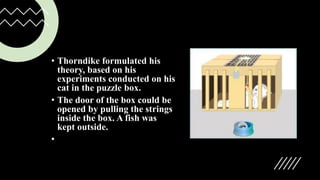
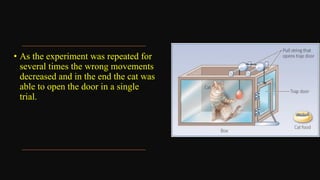
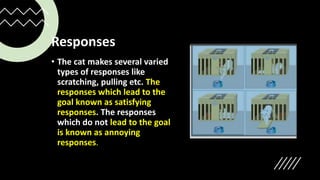
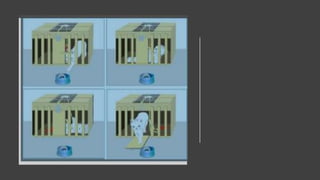
• Thorndike formulated his
theory, based on his
experiments conducted on his
cat in the puzzle box.
• The door of the box could be
opened by pulling the strings
inside the box. A fish was
kept outside.
•
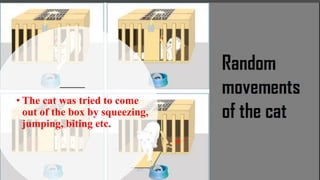
• The cat was tried to come
out of the box by squeezing,
jumping, biting etc.
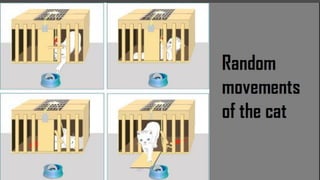
• As the experiment was repeated for
several times the wrong movements
decreased and in the end the cat was
able to open the door in a single
trial.
FACTORS INVOLVED IN
TRIAL-AND-ERROR THEORY
•
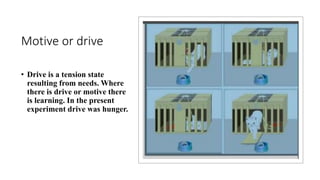
Motive or drive
• Drive is a tension state
resulting from needs. Where
there is drive or motive there
is learning. In the present
experiment drive was hunger.
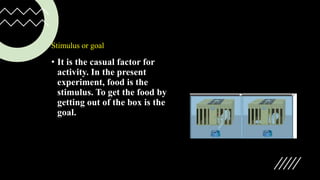
Stimulus or goal
• It is the casual factor for
activity. In the present
experiment, food is the
stimulus. To get the food by
getting out of the box is the
goal.
Responses
• The cat makes several varied
types of responses like
scratching, pulling etc. The
responses which lead to the
goal known as satisfying
responses. The responses
which do not lead to the goal
is known as annoying
responses.
Chance success
As a result of random movements, the
cat, by chance, succeeded in opening the
door.
Selection of
proper
movement
• Gradually the cat selected the
proper way of pulling the string
out of its random movements.
fixation
• At last, the cat learned the
proper way of opening the door
by eliminating all the incorrect
responses and fixing only right
response. Now the cat was able
to open the door without any
error.
LAWS OF
LEARNING
• PRIMARY LAWS
• Law of readiness
• Law of effect
• Law of exercise
Law of readiness
This law indicates the learners
state of willingness participate
in the learning process
Law of effect
The law of effect
states the pleasure
pain principle
A response is
strengthened if it is
followed by pleasures and
weakened if it is followed
by displeasure
Law of exercise
• According to this law the more times a stimulus induced response is
repeated the longer it will be retained
• This law has two sub parts use and disuse
• Law of use- the more often
an association is used the
stronger it becomes
• Law of disuse- the longer
an association is unused
the weaker it becomes.
SECONDARY
LAWS
• Law of multiple response
• Law of attitude
• Law of analogy
• Law of associative shifting
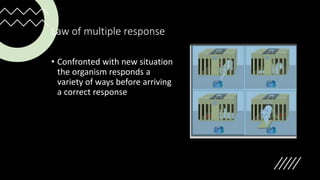
Law of multiple response
• Confronted with new situation
the organism responds a
variety of ways before arriving
a correct response
Law of attitude
• Learners perform the task well
if he has attitude set on the
task
Analogy
• The organism responds to a new
situation based on the response
made by him in a similar situation in
the past
• He make responses by comparison
or analogy
Law of
associative
shifting
• We can get any response from
the learner of which he is
capable associated with any
situation to which he is sensitive
Prepotency of
elements
• Effects of rewards and
punishment can affect the
learning of the child
Education
application
Motivation is very important
in the teaching-learning
process.
Learning should be made
purposeful, and goal directed.
• Theory stresses the importance of
mental readiness, meaningful
practice and intensives in
learning process.
• More opportunities should be
given to the learners to use and
repeat the knowledge they get in
the classroom.
• The learner should be
encouraged to do his task
independently. He must try
various solutions of the
problem before arriving at the
correct one.
Skinner
• Skinner revolt against no
stimulus, no response theory.
• His theory came to be known as
operant conditioning
• Skinner developed his theory on
the lines of Thorndike learning by
selecting and connecting under
law of effect
• Skinner formulated his theory
of behavior based on condition
in 1930
No stimulus, no
response theory.
• S-R theories have assumed the
existence of stimulus as a
prerequisite for evoking
response
• In the absence of external
stimuli, they have assumed
some internal stimuli for
evoking response.
• Skinner was against this. He
defined two kinds of responses
Types of response
• Elicited behavior(Respondent
Behavior) is learnt behavior
according to Pavlov model of
conditioning. Since it is
concerned with a stimuli it is
know as S type conditioning
• Emitted behavior (Operant
behavior)Response to
unknown stimuli
• Respondent behavior is learnt
according to the Pavlovian
model of conditioning .
• It is concerned with stimuli
known as S type conditioning
• Skinner attaches great importance
to operant behavior concerned with
response rather than stimuli.
• Skinner changed S_R formula to R_S
formula
• According To R_S formula when
desired response is emitted a
reinforce stimulus is presented
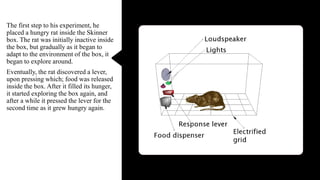
The first step to his experiment, he
placed a hungry rat inside the Skinner
box. The rat was initially inactive inside
the box, but gradually as it began to
adapt to the environment of the box, it
began to explore around.
Eventually, the rat discovered a lever,
upon pressing which; food was released
inside the box. After it filled its hunger,
it started exploring the box again, and
after a while it pressed the lever for the
second time as it grew hungry again.
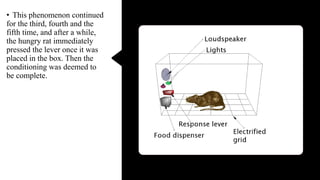
• This phenomenon continued
for the third, fourth and the
fifth time, and after a while,
the hungry rat immediately
pressed the lever once it was
placed in the box. Then the
conditioning was deemed to
be complete.
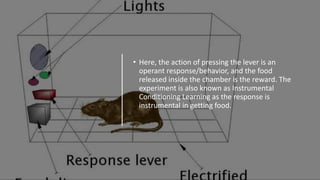
• Here, the action of pressing the lever is an
operant response/behavior, and the food
released inside the chamber is the reward. The
experiment is also known as Instrumental
Conditioning Learning as the response is
instrumental in getting food.
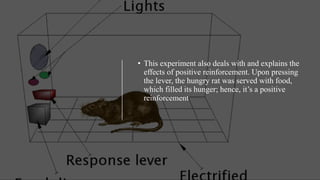
• This experiment also deals with and explains the
effects of positive reinforcement. Upon pressing
the lever, the hungry rat was served with food,
which filled its hunger; hence, it’s a positive
reinforcement
Reinforcement
• A reinforcer is a stimulus whose
presentation or removal
increases the probability of a
response
Types of
Reinforcement
• Positive Reinforcement is any
stimulus whose presentation can
strengthen the probability of
response(Reward Learning) •
• Negative Reinforcement a
response or behavior is
strengthened by stopping,
removing or avoiding a negative
outcome or aversive stimulus
(escape-avoidance learning
Positive
Reinforcement
• Positive Reinforcement is any
stimulus whose presentation can
strengthen the probability of
response(Reward Learning)
Negative
Reinforcement
• Negative Reinforcement :Release
from an unpleasant situation
given to strengthen behavior
• Primary reinforcers: Food ,water and
sex thar satisfies basic need
• Secondary reinforces: A consequence
that people learn to value through an
association with Primary reinforcers
Premack
principle
• Rule that states that enjoyable
activities can be used to reinforce
participation in less enjoyable
activities
• Punishment • Any event that causes a decrease in the behavior
Presentation punishment(positive
punishment)
• use of unpleasant consequences
to decrease the chances that the
behavior will occur again
Removal punishment(negative punishment)
• Withdrawal of pleasant consequences that is reinforcing behavior
designed to decrees the chance that behavior will occur again.
• Time out: Procedure for removing a student from the situation in
which behavior was reinforced
• Intrinsic reinforcement :behavior that a person enjoys
engaging for their own sake
• Extrinsic reinforce; praise and reward is given to motivate people
Components of Operant Conditioning
• Reinforcement – A kind of stimulus that aims to increase the
strength in behavior due to its consequence
• Punishment • Any event that causes a decrease in the behavior
Extinction
• When the response is no longer reinforce than extinction occurs
Variable interval
schedule
• Reinforcement scheduled in
which desired behavior is
rewarded following an
unpredictable amount of time
Fixed interval
schedule
• Reinforcement scheduled in
which desired behavior is
rewarded following a constant
amount of time
Variable ratio
schedule
• Reinforcement scheduled in
which desired behavior is
rewarded following an
unpredictable number of
behavior
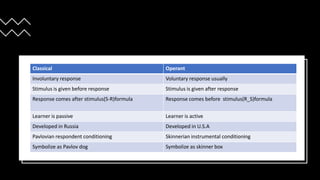
Classical Operant
Involuntary response Voluntary response usually
Stimulus is given before response Stimulus is given after response
Response comes after stimulus(S-R)formula Response comes before stimulus(R_S)formula
Learner is passive Learner is active
Developed in Russia Developed in U.S.A
Pavlovian respondent conditioning Skinnerian instrumental conditioning
Symbolize as Pavlov dog Symbolize as skinner box
Education application
• Operant conditioning has been applied to learning by developing
teaching machines and programmed learning
• Skinner has revolutionized the whole teaching learning process and
mechanical learning by replacing the teacher

Operant condtioning

  • 1.
  • 2.
    • Through operantconditioning, an association is made between a behavior and a consequence (whether negative or positive) for that behavior
  • 3.
    An operant isa set of acts which constitutes an organism doing something. In the process of operant conditioning operant responses are modified or changed by reinforcement
  • 4.
    • It iscalled trial and error learning
  • 5.
    Edward Thorndike (1898)is famous in psychology for his work on learning theory that led to the development of operant conditioning within Behaviorism. In1878 theory was given in his book animal intelligence
  • 6.
    According to himlearning takes place by trial and error. In learning the learner selects a correct response out of many possible ones and connects it with the appropriate stimulus Learning by this method is called trial and error learning theory.
  • 7.
    • Thorndike formulatedhis theory, based on his experiments conducted on his cat in the puzzle box. • The door of the box could be opened by pulling the strings inside the box. A fish was kept outside. •
  • 8.
    • The catwas tried to come out of the box by squeezing, jumping, biting etc.
  • 10.
    • As theexperiment was repeated for several times the wrong movements decreased and in the end the cat was able to open the door in a single trial.
  • 11.
  • 12.
    Motive or drive •Drive is a tension state resulting from needs. Where there is drive or motive there is learning. In the present experiment drive was hunger.
  • 13.
    Stimulus or goal •It is the casual factor for activity. In the present experiment, food is the stimulus. To get the food by getting out of the box is the goal.
  • 14.
    Responses • The catmakes several varied types of responses like scratching, pulling etc. The responses which lead to the goal known as satisfying responses. The responses which do not lead to the goal is known as annoying responses.
  • 15.
    Chance success As aresult of random movements, the cat, by chance, succeeded in opening the door.
  • 16.
    Selection of proper movement • Graduallythe cat selected the proper way of pulling the string out of its random movements.
  • 17.
    fixation • At last,the cat learned the proper way of opening the door by eliminating all the incorrect responses and fixing only right response. Now the cat was able to open the door without any error.
  • 19.
    LAWS OF LEARNING • PRIMARYLAWS • Law of readiness • Law of effect • Law of exercise
  • 20.
    Law of readiness Thislaw indicates the learners state of willingness participate in the learning process
  • 21.
    Law of effect Thelaw of effect states the pleasure pain principle A response is strengthened if it is followed by pleasures and weakened if it is followed by displeasure
  • 22.
    Law of exercise •According to this law the more times a stimulus induced response is repeated the longer it will be retained • This law has two sub parts use and disuse
  • 23.
    • Law ofuse- the more often an association is used the stronger it becomes • Law of disuse- the longer an association is unused the weaker it becomes.
  • 24.
    SECONDARY LAWS • Law ofmultiple response • Law of attitude • Law of analogy • Law of associative shifting
  • 25.
    Law of multipleresponse • Confronted with new situation the organism responds a variety of ways before arriving a correct response
  • 26.
    Law of attitude •Learners perform the task well if he has attitude set on the task
  • 27.
    Analogy • The organismresponds to a new situation based on the response made by him in a similar situation in the past • He make responses by comparison or analogy
  • 28.
    Law of associative shifting • Wecan get any response from the learner of which he is capable associated with any situation to which he is sensitive
  • 29.
    Prepotency of elements • Effectsof rewards and punishment can affect the learning of the child
  • 30.
    Education application Motivation is veryimportant in the teaching-learning process. Learning should be made purposeful, and goal directed.
  • 31.
    • Theory stressesthe importance of mental readiness, meaningful practice and intensives in learning process.
  • 32.
    • More opportunitiesshould be given to the learners to use and repeat the knowledge they get in the classroom.
  • 33.
    • The learnershould be encouraged to do his task independently. He must try various solutions of the problem before arriving at the correct one.
  • 34.
    Skinner • Skinner revoltagainst no stimulus, no response theory. • His theory came to be known as operant conditioning • Skinner developed his theory on the lines of Thorndike learning by selecting and connecting under law of effect
  • 35.
    • Skinner formulatedhis theory of behavior based on condition in 1930
  • 36.
    No stimulus, no responsetheory. • S-R theories have assumed the existence of stimulus as a prerequisite for evoking response • In the absence of external stimuli, they have assumed some internal stimuli for evoking response.
  • 37.
    • Skinner wasagainst this. He defined two kinds of responses
  • 38.
    Types of response •Elicited behavior(Respondent Behavior) is learnt behavior according to Pavlov model of conditioning. Since it is concerned with a stimuli it is know as S type conditioning • Emitted behavior (Operant behavior)Response to unknown stimuli
  • 39.
    • Respondent behavioris learnt according to the Pavlovian model of conditioning . • It is concerned with stimuli known as S type conditioning
  • 40.
    • Skinner attachesgreat importance to operant behavior concerned with response rather than stimuli. • Skinner changed S_R formula to R_S formula
  • 41.
    • According ToR_S formula when desired response is emitted a reinforce stimulus is presented
  • 42.
    The first stepto his experiment, he placed a hungry rat inside the Skinner box. The rat was initially inactive inside the box, but gradually as it began to adapt to the environment of the box, it began to explore around. Eventually, the rat discovered a lever, upon pressing which; food was released inside the box. After it filled its hunger, it started exploring the box again, and after a while it pressed the lever for the second time as it grew hungry again.
  • 43.
    • This phenomenoncontinued for the third, fourth and the fifth time, and after a while, the hungry rat immediately pressed the lever once it was placed in the box. Then the conditioning was deemed to be complete.
  • 44.
    • Here, theaction of pressing the lever is an operant response/behavior, and the food released inside the chamber is the reward. The experiment is also known as Instrumental Conditioning Learning as the response is instrumental in getting food.
  • 45.
    • This experimentalso deals with and explains the effects of positive reinforcement. Upon pressing the lever, the hungry rat was served with food, which filled its hunger; hence, it’s a positive reinforcement
  • 46.
    Reinforcement • A reinforceris a stimulus whose presentation or removal increases the probability of a response
  • 47.
    Types of Reinforcement • PositiveReinforcement is any stimulus whose presentation can strengthen the probability of response(Reward Learning) • • Negative Reinforcement a response or behavior is strengthened by stopping, removing or avoiding a negative outcome or aversive stimulus (escape-avoidance learning
  • 48.
    Positive Reinforcement • Positive Reinforcementis any stimulus whose presentation can strengthen the probability of response(Reward Learning)
  • 49.
    Negative Reinforcement • Negative Reinforcement:Release from an unpleasant situation given to strengthen behavior
  • 50.
    • Primary reinforcers:Food ,water and sex thar satisfies basic need • Secondary reinforces: A consequence that people learn to value through an association with Primary reinforcers
  • 51.
    Premack principle • Rule thatstates that enjoyable activities can be used to reinforce participation in less enjoyable activities
  • 52.
    • Punishment •Any event that causes a decrease in the behavior
  • 53.
    Presentation punishment(positive punishment) • useof unpleasant consequences to decrease the chances that the behavior will occur again
  • 54.
    Removal punishment(negative punishment) •Withdrawal of pleasant consequences that is reinforcing behavior designed to decrees the chance that behavior will occur again. • Time out: Procedure for removing a student from the situation in which behavior was reinforced
  • 55.
    • Intrinsic reinforcement:behavior that a person enjoys engaging for their own sake • Extrinsic reinforce; praise and reward is given to motivate people
  • 56.
    Components of OperantConditioning • Reinforcement – A kind of stimulus that aims to increase the strength in behavior due to its consequence • Punishment • Any event that causes a decrease in the behavior
  • 57.
    Extinction • When theresponse is no longer reinforce than extinction occurs
  • 58.
    Variable interval schedule • Reinforcementscheduled in which desired behavior is rewarded following an unpredictable amount of time
  • 59.
    Fixed interval schedule • Reinforcementscheduled in which desired behavior is rewarded following a constant amount of time
  • 60.
    Variable ratio schedule • Reinforcementscheduled in which desired behavior is rewarded following an unpredictable number of behavior
  • 61.
    Classical Operant Involuntary responseVoluntary response usually Stimulus is given before response Stimulus is given after response Response comes after stimulus(S-R)formula Response comes before stimulus(R_S)formula Learner is passive Learner is active Developed in Russia Developed in U.S.A Pavlovian respondent conditioning Skinnerian instrumental conditioning Symbolize as Pavlov dog Symbolize as skinner box
  • 62.
    Education application • Operantconditioning has been applied to learning by developing teaching machines and programmed learning • Skinner has revolutionized the whole teaching learning process and mechanical learning by replacing the teacher