J.P. Guilford’s STRUCTURE OF INTELLECT MODEL / Three
dimensional model (Revised)
by
Dr. Bonnie Amonge Crerar
Assistant Professor, Assam Donbosco University, Guwahati
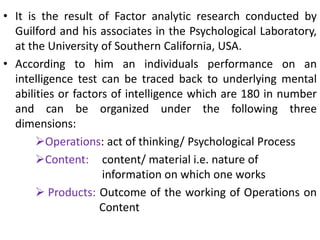
• It is the result of Factor analytic research conducted by
Guilford and his associates in the Psychological Laboratory,
at the University of Southern California, USA.
• According to him an individuals performance on an
intelligence test can be traced back to underlying mental
abilities or factors of intelligence which are 180 in number
and can be organized under the following three
dimensions:
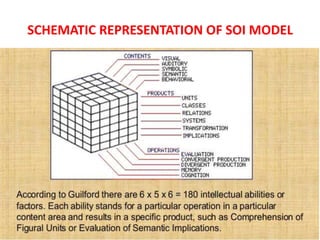
Operations: act of thinking/ Psychological Process
Content: content/ material i.e. nature of
information on which one works
 Products: Outcome of the working of Operations on
Content
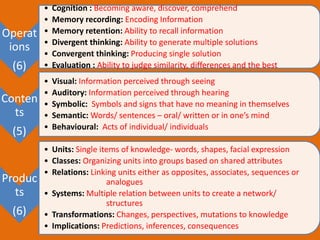
(Brain Operates) Operations (6)
Contents (5)
Products (6)
Operat
ions
(6)
• Cognition : Becoming aware, discover, comprehend
• Memory recording: Encoding Information
• Memory retention: Ability to recall information
• Divergent thinking: Ability to generate multiple solutions
• Convergent thinking: Producing single solution
• Evaluation : Ability to judge similarity, differences and the best
Conten
ts
(5)
• Visual: Information perceived through seeing
• Auditory: Information perceived through hearing
• Symbolic: Symbols and signs that have no meaning in themselves
• Semantic: Words/ sentences – oral/ written or in one’s mind
• Behavioural: Acts of individual/ individuals
Produc
ts
(6)
• Units: Single items of knowledge- words, shapes, facial expression
• Classes: Organizing units into groups based on shared attributes
• Relations: Linking units either as opposites, associates, sequences or
analogues
• Systems: Multiple relation between units to create a network/
structures
• Transformations: Changes, perspectives, mutations to knowledge
• Implications: Predictions, inferences, consequences
SCHEMATIC REPRESENTATION OF SOI MODEL
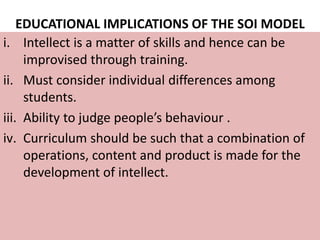
EDUCATIONAL IMPLICATIONS OF THE SOI MODEL
i. Intellect is a matter of skills and hence can be
improvised through training.
ii. Must consider individual differences among
students.
iii. Ability to judge people’s behaviour .
iv. Curriculum should be such that a combination of
operations, content and product is made for the
development of intellect.
References:
https://www.slideshare.net/fraaanceee/structure-of-
intelligence
https://www.youtube.com/watch?v=RnxGcmPlSVM
https://www.slideshare.net/veerabalajikumar/intellig
ence-testing
Mangal. S. K. (2003). Advanced educational
psychology. New Delhi: Prentice Hall.

Guilford's structure of intellect model

  • 1.
    J.P. Guilford’s STRUCTUREOF INTELLECT MODEL / Three dimensional model (Revised) by Dr. Bonnie Amonge Crerar Assistant Professor, Assam Donbosco University, Guwahati
  • 2.
    • It isthe result of Factor analytic research conducted by Guilford and his associates in the Psychological Laboratory, at the University of Southern California, USA. • According to him an individuals performance on an intelligence test can be traced back to underlying mental abilities or factors of intelligence which are 180 in number and can be organized under the following three dimensions: Operations: act of thinking/ Psychological Process Content: content/ material i.e. nature of information on which one works  Products: Outcome of the working of Operations on Content
  • 3.
    (Brain Operates) Operations(6) Contents (5) Products (6) Operat ions (6) • Cognition : Becoming aware, discover, comprehend • Memory recording: Encoding Information • Memory retention: Ability to recall information • Divergent thinking: Ability to generate multiple solutions • Convergent thinking: Producing single solution • Evaluation : Ability to judge similarity, differences and the best Conten ts (5) • Visual: Information perceived through seeing • Auditory: Information perceived through hearing • Symbolic: Symbols and signs that have no meaning in themselves • Semantic: Words/ sentences – oral/ written or in one’s mind • Behavioural: Acts of individual/ individuals Produc ts (6) • Units: Single items of knowledge- words, shapes, facial expression • Classes: Organizing units into groups based on shared attributes • Relations: Linking units either as opposites, associates, sequences or analogues • Systems: Multiple relation between units to create a network/ structures • Transformations: Changes, perspectives, mutations to knowledge • Implications: Predictions, inferences, consequences
  • 4.
  • 5.
    EDUCATIONAL IMPLICATIONS OFTHE SOI MODEL i. Intellect is a matter of skills and hence can be improvised through training. ii. Must consider individual differences among students. iii. Ability to judge people’s behaviour . iv. Curriculum should be such that a combination of operations, content and product is made for the development of intellect.
  • 6.

Editor's Notes

  • #4 These dimensions when multiplied 6x5x6 = 180 factors of intelligence.