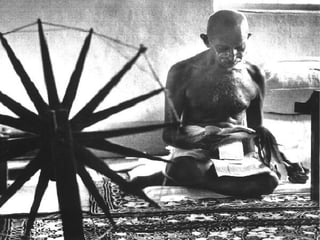
Educational Ideas of Mahatma Gandhi www.edusparx.com
“ We must be the change we wish to see in the world”.  ~M. K. Gandhi
Background Born on 2 nd  Oct 1869 in Porbandar A great socio-political reformer Apostle of peace and non-violence Champion of the freedom movement Organized Satyagraha and various other movements from 1919 to 1947 Died on 30 th  Jan 1948
“ In his life of truth and non-violence he could melt the differences between individuals, countries and continents.” ~Dr. Martin Luther King Jr.
His Philosophy… Belief in God Truth, Ahimsa, Love Brotherhood of Man Service to Humanity Satyagraha
Principles of a new social order Brotherhood Citizenship Economic Equality Sarvodaya Samaj
Educational Philosophy Education as a potent force for social reconstruction An activity for social, moral, political & economic development
Meaning of education “ By education, I mean an all-round drawing out of the best in the child and man, body, mind and spirit”. “ Literacy in itself is not education”.
Aims of Education Self-supporting aim Cultural developmnet Character building All round development Cultivation of higher values of life Social uplift and welfare
Curriculum Productive craft as the medium and focus of education Mathematics, social studies, general science Drawing, music, P.T. Mother tongue as the medium of instruction
Which Crafts? Spinning, weaving Leather-work Metal-work Basket-making Book-binding Pottery
Methods of Teaching Teaching through creative and productive activities Learning by doing Correlation technique Lecture & discussion methods
Basic Education Scheme Free and compulsory education for all from 7 – 14 years Craft as the centre of education Self-supporting education Mother tongue as the medium Ideals of citizenship Co-operative living Emphasis on non-violence No religious education
All the same… Basic Education Scheme Nayi Talim Buniyadi Shiksha Craft-based Education scheme Wardha Scheme
How would you classify Gandhi’s educational philosophy? Idealistic? Naturalistic? Pragmatic?
Gandhi’s Contribution to Education
What is the relevance of Gandhi’s educational ideas in the present Indian context?
Compare and contrast… Gandhi’s and Dewey’s Educational Philosophy

Gandhi's educational ideas

  • 1.
  • 2.
    Educational Ideas ofMahatma Gandhi www.edusparx.com
  • 3.
    “ We mustbe the change we wish to see in the world”. ~M. K. Gandhi
  • 4.
    Background Born on2 nd Oct 1869 in Porbandar A great socio-political reformer Apostle of peace and non-violence Champion of the freedom movement Organized Satyagraha and various other movements from 1919 to 1947 Died on 30 th Jan 1948
  • 5.
    “ In hislife of truth and non-violence he could melt the differences between individuals, countries and continents.” ~Dr. Martin Luther King Jr.
  • 6.
    His Philosophy… Beliefin God Truth, Ahimsa, Love Brotherhood of Man Service to Humanity Satyagraha
  • 7.
    Principles of anew social order Brotherhood Citizenship Economic Equality Sarvodaya Samaj
  • 8.
    Educational Philosophy Educationas a potent force for social reconstruction An activity for social, moral, political & economic development
  • 9.
    Meaning of education“ By education, I mean an all-round drawing out of the best in the child and man, body, mind and spirit”. “ Literacy in itself is not education”.
  • 10.
    Aims of EducationSelf-supporting aim Cultural developmnet Character building All round development Cultivation of higher values of life Social uplift and welfare
  • 11.
    Curriculum Productive craftas the medium and focus of education Mathematics, social studies, general science Drawing, music, P.T. Mother tongue as the medium of instruction
  • 12.
    Which Crafts? Spinning,weaving Leather-work Metal-work Basket-making Book-binding Pottery
  • 13.
    Methods of TeachingTeaching through creative and productive activities Learning by doing Correlation technique Lecture & discussion methods
  • 14.
    Basic Education SchemeFree and compulsory education for all from 7 – 14 years Craft as the centre of education Self-supporting education Mother tongue as the medium Ideals of citizenship Co-operative living Emphasis on non-violence No religious education
  • 15.
    All the same…Basic Education Scheme Nayi Talim Buniyadi Shiksha Craft-based Education scheme Wardha Scheme
  • 16.
    How would youclassify Gandhi’s educational philosophy? Idealistic? Naturalistic? Pragmatic?
  • 17.
  • 18.
    What is therelevance of Gandhi’s educational ideas in the present Indian context?
  • 19.
    Compare and contrast…Gandhi’s and Dewey’s Educational Philosophy