The document discusses Hunt's model of reflective teaching, emphasizing a problem-centered approach that fosters intellectual behavior and critical thinking among students. It highlights different teaching levels—memory, understanding, and reflective—where the teacher creates problems for students to solve, encouraging independent thought and hypothesis testing. Characteristics of effective reflective teachers include self-analysis and strong time-management skills.
Explains Morris L. Bigge's classification of teaching from thoughtful to thoughtless, emphasizing a three-level teaching approach: memory, understanding, and reflective.
Describes the reflective level of teaching as problem-centered and builds on understanding and memory teaching levels, aimed at developing intellectual behavior.
Focuses on creating problems for pupils to solve, fostering motivation and original attitudes through Hunt’s reflective model, also known as introspective teaching.
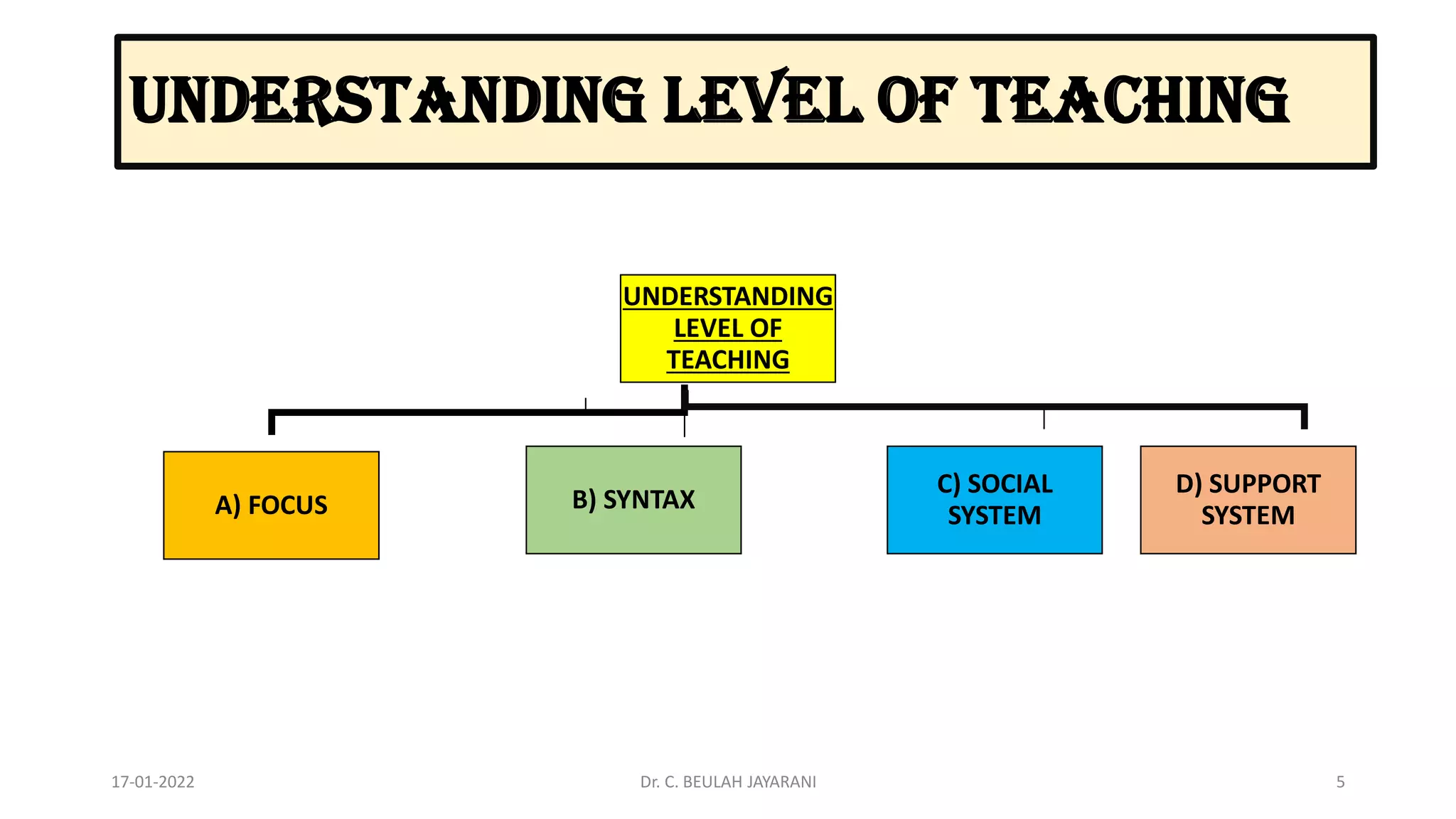
Details the understanding level of teaching with a focus on its components: focus, syntax, social system, and support, for effective student engagement.
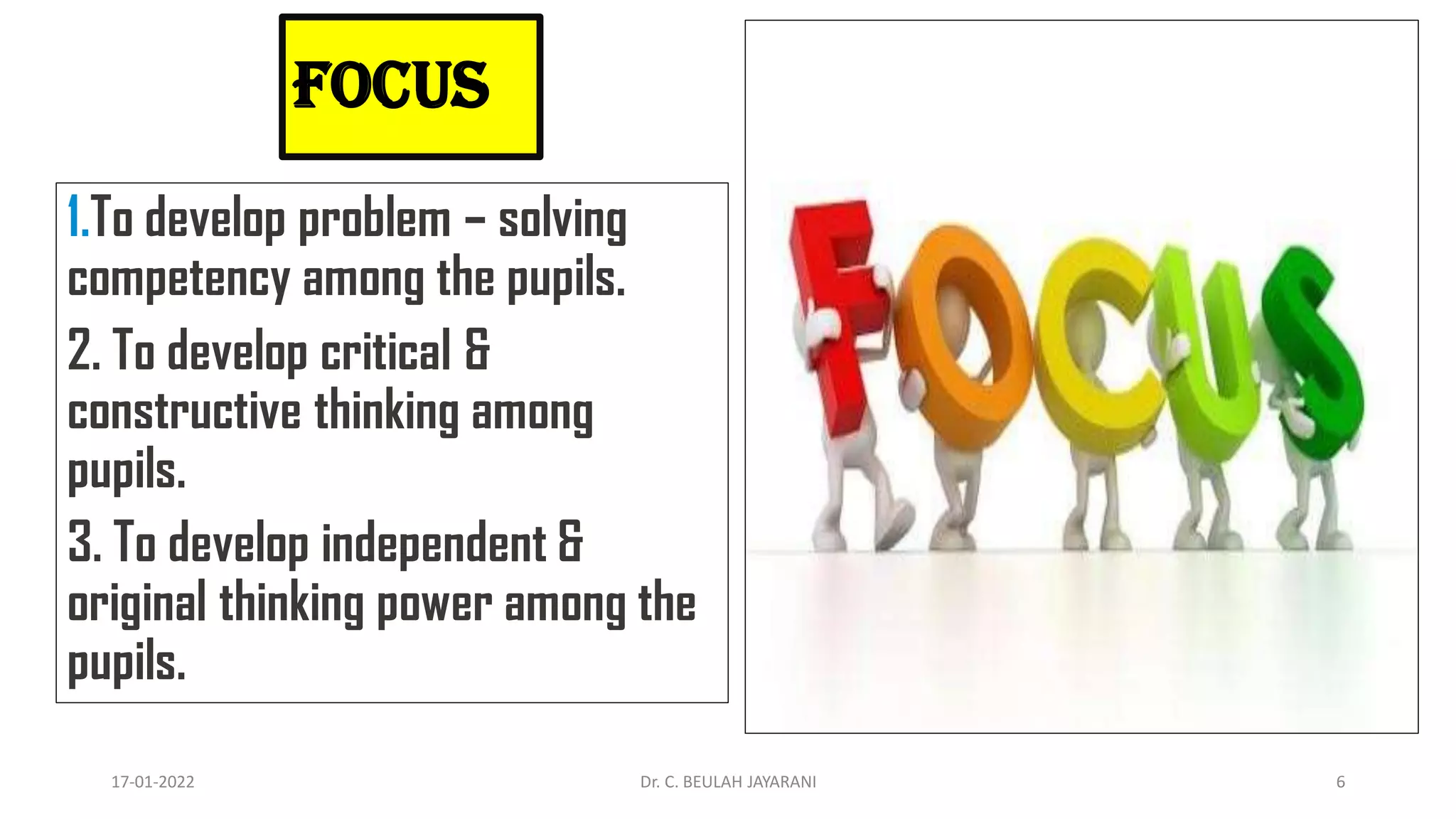
Lists goals for understanding level teaching aimed at promoting problem-solving, critical, and independent thinking skills among pupils.
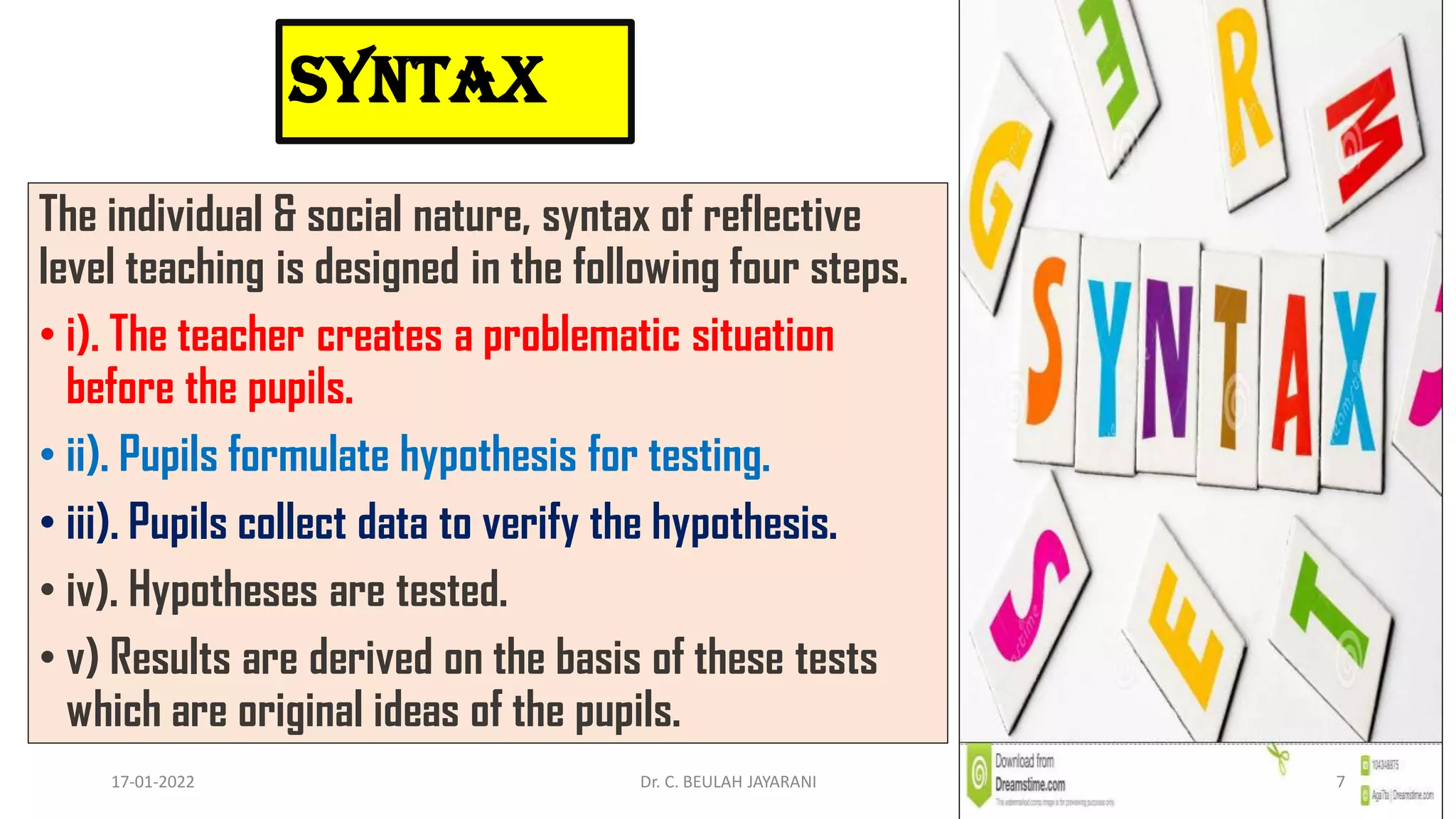
Outlines four steps in reflective teaching syntax: problem creation, hypothesis formulation, data collection, and testing, leading to original student insights.
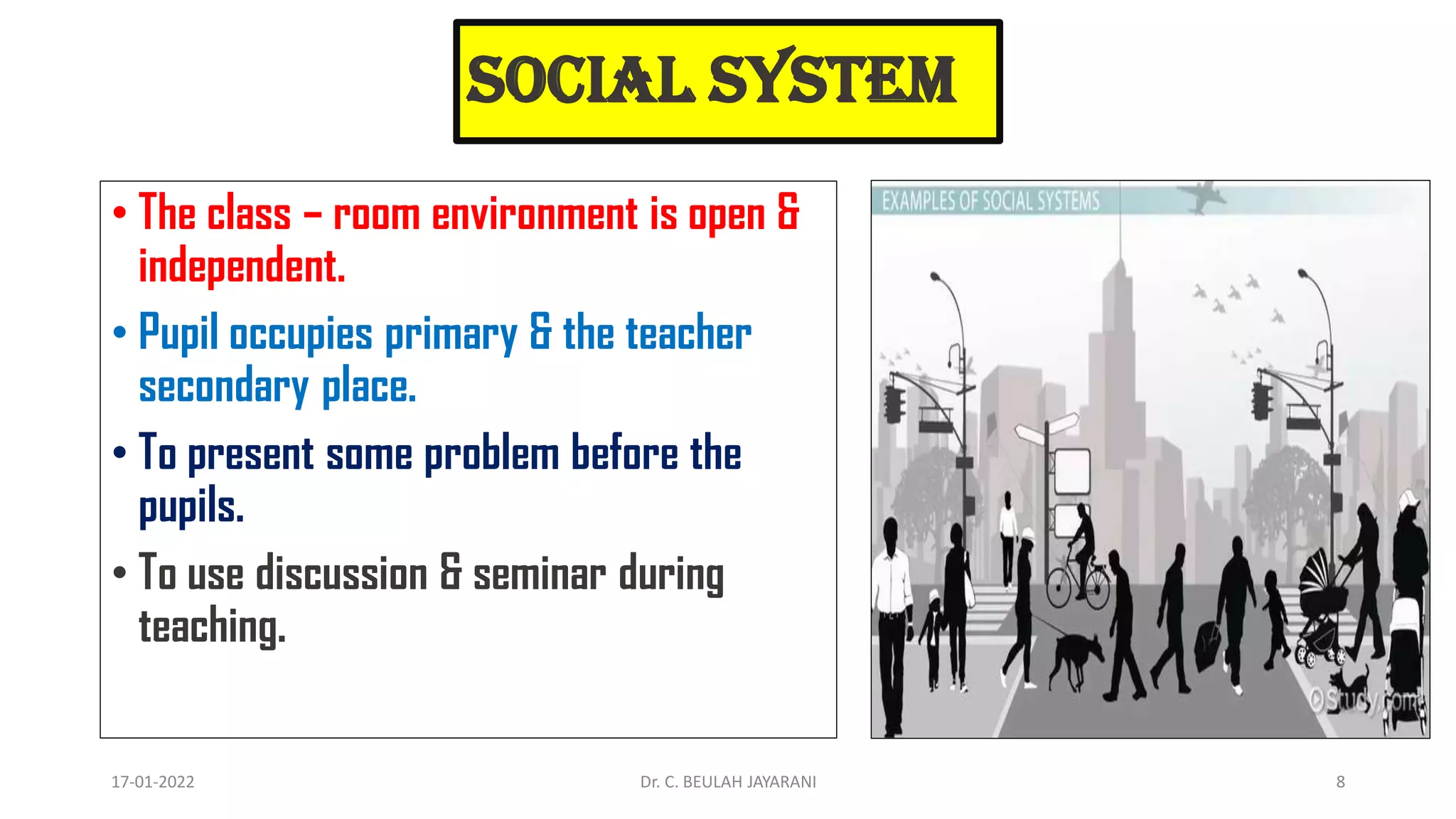
Describes an open classroom environment where pupils are prioritized, encourages the use of discussions and seminars to enhance problem-solving.
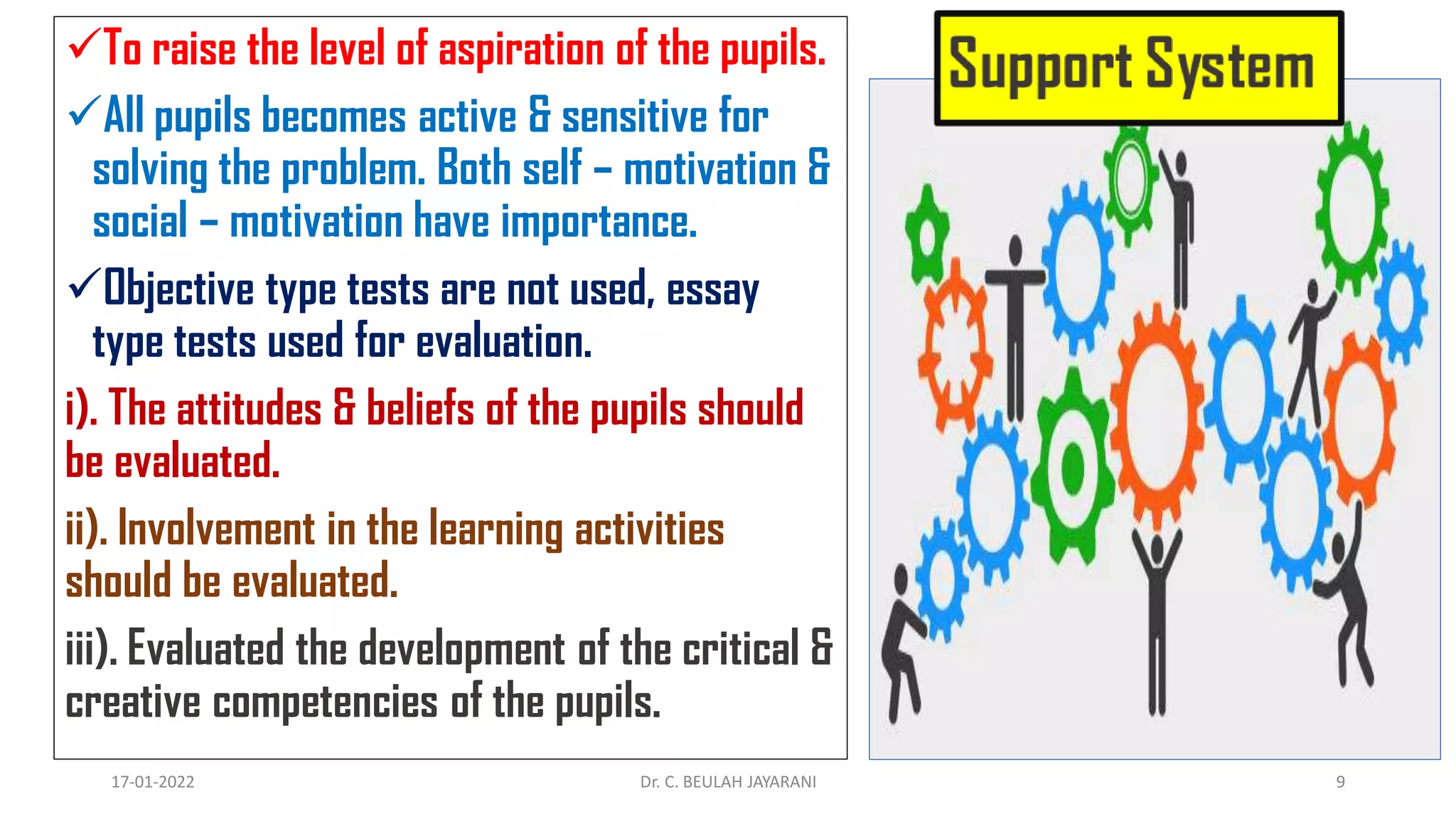
Stresses the importance of holistic evaluation methods over objective tests, focusing on pupils' attitudes, involvement, and development of critical thinking.
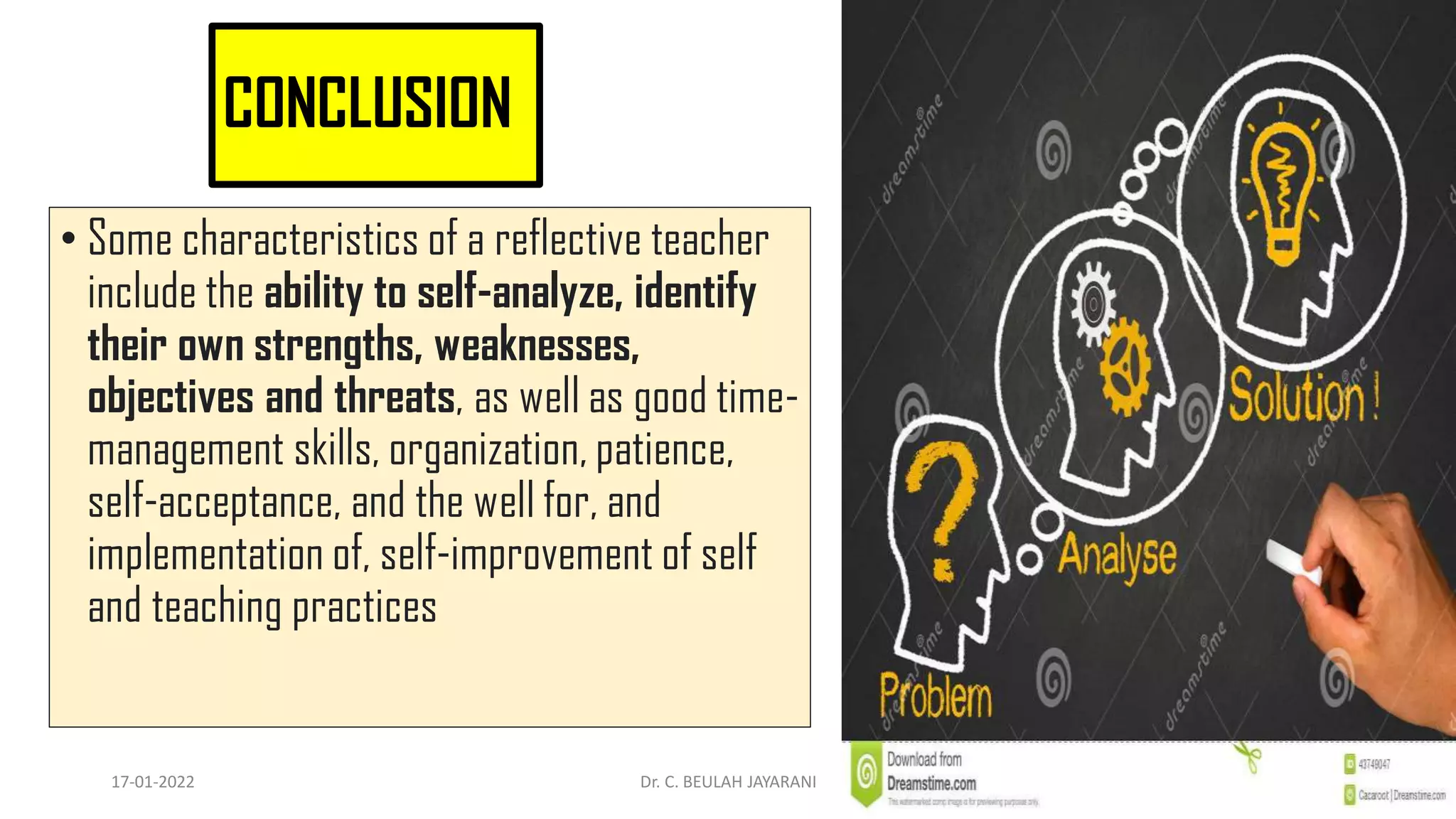
Lists qualities of reflective teachers, including self-analysis, strength identification, time-management, and commitment to self-improvement in teaching practices.
DR. C. BEULAHJAYARANI
M.Sc., M.A, M.Ed, M.Phil (Edn), M.Phil (ZOO), NET, Ph.D
ASST. PROFESSOR,
LOYOLA COLLEGE OF EDUCATION, CHENNAI - 34
2.
INTRODUCTION
• Morris .L.Bigge- “Teaching-learning
situations may be classified on a
continuum which ranges from thoughtful to
thoughtless modes of operation”. Hunt
developed the reflective model of
teaching.
• Teacher can present the content at three
levels—
• a) Memory level
• b) Understanding level
• c) Reflective level
17-01-2022 Dr. C. BEULAH JAYARANI 2
3.
REFLECTIVE LEVEL OFTEACHING
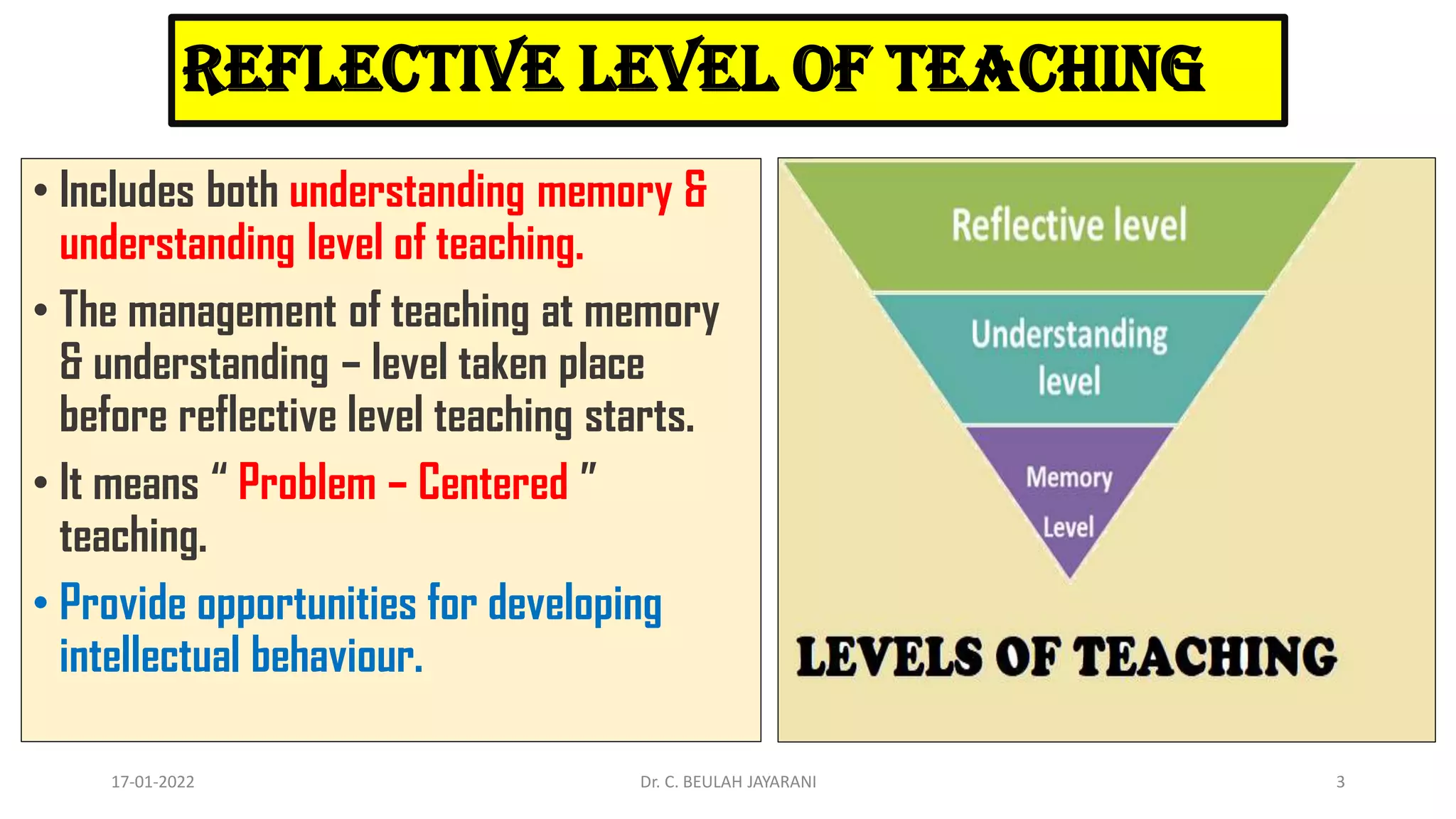
• Includes both understanding memory &
understanding level of teaching.
• The management of teaching at memory
& understanding – level taken place
before reflective level teaching starts.
• It means “ Problem – Centered ”
teaching.
• Provide opportunities for developing
intellectual behaviour.
17-01-2022 Dr. C. BEULAH JAYARANI 3
4.
Teacher creates aproblem before the
pupils, then pupils start solve it by
formulating & testing their hypotheses
as a result of their own motivation &
activeness.
Deep & serious study in order to solve
his problem, the pupil learns to develop
his original attitude.
For developing reflective level of
teaching the credit goes to hunt.
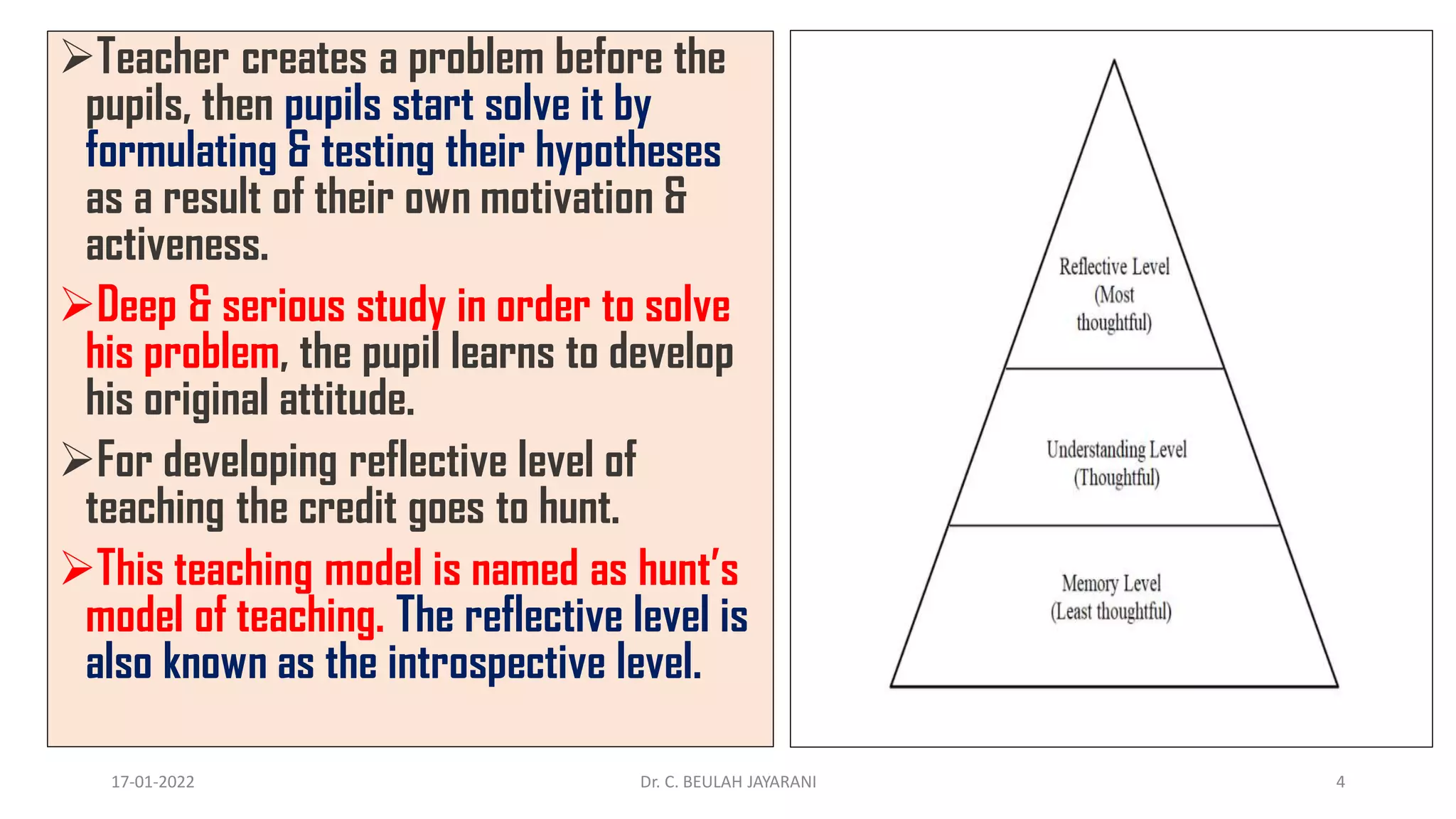
This teaching model is named as hunt’s
model of teaching. The reflective level is
also known as the introspective level.
17-01-2022 Dr. C. BEULAH JAYARANI 4
5.
UNDERSTANDING LEVEL OFTEACHING
UNDERSTANDING
LEVEL OF
TEACHING
A) FOCUS B) SYNTAX
C) SOCIAL
SYSTEM
D) SUPPORT
SYSTEM
17-01-2022 Dr. C. BEULAH JAYARANI 5
6.
FOCUS
1.To develop problem– solving
competency among the pupils.
2. To develop critical &
constructive thinking among
pupils.
3. To develop independent &
original thinking power among the
pupils.
17-01-2022 Dr. C. BEULAH JAYARANI 6
7.
SYNTAX
The individual &social nature, syntax of reflective
level teaching is designed in the following four steps.
• i). The teacher creates a problematic situation
before the pupils.
• ii). Pupils formulate hypothesis for testing.
• iii). Pupils collect data to verify the hypothesis.
• iv). Hypotheses are tested.
• v) Results are derived on the basis of these tests
which are original ideas of the pupils.
17-01-2022 Dr. C. BEULAH JAYARANI 7
8.
Social System
• Theclass – room environment is open &
independent.
• Pupil occupies primary & the teacher
secondary place.
• To present some problem before the
pupils.
• To use discussion & seminar during
teaching.
17-01-2022 Dr. C. BEULAH JAYARANI 8
9.
To raise thelevel of aspiration of the pupils.
All pupils becomes active & sensitive for
solving the problem. Both self – motivation &
social – motivation have importance.
Objective type tests are not used, essay
type tests used for evaluation.
i). The attitudes & beliefs of the pupils should
be evaluated.
ii). Involvement in the learning activities
should be evaluated.
iii). Evaluated the development of the critical &
creative competencies of the pupils.
17-01-2022 Dr. C. BEULAH JAYARANI 9
10.
CONCLUSION
• Some characteristicsof a reflective teacher
include the ability to self-analyze, identify
their own strengths, weaknesses,
objectives and threats, as well as good time-
management skills, organization, patience,
self-acceptance, and the well for, and
implementation of, self-improvement of self
and teaching practices
17-01-2022 Dr. C. BEULAH JAYARANI 10