


Thermodynamics
Important terms to remember

•   System
•   Surrounding
•   Work done
•   Heat
•   Spontaneous process
•   Non-spontaneous process
System and Surrounding


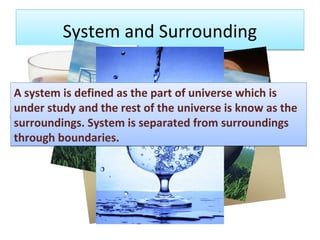
A system is defined as the part of universe which is
under study and the rest of the universe is know as the
surroundings. System is separated from surroundings
through boundaries.
Heat
Sign convention for HEAT


•   Heat is denoted as “q”.
•   Heat absorbed by the system is “+ve”
•   Heat transferred from the system is “-ve”.
Work

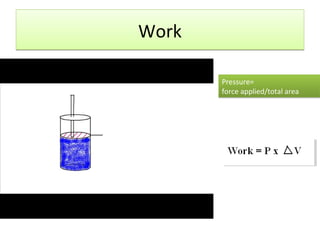
       Pressure=
       force applied/total area
Sign convention for work done


•   Work done is denoted as w
•   When work is done on the system it is “+ve”.
•   When work done by the system it is “-ve”.
First Law of thermodynamics


• Energy can neither be created nor destroyed.
Internal energy


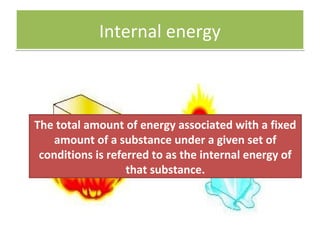
The total amount of energy associated with a fixed
    amount of a substance under a given set of
 conditions is referred to as the internal energy of
                   that substance.
Internal energy change


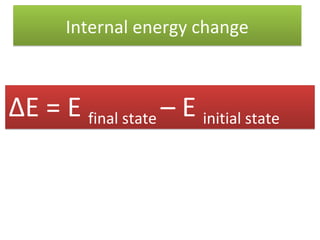
ΔE = E final state – E initial state
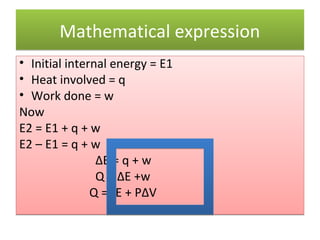
Mathematical expression
• Initial internal energy = E1
• Heat involved = q
• Work done = w
Now
E2 = E1 + q + w
E2 – E1 = q + w
                ΔE = q + w
                Q = ΔE +w
               Q =ΔE + PΔV
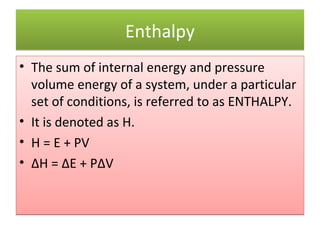
Enthalpy
• The sum of internal energy and pressure
  volume energy of a system, under a particular
  set of conditions, is referred to as ENTHALPY.
• It is denoted as H.
• H = E + PV
• ΔH = ΔE + PΔV
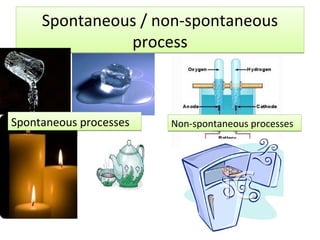
Spontaneous / non-spontaneous
               process


Spontaneous processes   Non-spontaneous processes
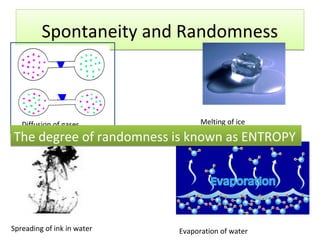
Spontaneity and Randomness


   Diffusion of gases             Melting of ice

The degree of randomness is known as ENTROPY


Spreading of ink in water   Evaporation of water
Second Law of Thermodynamics


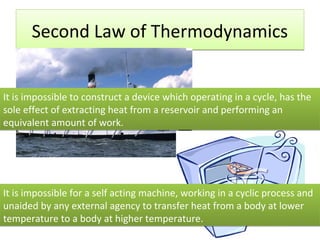
It is impossible to construct a device which operating in a cycle, has the
sole effect of extracting heat from a reservoir and performing an
equivalent amount of work.


It is impossible for a self acting machine, working in a cyclic process and
unaided by any external agency to transfer heat from a body at lower
temperature to a body at higher temperature.
Second Law of Thermodynamics


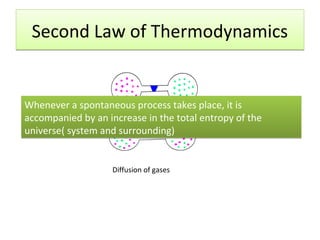
Whenever a spontaneous process takes place, it is
accompanied by an increase in the total entropy of the
universe( system and surrounding)


                    Diffusion of gases
Entropy and spontaneity


• Entropy is positive : the process if
  spontaneous
• Entropy change is zero: Equilibrium
• Entropy change is negative: non-spontaneous.
Entropy in various types of systems


• Isolated system: ΔS is positive
• Open or closed system:
  ΔS = ΔS system + ΔS surrounding
Adiabatic change and entropy
• For irreversible change:
      ΔS > q irrev/ T
• For reversible change:
      q= 0
      ΔS = 0
• During an adiabatic change the entropy of a
  system increases if the change is irreversible
  while it remains constant if the change is
  reversible.
Entropy change of the universe in a
       isothermal reversible process

•   ΔS system= q/T
•   ΔS surrounding= -q/T
•   Total change is entropy = 0
•   This means that in a reversible isothermal
    process there is no change in the entropy and
    the entropy of the universe remains constant.
Entropy change of the universe in an
         irreversible process


• Entropy of universe increases in an
  irreversible process.
Thermal death
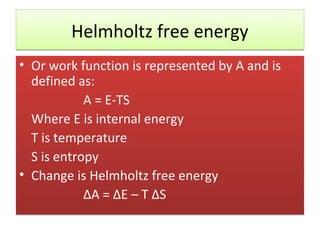
Helmholtz free energy
• Or work function is represented by A and is
  defined as:
            A = E-TS
  Where E is internal energy
  T is temperature
  S is entropy
• Change is Helmholtz free energy
            ΔA = ΔE – T ΔS
Gibb’s free energy
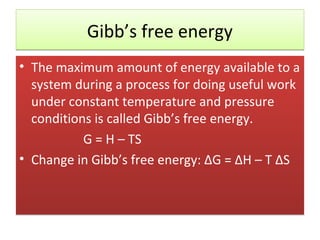
• The maximum amount of energy available to a
  system during a process for doing useful work
  under constant temperature and pressure
  conditions is called Gibb’s free energy.
           G = H – TS
• Change in Gibb’s free energy: ΔG = ΔH – T ΔS
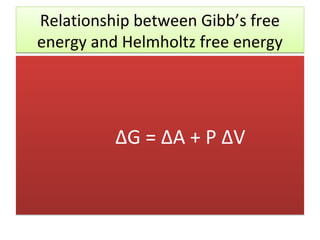
Relationship between Gibb’s free
energy and Helmholtz free energy


          ΔG = ΔA + P ΔV
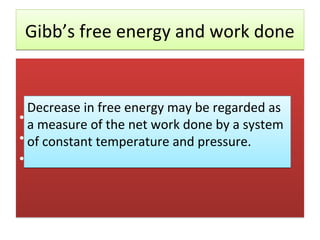
Gibb’s free energy and work done


  Decrease in free energy may be regarded as
• ΔA = -w
  a measure of the net work done by a system
• of constantPtemperature and pressure.
   ΔG = -w + ΔV
• - ΔG = w – P ΔV
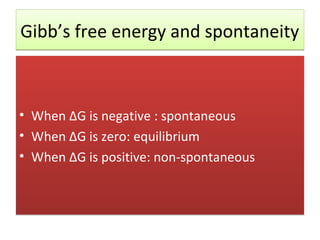
Gibb’s free energy and spontaneity


•   When ΔG is negative : spontaneous
•   When ΔG is zero: equilibrium
•   When ΔG is positive: non-spontaneous
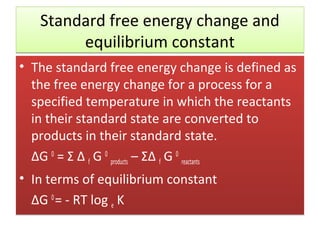
Standard free energy change and
        equilibrium constant
• The standard free energy change is defined as
  the free energy change for a process for a
  specified temperature in which the reactants
  in their standard state are converted to
  products in their standard state.
  ΔG 0 = Σ Δ f G 0 products – ΣΔ f G 0 reactants
• In terms of equilibrium constant
  ΔG 0 = - RT log e K
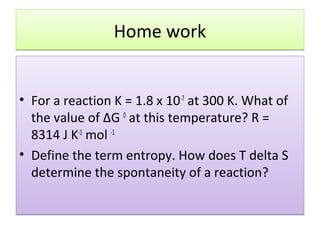
Home work


• For a reaction K = 1.8 x 10⁻⁷ at 300 K. What of
  the value of ΔG 0 at this temperature? R =
  8314 J K-1 mol -1
• Define the term entropy. How does T delta S
  determine the spontaneity of a reaction?
Thermodynamics

Thermodynamics

  • 1.
  • 2.
    Important terms toremember • System • Surrounding • Work done • Heat • Spontaneous process • Non-spontaneous process
  • 3.
    System and Surrounding Asystem is defined as the part of universe which is under study and the rest of the universe is know as the surroundings. System is separated from surroundings through boundaries.
  • 4.
  • 5.
    Sign convention forHEAT • Heat is denoted as “q”. • Heat absorbed by the system is “+ve” • Heat transferred from the system is “-ve”.
  • 6.
    Work Pressure= force applied/total area
  • 7.
    Sign convention forwork done • Work done is denoted as w • When work is done on the system it is “+ve”. • When work done by the system it is “-ve”.
  • 8.
    First Law ofthermodynamics • Energy can neither be created nor destroyed.
  • 9.
    Internal energy The totalamount of energy associated with a fixed amount of a substance under a given set of conditions is referred to as the internal energy of that substance.
  • 10.
    Internal energy change ΔE= E final state – E initial state
  • 11.
    Mathematical expression • Initialinternal energy = E1 • Heat involved = q • Work done = w Now E2 = E1 + q + w E2 – E1 = q + w ΔE = q + w Q = ΔE +w Q =ΔE + PΔV
  • 12.
    Enthalpy • The sumof internal energy and pressure volume energy of a system, under a particular set of conditions, is referred to as ENTHALPY. • It is denoted as H. • H = E + PV • ΔH = ΔE + PΔV
  • 13.
    Spontaneous / non-spontaneous process Spontaneous processes Non-spontaneous processes
  • 14.
    Spontaneity and Randomness Diffusion of gases Melting of ice The degree of randomness is known as ENTROPY Spreading of ink in water Evaporation of water
  • 16.
    Second Law ofThermodynamics It is impossible to construct a device which operating in a cycle, has the sole effect of extracting heat from a reservoir and performing an equivalent amount of work. It is impossible for a self acting machine, working in a cyclic process and unaided by any external agency to transfer heat from a body at lower temperature to a body at higher temperature.
  • 17.
    Second Law ofThermodynamics Whenever a spontaneous process takes place, it is accompanied by an increase in the total entropy of the universe( system and surrounding) Diffusion of gases
  • 18.
    Entropy and spontaneity •Entropy is positive : the process if spontaneous • Entropy change is zero: Equilibrium • Entropy change is negative: non-spontaneous.
  • 19.
    Entropy in varioustypes of systems • Isolated system: ΔS is positive • Open or closed system: ΔS = ΔS system + ΔS surrounding
  • 20.
    Adiabatic change andentropy • For irreversible change: ΔS > q irrev/ T • For reversible change: q= 0 ΔS = 0 • During an adiabatic change the entropy of a system increases if the change is irreversible while it remains constant if the change is reversible.
  • 21.
    Entropy change ofthe universe in a isothermal reversible process • ΔS system= q/T • ΔS surrounding= -q/T • Total change is entropy = 0 • This means that in a reversible isothermal process there is no change in the entropy and the entropy of the universe remains constant.
  • 22.
    Entropy change ofthe universe in an irreversible process • Entropy of universe increases in an irreversible process.
  • 23.
  • 24.
    Helmholtz free energy •Or work function is represented by A and is defined as: A = E-TS Where E is internal energy T is temperature S is entropy • Change is Helmholtz free energy ΔA = ΔE – T ΔS
  • 25.
    Gibb’s free energy •The maximum amount of energy available to a system during a process for doing useful work under constant temperature and pressure conditions is called Gibb’s free energy. G = H – TS • Change in Gibb’s free energy: ΔG = ΔH – T ΔS
  • 26.
    Relationship between Gibb’sfree energy and Helmholtz free energy ΔG = ΔA + P ΔV
  • 27.
    Gibb’s free energyand work done Decrease in free energy may be regarded as • ΔA = -w a measure of the net work done by a system • of constantPtemperature and pressure. ΔG = -w + ΔV • - ΔG = w – P ΔV
  • 28.
    Gibb’s free energyand spontaneity • When ΔG is negative : spontaneous • When ΔG is zero: equilibrium • When ΔG is positive: non-spontaneous
  • 29.
    Standard free energychange and equilibrium constant • The standard free energy change is defined as the free energy change for a process for a specified temperature in which the reactants in their standard state are converted to products in their standard state. ΔG 0 = Σ Δ f G 0 products – ΣΔ f G 0 reactants • In terms of equilibrium constant ΔG 0 = - RT log e K
  • 30.
    Home work • Fora reaction K = 1.8 x 10⁻⁷ at 300 K. What of the value of ΔG 0 at this temperature? R = 8314 J K-1 mol -1 • Define the term entropy. How does T delta S determine the spontaneity of a reaction?