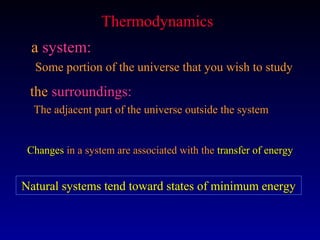
Thermodynamics
 a system:
  Some portion of the universe that you wish to study

 the surroundings:
  The adjacent part of the universe outside the system


 Changes in a system are associated with the transfer of energy


Natural systems tend toward states of minimum energy
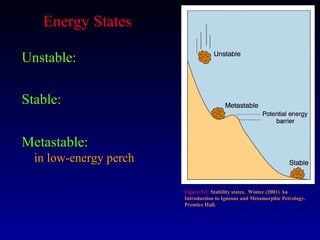
Energy States

Unstable:

Stable:


Metastable:
  in low-energy perch

                        Figure 5-1. Stability states. Winter (2001) An
                        Introduction to Igneous and Metamorphic Petrology.
                        Prentice Hall.
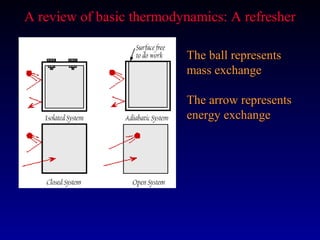
A review of basic thermodynamics: A refresher

                          The ball represents
                          mass exchange

                          The arrow represents
                          energy exchange
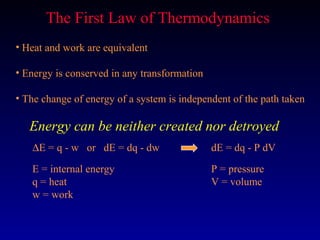
The First Law of Thermodynamics
• Heat and work are equivalent

• Energy is conserved in any transformation

• The change of energy of a system is independent of the path taken

   Energy can be neither created nor detroyed
   ∆E = q - w or dE = dq - dw                 dE = dq - P dV

   E = internal energy                        P = pressure
   q = heat                                   V = volume
   w = work
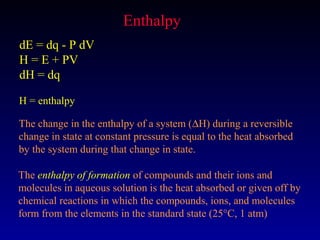
Enthalpy
dE = dq - P dV
H = E + PV
dH = dq

H = enthalpy

The change in the enthalpy of a system (∆H) during a reversible
change in state at constant pressure is equal to the heat absorbed
by the system during that change in state.

The enthalpy of formation of compounds and their ions and
molecules in aqueous solution is the heat absorbed or given off by
chemical reactions in which the compounds, ions, and molecules
form from the elements in the standard state (25°C, 1 atm)
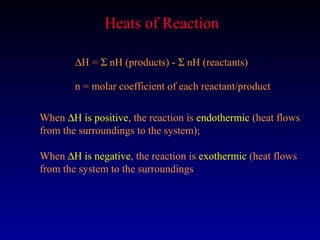
Heats of Reaction

        ∆H = Σ nH (products) - Σ nH (reactants)

        n = molar coefficient of each reactant/product

When ∆H is positive, the reaction is endothermic (heat flows
from the surroundings to the system);

When ∆H is negative, the reaction is exothermic (heat flows
from the system to the surroundings
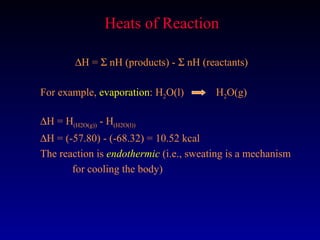
Heats of Reaction

         ∆H = Σ nH (products) - Σ nH (reactants)

For example, evaporation: H2O(l)        H2O(g)

∆H = H(H2O(g)) - H(H2O(l))
∆H = (-57.80) - (-68.32) = 10.52 kcal
The reaction is endothermic (i.e., sweating is a mechanism
       for cooling the body)
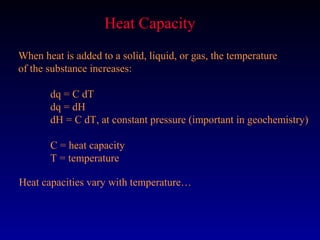
Heat Capacity
When heat is added to a solid, liquid, or gas, the temperature
of the substance increases:

       dq = C dT
       dq = dH
       dH = C dT, at constant pressure (important in geochemistry)

       C = heat capacity
       T = temperature

Heat capacities vary with temperature…
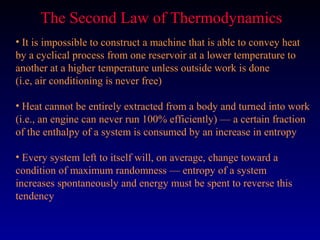
The Second Law of Thermodynamics
• It is impossible to construct a machine that is able to convey heat
by a cyclical process from one reservoir at a lower temperature to
another at a higher temperature unless outside work is done
(i.e, air conditioning is never free)

• Heat cannot be entirely extracted from a body and turned into work
(i.e., an engine can never run 100% efficiently) — a certain fraction
of the enthalpy of a system is consumed by an increase in entropy

• Every system left to itself will, on average, change toward a
condition of maximum randomness — entropy of a system
increases spontaneously and energy must be spent to reverse this
tendency
The entropy of the universe always increases


                           or


“You can’t shovel manure into the rear end of a horse and
           expect to get hay out of its mouth”
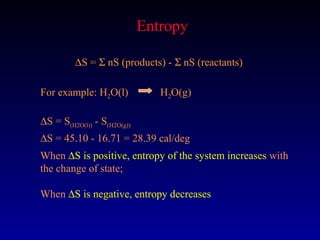
Entropy

         ∆S = Σ nS (products) - Σ nS (reactants)

For example: H2O(l)             H2O(g)

∆S = S(H2O(l)) - S(H2O(g))
∆S = 45.10 - 16.71 = 28.39 cal/deg
When ∆S is positive, entropy of the system increases with
the change of state;

When ∆S is negative, entropy decreases
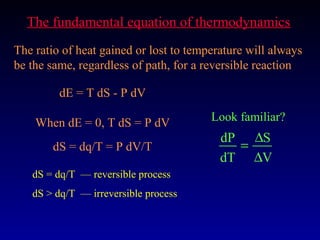
The fundamental equation of thermodynamics
The ratio of heat gained or lost to temperature will always
be the same, regardless of path, for a reversible reaction

         dE = T dS - P dV

    When dE = 0, T dS = P dV            Look familiar?
                                          dP ∆S
       dS = dq/T = P dV/T                   =
                                          dT ∆V
   dS = dq/T — reversible process
   dS > dq/T — irreversible process

RAM

  • 1.
    Thermodynamics a system: Some portion of the universe that you wish to study the surroundings: The adjacent part of the universe outside the system Changes in a system are associated with the transfer of energy Natural systems tend toward states of minimum energy
  • 2.
    Energy States Unstable: Stable: Metastable: in low-energy perch Figure 5-1. Stability states. Winter (2001) An Introduction to Igneous and Metamorphic Petrology. Prentice Hall.
  • 3.
    A review ofbasic thermodynamics: A refresher The ball represents mass exchange The arrow represents energy exchange
  • 4.
    The First Lawof Thermodynamics • Heat and work are equivalent • Energy is conserved in any transformation • The change of energy of a system is independent of the path taken Energy can be neither created nor detroyed ∆E = q - w or dE = dq - dw dE = dq - P dV E = internal energy P = pressure q = heat V = volume w = work
  • 5.
    Enthalpy dE = dq- P dV H = E + PV dH = dq H = enthalpy The change in the enthalpy of a system (∆H) during a reversible change in state at constant pressure is equal to the heat absorbed by the system during that change in state. The enthalpy of formation of compounds and their ions and molecules in aqueous solution is the heat absorbed or given off by chemical reactions in which the compounds, ions, and molecules form from the elements in the standard state (25°C, 1 atm)
  • 6.
    Heats of Reaction ∆H = Σ nH (products) - Σ nH (reactants) n = molar coefficient of each reactant/product When ∆H is positive, the reaction is endothermic (heat flows from the surroundings to the system); When ∆H is negative, the reaction is exothermic (heat flows from the system to the surroundings
  • 7.
    Heats of Reaction ∆H = Σ nH (products) - Σ nH (reactants) For example, evaporation: H2O(l) H2O(g) ∆H = H(H2O(g)) - H(H2O(l)) ∆H = (-57.80) - (-68.32) = 10.52 kcal The reaction is endothermic (i.e., sweating is a mechanism for cooling the body)
  • 8.
    Heat Capacity When heatis added to a solid, liquid, or gas, the temperature of the substance increases: dq = C dT dq = dH dH = C dT, at constant pressure (important in geochemistry) C = heat capacity T = temperature Heat capacities vary with temperature…
  • 9.
    The Second Lawof Thermodynamics • It is impossible to construct a machine that is able to convey heat by a cyclical process from one reservoir at a lower temperature to another at a higher temperature unless outside work is done (i.e, air conditioning is never free) • Heat cannot be entirely extracted from a body and turned into work (i.e., an engine can never run 100% efficiently) — a certain fraction of the enthalpy of a system is consumed by an increase in entropy • Every system left to itself will, on average, change toward a condition of maximum randomness — entropy of a system increases spontaneously and energy must be spent to reverse this tendency
  • 10.
    The entropy ofthe universe always increases or “You can’t shovel manure into the rear end of a horse and expect to get hay out of its mouth”
  • 11.
    Entropy ∆S = Σ nS (products) - Σ nS (reactants) For example: H2O(l) H2O(g) ∆S = S(H2O(l)) - S(H2O(g)) ∆S = 45.10 - 16.71 = 28.39 cal/deg When ∆S is positive, entropy of the system increases with the change of state; When ∆S is negative, entropy decreases
  • 12.
    The fundamental equationof thermodynamics The ratio of heat gained or lost to temperature will always be the same, regardless of path, for a reversible reaction dE = T dS - P dV When dE = 0, T dS = P dV Look familiar? dP ∆S dS = dq/T = P dV/T = dT ∆V dS = dq/T — reversible process dS > dq/T — irreversible process

Editor's Notes

  • #2 a system: Some portion of the universe that you wish to study a glass of water plagioclase the mantle Changes in a system are associated with the transfer of energy lift an object: stored chemical  potential drop an object: potential  kinetic pump up a bicycle tire: chemical  mechanical  heat (friction + compression) add an acid to a base: chemical  heat