BCHY101L
Engineering Chemistry
Module -1
A. Thermodynamics
1
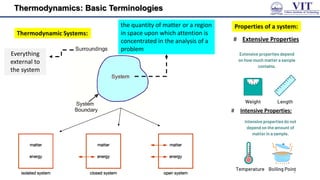
Thermodynamics: Basic Terminologies
Thermodynamic Systems:
the quantity of matter or a region
in space upon which attention is
concentrated in the analysis of a
problem
Everything
external to
the system
Properties of a system:
# Intensive Properties:
2
# Extensive Properties
Thermodynamics: Basic Terminologies
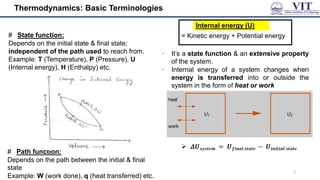
# State function:
Depends on the initial state & final state;
independent of the path used to reach from.
Example: T (Temperature), P (Pressure), U
(Internal energy), H (Enthalpy) etc.
# Path function:
Depends on the path between the initial & final
state
Example: W (work done), q (heat transferred) etc.
Internal energy (U)
= Kinetic energy + Potential energy
∙ It’s a state function & an extensive property
of the system.
∙ Internal energy of a system changes when
energy is transferred into or outside the
system in the form of heat or work
3
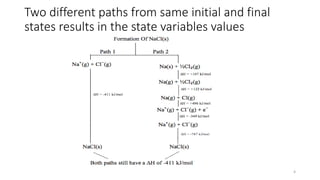
Two different paths from same initial and final
states results in the state variables values
4
Thermodynamics: Basic Terminologies
• Adiabatic – no heat transferred
• Isothermal – constant temperature
• Isobaric – constant pressure
• Isochoric – constant volume
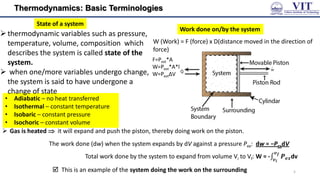
Work done on/by the system
W (Work) = F (force) x D(distance moved in the direction of
force)
 Gas is heated  it will expand and push the piston, thereby doing work on the piston.
The work done (dw) when the system expands by dV against a pressure Pex: dw = −PexdV
Total work done by the system to expand from volume Vi to Vf: W = - 𝑷𝒆𝒙
𝒗𝒇
𝒗𝒊
dv
 This is an example of the system doing the work on the surrounding
State of a system
thermodynamic variables such as pressure,
temperature, volume, composition which
describes the system is called state of the
system.
 when one/more variables undergo change,
the system is said to have undergone a
change of state
5
F=Pext*A
W=Pext*A*l
W=PextΔV
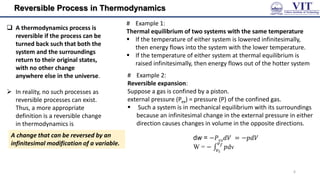
Reversible Process in Thermodynamics
# Example 1:
Thermal equilibrium of two systems with the same temperature
 If the temperature of either system is lowered infinitesimally,
then energy flows into the system with the lower temperature.
 If the temperature of either system at thermal equilibrium is
raised infinitesimally, then energy flows out of the hotter system
 A thermodynamics process is
reversible if the process can be
turned back such that both the
system and the surroundings
return to their original states,
with no other change
anywhere else in the universe.
 In reality, no such processes as
reversible processes can exist.
Thus, a more appropriate
definition is a reversible change
in thermodynamics is
# Example 2:
Reversible expansion:
Suppose a gas is confined by a piston.
external pressure (Pex) = pressure (P) of the confined gas.
 Such a system is in mechanical equilibrium with its surroundings
because an infinitesimal change in the external pressure in either
direction causes changes in volume in the opposite directions.
dw = −𝑃𝑒𝑥𝑑𝑉 = −𝑝𝑑𝑉
W = − 𝑝
𝑣𝑓
𝑣𝑖
dv
A change that can be reversed by an
infinitesimal modification of a variable.
6
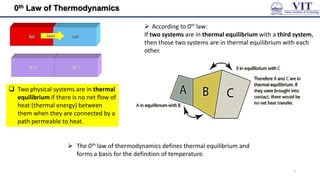
0th Law of Thermodynamics
 Two physical systems are in thermal
equilibrium if there is no net flow of
heat (thermal energy) between
them when they are connected by a
path permeable to heat.
 According to 0th law:
If two systems are in thermal equilibrium with a third system,
then those two systems are in thermal equilibrium with each
other.
 The 0th law of thermodynamics defines thermal equilibrium and
forms a basis for the definition of temperature.
7
8
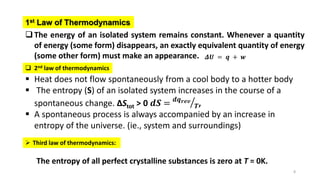
 Heat does not flow spontaneously from a cool body to a hotter body
 The entropy (S) of an isolated system increases in the course of a
spontaneous change. ΔStot > 0 𝒅𝑺 = 𝒅𝒒𝒓𝒆𝒗
𝑻,
 A spontaneous process is always accompanied by an increase in
entropy of the universe. (ie., system and surroundings)
The entropy of all perfect crystalline substances is zero at T = 0K.
 Third law of thermodynamics:
 2nd law of thermodynamics
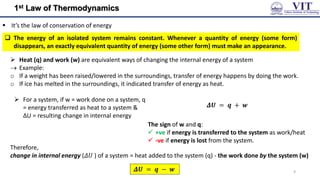
The energy of an isolated system remains constant. Whenever a quantity
of energy (some form) disappears, an exactly equivalent quantity of energy
(some other form) must make an appearance.
1st Law of Thermodynamics
𝜟𝑼 = 𝒒 + 𝒘
1st Law of Thermodynamics
 It’s the law of conservation of energy
𝜟𝑼 = 𝒒 + 𝒘
 For a system, if w = work done on a system, q
= energy transferred as heat to a system &
ΔU = resulting change in internal energy
The sign of w and q:
 +ve if energy is transferred to the system as work/heat
 -ve if energy is lost from the system.
Therefore,
change in internal energy (𝛥𝑈 ) of a system = heat added to the system (q) - the work done by the system (w)
𝜟𝑼 = 𝒒 − 𝒘
 The energy of an isolated system remains constant. Whenever a quantity of energy (some form)
disappears, an exactly equivalent quantity of energy (some other form) must make an appearance.
 Heat (q) and work (w) are equivalent ways of changing the internal energy of a system
 Example:
o If a weight has been raised/lowered in the surroundings, transfer of energy happens by doing the work.
o If ice has melted in the surroundings, it indicated transfer of energy as heat.
9
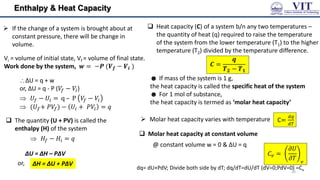
Enthalpy & Heat Capacity
 If the change of a system is brought about at
constant pressure, there will be change in
volume.
 The quantity (U + PV) is called the
enthalpy (H) of the system
ΔU = ΔH – PΔV
ΔU = q + w
or, ΔU = q - P (𝑉𝑓 − 𝑉𝑖)
 𝑈𝑓 − 𝑈𝑖 = q – P 𝑉𝑓 − 𝑉𝑖
 (𝑈𝑓+ 𝑃𝑉𝑓) − 𝑈𝑖 + 𝑃𝑉𝑖 = 𝑞
Vi = volume of initial state, Vf = volume of final state.
Work done by the system, 𝒘 = −𝑷 (𝑽𝒇 − 𝑽𝒊 )
 Heat capacity (C) of a system b/n any two temperatures –
the quantity of heat (q) required to raise the temperature
of the system from the lower temperature (T1) to the higher
temperature (T2) divided by the temperature difference.
𝑪 =
𝒒
𝑻𝟐 − 𝑻𝟏
☻ If mass of the system is 1 g,
the heat capacity is called the specific heat of the system
☻ For 1 mol of substance,
the heat capacity is termed as ‘molar heat capacity’
 𝐻𝑓 − 𝐻𝑖 = 𝑞
 Molar heat capacity varies with temperature
 Molar heat capacity at constant volume
C=
𝑑𝑞
𝑑𝑇
𝐶𝑣 =
𝜕𝑈
𝜕𝑇 𝑣
@ constant volume w = 0 & ΔU = q
ΔH = ΔU + PΔV
or,
10
dq= dU+PdV; Divide both side by dT; dq/dT=dU/dT (dV=0;PdV=0) =Cv
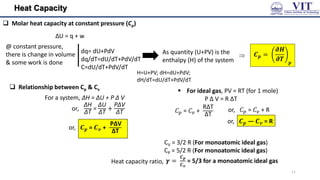
Heat Capacity
 Molar heat capacity at constant pressure (Cp)
@ constant pressure,
there is change in volume
& some work is done
dq= dU+PdV
dq/dT=dU/dT+PdV/dT
C=dU/dT+PdV/dT
𝑪𝒑 =
𝝏𝑯
𝝏𝑻 𝒑
ΔU = q + w
As quantity (U+PV) is the
enthalpy (H) of the system
 Relationship between Cp & Cv

For a system, ΔH = ΔU + P Δ V
or,
ΔH
ΔT
=
ΔU
ΔT
+
PΔV
ΔT
or, 𝑪𝒑 = 𝑪𝒗 +
PΔV
ΔT
 For ideal gas, PV = RT (for 1 mole)
P Δ V = R ΔT
𝐶𝑝 = 𝐶𝑣 +
RΔT
ΔT
or, 𝐶𝑝 = 𝐶𝑣 + R
or, 𝑪𝒑 ― 𝑪𝒗 = R
CV = 3/2 R (For monoatomic ideal gas)
CP = 5/2 R (For monoatomic ideal gas)
𝜸 =
𝑪𝒑
𝑪𝒗
= 5/3 for a monoatomic ideal gas
Heat capacity ratio,
11
H=U+PV; dH=dU+PdV;
dH/dT=dU/dT+PdV/dT
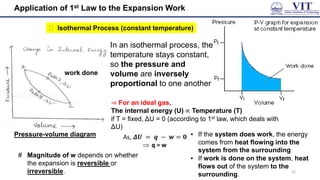
Application of 1st Law to the Expansion Work
⮚ Isothermal Process (constant temperature)
▪ In an isothermal process, the
temperature stays constant,
so the pressure and
volume are inversely
proportional to one another
⇒ For an ideal gas,
The internal energy (U) ∝ Temperature (T)
if T = fixed, ΔU = 0 (according to 1st law, which deals with
ΔU)
▪ If the system does work, the energy
comes from heat flowing into the
system from the surrounding
▪ If work is done on the system, heat
flows out of the system to the
surrounding.
# Magnitude of w depends on whether
the expansion is reversible or
irreversible. 12
work done
Pressure-volume diagram
Application of 1st Law to the Expansion Work
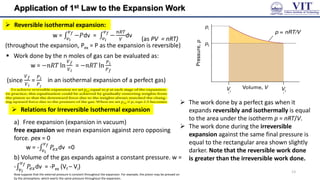
 Reversible isothermal expansion:
w = −𝑃
𝑣𝑓
𝑣𝑖
dv = −
𝑛𝑅𝑇
𝑉
𝑣𝑓
𝑣𝑖
dv
(throughout the expansion, Pex = P as the expansion is reversible)
 Work done by the n moles of gas can be evaluated as:
w = −𝑛𝑅𝑇 ln
𝑉𝑓
𝑉𝑖
= −𝑛𝑅𝑇 ln
𝑃𝑖
𝑃𝑓
 The work done by a perfect gas when it
expands reversibly and isothermally is equal
to the area under the isotherm p = nRT/V.
 The work done during the irreversible
expansion against the same final pressure is
equal to the rectangular area shown slightly
darker. Note that the reversible work done
is greater than the irreversible work done.
(as PV = nRT)
(since
𝑉𝑓
𝑉𝑖
=
𝑃𝑖
𝑃𝑓
in an isothermal expansion of a perfect gas)
 Relations for Irreversible Isothermal expansion
a) Free expansion (expansion in vacuum)
free expansion we mean expansion against zero opposing
force. pex = 0
w = - 𝑃𝑒𝑥
𝑣𝑓
𝑣𝑖
dv =0
b) Volume of the gas expands against a constant pressure. w =
- 𝑃𝑒𝑥
𝑣𝑓
𝑣𝑖
dv = -Pex (Vf – Vi)
Now suppose that the external pressure is constant throughout the expansion. For example, the piston may be pressed on
by the atmosphere, which exerts the same pressure throughout the expansion.
13
Application of 1st Law to the Expansion Work
 Adiabatic process (constant heat)
 no heat is added/ removed from a system.
 1st law of thermodynamics:
ΔU = w
 Example: A gas expanding so quickly that no heat can be
transferred. Due to the expansion work, temperature
drops. This is exactly what happens with a carbon dioxide
fire extinguisher, with the gas coming out at high
pressure and cooling as it expands at atmos. pressure
(as no heat is allowed to enter/leave the system, q = 0)
 Expansion: w = ― ve, ∆𝑼 = ― ve;
So, T of the system falls
Work is done by the system at the expense of its
internal energy
 w = ∆𝑈 = 𝑪𝒗𝚫𝑻 (for 1 mole of gas)
 ∆𝐻 = 𝑪𝒑𝚫𝑻 (for 1 mole of gas)
 Reversible adiabatic expansion
 Relation between T, V and P
𝑇𝑖
𝑇𝑓
=
𝑉𝑓
𝑉𝑖
𝛾−1
 ln
𝑇𝑖
𝑇𝑓
= 𝛾 − 1 𝑙𝑛
𝑉𝑓
𝑉𝑖
 ln
𝑇𝑖
𝑇𝑓
=
𝑪𝒑
𝑪𝒗
− 1 𝑙𝑛
𝑉𝑓
𝑉𝑖

[𝑎𝑠, 𝛾 =
𝐶𝑝
𝐶𝑣
]
ln
𝑇𝑖
𝑇𝑓
=
𝑹
𝑪𝒗
𝑙𝑛
𝑉𝑓
𝑉𝑖
[𝑎𝑠, 𝐶𝑝 ― 𝐶𝑣 = R]
 𝑪𝒗 ln
𝑻𝒊
𝑻𝒇
= 𝑹 𝒍𝒏
𝑽𝒇
𝑽𝒊
14
∆𝑈 =q-w
q=0
∆𝑈=-w
=-PdV
CvdT=-PdV
Cv dT=-RTdV/V
Cv
𝑇𝑓
𝑇𝑖
dT/T=-R
𝑣𝑓
𝑣𝑖
dV/V
Application of 1st Law to the Expansion Work
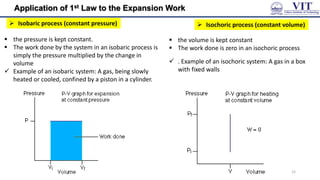
 Isobaric process (constant pressure)
 the pressure is kept constant.
 The work done by the system in an isobaric process is
simply the pressure multiplied by the change in
volume
 Example of an isobaric system: A gas, being slowly
heated or cooled, confined by a piston in a cylinder.
 Isochoric process (constant volume)
 the volume is kept constant
 The work done is zero in an isochoric process
 . Example of an isochoric system: A gas in a box
with fixed walls
15
Numerical from of 1st Law
 Example 1: Calculate w and ∆𝑈 for the conversion of 1
mole of water at 100 ℃ to steam at 1 atm pressure.
Heat of vaporisation of water at 100 ℃ is 40670 Jmol-1
Solution:
P = 1 atm =
8.314 𝐽 𝑚𝑜𝑙−1𝐾−1
0.08206 𝑑𝑚3 𝑚𝑜𝑙−1𝐾−1
Vi = vol. of 1 mole of liquid water at 1 atm pressure
= 18 ml = 18 × 10-3dm3
Vf = vol. of 1 mole of steam at 100 ℃ at 1 atm pressure
= (22.4 dm3 × 373)/273 = 30.60 dm3
The volume of one mole of any gaseous substance is
22.4 litres at 273K
w = P (Vf - Vi)
=
8.314 𝐽 𝑚𝑜𝑙−1𝐾−1
0.08206 𝑑𝑚3 𝑚𝑜𝑙−1𝐾−1 [30.60 dm3-18 × 10-3 dm3]
=
8.314 𝐽 𝑚𝑜𝑙−1𝐾−1
0.08206 𝑑𝑚3 𝑚𝑜𝑙−1𝐾−1 × 30.60d m3 = 3100 J
Since, conversion of water to steam is accompanied
by increase in volume, work is done by the system
on the surroundings.
Hence, w = – 3100 J
 Example 2: 1 mole of an ideal gas expands against
a constant external pressure of 1 atm from a
volume of 10 dm3 to a volume of 30 dm3.Calculate
the work done by the gas in Joules.
= − 1 𝑎𝑡𝑚 30 𝑑𝑚3 − 10𝑑𝑚3
Solution:
𝑤 = −𝑃𝑒𝑥𝛥𝑉
R = 8.314 Jmol-1K-1 = 0.08206 dm3 atm K-1 mol-1
1 atm =
8.314 𝐽 𝑚𝑜𝑙−1𝐾−1
0.08206 𝑑𝑚3 𝑚𝑜𝑙−1𝐾−1
Therefore,
𝑤 = −20 𝑑𝑚3 𝑎𝑡𝑚
= −20 𝑑𝑚3 ×
8.314 𝐽 𝑚𝑜𝑙−1𝐾−1
0.08206 𝑑𝑚3 𝑚𝑜𝑙−1𝐾−1 = – 2026 J
= −20 𝑑𝑚3 𝑎𝑡𝑚
16
Numerical from of 1st Law
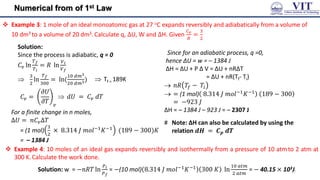
 Example 3: 1 mole of an ideal monoatomic gas at 27 C expands reversibly and adiabatically from a volume of
10 dm3 to a volume of 20 dm3.Calculate q, ∆U, W and ∆H. Given
𝐶𝑣
𝑅
=
3
2
Solution:
Since the process is adiabatic, q = 0
𝐶𝑣 ln
𝑇𝑓
𝑇𝑖
= 𝑅 ln
𝑉𝑖
𝑉𝑓

3
2
ln
𝑇𝑓
300
= ln(
10 𝑑𝑚3
20 𝑑𝑚3)
Since for an adiabatic process, q =0,
hence ΔU = w = – 1384 J
ΔH = ΔU + P Δ V = ΔU + nRΔT
= ΔU + nR(Tf- Ti)
 𝑛𝑅 𝑇𝑓 − 𝑇𝑖
 = (1 mol) 8.314 𝐽 𝑚𝑜𝑙−1𝐾−1 189 − 300
= −923 𝐽
ΔH = – 1384 J – 923 J = – 2307 J
 Tf = 189K
 𝑑𝑈 = 𝐶𝑣 𝑑𝑇
𝐶𝑣 =
𝜕𝑈
𝜕𝑇 𝑣
For a finite change in n moles,
∆𝑈 = 𝑛𝐶𝑣∆𝑇
= (1 mol)
3
2
× 8.314 𝐽 𝑚𝑜𝑙−1𝐾−1 (189 − 300)𝐾
= – 1384 J
# Note: ΔH can also be calculated by using the
relation 𝒅𝑯 = 𝑪𝒑 𝒅𝑻
 Example 4: 10 moles of an ideal gas expands reversibly and isothermally from a pressure of 10 atmto 2 atm at
300 K.Calculate the work done.
Solution: w = −𝑛𝑅𝑇 ln
𝑃𝑖
𝑃𝑓
= −(10 mol) 8.314 𝐽 𝑚𝑜𝑙−1
𝐾−1
300 𝐾 ln
10 𝑎𝑡𝑚
2 𝑎𝑡𝑚
= − 40.15 × 10³J
17
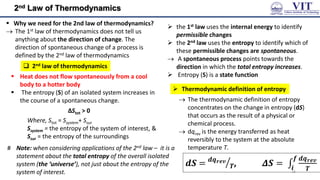
2nd Law of Thermodynamics
 Why we need for the 2nd law of thermodynamics?
 The 1st law of thermodynamics does not tell us
anything about the direction of change. The
direction of spontaneous change of a process is
defined by the 2nd law of thermodynamics
 Heat does not flow spontaneously from a cool
body to a hotter body
 The entropy (S) of an isolated system increases in
the course of a spontaneous change.
 2nd law of thermodynamics
# Note: when considering applications of the 2nd law – it is a
statement about the total entropy of the overall isolated
system (the ‘universe’), not just about the entropy of the
system of interest.
ΔStot > 0
Where, Stot = Ssystem+ Ssur
Ssystem = the entropy of the system of interest, &
Ssur = the entropy of the surroundings
 the 1st law uses the internal energy to identify
permissible changes
 the 2nd law uses the entropy to identify which of
these permissible changes are spontaneous.
 A spontaneous process points towards the
direction in which the total entropy increases.
 Entropy (S) is a state function
 The thermodynamic definition of entropy
concentrates on the change in entropy (dS)
that occurs as the result of a physical or
chemical process.
 dqrev is the energy transferred as heat
reversibly to the system at the absolute
temperature T.
 Thermodynamic definition of entropy
𝒅𝑺 = 𝒅𝒒𝒓𝒆𝒗
𝑻, 𝜟𝑺 =
𝒅𝒒𝒓𝒆𝒗
𝑻
𝒇
𝒊
18
Entropy
 Process that lead to an increase in entropy (ΔS > 0)
☻ Notice the increasing disorder in above processes
 Entropy change for the system of an isothermal
expansion of a perfect gas
ΔU = 0, q = -w  𝑞𝑟𝑒𝑣 = −𝑤𝑟𝑒𝑣
as, wrev =― nRT ln (𝑉𝑓 /𝑉𝑖)
[from the expression of work done in a
reversible isothermal expression]
 𝑞𝑟𝑒𝑣 = 𝑛𝑅𝑇𝑙𝑛(𝑉𝑓/𝑉𝑖)
Δ𝑆 = 𝑛𝑅𝑙𝑛(𝑉𝑓/𝑉𝑖)
as 𝑑𝑆 = 𝑑𝑞𝑟𝑒𝑣
𝑇

Δ𝑆𝑚 = 𝑅𝑙𝑛(𝑉𝑓/𝑉𝑖)
19
Entropy
 Total Entropy change in irreversible (spontaneous)
process of a perfect gas
 example: Isothermal expansion of an ideal gas at
constant temperature into vacuum
As, w = 0, 𝛥𝑈 = 0  𝑞 = 0 [from 1st law]
 no heat is absorbed by or removed from the
surrounding,
Hence, Δ𝑆𝑠𝑢𝑟𝑟𝑜𝑢𝑛𝑑𝑖𝑛𝑔 = 0
Δ𝑆𝑚 = 𝑅𝑙𝑛(𝑉𝑓/𝑉𝑖)
As, 𝑆𝑡𝑜𝑡𝑎𝑙 = 𝑆𝑠𝑦𝑠𝑡𝑒𝑚 + 𝑆𝑠𝑢𝑟𝑟𝑜𝑢𝑛𝑑𝑖𝑛𝑔
 Δ 𝑆𝑡𝑜𝑡𝑎𝑙 = 𝑆𝑠𝑦𝑠𝑡𝑒𝑚 +
𝑆𝑠𝑢𝑟𝑟𝑜𝑢𝑛𝑑𝑖𝑛𝑔
= 𝑅𝑙𝑛(𝑉𝑓/𝑉𝑖) + 0
= 𝑅𝑙𝑛(𝑉𝑓/𝑉𝑖)
 Isothermal Reversible expansion
w = −𝑝Δ𝑉 & qrev = 𝑝Δ𝑉
𝑆𝑡𝑜𝑡𝑎𝑙 =
𝑆𝑠𝑦𝑠𝑡𝑒𝑚 + 𝑆𝑠𝑢𝑟𝑟𝑜𝑢𝑛𝑑𝑖𝑛𝑔
=
𝑞𝑟𝑒𝑣
𝑇
+ −
𝑞𝑟𝑒𝑣
𝑇
= 0
 Clausius inequality dS ≥
𝑑𝑞
𝑇
 In an isolated system, there is no heat transfer and
𝑑𝑞 = 0 , thus dS ≥ 0
 all natural processes are spontaneous & irreversible.
 Reversible process:
𝑑𝑆𝑡𝑜𝑡𝑎𝑙 = 𝑑𝑆𝑠𝑦𝑠𝑡𝑒𝑚 + 𝑑𝑆𝑠𝑢𝑟𝑟𝑜𝑢𝑛𝑑𝑖𝑛𝑔 = 0
 spontaneous in neither direction and is at equilibrium
 As Vf > 𝑉𝑖, thisspontaneous (irreversible) isothermal expansion of a gas is
accompanied by the increase in entropy.
 Irreversible process
𝑑𝑆𝑡𝑜𝑡𝑎𝑙 > 𝑑𝑆𝑠𝑦𝑠𝑡𝑒𝑚 + 𝑑𝑠𝑠𝑢𝑟𝑟𝑜𝑢𝑛𝑑𝑖𝑛𝑔 > 0
 all spontaneous process occurring in Nature
is irreversible, entropy of the universe is
increasing continuously 20
Entropy
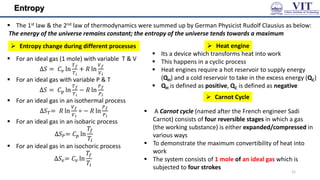
 The 1st law & the 2nd law of thermodynamics were summed up by German Physicist Rudolf Clausius as below:
The energy of the universe remains constant; the entropy of the universe tends towards a maximum
 For an ideal gas (1 mole) with variable T & V
∆𝑆 = 𝐶𝑣 ln
𝑇𝑓
𝑇𝑖
+ 𝑅 ln
𝑉𝑓
𝑉𝑖
 For an ideal gas with variable P & T
∆𝑆 = 𝐶𝑝 ln
𝑇𝑓
𝑇𝑖
− 𝑅 ln
𝑃𝑓
𝑃𝑖
 For an ideal gas in an isothermal process
∆𝑆𝑇= 𝑅 ln
𝑉𝑓
𝑉𝑖
= − 𝑅 ln
𝑃𝑓
𝑃𝑖
 For an ideal gas in an isobaric process
∆𝑆𝑃= 𝐶𝑝 ln
𝑇𝑓
𝑇𝑖
 For an ideal gas in an isochoric process
∆𝑆𝑣= 𝐶𝑣 ln
𝑇𝑓
𝑇𝑖
 Its a device which transforms heat into work
 This happens in a cyclic process
 Heat engines require a hot reservoir to supply energy
(QH) and a cold reservoir to take in the excess energy (QC)
 QH is defined as positive, QC is defined as negative
 A Carnot cycle (named after the French engineer Sadi
Carnot) consists of four reversible stages in which a gas
(the working substance) is either expanded/compressed in
various ways
 To demonstrate the maximum convertibility of heat into
work
 The system consists of 1 mole of an ideal gas which is
subjected to four strokes
 Entropy change during different processes  Heat engine
 Carnot Cycle
21
Carnot Cycle
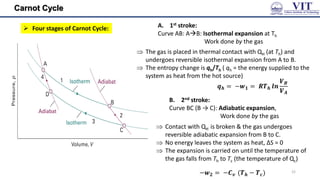
 Four stages of Carnot Cycle: A. 1st stroke:
Curve AB: AB: Isothermal expansion at Th
Work done by the gas
𝒒𝒉 = −𝒘𝟏 = 𝑹𝑻𝒉 𝒍𝒏
𝑽𝑩
𝑽𝑨
 The gas is placed in thermal contact with QH (at Th) and
undergoes reversible isothermal expansion from A to B.
 The entropy change is qh/Th ( qh = the energy supplied to the
system as heat from the hot source)
B. 2nd stroke:
Curve BC (B → C): Adiabatic expansion,
Work done by the gas
−𝒘𝟐 = −𝑪𝒗 (𝑻𝒉 − 𝑻𝒄)
 Contact with QH is broken & the gas undergoes
reversible adiabatic expansion from B to C.
 No energy leaves the system as heat, ΔS = 0
 The expansion is carried on until the temperature of
the gas falls from Th to Tc (the temperature of Qc)
22
Carnot Cycle
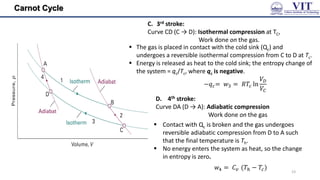
C. 3rd stroke:
Curve CD (C → D): Isothermal compression at TC,
Work done on the gas.
−𝑞𝑐= 𝑤3 = 𝑅𝑇𝑐 ln
𝑉𝐷
𝑉𝐶
 The gas is placed in contact with the cold sink (Qc) and
undergoes a reversible isothermal compression from C to D at Tc.
 Energy is released as heat to the cold sink; the entropy change of
the system = qc/Tc, where qc is negative.
D. 4th stroke:
Curve DA (D → A): Adiabatic compression
Work done on the gas
𝑤4 = 𝐶𝑣 (𝑇𝑕 − 𝑇𝑐)
 Contact with Qc is broken and the gas undergoes
reversible adiabatic compression from D to A such
that the final temperature is Th.
 No energy enters the system as heat, so the change
in entropy is zero.
23
Carnot Cycle
 The area enclosed by the four curves represents the net
work done by the engine in one cycle
 The total change in entropy around the cycle is the sum
of the changes in each of these four steps:
𝑑𝑆 =
𝑞𝑕
𝑇𝑕
+
𝑞𝑐
𝑇𝑐
 For an ideal gas, 𝑑𝑆 = 0 and
𝑞ℎ
𝑞𝑐
= −
𝑇ℎ
𝑇𝑐
 The “engine” statement of the 2nd Law:
– it is impossible for any system to have an
efficiency of 100% (𝜂 = 1)
Efficiency of a heat engine
• The thermal efficiency of a heat engine is
𝜂 =
𝑤𝑜𝑟𝑘 𝑝𝑒𝑟𝑓𝑜𝑟𝑚𝑒𝑑
𝑕𝑒𝑎𝑡 𝑎𝑏𝑜𝑠𝑟𝑏𝑒𝑑 𝑓𝑟𝑜𝑚 𝑡𝑕𝑒 𝑕𝑜𝑡 𝑠𝑜𝑢𝑟𝑐𝑒
=
𝑊
𝑞ℎ
= 1 − ⎤𝑞𝑐⎥/⎤𝑞ℎ⎥ =
1 − 𝑇𝑐/𝑇𝑕
• Another statement of the 2nd Law:
– It is impossible for any process to have as its sole
result the transfer of heat from a cooler object to
a warmer object
[Kelvin’s statement]
[Clausius’s statement]24
Application of the Carnot Cycle
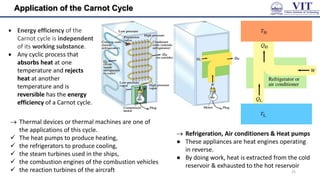
 Energy efficiency of the
Carnot cycle is independent
of its working substance.
 Any cyclic process that
absorbs heat at one
temperature and rejects
heat at another
temperature and is
reversible has the energy
efficiency of a Carnot cycle.
 Refrigeration, Air conditioners & Heat pumps
● These appliances are heat engines operating
in reverse.
● By doing work, heat is extracted from the cold
reservoir & exhausted to the hot reservoir
 Thermal devices or thermal machines are one of
the applications of this cycle.
 The heat pumps to produce heating,
 the refrigerators to produce cooling,
 the steam turbines used in the ships,
 the combustion engines of the combustion vehicles
 the reaction turbines of the aircraft 25
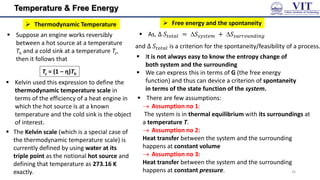
Temperature & Free Energy
 Suppose an engine works reversibly
between a hot source at a temperature
Th and a cold sink at a temperature Tc,
then it follows that
Tc = (1 − η)Th
 The Kelvin scale (which is a special case of
the thermodynamic temperature scale) is
currently defined by using water at its
triple point as the notional hot source and
defining that temperature as 273.16 K
exactly.
 Kelvin used this expression to define the
thermodynamic temperature scale in
terms of the efficiency of a heat engine in
which the hot source is at a known
temperature and the cold sink is the object
of interest.
 Free energy and the spontaneity
 Thermodynamic Temperature
 It is not always easy to know the entropy change of
both system and the surrounding
 We can express this in terms of G (the free energy
function) and thus can device a criterion of spontaneity
in terms of the state function of the system.
 As, Δ 𝑆𝑡𝑜𝑡𝑎𝑙 = 𝑆𝑠𝑦𝑠𝑡𝑒𝑚 + 𝑆𝑠𝑢𝑟𝑟𝑜𝑢𝑛𝑑𝑖𝑛𝑔
and Δ 𝑆𝑡𝑜𝑡𝑎𝑙 is a criterion for the spontaneity/feasibility of a process.
 There are few assumptions:
 Assumption no 1:
The system is in thermal equilibrium with its surroundings at
a temperature T.
 Assumption no 2:
Heat transfer between the system and the surrounding
happens at constant volume
 Assumption no 3:
Heat transfer between the system and the surrounding
happens at constant pressure. 26
Free Energy
 Under the Assumption 1 & Assumption 2
Clausius inequality becomes: dS −
𝑑𝑈
𝑇
≥ 0
dA=dU−TdS [A = Helmholtz free energy]
 TdS ≥ dU

 The criterion of spontaneity in terms of Gibbs Free
energy change (dG) and Helmholtz energy (dA)
 Under the Assumption 1 & Assumption 3
Clausius inequality becomes: dS −
𝑑𝐻
𝑇
≥ 0
[constant P, no additional work]
 TdS ≥ dH
dG=dH−TdS [G = Gibbs free energy]

A=U−TS
G=H−TS
𝑑𝐺 ≤ 0 & 𝑑𝐴 ≤ 0
dH > 0
but if such a reaction is to be spontaneous at constant
temperature and pressure, G must decrease.
 as dG = dH − TdS
it is possible for dG to be
negative provided that
the entropy of the system
increases so much that
TdS outweighs dH.
 Endothermic
reactions are
therefore driven by
the increase of
entropy of the system
[we get this by applying the 1st law & the
𝑑 𝑞𝑣 = 𝑑𝑈 𝑛𝑜 𝑒𝑥𝑝𝑎𝑛𝑠𝑖𝑜𝑛 𝑤𝑜𝑟𝑘]  In an endothermic reaction:
27
Free Energy
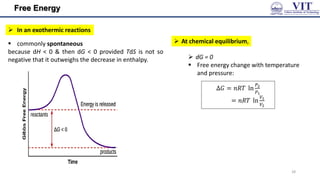
 commonly spontaneous
because dH < 0 & then dG < 0 provided TdS is not so
negative that it outweighs the decrease in enthalpy.  dG = 0
 Free energy change with temperature
and pressure:
 In an exothermic reactions
 At chemical equilibrium,
∆𝐺 = 𝑛𝑅𝑇 ln
𝑃2
𝑃1
= 𝑛𝑅𝑇 ln
𝑉1
𝑉2
28
Numerical from 2nd Law of Thermodynamics
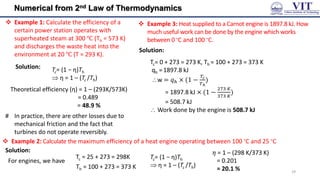
 Example 1: Calculate the efficiency of a
certain power station operates with
superheated steam at 300 ℃ (Th = 573 K)
and discharges the waste heat into the
environment at 20 ℃ (T = 293 K).
Tc= (1 − η)Th
 η = 1 – (Tc /Th)
Solution:
Theoretical efficiency (η) = 1 – (293K/573K)
= 0.489
# In practice, there are other losses due to
mechanical friction and the fact that
turbines do not operate reversibly.
 Example 2: Calculate the maximum efficiency of a heat engine operating between 100 ∘C and 25 ∘C
For engines, we have
Solution: 𝜂 = 1 – (298 K/373 K)
= 0.201
= 20.1 %
Tc​ = 25 + 273 = 298K
Th​ = 100 + 273 = 373 K
Tc= (1 − η)Th
 η = 1 – (Tc /Th)
= 48.9 %
 Example 3: Heat supplied to a Carnot engine is 1897.8 kJ. How
much useful work can be done by the engine which works
between 0 ∘C and 100 ∘C.
Tc​= 0 + 273 = 273 K, Th ​= 100 + 273 = 373 K
qh =1897.8 kJ
w = 𝑞𝑕 × (1 −
𝑇𝑐
𝑇ℎ
)
= 1897.8 kJ × (1 −
273 𝐾
373 𝐾
)
= 508.7 kJ
 Work done by the engine is 508.7 kJ
Solution:
29
Numerical from 2nd Law of Thermodynamics
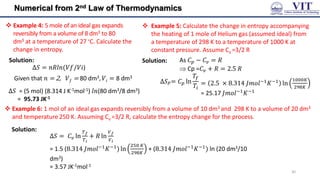
 Example 4: 5 mole of an ideal gas expands
reversibly from a volume of 8 dm3 to 80
dm3 at a temperature of 27 ∘C. Calculate the
change in entropy.
Solution:
Δ𝑆 = 𝑛𝑅𝑙𝑛(𝑉𝑓/𝑉𝑖)
Given that 𝑛 = 2, 𝑉𝑓 = 80 dm3, 𝑉𝑖 = 8 dm3
Δ𝑆 = (5 mol) (8.314 J K-1mol-1) 𝑙𝑛(80 dm3/8 dm3)
= 95.73 JK-1
 Example 5: Calculate the change in entropy accompanying
the heating of 1 mole of Helium gas (assumed ideal) from
a temperature of 298 K to a temperature of 1000 K at
constant pressure. Assume Cv =3/2 R
Solution: As 𝐶𝑝 − 𝐶𝑣 = 𝑅
 Cp =𝐶𝑣 + 𝑅 = 2.5 𝑅
= 2.5 × 8.314 𝐽𝑚𝑜𝑙−1
𝐾−1
ln
1000𝐾
298𝐾
= 25.17 𝐽𝑚𝑜𝑙−1𝐾−1
∆𝑆𝑃= 𝐶𝑝 ln
𝑇𝑓
𝑇𝑖
 Example 6: 1 mol of an ideal gas expands reversibly from a volume of 10 dm3 and 298 K to a volume of 20 dm3
and temperature 250 K. Assuming Cv =3/2 R, calculate the entropy change for the process.
∆𝑆 = 𝐶𝑣 ln
𝑇𝑓
𝑇𝑖
+ 𝑅 ln
𝑉𝑓
𝑉𝑖
= 1.5 (8.314 𝐽𝑚𝑜𝑙−1𝐾−1) ln
250 𝐾
298𝐾
+ (8.314 𝐽𝑚𝑜𝑙−1𝐾−1) ln (20 dm3/10
dm3)
= 3.57 JK-1mol-1
Solution:
30
3rd Law of Thermodynamics
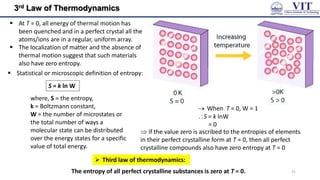
The entropy of all perfect crystalline substances is zero at T = 0.
 Third law of thermodynamics:
 At T = 0, all energy of thermal motion has
been quenched and in a perfect crystal all the
atoms/ions are in a regular, uniform array.
 The localization of matter and the absence of
thermal motion suggest that such materials
also have zero entropy.
 Statistical or microscopic definition of entropy:
S = k ln W
where, S = the entropy,
k = Boltzmann constant,
W = the number of microstates or
the total number of ways a
molecular state can be distributed
over the energy states for a specific
value of total energy.
 When T = 0, W = 1
S = k lnW
= 0
 if the value zero is ascribed to the entropies of elements
in their perfect crystalline form at T = 0, then all perfect
crystalline compounds also have zero entropy at T = 0
31
B. Chemical Kinetics
Module 1
32
 Chemical kinetics is the branch of chemistry which deals with the study of
rates (or fastness) of chemical reactions, the factors affecting it and the
mechanism by which the reactions proceed.
The rate of a chemical reaction might depend on variables such as
 pressure,
 temperature, and
 the presence of a catalyst,
What is Chemical kinetics?
33
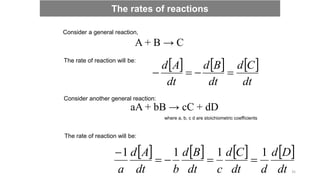
 The change in concentration of reactants or products per unit time.
 Here, the instantaneous rate of disappearance of one of the reactants
(A or B) at a given time, t (at constant volume) is −d[R]/dt. Similarly, the
rate of formation of one of the products is d[P]/dt. (Note the change in
the sign)
 The negative sign indicates that the concentration is decreasing with
time.
The rates of reactions
34
Consider a general reaction,
A + B → C
The rate of reaction will be:
     
dt
C
d
dt
B
d
dt
A
d




Consider another general reaction:
aA + bB → cC + dD
where a, b, c d are stoichiometric coefficients
The rate of reaction will be:
       
dt
D
d
d
dt
C
d
c
dt
B
d
b
dt
A
d
a
1
1
1
1





The rates of reactions
35
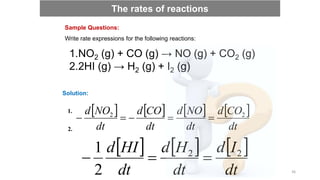
Write rate expressions for the following reactions:
Sample Questions:
1.NO2 (g) + CO (g) → NO (g) + CO2 (g)
2.2HI (g) → H2 (g) + I2 (g)
Solution:
       
dt
CO
d
dt
NO
d
dt
CO
d
dt
NO
d 2
2





1.
2.
     
dt
I
d
dt
H
d
dt
HI
d 2
2
2
1



The rates of reactions
36
 The rate law is the relationship between the rate and the concentration, which
are related by a proportionality constant k, known as rate constant.
aA + bB → cC + dD
rate = k [A]m[B]n
where m and n are order of reaction in A and B,
respectively k is the rate constant.
This above equation is called the rate law of the reaction.
Rate laws and rate constants
37
 Important points about rate laws and rate constant:
 Rate law is a result of experimental observation. You CANNOT look
at the stoichiometry of the reaction and predict the rate law (unless
the reaction is an elementary reaction).
 The rate law is not limited to reactants. It can have a product term,
For example: rate = k[A]m[B]n[C]c
 The rate constant is independent of the concentrations but depends
on the temperature.
 The units for k vary. Determine units for k by considering units for rate
and for concentration.
Rate laws and rate constants
38
A + B → C
For rate = k[A]m[B]n
Where, m is the order of reaction in A, n is the order of reaction in B. m
and n can be integers, fractions, negative or positive.
The overall reaction order is the sum of the exponents in the rate law.
 m+n = 0 (Zero order k[A]0)
 m+n= 1 (First order k[A]1)
 m+n = 2 (Second order k[A]2)
Order of a reaction
Examples:
H2 + Cl2 → 2HCl. Rate = k[H2]0 [Cl2]0 (Zero order)
SO2Cl2(g) → SO2(g) + Cl2(g) Rate = k[SO2Cl2]1 (First order)
2NO2 → 2 NO + O2 Rate = k[NO2]2 (Second order)
2NO(g) + 2H2(g) → N2 (g) + 2H2O (g) Rate = k[NO]2 [H2]1 (Third order)
CH3COOC2H5 + H2O  CH3COOH + C2H5OH Rate = [CH3COOC2H5]1[H2O]0 (pseudo-first
order) 39
Since rate laws are in differential form, we must integrate them to find out the concentration as
a function of time.
Integrated first-order rate law:
A → B
Rate =
Separate concentration and time terms
Integrating over the limits [A]0 to [A]t and 0 to t,
    kt
A
A t 

 0
ln
ln
Integrated rate laws
 
  
 

t
t
A
A
dt
k
A
A
d
0
]
[
0
]
[
 
 
kdt
A
A
d


 
  
 
 dt
k
A
A
d
   
A
k
dt
A
d


Continue….
40
Straight line equation (y = mx+c)
If we plot ln [A]t versus time, then we will get a straight line having negative
slope (-k). Rate constants can be determined from experiment by plotting data
in this manner.
Integrated rate laws
   0
ln
ln A
kt
A t 


41
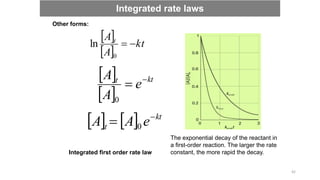
Other forms:
 
 
kt
A
A t


0
ln
 
 
kt
t
e
A
A 

0
    kt
t e
A
A 
 0
Integrated first order rate law
The exponential decay of the reactant in
a first-order reaction. The larger the rate
constant, the more rapid the decay.
Integrated rate laws
42
Question: The variation in the partial pressure of azomethane with time was
followed at 600 K, with the results given below. Confirm that the decomposition
is first-order in azomethane, and find the rate constant at 600 K.
CH3N2CH3 (g) → CH3CH3 (g) + N2 (g)
Solution: To confirm that a reaction is first-order, plot
ln([A]t/[A]0) against time and expect a straight line. Because
the partial pressure of a gas is proportional to its
concentration, an equivalent procedure is to plot ln(p/p0)
against t.
First, convert p into ln(p/p0) and draw the graph. The plot is
straight, confirming a first-order reaction, and its slope is -
3.610-4.
Therefore, k = 3.6 10-4 s-1.
Integrated rate laws
43
Half-life is the time it takes for the original concentration to be reduced by half.
From above:  
 
kt
A
A t


0
ln
 
  2
/
0
0
2
ln t
kt
A
A








2
/
2
1
ln t
kt


2
/
693
.
0 t
kt



k
tt /
693
.
0
2
/ 
It is clear from the result that the half-life of a reactant is independent of its initial concentration for a first-order
reaction. Therefore, if the concentration of A at some arbitrary stage of the reaction is [A], then it will have fallen to
1/2[A] after a further interval of (ln 2)/k.
First-order Half-life
44
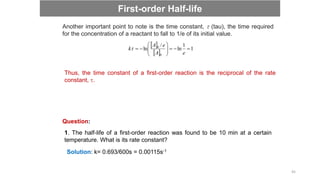
Another important point to note is the time constant,  (tau), the time required
for the concentration of a reactant to fall to 1/e of its initial value.
 
 
1
1
ln
/
ln
0
0













e
A
e
A
k
Thus, the time constant of a first-order reaction is the reciprocal of the rate
constant, .
Question:
1. The half-life of a first-order reaction was found to be 10 min at a certain
temperature. What is its rate constant?
Solution: k= 0.693/600s = 0.00115s-1
First-order Half-life
45
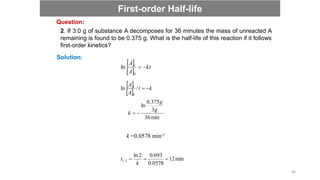
Solution:
 
 
kt
A
A t


0
ln
 
 
k
t
A
A t


/
ln
0
min
36
3
375
.
0
ln
g
g
k 

k =0.0578 min-1
min
12
0578
.
0
693
.
0
2
ln
2
/
1 


k
t
2. If 3.0 g of substance A decomposes for 36 minutes the mass of unreacted A
remaining is found to be 0.375 g. What is the half-life of this reaction if it follows
first-order kinetics?
Question:
First-order Half-life
46
A → B    2
A
k
dt
A
d


 
 
kdt
A
A
d


2
   
kt
A
A t


0
1
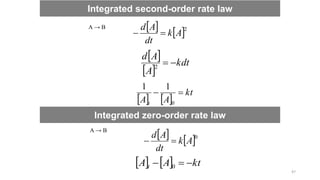
1
A → B
   0
A
k
dt
A
d


    kt
A
A t 

 0
Integrated second-order rate law
Integrated zero-order rate law
47
 A pseudo first-order reaction can be defined as a second-order or bimolecular
reaction that is made to behave like a first-order reaction.
 This reaction occurs when one reacting material is present in great excess or is
maintained at a constant concentration compared with the other substance.
A + B  C
So, if component B is in large excess and the concentration of B is very high as
compared to that of A, the reaction is considered to be a pseudo-first-order reaction
with respect to A and if component A is in large excess and the concentration of A is very
high as compared to that of B, the reaction is considered to be pseudo-first order with
respect to B.
CH3COOC2H5 + H2O  CH3COOH + C2H5OH
For example:
Rate = k [CH3COOC2H5]
The concentration of water is very high and thus does not change much during
the course of the reaction.
Pseudo First Order Reaction
48
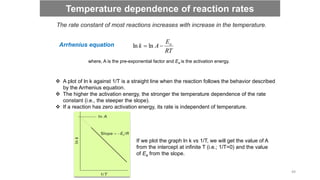
The rate constant of most reactions increases with increase in the temperature.
Arrhenius equation
RT
E
A
k a

 ln
ln
where, A is the pre-exponential factor and Ea is the activation energy.
 A plot of ln k against 1/T is a straight line when the reaction follows the behavior described
by the Arrhenius equation.
 The higher the activation energy, the stronger the temperature dependence of the rate
constant (i.e., the steeper the slope).
 If a reaction has zero activation energy, its rate is independent of temperature.
If we plot the graph ln k vs 1/T, we will get the value of A
from the intercept at infinite T (i.e.; 1/T=0) and the value
of Ea from the slope.
Temperature dependence of reaction rates
49
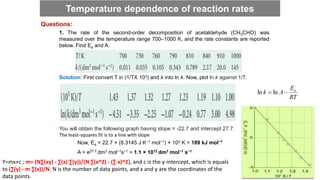
Questions:
1. The rate of the second-order decomposition of acetaldehyde (CH3CHO) was
measured over the temperature range 700–1000 K, and the rate constants are reported
below. Find Ea and A.
Solution: First convert T in (1/TX 103) and k into ln k. Now, plot ln k against 1/T.
You will obtain the following graph having slope = -22.7 and intercept 27.7.
The least-squares fit is to a line with slope
Now, Ea = 22.7 × (8.3145 J K−1 mol−1) × 103 K = 189 kJ mol−1
A = e27.7 dm3 mol−1s−1 = 1.1 × 10¹² dm3 mol−1 s−1
Temperature dependence of reaction rates
50
Y=mx+c ; m= (N∑(xy) - ∑(x) ∑(y))/(N ∑(x^2) - (∑ x)^2), and c is the y-intercept, which is equals
to (∑(y) - m ∑(x))/N. N is the number of data points, and x and y are the coordinates of the
data points.
RT
E
A
k a

 ln
ln
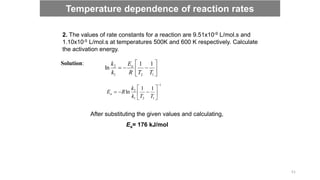
2. The values of rate constants for a reaction are 9.51x10⁻⁹ L/mol.s and
1.10x10⁻⁵ L/mol.s at temperatures 500K and 600 K respectively. Calculate
the activation energy.
Solution:









1
2
1
2 1
1
ln
T
T
R
E
k
k a
1
1
2
1
2 1
1
ln










T
T
k
k
R
Ea
After substituting the given values and calculating,
Ea= 176 kJ/mol
Temperature dependence of reaction rates
51
RT
E
A
k a

 ln
ln
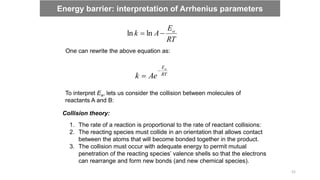
One can rewrite the above equation as:
RT
Ea
Ae
k


To interpret Ea, lets us consider the collision between molecules of
reactants A and B:
Energy barrier: interpretation of Arrhenius parameters
Collision theory:
1. The rate of a reaction is proportional to the rate of reactant collisions:
2. The reacting species must collide in an orientation that allows contact
between the atoms that will become bonded together in the product.
3. The collision must occur with adequate energy to permit mutual
penetration of the reacting species’ valence shells so that the electrons
can rearrange and form new bonds (and new chemical species).
52
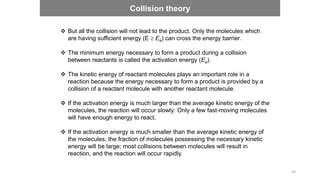
 But all the collision will not lead to the product. Only the molecules which
are having sufficient energy (E  Ea) can cross the energy barrier.
 The minimum energy necessary to form a product during a collision
between reactants is called the activation energy (Ea).
 The kinetic energy of reactant molecules plays an important role in a
reaction because the energy necessary to form a product is provided by a
collision of a reactant molecule with another reactant molecule.
 If the activation energy is much larger than the average kinetic energy of the
molecules, the reaction will occur slowly: Only a few fast-moving molecules
will have enough energy to react.
 If the activation energy is much smaller than the average kinetic energy of
the molecules, the fraction of molecules possessing the necessary kinetic
energy will be large; most collisions between molecules will result in
reaction, and the reaction will occur rapidly.
Collision theory
53
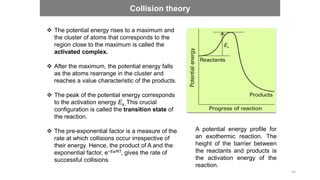
A potential energy profile for
an exothermic reaction. The
height of the barrier between
the reactants and products is
the activation energy of the
reaction.
 The potential energy rises to a maximum and
the cluster of atoms that corresponds to the
region close to the maximum is called the
activated complex.
 After the maximum, the potential energy falls
as the atoms rearrange in the cluster and
reaches a value characteristic of the products.
 The peak of the potential energy corresponds
to the activation energy Ea..This crucial
configuration is called the transition state of
the reaction.
 The pre-exponential factor is a measure of the
rate at which collisions occur irrespective of
their energy. Hence, the product of A and the
exponential factor, e−Ea/RT, gives the rate of
successful collisions.
Collision theory
54
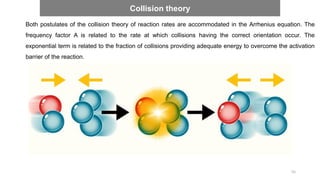
Both postulates of the collision theory of reaction rates are accommodated in the Arrhenius equation. The
frequency factor A is related to the rate at which collisions having the correct orientation occur. The
exponential term is related to the fraction of collisions providing adequate energy to overcome the activation
barrier of the reaction.
Collision theory
55
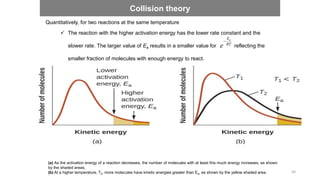
Quantitatively, for two reactions at the same temperature
 The reaction with the higher activation energy has the lower rate constant and the
slower rate. The larger value of Ea results in a smaller value for reflecting the
smaller fraction of molecules with enough energy to react.
RT
Ea
e

 The reaction with the smaller Ea has a larger fraction of molecules with enough
energy to react. This will be reflected as a larger value of , a larger rate
constant, and a faster rate for the reaction.
RT
Ea
e

Collision theory
(a) As the activation energy of a reaction decreases, the number of molecules with at least this much energy increases, as shown
by the shaded areas.
(b) At a higher temperature, T2, more molecules have kinetic energies greater than Ea, as shown by the yellow shaded area. 56
Module 1
C. Catalysis
57
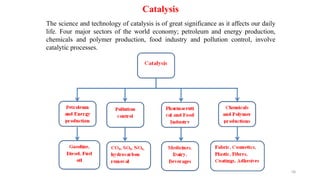
Catalysis
The science and technology of catalysis is of great significance as it affects our daily
life. Four major sectors of the world economy; petroleum and energy production,
chemicals and polymer production, food industry and pollution control, involve
catalytic processes.
58
The term catalysis, proposed in 1835 by Jöns Jakob Berzelius (1779-
1848), comes from the Greek words kata meaning down and lyein
meaning loosen.
Definition of Catalysis
The economic significance of the catalyst industry is enormous. The
catalytic processes contribute greater than 30-40% of global GDP. The
global catalyst market size was estimated at USD 34.0 billion in 2019 and
is expected to reach USD 35.1 billion in 2020.
“A catalyst is a chemical entity which by virtue of its presence in a
reacting system increases or decreases the rate of the reaction, itself
remaining unchanged in chemical properties or mass at the end of a
reaction.”
The phenomenon of alteration of the rate of a reaction by a catalyst is
known catalysis.
59
(1) The catalyst remains unchanged (in mass and chemical
composition) in the reaction.
(2) A small quantity of the catalyst is required.
(3) The catalyst does not change the equilibrium constant but the
equilibrium approaches earlier.
Characteristics of Catalysts
60
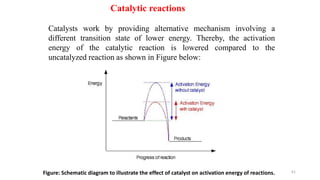
Catalysts work by providing alternative mechanism involving a
different transition state of lower energy. Thereby, the activation
energy of the catalytic reaction is lowered compared to the
uncatalyzed reaction as shown in Figure below:
Catalytic reactions
Figure: Schematic diagram to illustrate the effect of catalyst on activation energy of reactions. 61
1. Heterogeneous catalysis
2. Homogeneous catalysis
3. Enzyme catalysis
Types of catalysis
Following are the main types of catalysis:
62
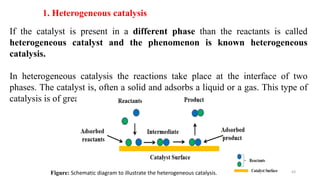
If the catalyst is present in a different phase than the reactants is called
heterogeneous catalyst and the phenomenon is known heterogeneous
catalysis.
In heterogeneous catalysis the reactions take place at the interface of two
phases. The catalyst is, often a solid and adsorbs a liquid or a gas. This type of
catalysis is of great importance in many industrial processes.
1. Heterogeneous catalysis
Figure: Schematic diagram to illustrate the heterogeneous catalysis. 63
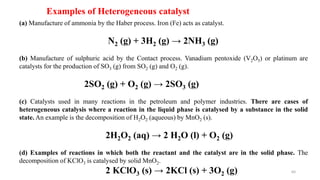
(a) Manufacture of ammonia by the Haber process. Iron (Fe) acts as catalyst.
N2 (g) + 3H2 (g) → 2NH3 (g)
(b) Manufacture of sulphuric acid by the Contact process. Vanadium pentoxide (V2O5) or platinum are
catalysts for the production of SO3 (g) from SO2 (g) and O2 (g).
2SO2 (g) + O2 (g) → 2SO3 (g)
(c) Catalysts used in many reactions in the petroleum and polymer industries. There are cases of
heterogeneous catalysis where a reaction in the liquid phase is catalysed by a substance in the solid
state. An example is the decomposition of H2O2 (aqueous) by MnO2 (s).
2H2O2 (aq) → 2 H2O (l) + O2 (g)
(d) Examples of reactions in which both the reactant and the catalyst are in the solid phase. The
decomposition of KClO3 is catalysed by solid MnO2.
2 KClO3 (s) → 2KCl (s) + 3O2 (g)
Examples of Heterogeneous catalyst
64
2. Homogeneous catalysis
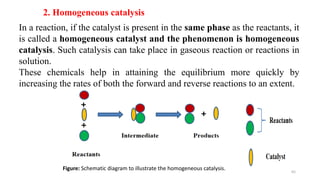
In a reaction, if the catalyst is present in the same phase as the reactants, it
is called a homogeneous catalyst and the phenomenon is homogeneous
catalysis. Such catalysis can take place in gaseous reaction or reactions in
solution.
These chemicals help in attaining the equilibrium more quickly by
increasing the rates of both the forward and reverse reactions to an extent.
Figure: Schematic diagram to illustrate the homogeneous catalysis. 65
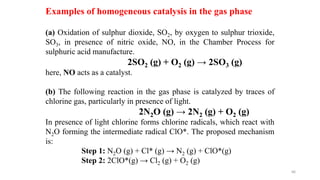
(a) Oxidation of sulphur dioxide, SO2, by oxygen to sulphur trioxide,
SO3, in presence of nitric oxide, NO, in the Chamber Process for
sulphuric acid manufacture.
2SO2 (g) + O2 (g) → 2SO3 (g)
here, NO acts as a catalyst.
(b) The following reaction in the gas phase is catalyzed by traces of
chlorine gas, particularly in presence of light.
2N2O (g) → 2N2 (g) + O2 (g)
In presence of light chlorine forms chlorine radicals, which react with
N2O forming the intermediate radical ClO*. The proposed mechanism
is:
Step 1: N2O (g) + Cl* (g) → N2 (g) + ClO*(g)
Step 2: 2ClO*(g) → Cl2 (g) + O2 (g)
Examples of homogeneous catalysis in the gas phase
66
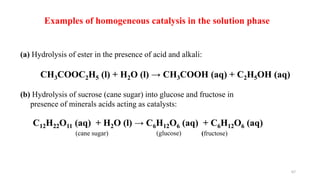
Examples of homogeneous catalysis in the solution phase
(a) Hydrolysis of ester in the presence of acid and alkali:
CH3COOC2H5 (l) + H2O (l) → CH3COOH (aq) + C2H5OH (aq)
(b) Hydrolysis of sucrose (cane sugar) into glucose and fructose in
presence of minerals acids acting as catalysts:
(cane sugar) (glucose) (fructose)
C12H22O11 (aq) + H2O (l) → C6H12O6 (aq) + C6H12O6 (aq)
67
D. Enzyme catalysis
Michaelis-Menton mechanism
68
Enzymes
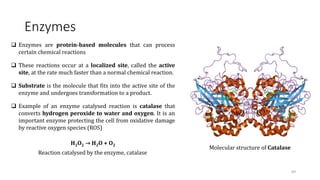
 Enzymes are protein-based molecules that can process
certain chemical reactions
 These reactions occur at a localized site, called the active
site, at the rate much faster than a normal chemical reaction.
 Substrate is the molecule that fits into the active site of the
enzyme and undergoes transformation to a product.
 Example of an enzyme catalysed reaction is catalase that
converts hydrogen peroxide to water and oxygen. It is an
important enzyme protecting the cell from oxidative damage
by reactive oxygen species (ROS)
H2O2 → H2O + O2
Reaction catalysed by the enzyme, catalase
Molecular structure of Catalase
69
Mechanism of enzyme-catalyzed reactions
 Enzyme-catalyzed reactions work
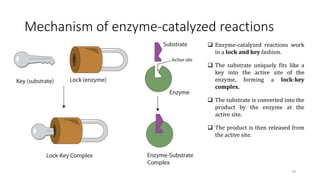
in a lock and key fashion.
 The substrate uniquely fits like a
key into the active site of the
enzyme, forming a lock-key
complex.
 The substrate is converted into the
product by the enzyme at the
active site.
 The product is then released from
the active site.
70
Enzymes’ effect on the activation energy
 Enzymes lower the activation energy for reactions. The
lower the activation energy, the faster the rate of the
reactions.
 For example: the enzyme catalase reduces the
activation energy for the decomposition of hydrogen
peroxide to 8 kJ mol-1, corresponding to an acceleration
of the reaction by a factor of 1015 at 298 K.
 A generic equation for the complex formation is as
follows:
E + S ES P + E
71
[𝐸𝑆] =
[𝐸]0 [𝑆]
[𝑆] + 𝐾𝑀
 When [S] << KM, the effective rate constant is equal to kb[S]/KM. Therefore, the rate increases linearly
with [S] at low concentrations.
 When [S] >> KM, the effective rate constant is equal to kb, and the rate law in eqn 1.3 reduces to
Rate of formation of P = kb[E]0

Engineering Chemistry Module 1.vitchennaipdf

  • 1.
  • 2.
    Thermodynamics: Basic Terminologies ThermodynamicSystems: the quantity of matter or a region in space upon which attention is concentrated in the analysis of a problem Everything external to the system Properties of a system: # Intensive Properties: 2 # Extensive Properties
  • 3.
    Thermodynamics: Basic Terminologies #State function: Depends on the initial state & final state; independent of the path used to reach from. Example: T (Temperature), P (Pressure), U (Internal energy), H (Enthalpy) etc. # Path function: Depends on the path between the initial & final state Example: W (work done), q (heat transferred) etc. Internal energy (U) = Kinetic energy + Potential energy ∙ It’s a state function & an extensive property of the system. ∙ Internal energy of a system changes when energy is transferred into or outside the system in the form of heat or work 3
  • 4.
    Two different pathsfrom same initial and final states results in the state variables values 4
  • 5.
    Thermodynamics: Basic Terminologies •Adiabatic – no heat transferred • Isothermal – constant temperature • Isobaric – constant pressure • Isochoric – constant volume Work done on/by the system W (Work) = F (force) x D(distance moved in the direction of force)  Gas is heated  it will expand and push the piston, thereby doing work on the piston. The work done (dw) when the system expands by dV against a pressure Pex: dw = −PexdV Total work done by the system to expand from volume Vi to Vf: W = - 𝑷𝒆𝒙 𝒗𝒇 𝒗𝒊 dv  This is an example of the system doing the work on the surrounding State of a system thermodynamic variables such as pressure, temperature, volume, composition which describes the system is called state of the system.  when one/more variables undergo change, the system is said to have undergone a change of state 5 F=Pext*A W=Pext*A*l W=PextΔV
  • 6.
    Reversible Process inThermodynamics # Example 1: Thermal equilibrium of two systems with the same temperature  If the temperature of either system is lowered infinitesimally, then energy flows into the system with the lower temperature.  If the temperature of either system at thermal equilibrium is raised infinitesimally, then energy flows out of the hotter system  A thermodynamics process is reversible if the process can be turned back such that both the system and the surroundings return to their original states, with no other change anywhere else in the universe.  In reality, no such processes as reversible processes can exist. Thus, a more appropriate definition is a reversible change in thermodynamics is # Example 2: Reversible expansion: Suppose a gas is confined by a piston. external pressure (Pex) = pressure (P) of the confined gas.  Such a system is in mechanical equilibrium with its surroundings because an infinitesimal change in the external pressure in either direction causes changes in volume in the opposite directions. dw = −𝑃𝑒𝑥𝑑𝑉 = −𝑝𝑑𝑉 W = − 𝑝 𝑣𝑓 𝑣𝑖 dv A change that can be reversed by an infinitesimal modification of a variable. 6
  • 7.
    0th Law ofThermodynamics  Two physical systems are in thermal equilibrium if there is no net flow of heat (thermal energy) between them when they are connected by a path permeable to heat.  According to 0th law: If two systems are in thermal equilibrium with a third system, then those two systems are in thermal equilibrium with each other.  The 0th law of thermodynamics defines thermal equilibrium and forms a basis for the definition of temperature. 7
  • 8.
    8  Heat doesnot flow spontaneously from a cool body to a hotter body  The entropy (S) of an isolated system increases in the course of a spontaneous change. ΔStot > 0 𝒅𝑺 = 𝒅𝒒𝒓𝒆𝒗 𝑻,  A spontaneous process is always accompanied by an increase in entropy of the universe. (ie., system and surroundings) The entropy of all perfect crystalline substances is zero at T = 0K.  Third law of thermodynamics:  2nd law of thermodynamics The energy of an isolated system remains constant. Whenever a quantity of energy (some form) disappears, an exactly equivalent quantity of energy (some other form) must make an appearance. 1st Law of Thermodynamics 𝜟𝑼 = 𝒒 + 𝒘
  • 9.
    1st Law ofThermodynamics  It’s the law of conservation of energy 𝜟𝑼 = 𝒒 + 𝒘  For a system, if w = work done on a system, q = energy transferred as heat to a system & ΔU = resulting change in internal energy The sign of w and q:  +ve if energy is transferred to the system as work/heat  -ve if energy is lost from the system. Therefore, change in internal energy (𝛥𝑈 ) of a system = heat added to the system (q) - the work done by the system (w) 𝜟𝑼 = 𝒒 − 𝒘  The energy of an isolated system remains constant. Whenever a quantity of energy (some form) disappears, an exactly equivalent quantity of energy (some other form) must make an appearance.  Heat (q) and work (w) are equivalent ways of changing the internal energy of a system  Example: o If a weight has been raised/lowered in the surroundings, transfer of energy happens by doing the work. o If ice has melted in the surroundings, it indicated transfer of energy as heat. 9
  • 10.
    Enthalpy & HeatCapacity  If the change of a system is brought about at constant pressure, there will be change in volume.  The quantity (U + PV) is called the enthalpy (H) of the system ΔU = ΔH – PΔV ΔU = q + w or, ΔU = q - P (𝑉𝑓 − 𝑉𝑖)  𝑈𝑓 − 𝑈𝑖 = q – P 𝑉𝑓 − 𝑉𝑖  (𝑈𝑓+ 𝑃𝑉𝑓) − 𝑈𝑖 + 𝑃𝑉𝑖 = 𝑞 Vi = volume of initial state, Vf = volume of final state. Work done by the system, 𝒘 = −𝑷 (𝑽𝒇 − 𝑽𝒊 )  Heat capacity (C) of a system b/n any two temperatures – the quantity of heat (q) required to raise the temperature of the system from the lower temperature (T1) to the higher temperature (T2) divided by the temperature difference. 𝑪 = 𝒒 𝑻𝟐 − 𝑻𝟏 ☻ If mass of the system is 1 g, the heat capacity is called the specific heat of the system ☻ For 1 mol of substance, the heat capacity is termed as ‘molar heat capacity’  𝐻𝑓 − 𝐻𝑖 = 𝑞  Molar heat capacity varies with temperature  Molar heat capacity at constant volume C= 𝑑𝑞 𝑑𝑇 𝐶𝑣 = 𝜕𝑈 𝜕𝑇 𝑣 @ constant volume w = 0 & ΔU = q ΔH = ΔU + PΔV or, 10 dq= dU+PdV; Divide both side by dT; dq/dT=dU/dT (dV=0;PdV=0) =Cv
  • 11.
    Heat Capacity  Molarheat capacity at constant pressure (Cp) @ constant pressure, there is change in volume & some work is done dq= dU+PdV dq/dT=dU/dT+PdV/dT C=dU/dT+PdV/dT 𝑪𝒑 = 𝝏𝑯 𝝏𝑻 𝒑 ΔU = q + w As quantity (U+PV) is the enthalpy (H) of the system  Relationship between Cp & Cv  For a system, ΔH = ΔU + P Δ V or, ΔH ΔT = ΔU ΔT + PΔV ΔT or, 𝑪𝒑 = 𝑪𝒗 + PΔV ΔT  For ideal gas, PV = RT (for 1 mole) P Δ V = R ΔT 𝐶𝑝 = 𝐶𝑣 + RΔT ΔT or, 𝐶𝑝 = 𝐶𝑣 + R or, 𝑪𝒑 ― 𝑪𝒗 = R CV = 3/2 R (For monoatomic ideal gas) CP = 5/2 R (For monoatomic ideal gas) 𝜸 = 𝑪𝒑 𝑪𝒗 = 5/3 for a monoatomic ideal gas Heat capacity ratio, 11 H=U+PV; dH=dU+PdV; dH/dT=dU/dT+PdV/dT
  • 12.
    Application of 1stLaw to the Expansion Work ⮚ Isothermal Process (constant temperature) ▪ In an isothermal process, the temperature stays constant, so the pressure and volume are inversely proportional to one another ⇒ For an ideal gas, The internal energy (U) ∝ Temperature (T) if T = fixed, ΔU = 0 (according to 1st law, which deals with ΔU) ▪ If the system does work, the energy comes from heat flowing into the system from the surrounding ▪ If work is done on the system, heat flows out of the system to the surrounding. # Magnitude of w depends on whether the expansion is reversible or irreversible. 12 work done Pressure-volume diagram
  • 13.
    Application of 1stLaw to the Expansion Work  Reversible isothermal expansion: w = −𝑃 𝑣𝑓 𝑣𝑖 dv = − 𝑛𝑅𝑇 𝑉 𝑣𝑓 𝑣𝑖 dv (throughout the expansion, Pex = P as the expansion is reversible)  Work done by the n moles of gas can be evaluated as: w = −𝑛𝑅𝑇 ln 𝑉𝑓 𝑉𝑖 = −𝑛𝑅𝑇 ln 𝑃𝑖 𝑃𝑓  The work done by a perfect gas when it expands reversibly and isothermally is equal to the area under the isotherm p = nRT/V.  The work done during the irreversible expansion against the same final pressure is equal to the rectangular area shown slightly darker. Note that the reversible work done is greater than the irreversible work done. (as PV = nRT) (since 𝑉𝑓 𝑉𝑖 = 𝑃𝑖 𝑃𝑓 in an isothermal expansion of a perfect gas)  Relations for Irreversible Isothermal expansion a) Free expansion (expansion in vacuum) free expansion we mean expansion against zero opposing force. pex = 0 w = - 𝑃𝑒𝑥 𝑣𝑓 𝑣𝑖 dv =0 b) Volume of the gas expands against a constant pressure. w = - 𝑃𝑒𝑥 𝑣𝑓 𝑣𝑖 dv = -Pex (Vf – Vi) Now suppose that the external pressure is constant throughout the expansion. For example, the piston may be pressed on by the atmosphere, which exerts the same pressure throughout the expansion. 13
  • 14.
    Application of 1stLaw to the Expansion Work  Adiabatic process (constant heat)  no heat is added/ removed from a system.  1st law of thermodynamics: ΔU = w  Example: A gas expanding so quickly that no heat can be transferred. Due to the expansion work, temperature drops. This is exactly what happens with a carbon dioxide fire extinguisher, with the gas coming out at high pressure and cooling as it expands at atmos. pressure (as no heat is allowed to enter/leave the system, q = 0)  Expansion: w = ― ve, ∆𝑼 = ― ve; So, T of the system falls Work is done by the system at the expense of its internal energy  w = ∆𝑈 = 𝑪𝒗𝚫𝑻 (for 1 mole of gas)  ∆𝐻 = 𝑪𝒑𝚫𝑻 (for 1 mole of gas)  Reversible adiabatic expansion  Relation between T, V and P 𝑇𝑖 𝑇𝑓 = 𝑉𝑓 𝑉𝑖 𝛾−1  ln 𝑇𝑖 𝑇𝑓 = 𝛾 − 1 𝑙𝑛 𝑉𝑓 𝑉𝑖  ln 𝑇𝑖 𝑇𝑓 = 𝑪𝒑 𝑪𝒗 − 1 𝑙𝑛 𝑉𝑓 𝑉𝑖  [𝑎𝑠, 𝛾 = 𝐶𝑝 𝐶𝑣 ] ln 𝑇𝑖 𝑇𝑓 = 𝑹 𝑪𝒗 𝑙𝑛 𝑉𝑓 𝑉𝑖 [𝑎𝑠, 𝐶𝑝 ― 𝐶𝑣 = R]  𝑪𝒗 ln 𝑻𝒊 𝑻𝒇 = 𝑹 𝒍𝒏 𝑽𝒇 𝑽𝒊 14 ∆𝑈 =q-w q=0 ∆𝑈=-w =-PdV CvdT=-PdV Cv dT=-RTdV/V Cv 𝑇𝑓 𝑇𝑖 dT/T=-R 𝑣𝑓 𝑣𝑖 dV/V
  • 15.
    Application of 1stLaw to the Expansion Work  Isobaric process (constant pressure)  the pressure is kept constant.  The work done by the system in an isobaric process is simply the pressure multiplied by the change in volume  Example of an isobaric system: A gas, being slowly heated or cooled, confined by a piston in a cylinder.  Isochoric process (constant volume)  the volume is kept constant  The work done is zero in an isochoric process  . Example of an isochoric system: A gas in a box with fixed walls 15
  • 16.
    Numerical from of1st Law  Example 1: Calculate w and ∆𝑈 for the conversion of 1 mole of water at 100 ℃ to steam at 1 atm pressure. Heat of vaporisation of water at 100 ℃ is 40670 Jmol-1 Solution: P = 1 atm = 8.314 𝐽 𝑚𝑜𝑙−1𝐾−1 0.08206 𝑑𝑚3 𝑚𝑜𝑙−1𝐾−1 Vi = vol. of 1 mole of liquid water at 1 atm pressure = 18 ml = 18 × 10-3dm3 Vf = vol. of 1 mole of steam at 100 ℃ at 1 atm pressure = (22.4 dm3 × 373)/273 = 30.60 dm3 The volume of one mole of any gaseous substance is 22.4 litres at 273K w = P (Vf - Vi) = 8.314 𝐽 𝑚𝑜𝑙−1𝐾−1 0.08206 𝑑𝑚3 𝑚𝑜𝑙−1𝐾−1 [30.60 dm3-18 × 10-3 dm3] = 8.314 𝐽 𝑚𝑜𝑙−1𝐾−1 0.08206 𝑑𝑚3 𝑚𝑜𝑙−1𝐾−1 × 30.60d m3 = 3100 J Since, conversion of water to steam is accompanied by increase in volume, work is done by the system on the surroundings. Hence, w = – 3100 J  Example 2: 1 mole of an ideal gas expands against a constant external pressure of 1 atm from a volume of 10 dm3 to a volume of 30 dm3.Calculate the work done by the gas in Joules. = − 1 𝑎𝑡𝑚 30 𝑑𝑚3 − 10𝑑𝑚3 Solution: 𝑤 = −𝑃𝑒𝑥𝛥𝑉 R = 8.314 Jmol-1K-1 = 0.08206 dm3 atm K-1 mol-1 1 atm = 8.314 𝐽 𝑚𝑜𝑙−1𝐾−1 0.08206 𝑑𝑚3 𝑚𝑜𝑙−1𝐾−1 Therefore, 𝑤 = −20 𝑑𝑚3 𝑎𝑡𝑚 = −20 𝑑𝑚3 × 8.314 𝐽 𝑚𝑜𝑙−1𝐾−1 0.08206 𝑑𝑚3 𝑚𝑜𝑙−1𝐾−1 = – 2026 J = −20 𝑑𝑚3 𝑎𝑡𝑚 16
  • 17.
    Numerical from of1st Law  Example 3: 1 mole of an ideal monoatomic gas at 27 C expands reversibly and adiabatically from a volume of 10 dm3 to a volume of 20 dm3.Calculate q, ∆U, W and ∆H. Given 𝐶𝑣 𝑅 = 3 2 Solution: Since the process is adiabatic, q = 0 𝐶𝑣 ln 𝑇𝑓 𝑇𝑖 = 𝑅 ln 𝑉𝑖 𝑉𝑓  3 2 ln 𝑇𝑓 300 = ln( 10 𝑑𝑚3 20 𝑑𝑚3) Since for an adiabatic process, q =0, hence ΔU = w = – 1384 J ΔH = ΔU + P Δ V = ΔU + nRΔT = ΔU + nR(Tf- Ti)  𝑛𝑅 𝑇𝑓 − 𝑇𝑖  = (1 mol) 8.314 𝐽 𝑚𝑜𝑙−1𝐾−1 189 − 300 = −923 𝐽 ΔH = – 1384 J – 923 J = – 2307 J  Tf = 189K  𝑑𝑈 = 𝐶𝑣 𝑑𝑇 𝐶𝑣 = 𝜕𝑈 𝜕𝑇 𝑣 For a finite change in n moles, ∆𝑈 = 𝑛𝐶𝑣∆𝑇 = (1 mol) 3 2 × 8.314 𝐽 𝑚𝑜𝑙−1𝐾−1 (189 − 300)𝐾 = – 1384 J # Note: ΔH can also be calculated by using the relation 𝒅𝑯 = 𝑪𝒑 𝒅𝑻  Example 4: 10 moles of an ideal gas expands reversibly and isothermally from a pressure of 10 atmto 2 atm at 300 K.Calculate the work done. Solution: w = −𝑛𝑅𝑇 ln 𝑃𝑖 𝑃𝑓 = −(10 mol) 8.314 𝐽 𝑚𝑜𝑙−1 𝐾−1 300 𝐾 ln 10 𝑎𝑡𝑚 2 𝑎𝑡𝑚 = − 40.15 × 10³J 17
  • 18.
    2nd Law ofThermodynamics  Why we need for the 2nd law of thermodynamics?  The 1st law of thermodynamics does not tell us anything about the direction of change. The direction of spontaneous change of a process is defined by the 2nd law of thermodynamics  Heat does not flow spontaneously from a cool body to a hotter body  The entropy (S) of an isolated system increases in the course of a spontaneous change.  2nd law of thermodynamics # Note: when considering applications of the 2nd law – it is a statement about the total entropy of the overall isolated system (the ‘universe’), not just about the entropy of the system of interest. ΔStot > 0 Where, Stot = Ssystem+ Ssur Ssystem = the entropy of the system of interest, & Ssur = the entropy of the surroundings  the 1st law uses the internal energy to identify permissible changes  the 2nd law uses the entropy to identify which of these permissible changes are spontaneous.  A spontaneous process points towards the direction in which the total entropy increases.  Entropy (S) is a state function  The thermodynamic definition of entropy concentrates on the change in entropy (dS) that occurs as the result of a physical or chemical process.  dqrev is the energy transferred as heat reversibly to the system at the absolute temperature T.  Thermodynamic definition of entropy 𝒅𝑺 = 𝒅𝒒𝒓𝒆𝒗 𝑻, 𝜟𝑺 = 𝒅𝒒𝒓𝒆𝒗 𝑻 𝒇 𝒊 18
  • 19.
    Entropy  Process thatlead to an increase in entropy (ΔS > 0) ☻ Notice the increasing disorder in above processes  Entropy change for the system of an isothermal expansion of a perfect gas ΔU = 0, q = -w  𝑞𝑟𝑒𝑣 = −𝑤𝑟𝑒𝑣 as, wrev =― nRT ln (𝑉𝑓 /𝑉𝑖) [from the expression of work done in a reversible isothermal expression]  𝑞𝑟𝑒𝑣 = 𝑛𝑅𝑇𝑙𝑛(𝑉𝑓/𝑉𝑖) Δ𝑆 = 𝑛𝑅𝑙𝑛(𝑉𝑓/𝑉𝑖) as 𝑑𝑆 = 𝑑𝑞𝑟𝑒𝑣 𝑇  Δ𝑆𝑚 = 𝑅𝑙𝑛(𝑉𝑓/𝑉𝑖) 19
  • 20.
    Entropy  Total Entropychange in irreversible (spontaneous) process of a perfect gas  example: Isothermal expansion of an ideal gas at constant temperature into vacuum As, w = 0, 𝛥𝑈 = 0  𝑞 = 0 [from 1st law]  no heat is absorbed by or removed from the surrounding, Hence, Δ𝑆𝑠𝑢𝑟𝑟𝑜𝑢𝑛𝑑𝑖𝑛𝑔 = 0 Δ𝑆𝑚 = 𝑅𝑙𝑛(𝑉𝑓/𝑉𝑖) As, 𝑆𝑡𝑜𝑡𝑎𝑙 = 𝑆𝑠𝑦𝑠𝑡𝑒𝑚 + 𝑆𝑠𝑢𝑟𝑟𝑜𝑢𝑛𝑑𝑖𝑛𝑔  Δ 𝑆𝑡𝑜𝑡𝑎𝑙 = 𝑆𝑠𝑦𝑠𝑡𝑒𝑚 + 𝑆𝑠𝑢𝑟𝑟𝑜𝑢𝑛𝑑𝑖𝑛𝑔 = 𝑅𝑙𝑛(𝑉𝑓/𝑉𝑖) + 0 = 𝑅𝑙𝑛(𝑉𝑓/𝑉𝑖)  Isothermal Reversible expansion w = −𝑝Δ𝑉 & qrev = 𝑝Δ𝑉 𝑆𝑡𝑜𝑡𝑎𝑙 = 𝑆𝑠𝑦𝑠𝑡𝑒𝑚 + 𝑆𝑠𝑢𝑟𝑟𝑜𝑢𝑛𝑑𝑖𝑛𝑔 = 𝑞𝑟𝑒𝑣 𝑇 + − 𝑞𝑟𝑒𝑣 𝑇 = 0  Clausius inequality dS ≥ 𝑑𝑞 𝑇  In an isolated system, there is no heat transfer and 𝑑𝑞 = 0 , thus dS ≥ 0  all natural processes are spontaneous & irreversible.  Reversible process: 𝑑𝑆𝑡𝑜𝑡𝑎𝑙 = 𝑑𝑆𝑠𝑦𝑠𝑡𝑒𝑚 + 𝑑𝑆𝑠𝑢𝑟𝑟𝑜𝑢𝑛𝑑𝑖𝑛𝑔 = 0  spontaneous in neither direction and is at equilibrium  As Vf > 𝑉𝑖, thisspontaneous (irreversible) isothermal expansion of a gas is accompanied by the increase in entropy.  Irreversible process 𝑑𝑆𝑡𝑜𝑡𝑎𝑙 > 𝑑𝑆𝑠𝑦𝑠𝑡𝑒𝑚 + 𝑑𝑠𝑠𝑢𝑟𝑟𝑜𝑢𝑛𝑑𝑖𝑛𝑔 > 0  all spontaneous process occurring in Nature is irreversible, entropy of the universe is increasing continuously 20
  • 21.
    Entropy  The 1stlaw & the 2nd law of thermodynamics were summed up by German Physicist Rudolf Clausius as below: The energy of the universe remains constant; the entropy of the universe tends towards a maximum  For an ideal gas (1 mole) with variable T & V ∆𝑆 = 𝐶𝑣 ln 𝑇𝑓 𝑇𝑖 + 𝑅 ln 𝑉𝑓 𝑉𝑖  For an ideal gas with variable P & T ∆𝑆 = 𝐶𝑝 ln 𝑇𝑓 𝑇𝑖 − 𝑅 ln 𝑃𝑓 𝑃𝑖  For an ideal gas in an isothermal process ∆𝑆𝑇= 𝑅 ln 𝑉𝑓 𝑉𝑖 = − 𝑅 ln 𝑃𝑓 𝑃𝑖  For an ideal gas in an isobaric process ∆𝑆𝑃= 𝐶𝑝 ln 𝑇𝑓 𝑇𝑖  For an ideal gas in an isochoric process ∆𝑆𝑣= 𝐶𝑣 ln 𝑇𝑓 𝑇𝑖  Its a device which transforms heat into work  This happens in a cyclic process  Heat engines require a hot reservoir to supply energy (QH) and a cold reservoir to take in the excess energy (QC)  QH is defined as positive, QC is defined as negative  A Carnot cycle (named after the French engineer Sadi Carnot) consists of four reversible stages in which a gas (the working substance) is either expanded/compressed in various ways  To demonstrate the maximum convertibility of heat into work  The system consists of 1 mole of an ideal gas which is subjected to four strokes  Entropy change during different processes  Heat engine  Carnot Cycle 21
  • 22.
    Carnot Cycle  Fourstages of Carnot Cycle: A. 1st stroke: Curve AB: AB: Isothermal expansion at Th Work done by the gas 𝒒𝒉 = −𝒘𝟏 = 𝑹𝑻𝒉 𝒍𝒏 𝑽𝑩 𝑽𝑨  The gas is placed in thermal contact with QH (at Th) and undergoes reversible isothermal expansion from A to B.  The entropy change is qh/Th ( qh = the energy supplied to the system as heat from the hot source) B. 2nd stroke: Curve BC (B → C): Adiabatic expansion, Work done by the gas −𝒘𝟐 = −𝑪𝒗 (𝑻𝒉 − 𝑻𝒄)  Contact with QH is broken & the gas undergoes reversible adiabatic expansion from B to C.  No energy leaves the system as heat, ΔS = 0  The expansion is carried on until the temperature of the gas falls from Th to Tc (the temperature of Qc) 22
  • 23.
    Carnot Cycle C. 3rdstroke: Curve CD (C → D): Isothermal compression at TC, Work done on the gas. −𝑞𝑐= 𝑤3 = 𝑅𝑇𝑐 ln 𝑉𝐷 𝑉𝐶  The gas is placed in contact with the cold sink (Qc) and undergoes a reversible isothermal compression from C to D at Tc.  Energy is released as heat to the cold sink; the entropy change of the system = qc/Tc, where qc is negative. D. 4th stroke: Curve DA (D → A): Adiabatic compression Work done on the gas 𝑤4 = 𝐶𝑣 (𝑇𝑕 − 𝑇𝑐)  Contact with Qc is broken and the gas undergoes reversible adiabatic compression from D to A such that the final temperature is Th.  No energy enters the system as heat, so the change in entropy is zero. 23
  • 24.
    Carnot Cycle  Thearea enclosed by the four curves represents the net work done by the engine in one cycle  The total change in entropy around the cycle is the sum of the changes in each of these four steps: 𝑑𝑆 = 𝑞𝑕 𝑇𝑕 + 𝑞𝑐 𝑇𝑐  For an ideal gas, 𝑑𝑆 = 0 and 𝑞ℎ 𝑞𝑐 = − 𝑇ℎ 𝑇𝑐  The “engine” statement of the 2nd Law: – it is impossible for any system to have an efficiency of 100% (𝜂 = 1) Efficiency of a heat engine • The thermal efficiency of a heat engine is 𝜂 = 𝑤𝑜𝑟𝑘 𝑝𝑒𝑟𝑓𝑜𝑟𝑚𝑒𝑑 𝑕𝑒𝑎𝑡 𝑎𝑏𝑜𝑠𝑟𝑏𝑒𝑑 𝑓𝑟𝑜𝑚 𝑡𝑕𝑒 𝑕𝑜𝑡 𝑠𝑜𝑢𝑟𝑐𝑒 = 𝑊 𝑞ℎ = 1 − ⎤𝑞𝑐⎥/⎤𝑞ℎ⎥ = 1 − 𝑇𝑐/𝑇𝑕 • Another statement of the 2nd Law: – It is impossible for any process to have as its sole result the transfer of heat from a cooler object to a warmer object [Kelvin’s statement] [Clausius’s statement]24
  • 25.
    Application of theCarnot Cycle  Energy efficiency of the Carnot cycle is independent of its working substance.  Any cyclic process that absorbs heat at one temperature and rejects heat at another temperature and is reversible has the energy efficiency of a Carnot cycle.  Refrigeration, Air conditioners & Heat pumps ● These appliances are heat engines operating in reverse. ● By doing work, heat is extracted from the cold reservoir & exhausted to the hot reservoir  Thermal devices or thermal machines are one of the applications of this cycle.  The heat pumps to produce heating,  the refrigerators to produce cooling,  the steam turbines used in the ships,  the combustion engines of the combustion vehicles  the reaction turbines of the aircraft 25
  • 26.
    Temperature & FreeEnergy  Suppose an engine works reversibly between a hot source at a temperature Th and a cold sink at a temperature Tc, then it follows that Tc = (1 − η)Th  The Kelvin scale (which is a special case of the thermodynamic temperature scale) is currently defined by using water at its triple point as the notional hot source and defining that temperature as 273.16 K exactly.  Kelvin used this expression to define the thermodynamic temperature scale in terms of the efficiency of a heat engine in which the hot source is at a known temperature and the cold sink is the object of interest.  Free energy and the spontaneity  Thermodynamic Temperature  It is not always easy to know the entropy change of both system and the surrounding  We can express this in terms of G (the free energy function) and thus can device a criterion of spontaneity in terms of the state function of the system.  As, Δ 𝑆𝑡𝑜𝑡𝑎𝑙 = 𝑆𝑠𝑦𝑠𝑡𝑒𝑚 + 𝑆𝑠𝑢𝑟𝑟𝑜𝑢𝑛𝑑𝑖𝑛𝑔 and Δ 𝑆𝑡𝑜𝑡𝑎𝑙 is a criterion for the spontaneity/feasibility of a process.  There are few assumptions:  Assumption no 1: The system is in thermal equilibrium with its surroundings at a temperature T.  Assumption no 2: Heat transfer between the system and the surrounding happens at constant volume  Assumption no 3: Heat transfer between the system and the surrounding happens at constant pressure. 26
  • 27.
    Free Energy  Underthe Assumption 1 & Assumption 2 Clausius inequality becomes: dS − 𝑑𝑈 𝑇 ≥ 0 dA=dU−TdS [A = Helmholtz free energy]  TdS ≥ dU   The criterion of spontaneity in terms of Gibbs Free energy change (dG) and Helmholtz energy (dA)  Under the Assumption 1 & Assumption 3 Clausius inequality becomes: dS − 𝑑𝐻 𝑇 ≥ 0 [constant P, no additional work]  TdS ≥ dH dG=dH−TdS [G = Gibbs free energy]  A=U−TS G=H−TS 𝑑𝐺 ≤ 0 & 𝑑𝐴 ≤ 0 dH > 0 but if such a reaction is to be spontaneous at constant temperature and pressure, G must decrease.  as dG = dH − TdS it is possible for dG to be negative provided that the entropy of the system increases so much that TdS outweighs dH.  Endothermic reactions are therefore driven by the increase of entropy of the system [we get this by applying the 1st law & the 𝑑 𝑞𝑣 = 𝑑𝑈 𝑛𝑜 𝑒𝑥𝑝𝑎𝑛𝑠𝑖𝑜𝑛 𝑤𝑜𝑟𝑘]  In an endothermic reaction: 27
  • 28.
    Free Energy  commonlyspontaneous because dH < 0 & then dG < 0 provided TdS is not so negative that it outweighs the decrease in enthalpy.  dG = 0  Free energy change with temperature and pressure:  In an exothermic reactions  At chemical equilibrium, ∆𝐺 = 𝑛𝑅𝑇 ln 𝑃2 𝑃1 = 𝑛𝑅𝑇 ln 𝑉1 𝑉2 28
  • 29.
    Numerical from 2ndLaw of Thermodynamics  Example 1: Calculate the efficiency of a certain power station operates with superheated steam at 300 ℃ (Th = 573 K) and discharges the waste heat into the environment at 20 ℃ (T = 293 K). Tc= (1 − η)Th  η = 1 – (Tc /Th) Solution: Theoretical efficiency (η) = 1 – (293K/573K) = 0.489 # In practice, there are other losses due to mechanical friction and the fact that turbines do not operate reversibly.  Example 2: Calculate the maximum efficiency of a heat engine operating between 100 ∘C and 25 ∘C For engines, we have Solution: 𝜂 = 1 – (298 K/373 K) = 0.201 = 20.1 % Tc​ = 25 + 273 = 298K Th​ = 100 + 273 = 373 K Tc= (1 − η)Th  η = 1 – (Tc /Th) = 48.9 %  Example 3: Heat supplied to a Carnot engine is 1897.8 kJ. How much useful work can be done by the engine which works between 0 ∘C and 100 ∘C. Tc​= 0 + 273 = 273 K, Th ​= 100 + 273 = 373 K qh =1897.8 kJ w = 𝑞𝑕 × (1 − 𝑇𝑐 𝑇ℎ ) = 1897.8 kJ × (1 − 273 𝐾 373 𝐾 ) = 508.7 kJ  Work done by the engine is 508.7 kJ Solution: 29
  • 30.
    Numerical from 2ndLaw of Thermodynamics  Example 4: 5 mole of an ideal gas expands reversibly from a volume of 8 dm3 to 80 dm3 at a temperature of 27 ∘C. Calculate the change in entropy. Solution: Δ𝑆 = 𝑛𝑅𝑙𝑛(𝑉𝑓/𝑉𝑖) Given that 𝑛 = 2, 𝑉𝑓 = 80 dm3, 𝑉𝑖 = 8 dm3 Δ𝑆 = (5 mol) (8.314 J K-1mol-1) 𝑙𝑛(80 dm3/8 dm3) = 95.73 JK-1  Example 5: Calculate the change in entropy accompanying the heating of 1 mole of Helium gas (assumed ideal) from a temperature of 298 K to a temperature of 1000 K at constant pressure. Assume Cv =3/2 R Solution: As 𝐶𝑝 − 𝐶𝑣 = 𝑅  Cp =𝐶𝑣 + 𝑅 = 2.5 𝑅 = 2.5 × 8.314 𝐽𝑚𝑜𝑙−1 𝐾−1 ln 1000𝐾 298𝐾 = 25.17 𝐽𝑚𝑜𝑙−1𝐾−1 ∆𝑆𝑃= 𝐶𝑝 ln 𝑇𝑓 𝑇𝑖  Example 6: 1 mol of an ideal gas expands reversibly from a volume of 10 dm3 and 298 K to a volume of 20 dm3 and temperature 250 K. Assuming Cv =3/2 R, calculate the entropy change for the process. ∆𝑆 = 𝐶𝑣 ln 𝑇𝑓 𝑇𝑖 + 𝑅 ln 𝑉𝑓 𝑉𝑖 = 1.5 (8.314 𝐽𝑚𝑜𝑙−1𝐾−1) ln 250 𝐾 298𝐾 + (8.314 𝐽𝑚𝑜𝑙−1𝐾−1) ln (20 dm3/10 dm3) = 3.57 JK-1mol-1 Solution: 30
  • 31.
    3rd Law ofThermodynamics The entropy of all perfect crystalline substances is zero at T = 0.  Third law of thermodynamics:  At T = 0, all energy of thermal motion has been quenched and in a perfect crystal all the atoms/ions are in a regular, uniform array.  The localization of matter and the absence of thermal motion suggest that such materials also have zero entropy.  Statistical or microscopic definition of entropy: S = k ln W where, S = the entropy, k = Boltzmann constant, W = the number of microstates or the total number of ways a molecular state can be distributed over the energy states for a specific value of total energy.  When T = 0, W = 1 S = k lnW = 0  if the value zero is ascribed to the entropies of elements in their perfect crystalline form at T = 0, then all perfect crystalline compounds also have zero entropy at T = 0 31
  • 32.
  • 33.
     Chemical kineticsis the branch of chemistry which deals with the study of rates (or fastness) of chemical reactions, the factors affecting it and the mechanism by which the reactions proceed. The rate of a chemical reaction might depend on variables such as  pressure,  temperature, and  the presence of a catalyst, What is Chemical kinetics? 33
  • 34.
     The changein concentration of reactants or products per unit time.  Here, the instantaneous rate of disappearance of one of the reactants (A or B) at a given time, t (at constant volume) is −d[R]/dt. Similarly, the rate of formation of one of the products is d[P]/dt. (Note the change in the sign)  The negative sign indicates that the concentration is decreasing with time. The rates of reactions 34
  • 35.
    Consider a generalreaction, A + B → C The rate of reaction will be:       dt C d dt B d dt A d     Consider another general reaction: aA + bB → cC + dD where a, b, c d are stoichiometric coefficients The rate of reaction will be:         dt D d d dt C d c dt B d b dt A d a 1 1 1 1      The rates of reactions 35
  • 36.
    Write rate expressionsfor the following reactions: Sample Questions: 1.NO2 (g) + CO (g) → NO (g) + CO2 (g) 2.2HI (g) → H2 (g) + I2 (g) Solution:         dt CO d dt NO d dt CO d dt NO d 2 2      1. 2.       dt I d dt H d dt HI d 2 2 2 1    The rates of reactions 36
  • 37.
     The ratelaw is the relationship between the rate and the concentration, which are related by a proportionality constant k, known as rate constant. aA + bB → cC + dD rate = k [A]m[B]n where m and n are order of reaction in A and B, respectively k is the rate constant. This above equation is called the rate law of the reaction. Rate laws and rate constants 37
  • 38.
     Important pointsabout rate laws and rate constant:  Rate law is a result of experimental observation. You CANNOT look at the stoichiometry of the reaction and predict the rate law (unless the reaction is an elementary reaction).  The rate law is not limited to reactants. It can have a product term, For example: rate = k[A]m[B]n[C]c  The rate constant is independent of the concentrations but depends on the temperature.  The units for k vary. Determine units for k by considering units for rate and for concentration. Rate laws and rate constants 38
  • 39.
    A + B→ C For rate = k[A]m[B]n Where, m is the order of reaction in A, n is the order of reaction in B. m and n can be integers, fractions, negative or positive. The overall reaction order is the sum of the exponents in the rate law.  m+n = 0 (Zero order k[A]0)  m+n= 1 (First order k[A]1)  m+n = 2 (Second order k[A]2) Order of a reaction Examples: H2 + Cl2 → 2HCl. Rate = k[H2]0 [Cl2]0 (Zero order) SO2Cl2(g) → SO2(g) + Cl2(g) Rate = k[SO2Cl2]1 (First order) 2NO2 → 2 NO + O2 Rate = k[NO2]2 (Second order) 2NO(g) + 2H2(g) → N2 (g) + 2H2O (g) Rate = k[NO]2 [H2]1 (Third order) CH3COOC2H5 + H2O  CH3COOH + C2H5OH Rate = [CH3COOC2H5]1[H2O]0 (pseudo-first order) 39
  • 40.
    Since rate lawsare in differential form, we must integrate them to find out the concentration as a function of time. Integrated first-order rate law: A → B Rate = Separate concentration and time terms Integrating over the limits [A]0 to [A]t and 0 to t,     kt A A t    0 ln ln Integrated rate laws         t t A A dt k A A d 0 ] [ 0 ] [     kdt A A d           dt k A A d     A k dt A d   Continue…. 40
  • 41.
    Straight line equation(y = mx+c) If we plot ln [A]t versus time, then we will get a straight line having negative slope (-k). Rate constants can be determined from experiment by plotting data in this manner. Integrated rate laws    0 ln ln A kt A t    41
  • 42.
    Other forms:    kt A A t   0 ln     kt t e A A   0     kt t e A A   0 Integrated first order rate law The exponential decay of the reactant in a first-order reaction. The larger the rate constant, the more rapid the decay. Integrated rate laws 42
  • 43.
    Question: The variationin the partial pressure of azomethane with time was followed at 600 K, with the results given below. Confirm that the decomposition is first-order in azomethane, and find the rate constant at 600 K. CH3N2CH3 (g) → CH3CH3 (g) + N2 (g) Solution: To confirm that a reaction is first-order, plot ln([A]t/[A]0) against time and expect a straight line. Because the partial pressure of a gas is proportional to its concentration, an equivalent procedure is to plot ln(p/p0) against t. First, convert p into ln(p/p0) and draw the graph. The plot is straight, confirming a first-order reaction, and its slope is - 3.610-4. Therefore, k = 3.6 10-4 s-1. Integrated rate laws 43
  • 44.
    Half-life is thetime it takes for the original concentration to be reduced by half. From above:     kt A A t   0 ln     2 / 0 0 2 ln t kt A A         2 / 2 1 ln t kt   2 / 693 . 0 t kt    k tt / 693 . 0 2 /  It is clear from the result that the half-life of a reactant is independent of its initial concentration for a first-order reaction. Therefore, if the concentration of A at some arbitrary stage of the reaction is [A], then it will have fallen to 1/2[A] after a further interval of (ln 2)/k. First-order Half-life 44
  • 45.
    Another important pointto note is the time constant,  (tau), the time required for the concentration of a reactant to fall to 1/e of its initial value.     1 1 ln / ln 0 0              e A e A k Thus, the time constant of a first-order reaction is the reciprocal of the rate constant, . Question: 1. The half-life of a first-order reaction was found to be 10 min at a certain temperature. What is its rate constant? Solution: k= 0.693/600s = 0.00115s-1 First-order Half-life 45
  • 46.
    Solution:     kt A At   0 ln     k t A A t   / ln 0 min 36 3 375 . 0 ln g g k   k =0.0578 min-1 min 12 0578 . 0 693 . 0 2 ln 2 / 1    k t 2. If 3.0 g of substance A decomposes for 36 minutes the mass of unreacted A remaining is found to be 0.375 g. What is the half-life of this reaction if it follows first-order kinetics? Question: First-order Half-life 46
  • 47.
    A → B   2 A k dt A d       kdt A A d   2     kt A A t   0 1 1 A → B    0 A k dt A d       kt A A t    0 Integrated second-order rate law Integrated zero-order rate law 47
  • 48.
     A pseudofirst-order reaction can be defined as a second-order or bimolecular reaction that is made to behave like a first-order reaction.  This reaction occurs when one reacting material is present in great excess or is maintained at a constant concentration compared with the other substance. A + B  C So, if component B is in large excess and the concentration of B is very high as compared to that of A, the reaction is considered to be a pseudo-first-order reaction with respect to A and if component A is in large excess and the concentration of A is very high as compared to that of B, the reaction is considered to be pseudo-first order with respect to B. CH3COOC2H5 + H2O  CH3COOH + C2H5OH For example: Rate = k [CH3COOC2H5] The concentration of water is very high and thus does not change much during the course of the reaction. Pseudo First Order Reaction 48
  • 49.
    The rate constantof most reactions increases with increase in the temperature. Arrhenius equation RT E A k a   ln ln where, A is the pre-exponential factor and Ea is the activation energy.  A plot of ln k against 1/T is a straight line when the reaction follows the behavior described by the Arrhenius equation.  The higher the activation energy, the stronger the temperature dependence of the rate constant (i.e., the steeper the slope).  If a reaction has zero activation energy, its rate is independent of temperature. If we plot the graph ln k vs 1/T, we will get the value of A from the intercept at infinite T (i.e.; 1/T=0) and the value of Ea from the slope. Temperature dependence of reaction rates 49
  • 50.
    Questions: 1. The rateof the second-order decomposition of acetaldehyde (CH3CHO) was measured over the temperature range 700–1000 K, and the rate constants are reported below. Find Ea and A. Solution: First convert T in (1/TX 103) and k into ln k. Now, plot ln k against 1/T. You will obtain the following graph having slope = -22.7 and intercept 27.7. The least-squares fit is to a line with slope Now, Ea = 22.7 × (8.3145 J K−1 mol−1) × 103 K = 189 kJ mol−1 A = e27.7 dm3 mol−1s−1 = 1.1 × 10¹² dm3 mol−1 s−1 Temperature dependence of reaction rates 50 Y=mx+c ; m= (N∑(xy) - ∑(x) ∑(y))/(N ∑(x^2) - (∑ x)^2), and c is the y-intercept, which is equals to (∑(y) - m ∑(x))/N. N is the number of data points, and x and y are the coordinates of the data points. RT E A k a   ln ln
  • 51.
    2. The valuesof rate constants for a reaction are 9.51x10⁻⁹ L/mol.s and 1.10x10⁻⁵ L/mol.s at temperatures 500K and 600 K respectively. Calculate the activation energy. Solution:          1 2 1 2 1 1 ln T T R E k k a 1 1 2 1 2 1 1 ln           T T k k R Ea After substituting the given values and calculating, Ea= 176 kJ/mol Temperature dependence of reaction rates 51
  • 52.
    RT E A k a   ln ln Onecan rewrite the above equation as: RT Ea Ae k   To interpret Ea, lets us consider the collision between molecules of reactants A and B: Energy barrier: interpretation of Arrhenius parameters Collision theory: 1. The rate of a reaction is proportional to the rate of reactant collisions: 2. The reacting species must collide in an orientation that allows contact between the atoms that will become bonded together in the product. 3. The collision must occur with adequate energy to permit mutual penetration of the reacting species’ valence shells so that the electrons can rearrange and form new bonds (and new chemical species). 52
  • 53.
     But allthe collision will not lead to the product. Only the molecules which are having sufficient energy (E  Ea) can cross the energy barrier.  The minimum energy necessary to form a product during a collision between reactants is called the activation energy (Ea).  The kinetic energy of reactant molecules plays an important role in a reaction because the energy necessary to form a product is provided by a collision of a reactant molecule with another reactant molecule.  If the activation energy is much larger than the average kinetic energy of the molecules, the reaction will occur slowly: Only a few fast-moving molecules will have enough energy to react.  If the activation energy is much smaller than the average kinetic energy of the molecules, the fraction of molecules possessing the necessary kinetic energy will be large; most collisions between molecules will result in reaction, and the reaction will occur rapidly. Collision theory 53
  • 54.
    A potential energyprofile for an exothermic reaction. The height of the barrier between the reactants and products is the activation energy of the reaction.  The potential energy rises to a maximum and the cluster of atoms that corresponds to the region close to the maximum is called the activated complex.  After the maximum, the potential energy falls as the atoms rearrange in the cluster and reaches a value characteristic of the products.  The peak of the potential energy corresponds to the activation energy Ea..This crucial configuration is called the transition state of the reaction.  The pre-exponential factor is a measure of the rate at which collisions occur irrespective of their energy. Hence, the product of A and the exponential factor, e−Ea/RT, gives the rate of successful collisions. Collision theory 54
  • 55.
    Both postulates ofthe collision theory of reaction rates are accommodated in the Arrhenius equation. The frequency factor A is related to the rate at which collisions having the correct orientation occur. The exponential term is related to the fraction of collisions providing adequate energy to overcome the activation barrier of the reaction. Collision theory 55
  • 56.
    Quantitatively, for tworeactions at the same temperature  The reaction with the higher activation energy has the lower rate constant and the slower rate. The larger value of Ea results in a smaller value for reflecting the smaller fraction of molecules with enough energy to react. RT Ea e   The reaction with the smaller Ea has a larger fraction of molecules with enough energy to react. This will be reflected as a larger value of , a larger rate constant, and a faster rate for the reaction. RT Ea e  Collision theory (a) As the activation energy of a reaction decreases, the number of molecules with at least this much energy increases, as shown by the shaded areas. (b) At a higher temperature, T2, more molecules have kinetic energies greater than Ea, as shown by the yellow shaded area. 56
  • 57.
  • 58.
    Catalysis The science andtechnology of catalysis is of great significance as it affects our daily life. Four major sectors of the world economy; petroleum and energy production, chemicals and polymer production, food industry and pollution control, involve catalytic processes. 58
  • 59.
    The term catalysis,proposed in 1835 by Jöns Jakob Berzelius (1779- 1848), comes from the Greek words kata meaning down and lyein meaning loosen. Definition of Catalysis The economic significance of the catalyst industry is enormous. The catalytic processes contribute greater than 30-40% of global GDP. The global catalyst market size was estimated at USD 34.0 billion in 2019 and is expected to reach USD 35.1 billion in 2020. “A catalyst is a chemical entity which by virtue of its presence in a reacting system increases or decreases the rate of the reaction, itself remaining unchanged in chemical properties or mass at the end of a reaction.” The phenomenon of alteration of the rate of a reaction by a catalyst is known catalysis. 59
  • 60.
    (1) The catalystremains unchanged (in mass and chemical composition) in the reaction. (2) A small quantity of the catalyst is required. (3) The catalyst does not change the equilibrium constant but the equilibrium approaches earlier. Characteristics of Catalysts 60
  • 61.
    Catalysts work byproviding alternative mechanism involving a different transition state of lower energy. Thereby, the activation energy of the catalytic reaction is lowered compared to the uncatalyzed reaction as shown in Figure below: Catalytic reactions Figure: Schematic diagram to illustrate the effect of catalyst on activation energy of reactions. 61
  • 62.
    1. Heterogeneous catalysis 2.Homogeneous catalysis 3. Enzyme catalysis Types of catalysis Following are the main types of catalysis: 62
  • 63.
    If the catalystis present in a different phase than the reactants is called heterogeneous catalyst and the phenomenon is known heterogeneous catalysis. In heterogeneous catalysis the reactions take place at the interface of two phases. The catalyst is, often a solid and adsorbs a liquid or a gas. This type of catalysis is of great importance in many industrial processes. 1. Heterogeneous catalysis Figure: Schematic diagram to illustrate the heterogeneous catalysis. 63
  • 64.
    (a) Manufacture ofammonia by the Haber process. Iron (Fe) acts as catalyst. N2 (g) + 3H2 (g) → 2NH3 (g) (b) Manufacture of sulphuric acid by the Contact process. Vanadium pentoxide (V2O5) or platinum are catalysts for the production of SO3 (g) from SO2 (g) and O2 (g). 2SO2 (g) + O2 (g) → 2SO3 (g) (c) Catalysts used in many reactions in the petroleum and polymer industries. There are cases of heterogeneous catalysis where a reaction in the liquid phase is catalysed by a substance in the solid state. An example is the decomposition of H2O2 (aqueous) by MnO2 (s). 2H2O2 (aq) → 2 H2O (l) + O2 (g) (d) Examples of reactions in which both the reactant and the catalyst are in the solid phase. The decomposition of KClO3 is catalysed by solid MnO2. 2 KClO3 (s) → 2KCl (s) + 3O2 (g) Examples of Heterogeneous catalyst 64
  • 65.
    2. Homogeneous catalysis Ina reaction, if the catalyst is present in the same phase as the reactants, it is called a homogeneous catalyst and the phenomenon is homogeneous catalysis. Such catalysis can take place in gaseous reaction or reactions in solution. These chemicals help in attaining the equilibrium more quickly by increasing the rates of both the forward and reverse reactions to an extent. Figure: Schematic diagram to illustrate the homogeneous catalysis. 65
  • 66.
    (a) Oxidation ofsulphur dioxide, SO2, by oxygen to sulphur trioxide, SO3, in presence of nitric oxide, NO, in the Chamber Process for sulphuric acid manufacture. 2SO2 (g) + O2 (g) → 2SO3 (g) here, NO acts as a catalyst. (b) The following reaction in the gas phase is catalyzed by traces of chlorine gas, particularly in presence of light. 2N2O (g) → 2N2 (g) + O2 (g) In presence of light chlorine forms chlorine radicals, which react with N2O forming the intermediate radical ClO*. The proposed mechanism is: Step 1: N2O (g) + Cl* (g) → N2 (g) + ClO*(g) Step 2: 2ClO*(g) → Cl2 (g) + O2 (g) Examples of homogeneous catalysis in the gas phase 66
  • 67.
    Examples of homogeneouscatalysis in the solution phase (a) Hydrolysis of ester in the presence of acid and alkali: CH3COOC2H5 (l) + H2O (l) → CH3COOH (aq) + C2H5OH (aq) (b) Hydrolysis of sucrose (cane sugar) into glucose and fructose in presence of minerals acids acting as catalysts: (cane sugar) (glucose) (fructose) C12H22O11 (aq) + H2O (l) → C6H12O6 (aq) + C6H12O6 (aq) 67
  • 68.
  • 69.
    Enzymes  Enzymes areprotein-based molecules that can process certain chemical reactions  These reactions occur at a localized site, called the active site, at the rate much faster than a normal chemical reaction.  Substrate is the molecule that fits into the active site of the enzyme and undergoes transformation to a product.  Example of an enzyme catalysed reaction is catalase that converts hydrogen peroxide to water and oxygen. It is an important enzyme protecting the cell from oxidative damage by reactive oxygen species (ROS) H2O2 → H2O + O2 Reaction catalysed by the enzyme, catalase Molecular structure of Catalase 69
  • 70.
    Mechanism of enzyme-catalyzedreactions  Enzyme-catalyzed reactions work in a lock and key fashion.  The substrate uniquely fits like a key into the active site of the enzyme, forming a lock-key complex.  The substrate is converted into the product by the enzyme at the active site.  The product is then released from the active site. 70
  • 71.
    Enzymes’ effect onthe activation energy  Enzymes lower the activation energy for reactions. The lower the activation energy, the faster the rate of the reactions.  For example: the enzyme catalase reduces the activation energy for the decomposition of hydrogen peroxide to 8 kJ mol-1, corresponding to an acceleration of the reaction by a factor of 1015 at 298 K.  A generic equation for the complex formation is as follows: E + S ES P + E 71 [𝐸𝑆] = [𝐸]0 [𝑆] [𝑆] + 𝐾𝑀  When [S] << KM, the effective rate constant is equal to kb[S]/KM. Therefore, the rate increases linearly with [S] at low concentrations.  When [S] >> KM, the effective rate constant is equal to kb, and the rate law in eqn 1.3 reduces to Rate of formation of P = kb[E]0