SEMINAR
ON
PHOTOCHEMISTRY
Presented By:- Mr.Dinkar B.Kamkhede
MSc.Chemistry,IIYear
2013-2014
Vidyabharati Mahavidyalay,
Amravati.
Introduction
Photochemistry is concerned with the changes in chemical and physical behaviour
of molecules following absorption of one or (more) photons.
Primarily consider absorption of visible/UV although IR absorption may also
change chemical behaviour
Mainly concerned with electronic excitation, usually accompanied by some
vibrational excitation
And (rotational in gas phase ) excitation.
Contents-
Introduction
Phoyochemistry
Intracion of Radition with matter
Electronic Transition
Laws of Photochemistry
Mechanisim of Light Absorption
Photosensitisation
Joblonski Digram
Modes of Dissipation of Energy
Energy Transfer
Photochemistry
Chemical reactions-
1 .Thermal Reaction-The Reaction proceed with the
absorption of heat energy.
Action of light → chemical change (light induced reactions)
2 .Photochemical Reaction-The Reaction takes place by the absorsption of light energy.
The Chemical reaction that are initiated or affected
by Light called photochemical reaction.
Chemical reaction → light emission (chemiluminescence)
Intraction of Radiations with Matter
Light: electromagnetic field vibration spreading in quanta (photons)
Photon: the smallest amount of light carrying energy
Quantise- transition means for a particular energy molecule absorbed specific amount
of energy.which lead to chemical change in a molecule due to absorption of EMR.
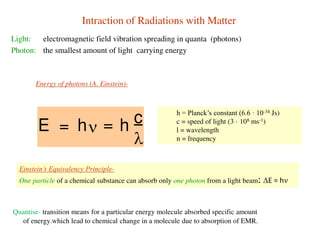
Energy of photons (A. Einstein)-
E = c

h h=
h = Planck’s constant (6.6 · 10-34 Js)
c = speed of light (3 · 108 ms-1)
l = wavelength
n = frequency
Einstein’s Equivalency Principle-
One particle of a chemical substance can absorb only one photon from a light beam: DE = h
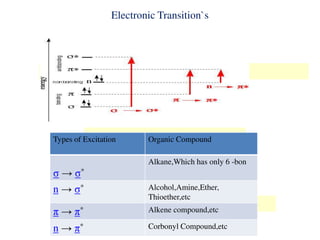
Types of Excitation Organic Compound
σ → σ*
Alkane,Which has only 6 -bon
n → σ* Alcohol,Amine,Ether,
Thioether,etc
π → π* Alkene compound,etc
n → π* Corbonyl Compound,etc
Electronic Transition`s
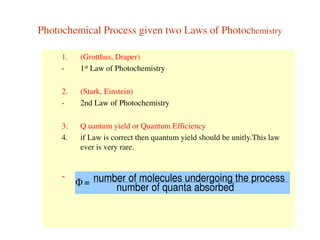
Photochemical Process given two Laws of Photochemistry
1. (Grotthus, Draper)
- 1st Law of Photochemistry
2. (Stark, Einstein)
- 2nd Law of Photochemistry
3. Q uantum yield or Quantum Efficiency
4. if Law is correct then quantum yield should be unitly.This law
ever is very rare.
- number of molecules undergoing the process
number of quanta absorbed=
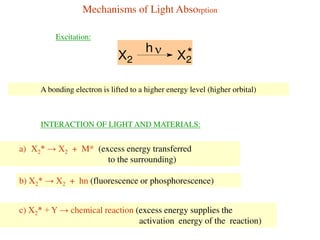
Mechanisms of Light Absorption
Excitation:
X2
h *X2
A bonding electron is lifted to a higher energy level (higher orbital)
INTERACTION OF LIGHT AND MATERIALS:
a) X2* → X2 + M* (excess energy transferred
to the surrounding)
b) X2* → X2 + hn (fluorescence or phosphorescence)
c) X2* + Y → chemical reaction (excess energy supplies the
activation energy of the reaction)
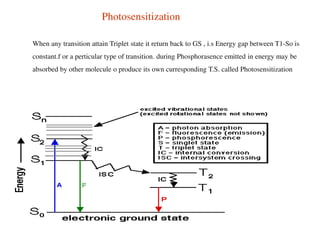
When any transition attain Triplet state it return back to GS , i.s Energy gap between T1-So is
constant.f or a perticular type of transition. during Phosphorasence emitted in energy may be
absorbed by other molecule o produce its own curresponding T.S. called Photosensitization
Photosensitization
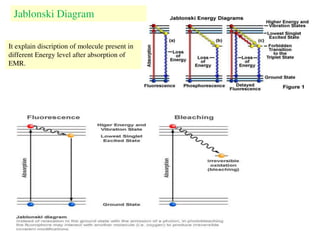
Jablonski Diagram
It explain discription of molecule present in
different Energy level after absorption of
EMR.
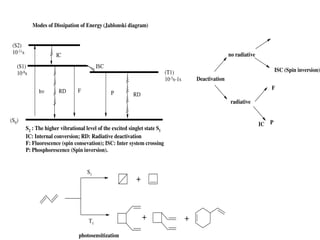
Modes of Dissipation of Energy
(S0)
(S1)
10-8s
(S2)
10-11s
(T1)
10-3s-1s
S2 : The higher vibrational level of the excited singlet state S1
IC: Internal conversion; RD: Radiative deactivation
F: Fluorescence (spin consevation); ISC: Inter system crossing
P: Phosphorescence (Spin inversion).
h
IC
RD F
ISC
P RD
(Jablonski diagram)
Deactivation
no radiative
IC
ISC (Spin inversion)
radiative
F
P
S1
T1
+ +
+
photosensitization
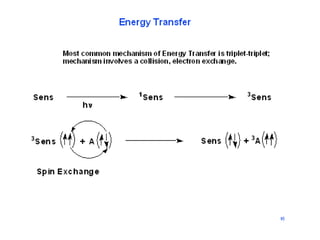
Energy transfer through photosensitization
D 1D
h
1D 3D
ISC
A + 3D D + 3A
3A Products
D = Donor
A = Acceptor
1 = Singlet
3 = Triplet
S0
S1
74 Kcal
.mole-1 69 Kcal/mole
T1
ISC
120 Kcal/mole
S0
T1
S1
60 Kcal/mole
Energy transfer
Benzophenone Butadiene
Ph2CO
h
1[Ph2CO]
ISC 3[Ph2CO]
+ Ph2CO
3
Dimeric products
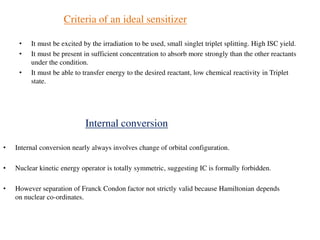
Criteria of an ideal sensitizer
• It must be excited by the irradiation to be used, small singlet triplet splitting. High ISC yield.
• It must be present in sufficient concentration to absorb more strongly than the other reactants
under the condition.
• It must be able to transfer energy to the desired reactant, low chemical reactivity in Triplet
state.
Internal conversion
• Internal conversion nearly always involves change of orbital configuration.
• Nuclear kinetic energy operator is totally symmetric, suggesting IC is formally forbidden.
• However separation of Franck Condon factor not strictly valid because Hamiltonian depends
on nuclear co-ordinates.
Thank
You....!
14

Dinkars presentation on potochemistry.

  • 1.
    SEMINAR ON PHOTOCHEMISTRY Presented By:- Mr.DinkarB.Kamkhede MSc.Chemistry,IIYear 2013-2014 Vidyabharati Mahavidyalay, Amravati.
  • 2.
    Introduction Photochemistry is concernedwith the changes in chemical and physical behaviour of molecules following absorption of one or (more) photons. Primarily consider absorption of visible/UV although IR absorption may also change chemical behaviour Mainly concerned with electronic excitation, usually accompanied by some vibrational excitation And (rotational in gas phase ) excitation. Contents- Introduction Phoyochemistry Intracion of Radition with matter Electronic Transition Laws of Photochemistry Mechanisim of Light Absorption Photosensitisation Joblonski Digram Modes of Dissipation of Energy Energy Transfer
  • 3.
    Photochemistry Chemical reactions- 1 .ThermalReaction-The Reaction proceed with the absorption of heat energy. Action of light → chemical change (light induced reactions) 2 .Photochemical Reaction-The Reaction takes place by the absorsption of light energy. The Chemical reaction that are initiated or affected by Light called photochemical reaction. Chemical reaction → light emission (chemiluminescence)
  • 4.
    Intraction of Radiationswith Matter Light: electromagnetic field vibration spreading in quanta (photons) Photon: the smallest amount of light carrying energy Quantise- transition means for a particular energy molecule absorbed specific amount of energy.which lead to chemical change in a molecule due to absorption of EMR. Energy of photons (A. Einstein)- E = c  h h= h = Planck’s constant (6.6 · 10-34 Js) c = speed of light (3 · 108 ms-1) l = wavelength n = frequency Einstein’s Equivalency Principle- One particle of a chemical substance can absorb only one photon from a light beam: DE = h
  • 5.
    Types of ExcitationOrganic Compound σ → σ* Alkane,Which has only 6 -bon n → σ* Alcohol,Amine,Ether, Thioether,etc π → π* Alkene compound,etc n → π* Corbonyl Compound,etc Electronic Transition`s
  • 6.
    Photochemical Process giventwo Laws of Photochemistry 1. (Grotthus, Draper) - 1st Law of Photochemistry 2. (Stark, Einstein) - 2nd Law of Photochemistry 3. Q uantum yield or Quantum Efficiency 4. if Law is correct then quantum yield should be unitly.This law ever is very rare. - number of molecules undergoing the process number of quanta absorbed=
  • 7.
    Mechanisms of LightAbsorption Excitation: X2 h *X2 A bonding electron is lifted to a higher energy level (higher orbital) INTERACTION OF LIGHT AND MATERIALS: a) X2* → X2 + M* (excess energy transferred to the surrounding) b) X2* → X2 + hn (fluorescence or phosphorescence) c) X2* + Y → chemical reaction (excess energy supplies the activation energy of the reaction)
  • 8.
    When any transitionattain Triplet state it return back to GS , i.s Energy gap between T1-So is constant.f or a perticular type of transition. during Phosphorasence emitted in energy may be absorbed by other molecule o produce its own curresponding T.S. called Photosensitization Photosensitization
  • 9.
    Jablonski Diagram It explaindiscription of molecule present in different Energy level after absorption of EMR.
  • 10.
    Modes of Dissipationof Energy (S0) (S1) 10-8s (S2) 10-11s (T1) 10-3s-1s S2 : The higher vibrational level of the excited singlet state S1 IC: Internal conversion; RD: Radiative deactivation F: Fluorescence (spin consevation); ISC: Inter system crossing P: Phosphorescence (Spin inversion). h IC RD F ISC P RD (Jablonski diagram) Deactivation no radiative IC ISC (Spin inversion) radiative F P S1 T1 + + + photosensitization
  • 11.
    Energy transfer throughphotosensitization D 1D h 1D 3D ISC A + 3D D + 3A 3A Products D = Donor A = Acceptor 1 = Singlet 3 = Triplet S0 S1 74 Kcal .mole-1 69 Kcal/mole T1 ISC 120 Kcal/mole S0 T1 S1 60 Kcal/mole Energy transfer Benzophenone Butadiene Ph2CO h 1[Ph2CO] ISC 3[Ph2CO] + Ph2CO 3 Dimeric products
  • 13.
    Criteria of anideal sensitizer • It must be excited by the irradiation to be used, small singlet triplet splitting. High ISC yield. • It must be present in sufficient concentration to absorb more strongly than the other reactants under the condition. • It must be able to transfer energy to the desired reactant, low chemical reactivity in Triplet state. Internal conversion • Internal conversion nearly always involves change of orbital configuration. • Nuclear kinetic energy operator is totally symmetric, suggesting IC is formally forbidden. • However separation of Franck Condon factor not strictly valid because Hamiltonian depends on nuclear co-ordinates.
  • 14.