A-level Physics


  Unit G484:
  The Newtonian
  World


  Internal energy


Thermal physics
The energy of an ideal gas                               LOs


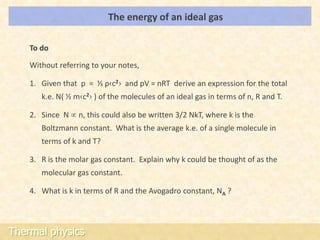
    To do

    Without referring to your notes,

    1. Given that p = ⅓ ρ‹c2› and pV = nRT derive an expression for the total
       k.e. N( ½ m‹c2› ) of the molecules of an ideal gas in terms of n, R and T.

    2. Since N    n, this could also be written 3/2 NkT, where k is the
       Boltzmann constant. What is the average k.e. of a single molecule in
       terms of k and T?

    3. R is the molar gas constant. Explain why k could be thought of as the
       molecular gas constant.

    4. What is k in terms of R and the Avogadro constant, NA ?


Thermal physics
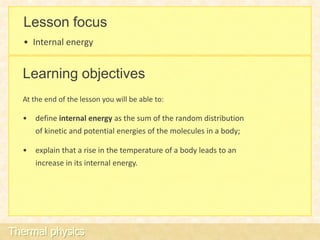
Lesson focus
  • Internal energy


  Learning objectives
  At the end of the lesson you will be able to:

  •   define internal energy as the sum of the random distribution
      of kinetic and potential energies of the molecules in a body;

  •   explain that a rise in the temperature of a body leads to an
      increase in its internal energy.


Thermal physics
Learning outcomes
  All of you should be able to

  • give an exam quality definition of internal energy;
  • describe the internal energy of an ideal gas;
  • explain how we can measure the internal energy of an ideal gas;
  • explain how the internal energy of a real gas can be changed;
  • solve simple problems using the 1st law of thermodynamics.

  Most of you should be able to
  • solve more complex problems using the 1st law of thermodynamics.


Thermal physics
Internal energy                                                  LOs


    Key definition

    The internal energy of a body is the sum of the random distribution of
    kinetic and potential energies of all the molecules in the body.


    To do
    Make your own notes on
    • the internal energy of an ideal gas
    • changes in internal energy during phase changes.


                                  LO 1: define internal energy as the sum of the random distribution of
Thermal physics                                kinetic and potential energies of the molecules in a body
The 1st law of thermodynamics                                             LOs


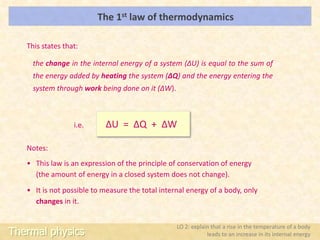
   This states that:

     the change in the internal energy of a system (ΔU) is equal to the sum of
     the energy added by heating the system (ΔQ) and the energy entering the
     system through work being done on it (ΔW).


                  i.e.     ΔU = ΔQ + ΔW

   Notes:
   • This law is an expression of the principle of conservation of energy
     (the amount of energy in a closed system does not change).
   • It is not possible to measure the total internal energy of a body, only
     changes in it.


                                                  LO 2: explain that a rise in the temperature of a body
Thermal physics                                               leads to an increase in its internal energy
Doing work                               LOs


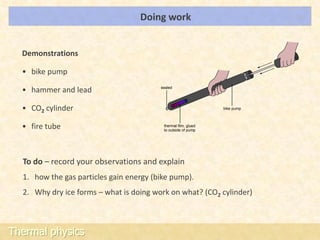
  Demonstrations

  • bike pump

  • hammer and lead                      sealed


  • CO2 cylinder                                                bike pump


  • fire tube                             thermal film, glued
                                          to outside of pump


  To do – record your observations and explain
  1. how the gas particles gain energy (bike pump).
  2. Why dry ice forms – what is doing work on what? (CO2 cylinder)


Thermal physics
Internal energy                           LOs


  Questions

  1. The tyres of a racing bike are generally inflated to pressures of p 6
     atmospheres. When he valve is sharply depressed, ice forms around it.
     Why?


Thermal physics

Tp 11 internal energy (shared)

  • 1.
    A-level Physics Unit G484: The Newtonian World Internal energy Thermal physics
  • 2.
    The energy ofan ideal gas LOs To do Without referring to your notes, 1. Given that p = ⅓ ρ‹c2› and pV = nRT derive an expression for the total k.e. N( ½ m‹c2› ) of the molecules of an ideal gas in terms of n, R and T. 2. Since N n, this could also be written 3/2 NkT, where k is the Boltzmann constant. What is the average k.e. of a single molecule in terms of k and T? 3. R is the molar gas constant. Explain why k could be thought of as the molecular gas constant. 4. What is k in terms of R and the Avogadro constant, NA ? Thermal physics
  • 3.
    Lesson focus • Internal energy Learning objectives At the end of the lesson you will be able to: • define internal energy as the sum of the random distribution of kinetic and potential energies of the molecules in a body; • explain that a rise in the temperature of a body leads to an increase in its internal energy. Thermal physics
  • 4.
    Learning outcomes All of you should be able to • give an exam quality definition of internal energy; • describe the internal energy of an ideal gas; • explain how we can measure the internal energy of an ideal gas; • explain how the internal energy of a real gas can be changed; • solve simple problems using the 1st law of thermodynamics. Most of you should be able to • solve more complex problems using the 1st law of thermodynamics. Thermal physics
  • 5.
    Internal energy LOs Key definition The internal energy of a body is the sum of the random distribution of kinetic and potential energies of all the molecules in the body. To do Make your own notes on • the internal energy of an ideal gas • changes in internal energy during phase changes. LO 1: define internal energy as the sum of the random distribution of Thermal physics kinetic and potential energies of the molecules in a body
  • 6.
    The 1st lawof thermodynamics LOs This states that: the change in the internal energy of a system (ΔU) is equal to the sum of the energy added by heating the system (ΔQ) and the energy entering the system through work being done on it (ΔW). i.e. ΔU = ΔQ + ΔW Notes: • This law is an expression of the principle of conservation of energy (the amount of energy in a closed system does not change). • It is not possible to measure the total internal energy of a body, only changes in it. LO 2: explain that a rise in the temperature of a body Thermal physics leads to an increase in its internal energy
  • 7.
    Doing work LOs Demonstrations • bike pump • hammer and lead sealed • CO2 cylinder bike pump • fire tube thermal film, glued to outside of pump To do – record your observations and explain 1. how the gas particles gain energy (bike pump). 2. Why dry ice forms – what is doing work on what? (CO2 cylinder) Thermal physics
  • 8.
    Internal energy LOs Questions 1. The tyres of a racing bike are generally inflated to pressures of p 6 atmospheres. When he valve is sharply depressed, ice forms around it. Why? Thermal physics