Art IntegrationProject
Presentedby : jatin Bhatia
Submittedto : kiranNangiaMam
THERMODYNAMICS
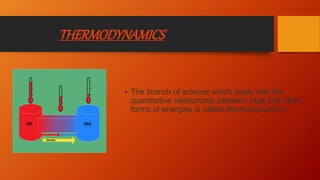
• The branch of science which deals with the
quantitative relationship between heat and other
forms of energies is called thermodynamics.
ImportantTermsRelatedtoThermodynamics
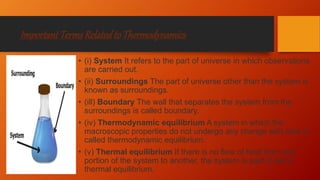
• (i) System It refers to the part of universe in which observations
are carried out.
• (ii) Surroundings The part of universe other than the system is
known as surroundings.
• (ill) Boundary The wall that separates the system from the
surroundings is called boundary.
• (iv) Thermodynamic equilibrium A system in which the
macroscopic properties do not undergo any change with time is
called thermodynamic equilibrium.
• (v) Thermal equilibrium If there is no flow of heat from one
portion of the system to another, the system is said to be in
thermal equilibrium.
Typesof System
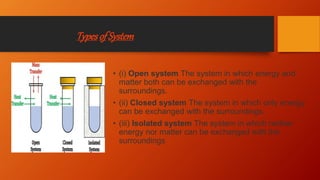
• (i) Open system The system in which energy and
matter both can be exchanged with the
surroundings.
• (ii) Closed system The system in which only energy
can be exchanged with the surroundings.
• (iii) Isolated system The system in which neither
energy nor matter can be exchanged with the
surroundings
ThermodynamicsProperties
• State of System
• When microscopic properties have definite
value, the conditions of existence of the system
is known as state of system.
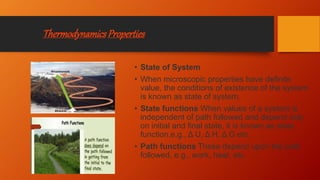
• State functions When values of a system is
independent of path followed and depend only
on initial and final state, it is known as state
function,e.g., Ī” U, Ī” H, Ī” G etc.
• Path functions These depend upon the path
followed, e.g., work, heat, etc.
• Intensive Properties
Properties of the system which depend only on the nature
of matter but not on the quantity of matter are called
Intensive properties, e.g., pressure, temperature, specific
heat, etc
• Extensive Properties
Properties of the system which are dependent on the
quantity of matter are called extensive properties, e.g.,
internal energy, volume, enthalpy, etc
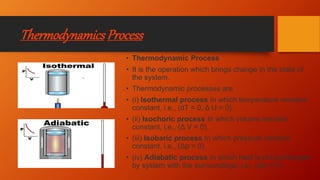
Thermodynamics Process
• Thermodynamic Process
• It is the operation which brings change in the state of
the system.
• Thermodynamic processes are
• (i) Isothermal process In which temperature remains
constant, i.e., (dT = 0, Ī” U = 0).
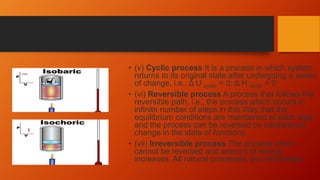
• (ii) Isochoric process In which volume remains
constant, i.e., (Ī” V = 0).
• (iii) Isobaric process In which pressure remains
constant, i.e., (Δp = 0).
• (iv) Adiabatic process In which heat is not exchanged
by system with the surroundings, i.e., (Δq = 0).
• (v) Cyclic process It is a process in which system
returns to its original state after undergoing a series
of change, i.e., Ī” U cyclic = 0; Ī” H cyclic = 0
• (vi) Reversible process A process that follows the
reversible path, i.e., the process which occurs in
infinite number of steps in this Way that the
equilibrium conditions are maintained at each step,
and the process can be reversed by infinitesimal
change in the state of functions.
• (vii) Irreversible process The process which
cannot be reversed and amount of energy
increases. All natural processes are Irreversible.
Internal Energy
• Internal Energy (E or U)
• It is the total energy within the substance. It is the sum of many types of
energies like vibrational energy, translational energy. etc. It is a extensive
property and state function.
• Its absolute value cannot be determined but experimentally change in
internal energy (Ī”) can be determined by
• Ī”U = U2 – U1 or Ī£Up – Ī£UR
• For exothermic process, Ī”U = -ve, whereas for endothermic process Ī”U =
+ve
• U depends on temperature, pressure, volume and quantity of matter.
Change in Internal Energy by Doing Work
Let us bring the change in the internal energy by doing work.
Let the initial state of the system is state A and Temp. TA Internal energy = uA
On doing’some mechanical work the new state is called state B and the temp. TB. It is found to
be
TB > TA
uB is the internal energy after change.
∓ Ī”u = uB – uA
Change in Internal Energy by Transfer of Heat
Internal energy of a system can be changed by the transfer of heat from the surroundings to the system
without doing work.
Δu = q
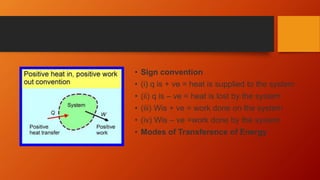
• Sign convention
• (i) q is + ve = heat is supplied to the system
• (ii) q is – ve = heat is lost by the system
• (iii) Wis + ve = work done on the system
• (iv) Wis – ve =work done by the system
• Modes of Transference of Energy
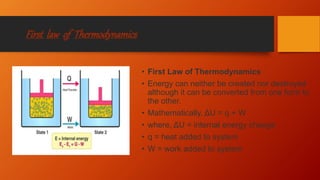
First law of Thermodynamics
• First Law of Thermodynamics
• Energy can neither be created nor destroyed
although it can be converted from one form to
the other.
• Mathematically, Ī”U = q + W
• where, Ī”U = internal energy change
• q = heat added to system
• W = work added to system
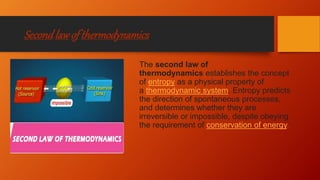
Secondlawof thermodynamics
The second law of
thermodynamics establishes the concept
of entropy as a physical property of
a thermodynamic system. Entropy predicts
the direction of spontaneous processes,
and determines whether they are
irreversible or impossible, despite obeying
the requirement of conservation of energy.
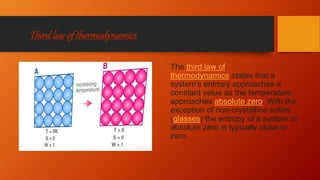
Thirdlawof thermodynamics
The third law of
thermodynamics states that a
system's entropy approaches a
constant value as the temperature
approaches absolute zero. With the
exception of non-crystalline solids
(glasses) the entropy of a system at
absolute zero is typically close to
zero.
• Heat (q)
It occurs when there is a difference of temperature between system and surroundings.
It is a random form of energy and path dependent. Its units are joule or calorie.
• Work (W)
If the system involves gaseous substances and there is a difference of pressure
between system and surroundings. work is referred as pressure – volume work (WpV).
Important terms :-
• Heat Capacity of a System
• Heat Capacity (c) of a system is defined as the amount of heat required to raise
the temperature of a system by 1° C.
• 1. Molar Heat Capacity
• It is the heat capacity 1 mole of substance of the system.
• 2. Specific Heat Capacity
• It is the heat capacity of 1 g of substance of the system
• q = mc Ī” T.
• where, m = mass of substance
• c = specific heat or heat capacity
• Molar heat capacity, at constant pressure,
• Cp = Cp * M
• Molar heat capacity. at constant volume
• CV = CV * M
• (cp and CV are specific heats at constant pressure and constant volume respectively and M is molecular weight of gas)
• cp – CV = R (R = Molar gas constant)
• Cp – CV = R / M
• The molar heat capacity at constant volume,
• CV = (3 / 2) R
• The molar heat capacity at constant pressure,
• Cp = (3 / 2) R + R = (5 / 2)R
• Poisson’s ratio, γ = Cp / CV = (5 / 3) = 1.66
• γ = 1.66 for monoatomic gas
• γ = 1.40 for diatomic gas
• γ = 1.33 for triatomic gas
Enthalpy
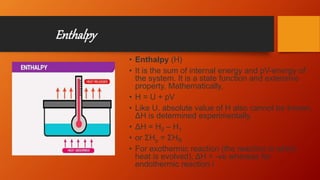
• Enthalpy (H)
• It is the sum of internal energy and pV-energy of
the system. It is a state function and extensive
property. Mathematically,
• H = U + pV
• Like U. absolute value of H also cannot be known,
ΔH is determined experimentally.
• Ī”H = H2 – H1
• or Ī£Hp = Ī£HR
• For exothermic reaction (the reaction in which
heat is evolved), ΔH = -ve whereas for
endothermic reaction i
• Enthalpy Changes During Phase Transformation
Enthalpy of fusion: Enthalpy of fusion is the heat energy or change in enthalpy when one mole of a solid
at its melting point is converted into liquid state.
Enthalpy of vaporisation: It is defined as the heat energy or change in enthalpy when one mole of a
liquid at its boiling point changes to gaseous state.
Enthalpy of Sublimation: Enthalpy of sublimation is defined as the change in heat energy or change in
enthalpy when one mole of solid directly changes into gaseous state at a temperature below its melting point.
• Standard Enthalpy of Formation
Enthalpy of formation is defined as the change in enthalpy in the formation of 1 mole of a substance from its
constituting elements under standard conditions of temperature at 298K and 1 atm pressure.
Enthalpy of Combustion: It is defined as the heat energy or change in enthalpy that accompanies the
combustion of 1 mole of a substance in excess of air or oxygen.
Expression for p-vWork
• Expression for Pressure – Volume Work
• (i) Work of Irreversible expansion against constant pressure B under isothermal conditions
• WpV = – pext Ī”V
• (iv) Work of irreversible expansion under adiabatic conditions
• (v) When an ideal gas expands in vacuum then
• pext = 0
• Work done is maximum in reversible conditions
• Units CGS system – erg
• SI system – joule
• Work and heat both appear only at the boundary of the system during a change in state.]
Entropy
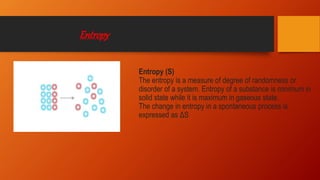
Entropy (S)
The entropy is a measure of degree of randomness or
disorder of a system. Entropy of a substance is minimum in
solid state while it is maximum in gaseous state.
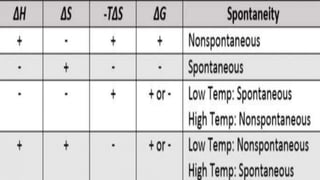
The change in entropy in a spontaneous process is
expressed as ΔS
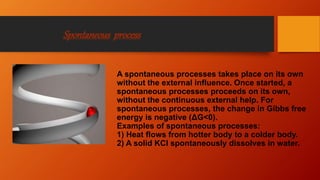
Spontaneous process
A spontaneous processes takes place on its own
without the external influence. Once started, a
spontaneous processes proceeds on its own,
without the continuous external help. For
spontaneous processes, the change in Gibbs free
energy is negative (ΔG<0).
Examples of spontaneous processes:
1) Heat flows from hotter body to a colder body.
2) A solid KCl spontaneously dissolves in water.
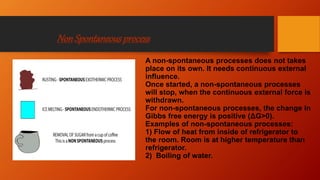
NonSpontaneousprocess
A non-spontaneous processes does not takes
place on its own. It needs continuous external
influence.
Once started, a non-spontaneous processes
will stop, when the continuous external force is
withdrawn.
For non-spontaneous processes, the change in
Gibbs free energy is positive (ΔG>0).
Examples of non-spontaneous processes:
1) Flow of heat from inside of refrigerator to
the room. Room is at higher temperature than
refrigerator.
2) Boiling of water.
Laws of thermochemistry
• 1. Lavoisier Laplace Law
• Th enthalpy change during a reaction is equal in magnitude to the enthalpy
change in the reverse process but it is opposite in sign.
• 2. Hess’s Law of Constant Heat Summation
• The standard enthalpy of a reaction. which takes place in several steps, is
the sum of the standard enthalpIes of the intermediate reactions into which
the overall reactions may be divided at the same temperature.
• According to Hess’s law
• Ī”H = Ī”H1 + Ī”H2 + Ī”H3
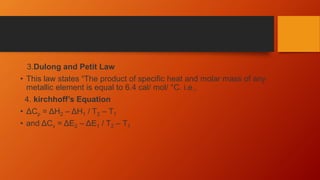
3.Dulong and Petit Law
• This law states ā€œThe product of specific heat and molar mass of any
metallic element is equal to 6.4 cal/ mol/ °C. i.e.,
4. kirchhoff’s Equation
• Ī”Cp = Ī”H2 – Ī”H1 / T2 – T1
• and Ī”Cv = Ī”E2 – Ī”E1 / T2 – T1
Bond enthalpy
• Bond Enthalpy
• It is the average amount of energy required to break one mole of bonds in
gaseous molecules.
• Bond Dissociation Enthalpy
• The energy required to break the particular bond in a gaseous molecule is
called bond dissociation enthalpy. It is definite in quantity and expressed in
kJ mol-1.
• In diatomic molecule, bond dissociation enthalpy = Bond enthalpy
Gibb’s free Energy
Gibbs free energy, also known as the Gibbs function,
Gibbs energy, or free enthalpy, is a quantity that is used
to measure the maximum amount of work done in a
thermodynamic system when the temperature and
pressure are kept constant. Gibbs free energy is
denoted by the symbol ā€˜G’. Its value is usually
expressed in Joules or Kilojoules. Gibbs free energy
can be defined as the maximum amount of work that
can be extracted from a closed system.
Jatin bhatia art integration project 22

Jatin bhatia art integration project 22

  • 1.
  • 2.
  • 3.
  • 5.
    THERMODYNAMICS • The branchof science which deals with the quantitative relationship between heat and other forms of energies is called thermodynamics.
  • 6.
    ImportantTermsRelatedtoThermodynamics • (i) SystemIt refers to the part of universe in which observations are carried out. • (ii) Surroundings The part of universe other than the system is known as surroundings. • (ill) Boundary The wall that separates the system from the surroundings is called boundary. • (iv) Thermodynamic equilibrium A system in which the macroscopic properties do not undergo any change with time is called thermodynamic equilibrium. • (v) Thermal equilibrium If there is no flow of heat from one portion of the system to another, the system is said to be in thermal equilibrium.
  • 7.
    Typesof System • (i)Open system The system in which energy and matter both can be exchanged with the surroundings. • (ii) Closed system The system in which only energy can be exchanged with the surroundings. • (iii) Isolated system The system in which neither energy nor matter can be exchanged with the surroundings
  • 8.
    ThermodynamicsProperties • State ofSystem • When microscopic properties have definite value, the conditions of existence of the system is known as state of system. • State functions When values of a system is independent of path followed and depend only on initial and final state, it is known as state function,e.g., Ī” U, Ī” H, Ī” G etc. • Path functions These depend upon the path followed, e.g., work, heat, etc.
  • 9.
    • Intensive Properties Propertiesof the system which depend only on the nature of matter but not on the quantity of matter are called Intensive properties, e.g., pressure, temperature, specific heat, etc • Extensive Properties Properties of the system which are dependent on the quantity of matter are called extensive properties, e.g., internal energy, volume, enthalpy, etc
  • 10.
    Thermodynamics Process • ThermodynamicProcess • It is the operation which brings change in the state of the system. • Thermodynamic processes are • (i) Isothermal process In which temperature remains constant, i.e., (dT = 0, Ī” U = 0). • (ii) Isochoric process In which volume remains constant, i.e., (Ī” V = 0). • (iii) Isobaric process In which pressure remains constant, i.e., (Ī”p = 0). • (iv) Adiabatic process In which heat is not exchanged by system with the surroundings, i.e., (Ī”q = 0).
  • 11.
    • (v) Cyclicprocess It is a process in which system returns to its original state after undergoing a series of change, i.e., Ī” U cyclic = 0; Ī” H cyclic = 0 • (vi) Reversible process A process that follows the reversible path, i.e., the process which occurs in infinite number of steps in this Way that the equilibrium conditions are maintained at each step, and the process can be reversed by infinitesimal change in the state of functions. • (vii) Irreversible process The process which cannot be reversed and amount of energy increases. All natural processes are Irreversible.
  • 12.
    Internal Energy • InternalEnergy (E or U) • It is the total energy within the substance. It is the sum of many types of energies like vibrational energy, translational energy. etc. It is a extensive property and state function. • Its absolute value cannot be determined but experimentally change in internal energy (Ī”) can be determined by • Ī”U = U2 – U1 or Ī£Up – Ī£UR • For exothermic process, Ī”U = -ve, whereas for endothermic process Ī”U = +ve • U depends on temperature, pressure, volume and quantity of matter.
  • 13.
    Change in InternalEnergy by Doing Work Let us bring the change in the internal energy by doing work. Let the initial state of the system is state A and Temp. TA Internal energy = uA On doing’some mechanical work the new state is called state B and the temp. TB. It is found to be TB > TA uB is the internal energy after change. ∓ Ī”u = uB – uA
  • 14.
    Change in InternalEnergy by Transfer of Heat Internal energy of a system can be changed by the transfer of heat from the surroundings to the system without doing work. Δu = q
  • 15.
    • Sign convention •(i) q is + ve = heat is supplied to the system • (ii) q is – ve = heat is lost by the system • (iii) Wis + ve = work done on the system • (iv) Wis – ve =work done by the system • Modes of Transference of Energy
  • 16.
    First law ofThermodynamics • First Law of Thermodynamics • Energy can neither be created nor destroyed although it can be converted from one form to the other. • Mathematically, Ī”U = q + W • where, Ī”U = internal energy change • q = heat added to system • W = work added to system
  • 17.
    Secondlawof thermodynamics The secondlaw of thermodynamics establishes the concept of entropy as a physical property of a thermodynamic system. Entropy predicts the direction of spontaneous processes, and determines whether they are irreversible or impossible, despite obeying the requirement of conservation of energy.
  • 18.
    Thirdlawof thermodynamics The thirdlaw of thermodynamics states that a system's entropy approaches a constant value as the temperature approaches absolute zero. With the exception of non-crystalline solids (glasses) the entropy of a system at absolute zero is typically close to zero.
  • 19.
    • Heat (q) Itoccurs when there is a difference of temperature between system and surroundings. It is a random form of energy and path dependent. Its units are joule or calorie. • Work (W) If the system involves gaseous substances and there is a difference of pressure between system and surroundings. work is referred as pressure – volume work (WpV).
  • 20.
    Important terms :- •Heat Capacity of a System • Heat Capacity (c) of a system is defined as the amount of heat required to raise the temperature of a system by 1° C. • 1. Molar Heat Capacity • It is the heat capacity 1 mole of substance of the system. • 2. Specific Heat Capacity • It is the heat capacity of 1 g of substance of the system • q = mc Ī” T. • where, m = mass of substance • c = specific heat or heat capacity
  • 21.
    • Molar heatcapacity, at constant pressure, • Cp = Cp * M • Molar heat capacity. at constant volume • CV = CV * M • (cp and CV are specific heats at constant pressure and constant volume respectively and M is molecular weight of gas) • cp – CV = R (R = Molar gas constant) • Cp – CV = R / M • The molar heat capacity at constant volume, • CV = (3 / 2) R • The molar heat capacity at constant pressure, • Cp = (3 / 2) R + R = (5 / 2)R • Poisson’s ratio, γ = Cp / CV = (5 / 3) = 1.66 • γ = 1.66 for monoatomic gas • γ = 1.40 for diatomic gas • γ = 1.33 for triatomic gas
  • 22.
    Enthalpy • Enthalpy (H) •It is the sum of internal energy and pV-energy of the system. It is a state function and extensive property. Mathematically, • H = U + pV • Like U. absolute value of H also cannot be known, Ī”H is determined experimentally. • Ī”H = H2 – H1 • or Ī£Hp = Ī£HR • For exothermic reaction (the reaction in which heat is evolved), Ī”H = -ve whereas for endothermic reaction i
  • 23.
    • Enthalpy ChangesDuring Phase Transformation Enthalpy of fusion: Enthalpy of fusion is the heat energy or change in enthalpy when one mole of a solid at its melting point is converted into liquid state. Enthalpy of vaporisation: It is defined as the heat energy or change in enthalpy when one mole of a liquid at its boiling point changes to gaseous state.
  • 24.
    Enthalpy of Sublimation:Enthalpy of sublimation is defined as the change in heat energy or change in enthalpy when one mole of solid directly changes into gaseous state at a temperature below its melting point. • Standard Enthalpy of Formation Enthalpy of formation is defined as the change in enthalpy in the formation of 1 mole of a substance from its constituting elements under standard conditions of temperature at 298K and 1 atm pressure. Enthalpy of Combustion: It is defined as the heat energy or change in enthalpy that accompanies the combustion of 1 mole of a substance in excess of air or oxygen.
  • 25.
    Expression for p-vWork •Expression for Pressure – Volume Work • (i) Work of Irreversible expansion against constant pressure B under isothermal conditions • WpV = – pext Ī”V • (iv) Work of irreversible expansion under adiabatic conditions • (v) When an ideal gas expands in vacuum then • pext = 0 • Work done is maximum in reversible conditions • Units CGS system – erg • SI system – joule • Work and heat both appear only at the boundary of the system during a change in state.]
  • 26.
    Entropy Entropy (S) The entropyis a measure of degree of randomness or disorder of a system. Entropy of a substance is minimum in solid state while it is maximum in gaseous state. The change in entropy in a spontaneous process is expressed as ΔS
  • 27.
    Spontaneous process A spontaneousprocesses takes place on its own without the external influence. Once started, a spontaneous processes proceeds on its own, without the continuous external help. For spontaneous processes, the change in Gibbs free energy is negative (ΔG<0). Examples of spontaneous processes: 1) Heat flows from hotter body to a colder body. 2) A solid KCl spontaneously dissolves in water.
  • 28.
    NonSpontaneousprocess A non-spontaneous processesdoes not takes place on its own. It needs continuous external influence. Once started, a non-spontaneous processes will stop, when the continuous external force is withdrawn. For non-spontaneous processes, the change in Gibbs free energy is positive (ΔG>0). Examples of non-spontaneous processes: 1) Flow of heat from inside of refrigerator to the room. Room is at higher temperature than refrigerator. 2) Boiling of water.
  • 29.
    Laws of thermochemistry •1. Lavoisier Laplace Law • Th enthalpy change during a reaction is equal in magnitude to the enthalpy change in the reverse process but it is opposite in sign. • 2. Hess’s Law of Constant Heat Summation • The standard enthalpy of a reaction. which takes place in several steps, is the sum of the standard enthalpIes of the intermediate reactions into which the overall reactions may be divided at the same temperature. • According to Hess’s law • Ī”H = Ī”H1 + Ī”H2 + Ī”H3
  • 30.
    3.Dulong and PetitLaw • This law states ā€œThe product of specific heat and molar mass of any metallic element is equal to 6.4 cal/ mol/ °C. i.e., 4. kirchhoff’s Equation • Ī”Cp = Ī”H2 – Ī”H1 / T2 – T1 • and Ī”Cv = Ī”E2 – Ī”E1 / T2 – T1
  • 31.
    Bond enthalpy • BondEnthalpy • It is the average amount of energy required to break one mole of bonds in gaseous molecules. • Bond Dissociation Enthalpy • The energy required to break the particular bond in a gaseous molecule is called bond dissociation enthalpy. It is definite in quantity and expressed in kJ mol-1. • In diatomic molecule, bond dissociation enthalpy = Bond enthalpy
  • 32.
    Gibb’s free Energy Gibbsfree energy, also known as the Gibbs function, Gibbs energy, or free enthalpy, is a quantity that is used to measure the maximum amount of work done in a thermodynamic system when the temperature and pressure are kept constant. Gibbs free energy is denoted by the symbol ā€˜G’. Its value is usually expressed in Joules or Kilojoules. Gibbs free energy can be defined as the maximum amount of work that can be extracted from a closed system.