Dr. Rachana Choudhary
Asstt. Prof. Microbiology
“THERMODYNAMICS”
SYNOPSIS
 Interoduction
 Defination
 Terms used in chemical thermodynamics
 Internal energy
 Law’s of thermodynamics
 Difference between 1st
and 2nd
low of thermodynamics
 FREE ENERGY OR GIBB’S FREE ENERGY(G)
 Energy crises in nature
 Conclusion
 Refrence
INTRODUCTION
 The word ‘thermodynamics’ means study of
flow of heat.
 DEFINATION
The branch of physical chemistry which deals
with the energy changes accompanying a
chemical reaction.
TERMS USED IN CHEMICAL
THERMODYNAMICS
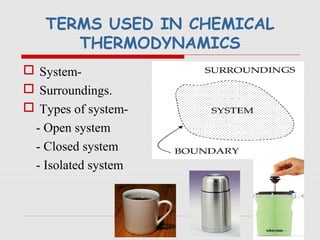
 System-
 Surroundings.
 Types of system-
- Open system
- Closed system
- Isolated system
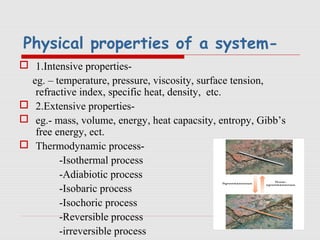
Physical properties of a system-
 1.Intensive properties-
eg. – temperature, pressure, viscosity, surface tension,
refractive index, specific heat, density, etc.
 2.Extensive properties-
 eg.- mass, volume, energy, heat capacsity, entropy, Gibb’s
free energy, ect.
 Thermodynamic process-
-Isothermal process
-Adiabiotic process
-Isobaric process
-Isochoric process
-Reversible process
-irreversible process
INTERNAL ENERGY
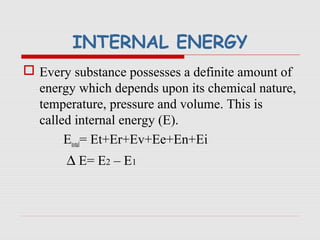
 Every substance possesses a definite amount of
energy which depends upon its chemical nature,
temperature, pressure and volume. This is
called internal energy (E).
Etotal= Et+Er+Ev+Ee+En+Ei
∆ E= E2 – E1
LAW’S OF THERMODYNAMICS
 First law of thermodynamics or law of
conservation of energy-
-Frist stated by Meyer and Helmholtz in 1840.
“Energy can neither be created nor destroyed
although it can be transformed from one form
to another”.
OR
“The total amount of the energy of the
universe is a constant”.
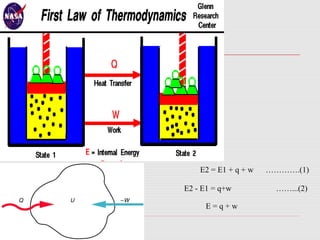
E2 = E1 + q + w ………….(1)
E2 - E1 = q+w ……...(2)
E = q + w
E2 = E1+q + w ………….(1)
E2- E1= q+w ..………...(2)
∆E = q + w
 If work is done by the system, then
∆E = q – w
 +q= heat absorbed by the system.
 –q= heat liberate by the system.
 +w= work done on the system.
 –w= work done by the system.
ENTHALPY(H) AND ENTHLPY
CHANGE(∆H)
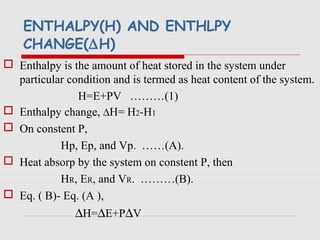
 Enthalpy is the amount of heat stored in the system under
particular condition and is termed as heat content of the system.
H=E+PV ………(1)
 Enthalpy change, ∆H= H2-H1
 On constent P,
Hp, Ep, and Vp. ……(A).
 Heat absorp by the system on constent P, then
HR, ER, and VR. ………(B).
 Eq. ( B)- Eq. (A ),
∆H=∆E+P∆V
SPONTANEOUS PROCESS
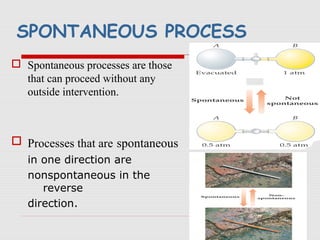
 Spontaneous processes are those
that can proceed without any
outside intervention.
 Processes that are spontaneous
in one direction are
nonspontaneous in the
reverse
direction.
ENTROPY(S)
 Entropy can be thought of as a measure
of the randomness of a system.
Sgas >Sliquid>Ssolid
 Like total energy, E, and enthalpy H, entropy is a state
function.
 Therefore,
∆S = Sfinal − Sinitial
SECOND LAW OF
THERMODYNAMICS
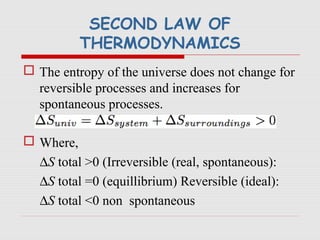
 The entropy of the universe does not change for
reversible processes and increases for
spontaneous processes.
 Where,
∆S total >0 (Irreversible (real, spontaneous):
∆S total =0 (equillibrium) Reversible (ideal):
∆S total <0 non spontaneous
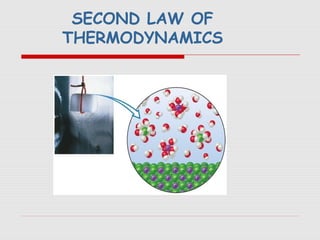
SECOND LAW OF
THERMODYNAMICS
THIRD LAW OF
THERMODYNAMICS
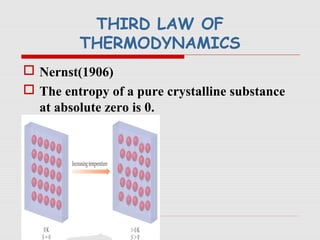
 Nernst(1906)
 The entropy of a pure crystalline substance
at absolute zero is 0.
DIFFERENCE B/N 1st
and 2nd
law
 1st
law is conserned with the accounting of the
various kinds of energy involved in a given
process.
 2nd
low is conserned with the availabity of the
energy of a given system for doing useful work.
 Combining the 1st
and 2nd
law of
thermodynamics (Gibb’s in 1878)
∆G=∆H-T∆S
FREE ENERGY OR GIBB’S FREE ENERGY(G)
 In 1878 J.V. Gibb’s created the free energy function by
combining the 1st
and 2nd
law of thermodynamics.
∆G = ∆H – T(∆S)
 Free energy change (∆G )
G1, H1 and S1
G2, H2 and S2
 A/C to Gibb’s
G1, H1 and S1 ….......(a)
G2, H2 and S2 ……...(b) where T is constant.
 Eq. (b)- Eq. (a),
∆G = ∆H – T(∆S)
FREE ENERGY CHANGES AND
SPONTANEITY OF A PROCESS
 For spontaneous process-
∆Stotal =∆Ssystem+ ∆ Ssurroundings
or ∆Stotal = ∆Ssystem+(-q/T) system
(qpsurroundings= -qpsystem)
or ∆Stotal= ∆S–∆Η/Τ (qp = ∆Η)
 Multiply of –T on both side,
−Τ∆Stotal= −Τ∆S+ ∆Η
Or −Τ∆S = ∆Η −Τ∆S
 For Gibb’s Free energy,
∆G = ∆H – T(∆S) (For spontaneous process-)
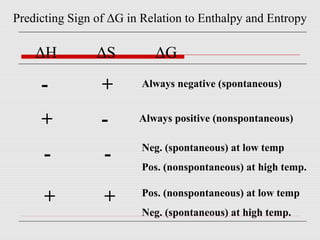
Predicting Sign of ΔG in Relation to Enthalpy and Entropy
ΔH ΔS ΔG
- +
+ -
- -
+ +
Always negative (spontaneous)
Always positive (nonspontaneous)
Neg. (spontaneous) at low temp
Pos. (nonspontaneous) at high temp.
Pos. (nonspontaneous) at low temp
Neg. (spontaneous) at high temp.
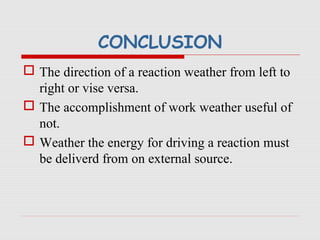
CONCLUSION
 The direction of a reaction weather from left to
right or vise versa.
 The accomplishment of work weather useful of
not.
 Weather the energy for driving a reaction must
be deliverd from on external source.
REFRENCE
 A text book from:-
 - Fundamental of biochemistry- Dr. A C Deb.
 - Fundamental of biochemistry (Multicolored
Edition) by J.L. Jain.
 Principle of biochemistry by Nelson, Cox and
Lehninger.
THANKYOU

Thermodynamics

  • 1.
    Dr. Rachana Choudhary Asstt.Prof. Microbiology “THERMODYNAMICS”
  • 2.
    SYNOPSIS  Interoduction  Defination Terms used in chemical thermodynamics  Internal energy  Law’s of thermodynamics  Difference between 1st and 2nd low of thermodynamics  FREE ENERGY OR GIBB’S FREE ENERGY(G)  Energy crises in nature  Conclusion  Refrence
  • 3.
    INTRODUCTION  The word‘thermodynamics’ means study of flow of heat.  DEFINATION The branch of physical chemistry which deals with the energy changes accompanying a chemical reaction.
  • 4.
    TERMS USED INCHEMICAL THERMODYNAMICS  System-  Surroundings.  Types of system- - Open system - Closed system - Isolated system
  • 5.
    Physical properties ofa system-  1.Intensive properties- eg. – temperature, pressure, viscosity, surface tension, refractive index, specific heat, density, etc.  2.Extensive properties-  eg.- mass, volume, energy, heat capacsity, entropy, Gibb’s free energy, ect.  Thermodynamic process- -Isothermal process -Adiabiotic process -Isobaric process -Isochoric process -Reversible process -irreversible process
  • 6.
    INTERNAL ENERGY  Everysubstance possesses a definite amount of energy which depends upon its chemical nature, temperature, pressure and volume. This is called internal energy (E). Etotal= Et+Er+Ev+Ee+En+Ei ∆ E= E2 – E1
  • 7.
    LAW’S OF THERMODYNAMICS First law of thermodynamics or law of conservation of energy- -Frist stated by Meyer and Helmholtz in 1840. “Energy can neither be created nor destroyed although it can be transformed from one form to another”. OR “The total amount of the energy of the universe is a constant”.
  • 8.
    E2 = E1+ q + w ………….(1) E2 - E1 = q+w ……...(2) E = q + w
  • 9.
    E2 = E1+q+ w ………….(1) E2- E1= q+w ..………...(2) ∆E = q + w  If work is done by the system, then ∆E = q – w  +q= heat absorbed by the system.  –q= heat liberate by the system.  +w= work done on the system.  –w= work done by the system.
  • 10.
    ENTHALPY(H) AND ENTHLPY CHANGE(∆H) Enthalpy is the amount of heat stored in the system under particular condition and is termed as heat content of the system. H=E+PV ………(1)  Enthalpy change, ∆H= H2-H1  On constent P, Hp, Ep, and Vp. ……(A).  Heat absorp by the system on constent P, then HR, ER, and VR. ………(B).  Eq. ( B)- Eq. (A ), ∆H=∆E+P∆V
  • 11.
    SPONTANEOUS PROCESS  Spontaneousprocesses are those that can proceed without any outside intervention.  Processes that are spontaneous in one direction are nonspontaneous in the reverse direction.
  • 12.
    ENTROPY(S)  Entropy canbe thought of as a measure of the randomness of a system. Sgas >Sliquid>Ssolid  Like total energy, E, and enthalpy H, entropy is a state function.  Therefore, ∆S = Sfinal − Sinitial
  • 13.
    SECOND LAW OF THERMODYNAMICS The entropy of the universe does not change for reversible processes and increases for spontaneous processes.  Where, ∆S total >0 (Irreversible (real, spontaneous): ∆S total =0 (equillibrium) Reversible (ideal): ∆S total <0 non spontaneous
  • 14.
  • 15.
    THIRD LAW OF THERMODYNAMICS Nernst(1906)  The entropy of a pure crystalline substance at absolute zero is 0.
  • 16.
    DIFFERENCE B/N 1st and2nd law  1st law is conserned with the accounting of the various kinds of energy involved in a given process.  2nd low is conserned with the availabity of the energy of a given system for doing useful work.  Combining the 1st and 2nd law of thermodynamics (Gibb’s in 1878) ∆G=∆H-T∆S
  • 17.
    FREE ENERGY ORGIBB’S FREE ENERGY(G)  In 1878 J.V. Gibb’s created the free energy function by combining the 1st and 2nd law of thermodynamics. ∆G = ∆H – T(∆S)  Free energy change (∆G ) G1, H1 and S1 G2, H2 and S2  A/C to Gibb’s G1, H1 and S1 ….......(a) G2, H2 and S2 ……...(b) where T is constant.  Eq. (b)- Eq. (a), ∆G = ∆H – T(∆S)
  • 18.
    FREE ENERGY CHANGESAND SPONTANEITY OF A PROCESS  For spontaneous process- ∆Stotal =∆Ssystem+ ∆ Ssurroundings or ∆Stotal = ∆Ssystem+(-q/T) system (qpsurroundings= -qpsystem) or ∆Stotal= ∆S–∆Η/Τ (qp = ∆Η)  Multiply of –T on both side, −Τ∆Stotal= −Τ∆S+ ∆Η Or −Τ∆S = ∆Η −Τ∆S  For Gibb’s Free energy, ∆G = ∆H – T(∆S) (For spontaneous process-)
  • 19.
    Predicting Sign ofΔG in Relation to Enthalpy and Entropy ΔH ΔS ΔG - + + - - - + + Always negative (spontaneous) Always positive (nonspontaneous) Neg. (spontaneous) at low temp Pos. (nonspontaneous) at high temp. Pos. (nonspontaneous) at low temp Neg. (spontaneous) at high temp.
  • 20.
    CONCLUSION  The directionof a reaction weather from left to right or vise versa.  The accomplishment of work weather useful of not.  Weather the energy for driving a reaction must be deliverd from on external source.
  • 21.
    REFRENCE  A textbook from:-  - Fundamental of biochemistry- Dr. A C Deb.  - Fundamental of biochemistry (Multicolored Edition) by J.L. Jain.  Principle of biochemistry by Nelson, Cox and Lehninger.
  • 22.