Thermodynamics
Chemical
Thermodynamics
Thermodynamics: The study of the flow of heat or any other
form of energy into or out of a system as it undergoes a
physical or chemical transformation, is called
Thermodynamics.
Most of the important laws of Physical Chemistry can be
derived from the laws of thermodynamics.
It tells whether a particular physical or chemical change can
occur under a given set of conditions of temperature, pressure
and concentration.
It also helps in predicting how far a physical or chemical
change can proceed, until the equilibrium conditions are
established.
Chemical
Thermodynamics
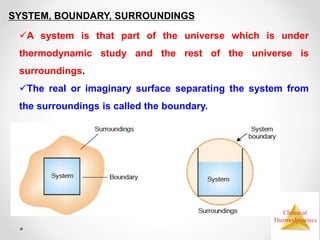
SYSTEM, BOUNDARY, SURROUNDINGS
A system is that part of the universe which is under
thermodynamic study and the rest of the universe is
surroundings.
The real or imaginary surface separating the system from
the surroundings is called the boundary.
Chemical
Thermodynamics
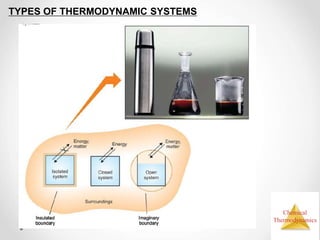
TYPES OF THERMODYNAMIC SYSTEMS
Chemical
Thermodynamics
STATE OF A SYSTEM
A thermodynamic system is said to be in a certain state when
all its properties are fixed.
The fundamental properties which determine the state of
a system are pressure (P), temperature (T), volume (V), mass
and composition. Since a change in the magnitude of such
properties alters the state of the system, these are referred to
as State variables or State functions or Thermodynamic
parameters. It also stands to reason that a change of system
from the initial state to the final state (2nd state) will be
accompanied by change in the state variables.
Chemical
Thermodynamics
THERMODYNAMIC PROCESSES
When a thermodynamic system changes from one state
to another, the operation is called a Process.
(1) Isothermal Processes
Those processes in which the temperature remains
fixed, are termed isothermal processes. dT = 0
(2) Adiabatic Processes
Those processes in which no heat can flow into or out of
the system, are called adiabatic processes. dq = 0
(3) Isobaric Processes
Those processes which take place at constant pressure
are called isobaric processes. dp = 0
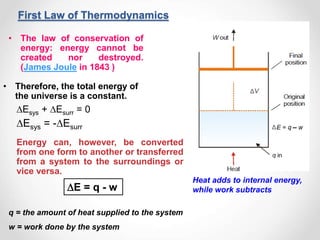
First Law of Thermodynamics
• The law of conservation of
energy: energy cannot be
created nor destroyed.
(James Joule in 1843 )
E = q - w
Esys + Esurr = 0
Esys = -Esurr
• Therefore, the total energy of
the universe is a constant.
Energy can, however, be converted
from one form to another or transferred
from a system to the surroundings or
vice versa.
q = the amount of heat supplied to the system
w = work done by the system
Heat adds to internal energy,
while work subtracts
Chemical
Thermodynamics
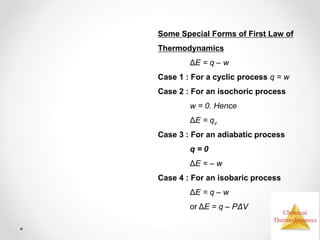
Some Special Forms of First Law of
Thermodynamics
ΔE = q – w
Case 1 : For a cyclic process q = w
Case 2 : For an isochoric process
w = 0. Hence
ΔE = qv
Case 3 : For an adiabatic process
q = 0
ΔE = – w
Case 4 : For an isobaric process
ΔE = q – w
or ΔE = q – PΔV
Chemical
Thermodynamics
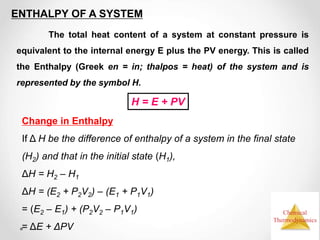
ENTHALPY OF A SYSTEM
The total heat content of a system at constant pressure is
equivalent to the internal energy E plus the PV energy. This is called
the Enthalpy (Greek en = in; thalpos = heat) of the system and is
represented by the symbol H.
Change in Enthalpy
If Δ H be the difference of enthalpy of a system in the final state
(H2) and that in the initial state (H1),
ΔH = H2 – H1
ΔH = (E2 + P2V2) – (E1 + P1V1)
= (E2 – E1) + (P2V2 – P1V1)
= ΔE + ΔPV
H = E + PV
Second Law of
Thermodynamics
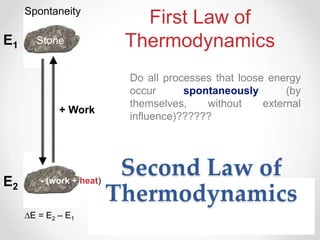
Do all processes that loose energy
occur spontaneously (by
themselves, without external
influence)??????
First Law of
Thermodynamics
Stone
E1
E2
E = E2 – E1
Spontaneity
+ Work
- (work + heat)
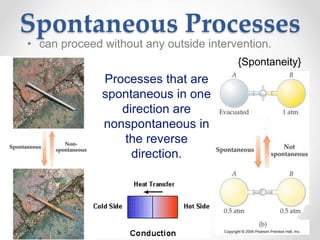
Spontaneous Processes
• can proceed without any outside intervention.
{Spontaneity}
Processes that are
spontaneous in one
direction are
nonspontaneous in
the reverse
direction.
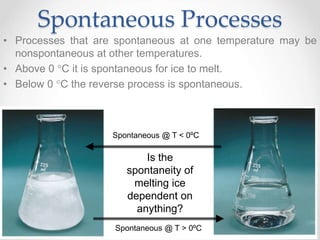
Spontaneous Processes
• Processes that are spontaneous at one temperature may be
nonspontaneous at other temperatures.
• Above 0 C it is spontaneous for ice to melt.
• Below 0 C the reverse process is spontaneous.
Is the
spontaneity of
melting ice
dependent on
anything?
Spontaneous @ T > 0ºC
Spontaneous @ T < 0ºC
Stone
+ Work
Irreversible Processes
• Heat energy is lost to dissipation and
that energy will not be recoverable if the
process is reversed.
• Irreversible processes cannot be undone
by exactly reversing the change to the
system.
• Spontaneous processes are irreversible.
In a reversible process the system
changes in such a way that the system
and surroundings can be put back in their
original states by exactly reversing the
process.
E1
E2
- (work + heat)
Reversible Processes
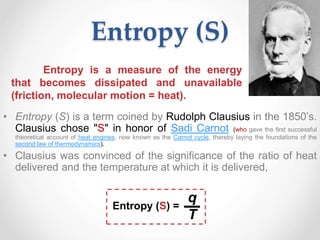
Entropy (S)
• Entropy (S) is a term coined by Rudolph Clausius in the 1850’s.
Clausius chose "S" in honor of Sadi Carnot (who gave the first successful
theoretical account of heat engines, now known as the Carnot cycle, thereby laying the foundations of the
second law of thermodynamics).
• Clausius was convinced of the significance of the ratio of heat
delivered and the temperature at which it is delivered,
q
T
Entropy (S) =
Entropy is a measure of the energy
that becomes dissipated and unavailable
(friction, molecular motion = heat).
Entropy (S)
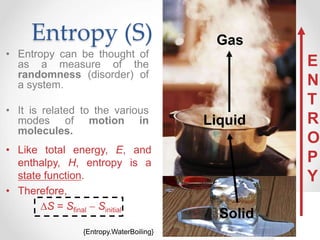
• Entropy can be thought of
as a measure of the
randomness (disorder) of
a system.
• It is related to the various
modes of motion in
molecules.
{Entropy.WaterBoiling}
• Like total energy, E, and
enthalpy, H, entropy is a
state function.
• Therefore,
S = Sfinal  Sinitial
Solid
Liquid
Gas
E
N
T
R
O
P
Y
Second Law of
Thermodynamics
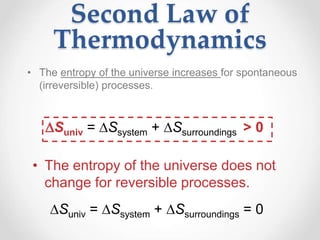
• The entropy of the universe increases for spontaneous
(irreversible) processes.
• The entropy of the universe does not
change for reversible processes.
Suniv = Ssystem + Ssurroundings > 0
Suniv = Ssystem + Ssurroundings = 0
Third Law of
Thermodynamics
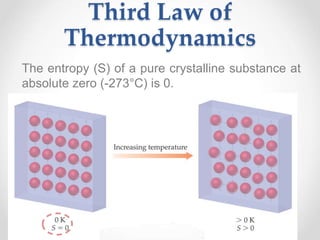
The entropy (S) of a pure crystalline substance at
absolute zero (-273°C) is 0.
Gibbs Free Energy (G)
• When Suniv is positive, G is negative.
• When G is negative, the process is spontaneous.
Gibbs Energy (-TΔS) measures the "useful" or process-initiating work
obtainable from an isothermal, isobaric thermodynamic system. Technically, the
Gibbs free energy is the maximum amount of non-expansion work which can be
extracted from a closed system or this maximum can be attained only in a
completely reversible process.
Guniv = Hsys  TSsys
Free Energy Changes
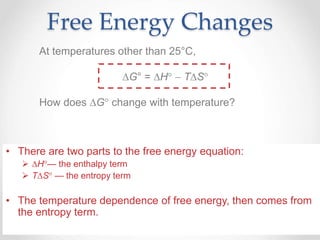
At temperatures other than 25°C,
G° = H  TS
How does G change with temperature?
• There are two parts to the free energy equation:
 H— the enthalpy term
 TS — the entropy term
• The temperature dependence of free energy, then comes from
the entropy term.
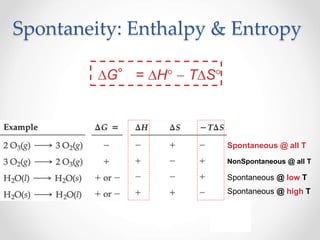
Spontaneity: Enthalpy & Entropy
G° = H  TS
Spontaneous @ all T
NonSpontaneous @ all T
Spontaneous @ high T
Spontaneous @ low T

Thermodynamics.ppt

  • 1.
  • 2.
    Chemical Thermodynamics Thermodynamics: The studyof the flow of heat or any other form of energy into or out of a system as it undergoes a physical or chemical transformation, is called Thermodynamics. Most of the important laws of Physical Chemistry can be derived from the laws of thermodynamics. It tells whether a particular physical or chemical change can occur under a given set of conditions of temperature, pressure and concentration. It also helps in predicting how far a physical or chemical change can proceed, until the equilibrium conditions are established.
  • 3.
    Chemical Thermodynamics SYSTEM, BOUNDARY, SURROUNDINGS Asystem is that part of the universe which is under thermodynamic study and the rest of the universe is surroundings. The real or imaginary surface separating the system from the surroundings is called the boundary.
  • 4.
  • 5.
    Chemical Thermodynamics STATE OF ASYSTEM A thermodynamic system is said to be in a certain state when all its properties are fixed. The fundamental properties which determine the state of a system are pressure (P), temperature (T), volume (V), mass and composition. Since a change in the magnitude of such properties alters the state of the system, these are referred to as State variables or State functions or Thermodynamic parameters. It also stands to reason that a change of system from the initial state to the final state (2nd state) will be accompanied by change in the state variables.
  • 6.
    Chemical Thermodynamics THERMODYNAMIC PROCESSES When athermodynamic system changes from one state to another, the operation is called a Process. (1) Isothermal Processes Those processes in which the temperature remains fixed, are termed isothermal processes. dT = 0 (2) Adiabatic Processes Those processes in which no heat can flow into or out of the system, are called adiabatic processes. dq = 0 (3) Isobaric Processes Those processes which take place at constant pressure are called isobaric processes. dp = 0
  • 7.
    First Law ofThermodynamics • The law of conservation of energy: energy cannot be created nor destroyed. (James Joule in 1843 ) E = q - w Esys + Esurr = 0 Esys = -Esurr • Therefore, the total energy of the universe is a constant. Energy can, however, be converted from one form to another or transferred from a system to the surroundings or vice versa. q = the amount of heat supplied to the system w = work done by the system Heat adds to internal energy, while work subtracts
  • 8.
    Chemical Thermodynamics Some Special Formsof First Law of Thermodynamics ΔE = q – w Case 1 : For a cyclic process q = w Case 2 : For an isochoric process w = 0. Hence ΔE = qv Case 3 : For an adiabatic process q = 0 ΔE = – w Case 4 : For an isobaric process ΔE = q – w or ΔE = q – PΔV
  • 9.
    Chemical Thermodynamics ENTHALPY OF ASYSTEM The total heat content of a system at constant pressure is equivalent to the internal energy E plus the PV energy. This is called the Enthalpy (Greek en = in; thalpos = heat) of the system and is represented by the symbol H. Change in Enthalpy If Δ H be the difference of enthalpy of a system in the final state (H2) and that in the initial state (H1), ΔH = H2 – H1 ΔH = (E2 + P2V2) – (E1 + P1V1) = (E2 – E1) + (P2V2 – P1V1) = ΔE + ΔPV H = E + PV
  • 10.
    Second Law of Thermodynamics Doall processes that loose energy occur spontaneously (by themselves, without external influence)?????? First Law of Thermodynamics Stone E1 E2 E = E2 – E1 Spontaneity + Work - (work + heat)
  • 11.
    Spontaneous Processes • canproceed without any outside intervention. {Spontaneity} Processes that are spontaneous in one direction are nonspontaneous in the reverse direction.
  • 12.
    Spontaneous Processes • Processesthat are spontaneous at one temperature may be nonspontaneous at other temperatures. • Above 0 C it is spontaneous for ice to melt. • Below 0 C the reverse process is spontaneous. Is the spontaneity of melting ice dependent on anything? Spontaneous @ T > 0ºC Spontaneous @ T < 0ºC
  • 13.
    Stone + Work Irreversible Processes •Heat energy is lost to dissipation and that energy will not be recoverable if the process is reversed. • Irreversible processes cannot be undone by exactly reversing the change to the system. • Spontaneous processes are irreversible. In a reversible process the system changes in such a way that the system and surroundings can be put back in their original states by exactly reversing the process. E1 E2 - (work + heat) Reversible Processes
  • 14.
    Entropy (S) • Entropy(S) is a term coined by Rudolph Clausius in the 1850’s. Clausius chose "S" in honor of Sadi Carnot (who gave the first successful theoretical account of heat engines, now known as the Carnot cycle, thereby laying the foundations of the second law of thermodynamics). • Clausius was convinced of the significance of the ratio of heat delivered and the temperature at which it is delivered, q T Entropy (S) = Entropy is a measure of the energy that becomes dissipated and unavailable (friction, molecular motion = heat).
  • 15.
    Entropy (S) • Entropycan be thought of as a measure of the randomness (disorder) of a system. • It is related to the various modes of motion in molecules. {Entropy.WaterBoiling} • Like total energy, E, and enthalpy, H, entropy is a state function. • Therefore, S = Sfinal  Sinitial Solid Liquid Gas E N T R O P Y
  • 16.
    Second Law of Thermodynamics •The entropy of the universe increases for spontaneous (irreversible) processes. • The entropy of the universe does not change for reversible processes. Suniv = Ssystem + Ssurroundings > 0 Suniv = Ssystem + Ssurroundings = 0
  • 17.
    Third Law of Thermodynamics Theentropy (S) of a pure crystalline substance at absolute zero (-273°C) is 0.
  • 18.
    Gibbs Free Energy(G) • When Suniv is positive, G is negative. • When G is negative, the process is spontaneous. Gibbs Energy (-TΔS) measures the "useful" or process-initiating work obtainable from an isothermal, isobaric thermodynamic system. Technically, the Gibbs free energy is the maximum amount of non-expansion work which can be extracted from a closed system or this maximum can be attained only in a completely reversible process. Guniv = Hsys  TSsys
  • 19.
    Free Energy Changes Attemperatures other than 25°C, G° = H  TS How does G change with temperature? • There are two parts to the free energy equation:  H— the enthalpy term  TS — the entropy term • The temperature dependence of free energy, then comes from the entropy term.
  • 20.
    Spontaneity: Enthalpy &Entropy G° = H  TS Spontaneous @ all T NonSpontaneous @ all T Spontaneous @ high T Spontaneous @ low T