Spontaneity, Entropy & Free Energy
First Law of Thermodynamics
Basically the law of conservation of energy
energy can be neither created nor destroyed
i.e., the energy of the universe is constant
• the total energy is constant
• energy can be interchanged
– e.g. potential energy (stored in chemical bonds) can be
converted to thermal energy in a chemical reaction
– CH4 + O2 --> CO2 + H2O + energy
Doesn’t tell us why a reaction proceeds in a
particular direction
Spontaneity, Entropy & Free Energy
Spontaneous Processes and Entropy
Spontaneous processes occurs without
outside intervention
Spontaneous processes can be fast or slow
Spontaneity, Entropy & Free Energy
Thermodynamics
lets us predict whether a process will occur
tells us the direction a reaction will go
only considers the initial and final states
does not require knowledge of the pathway
taken for a reaction
Spontaneity, Entropy & Free Energy
Kinetics
depends on the pathway taken
tells us the speed of the process
depends on
activation energy
temperature
concentration
catalysts
Spontaneity, Entropy & Free Energy
Spontaneous Processes
a ball rolls downhill, but the ball never
spontaneously rolls uphill
steel rusts, but the rust never spontaneously
forms iron and oxygen
a gas fills its container, but a gas will never
spontaneously collect in one corner of the
container.
Water spontaneously freezes at temperatures
below 0o
C
Spontaneity, Entropy & Free Energy
What thermodynamic principle explains why
these processes occur in one direction?
The driving force for a spontaneous reaction
is an increase in the entropy of the universe
Spontaneity, Entropy & Free Energy
Entropy
Symbol: S
A measure of randomness or disorder
The natural progression is from order to disorder
It is natural for disorder to increase
Entropy is a thermodynamic function
Describes the number of arrangements that are
available to a system in a given state
Spontaneity, Entropy & Free Energy
Entropy
The greater the number of possible
arrangements, the greater the entropy of a
system, i.e., there is a large positional
probability.
The positional probability or the entropy
increases as a solid changes from a liquid or
as a liquid changes to a gas
Spontaneity, Entropy & Free Energy
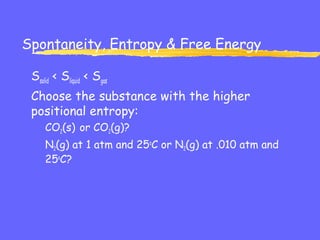
Ssolid < Sliquid < Sgas
Choose the substance with the higher
positional entropy:
CO2(s) or CO2(g)?
N2(g) at 1 atm and 25o
C or N2(g) at .010 atm and
25o
C?
Spontaneity, Entropy & Free Energy
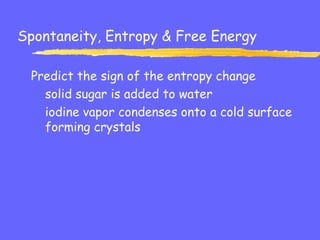
Predict the sign of the entropy change
solid sugar is added to water
iodine vapor condenses onto a cold surface
forming crystals
Spontaneity, Entropy & Free Energy
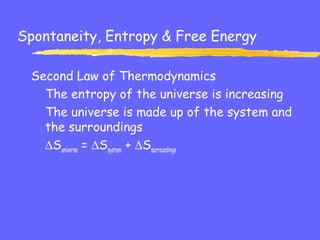
Second Law of Thermodynamics
The entropy of the universe is increasing
The universe is made up of the system and
the surroundings
∆Suniverse = ∆Ssystem + ∆Ssurroundings
Spontaneity, Entropy & Free Energy
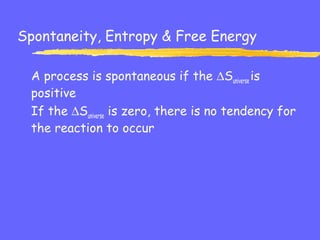
A process is spontaneous if the ∆Suniverse is
positive
If the ∆Suniverse is zero, there is no tendency for
the reaction to occur
Spontaneity, Entropy & Free Energy
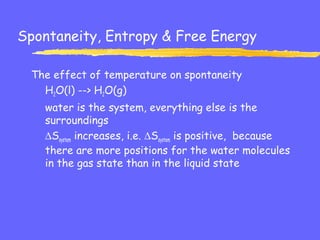
The effect of temperature on spontaneity
H2O(l) --> H2O(g)
water is the system, everything else is the
surroundings
∆Ssystem increases, i.e. ∆Ssystem is positive, because
there are more positions for the water molecules
in the gas state than in the liquid state
Spontaneity, Entropy & Free Energy
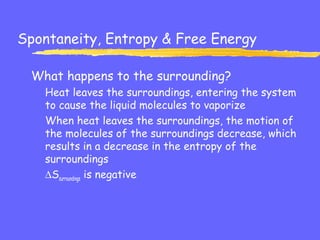
What happens to the surrounding?
Heat leaves the surroundings, entering the system
to cause the liquid molecules to vaporize
When heat leaves the surroundings, the motion of
the molecules of the surroundings decrease, which
results in a decrease in the entropy of the
surroundings
∆Ssurroundings is negative
Spontaneity, Entropy & Free Energy
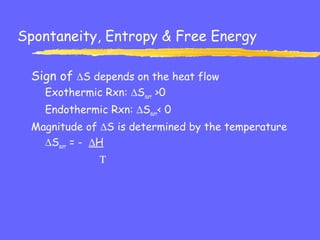
Sign of ∆S depends on the heat flow
Exothermic Rxn: ∆Ssurr >0
Endothermic Rxn: ∆Ssurr< 0
Magnitude of ∆S is determined by the temperature
∆Ssurr = - ∆H
Τ
Spontaneity, Entropy & Free Energy
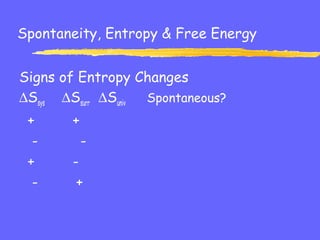
Signs of Entropy Changes
∆Ssys ∆Ssurr ∆Suniv Spontaneous?
+ +
- -
+ -
- +
Spontaneity, Entropy & Free Energy
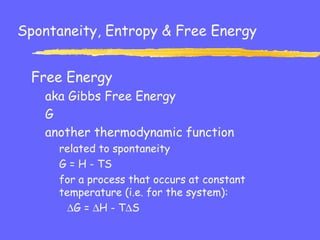
Free Energy
aka Gibbs Free Energy
G
another thermodynamic function
related to spontaneity
G = H - TS
for a process that occurs at constant
temperature (i.e. for the system):
∆G = ∆H - T∆S
Spontaneity, Entropy & Free Energy
How does the free energy related to
spontaneity?
∆G = ∆H - T∆S
− ∆G = - ∆H + ∆S (remember, - ∆H = ∆Ssurr )
T T T
−∆G = ∆Ssurr + ∆Ssys (remember, ∆Ssurr + ∆Ssys = ∆Suniv)
T
-∆G = ∆Suniv
T
Spontaneity, Entropy & Free Energy
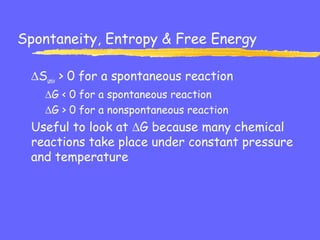
∆Suniv > 0 for a spontaneous reaction
∆G < 0 for a spontaneous reaction
∆G > 0 for a nonspontaneous reaction
Useful to look at ∆G because many chemical
reactions take place under constant pressure
and temperature
Spontaneity, Entropy & Free Energy
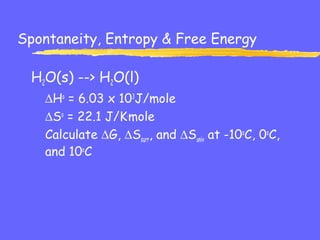
H2O(s) --> H2O(l)
∆Ho
= 6.03 x 10³
J/mole
∆So
= 22.1 J/K.
mole
Calculate ∆G, ∆Ssurr, and ∆Suniv at -10o
C, 0o
C,
and 10o
C
Spontaneity, Entropy & Free Energy
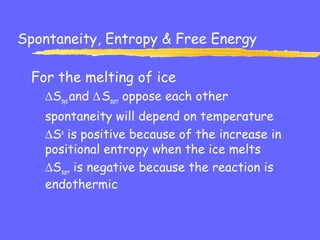
For the melting of ice
∆Ssys and ∆Ssurr oppose each other
spontaneity will depend on temperature
∆So
is positive because of the increase in
positional entropy when the ice melts
∆Ssurr is negative because the reaction is
endothermic
Spontaneity, Entropy & Free Energy
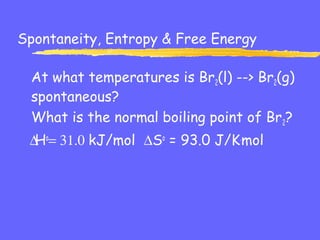
At what temperatures is Br2(l) --> Br2(g)
spontaneous?
What is the normal boiling point of Br2?
∆Ho
= 31.0 kJ/mol ∆So
= 93.0 J/K.
mol
Spontaneity, Entropy & Free Energy
Entropy Changes in Chemical Reactions
Just like physical changes, entropy changes
in the surroundings are determined by heat
flow
Entropy changes in the system are
determined by positional entropy (the
change in the number of possible
arrangements)
Spontaneity, Entropy & Free Energy
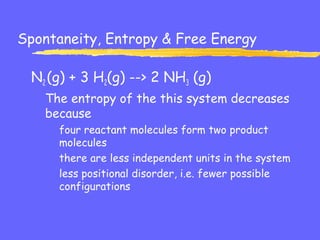
N2 (g) + 3 H2(g) --> 2 NH3 (g)
The entropy of the this system decreases
because
four reactant molecules form two product
molecules
there are less independent units in the system
less positional disorder, i.e. fewer possible
configurations
Spontaneity, Entropy & Free Energy
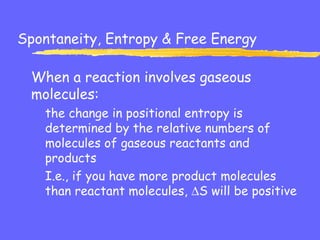
When a reaction involves gaseous
molecules:
the change in positional entropy is
determined by the relative numbers of
molecules of gaseous reactants and
products
I.e., if you have more product molecules
than reactant molecules, ∆S will be positive
Spontaneity, Entropy & Free Energy
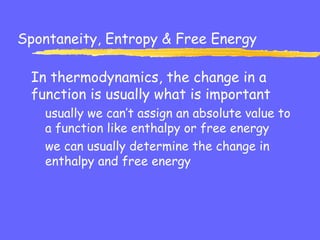
In thermodynamics, the change in a
function is usually what is important
usually we can’t assign an absolute value to
a function like enthalpy or free energy
we can usually determine the change in
enthalpy and free energy
Spontaneity, Entropy & Free Energy
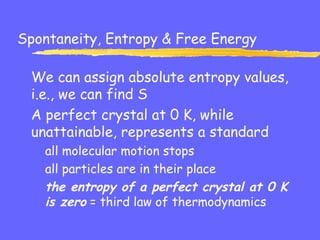
We can assign absolute entropy values,
i.e., we can find S
A perfect crystal at 0 K, while
unattainable, represents a standard
all molecular motion stops
all particles are in their place
the entropy of a perfect crystal at 0 K
is zero = third law of thermodynamics
Spontaneity, Entropy & Free Energy
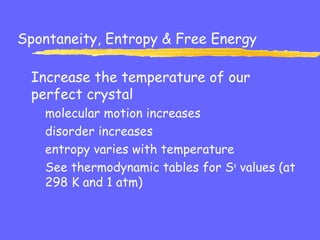
Increase the temperature of our
perfect crystal
molecular motion increases
disorder increases
entropy varies with temperature
See thermodynamic tables for So
values (at
298 K and 1 atm)
Spontaneity, Entropy & Free Energy
Entropy is a state function
entropy does not depend on the pathway
taken
∆Srxn = Σn∆So
products- Σn∆So
reactant
Spontaneity, Entropy & Free Energy
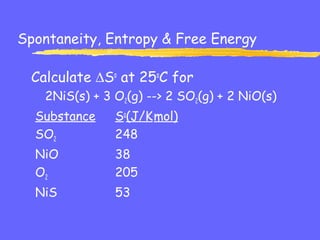
Calculate ∆So
at 25o
C for
2NiS(s) + 3 O2(g) --> 2 SO2(g) + 2 NiO(s)
Substance So
(J/K.
mol)
SO2 248
NiO 38
O2 205
NiS 53
Spontaneity, Entropy & Free Energy
Calculate ∆So
for
Al2O3(s) + 3 H2(g) --> 2 Al(s) + 3 H2O(g)
Substance So
(J/K.
mol)
Al2O3 51
H2 131
Al 28
H2O 189
Spontaneity, Entropy & Free Energy
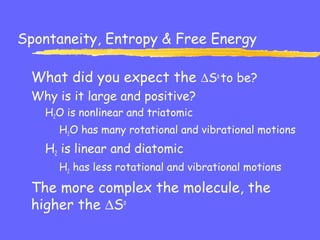
What did you expect the ∆So
to be?
Why is it large and positive?
H2O is nonlinear and triatomic
H2O has many rotational and vibrational motions
H2 is linear and diatomic
H2 has less rotational and vibrational motions
The more complex the molecule, the
higher the ∆So
Spontaneity, Entropy & Free Energy
Free Energy and Chemical Reactions
Standard Free Energy Change
∆Go
the change in the free energy that occurs if the
reactants in their standard states are changed to
products in their standard states
can’t be measured directly
calculate from other values
allows us to predict the tendency for a reaction to
go
Spontaneity, Entropy & Free Energy
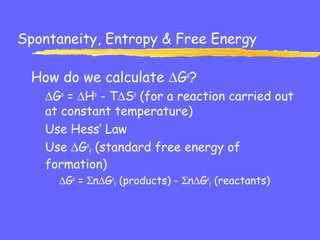
How do we calculate ∆Go
?
∆Go
= ∆Ho
- T∆So
(for a reaction carried out
at constant temperature)
Use Hess’ Law
Use ∆Go
f (standard free energy of
formation)
∆Go
= Σn∆Go
f (products) - Σn∆Go
f (reactants)
Spontaneity, Entropy & Free Energy
Calculate ∆Go
for the reaction at 25o
C
2SO2(g) + O2(g) --> 2 SO3(g)
Substance ∆Ho
f(kJ/mol) ∆So
(J/K.
mol)
SO2(g) -297 248
SO3 -396 257
O2 0 205
Spontaneity, Entropy & Free Energy
Calculate ∆Go
for the reaction Cdia --> Cgr
using the following data:
Cdia + O2 --> CO2(g) ∆Go
= -397 kJ
Cgr + O2 --> CO2(g) ∆Go
= -394 kJ
Spontaneity, Entropy & Free Energy
Calculate ∆Go
for the reaction
2CH3OH + 3 O2--> 2 CO2 + 4 H2O
Substance ∆Go
f(kJ/mol)
CH3OH -163
O2 0
CO2 -394
H2O -229
Spontaneity, Entropy & Free Energy
The dependence of free energy on pressure
How does pressure affect enthalpy and entropy?
Pressure does not affect enthalpy
Pressure does affect entropy because pressure
depends on the volume
• 1 mole of a gas at 10.0 L has more positions available
than 1 mole of a gas at 1.0 L
• Slarge volume > Ssmall volume
• Slow pressure > Shigh pressure
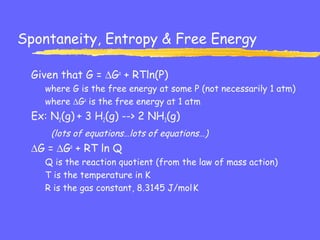
Spontaneity, Entropy & Free Energy
Given that G = ∆Go
+ RTln(P)
where G is the free energy at some P (not necessarily 1 atm)
where ∆Go
is the free energy at 1 atm
Ex: N2(g) + 3 H2(g) --> 2 NH3(g)
(lots of equations…lots of equations…)
∆G = ∆Go
+ RT ln Q
Q is the reaction quotient (from the law of mass action)
T is the temperature in K
R is the gas constant, 8.3145 J/mol.
K
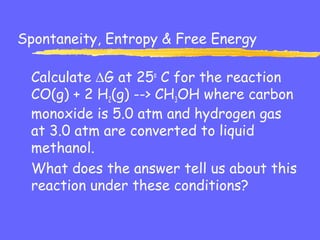
Spontaneity, Entropy & Free Energy
Calculate ∆G at 25o
C for the reaction
CO(g) + 2 H2(g) --> CH3OH where carbon
monoxide is 5.0 atm and hydrogen gas
at 3.0 atm are converted to liquid
methanol.
What does the answer tell us about this
reaction under these conditions?
Spontaneity, Entropy & Free Energy
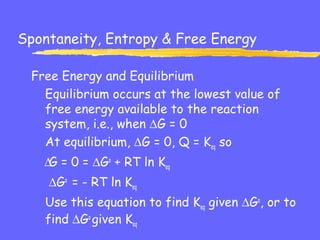
Free Energy and Equilibrium
Equilibrium occurs at the lowest value of
free energy available to the reaction
system, i.e., when ∆G = 0
At equilibrium, ∆G = 0, Q = Keq so
∆G = 0 = ∆Go
+ RT ln Keq
∆Go
= - RT ln Keq
Use this equation to find Keq given ∆Go
, or to
find ∆Go
given Keq
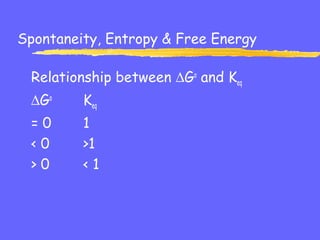
Spontaneity, Entropy & Free Energy
Relationship between ∆Go
and Keq
∆Go
Keq
= 0 1
< 0 >1
> 0 < 1
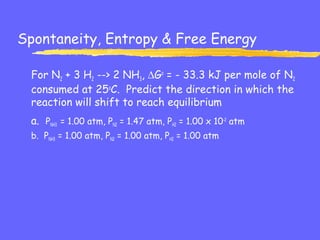
Spontaneity, Entropy & Free Energy
For N2 + 3 H2 --> 2 NH3, ∆Go
= - 33.3 kJ per mole of N2
consumed at 25o
C. Predict the direction in which the
reaction will shift to reach equilibrium
a. PNH3 = 1.00 atm, PN2 = 1.47 atm, PH2 = 1.00 x 10⁻²
atm
b. PNH3 = 1.00 atm, PN2 = 1.00 atm, PH2 = 1.00 atm
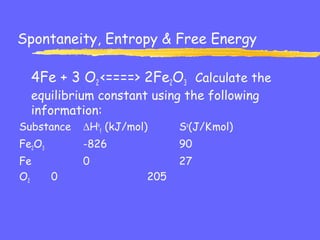
Spontaneity, Entropy & Free Energy
4Fe + 3 O2 <====> 2Fe2O3 Calculate the
equilibrium constant using the following
information:
Substance ∆Ho
f (kJ/mol) So
(J/K.
mol)
Fe2O3 -826 90
Fe 0 27
O2 0 205
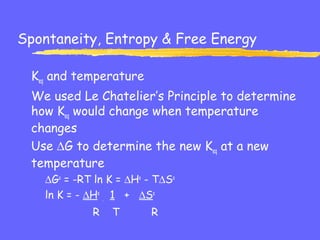
Spontaneity, Entropy & Free Energy
Keq and temperature
We used Le Chatelier’s Principle to determine
how Keq would change when temperature
changes
Use ∆G to determine the new Keq at a new
temperature
∆Go
= -RT ln K = ∆Ho
- T∆So
ln K = - ∆Ho
. 1 + ∆So
R T R

Spontaneity entropy___free_energy

  • 1.
    Spontaneity, Entropy &Free Energy First Law of Thermodynamics Basically the law of conservation of energy energy can be neither created nor destroyed i.e., the energy of the universe is constant • the total energy is constant • energy can be interchanged – e.g. potential energy (stored in chemical bonds) can be converted to thermal energy in a chemical reaction – CH4 + O2 --> CO2 + H2O + energy Doesn’t tell us why a reaction proceeds in a particular direction
  • 2.
    Spontaneity, Entropy &Free Energy Spontaneous Processes and Entropy Spontaneous processes occurs without outside intervention Spontaneous processes can be fast or slow
  • 3.
    Spontaneity, Entropy &Free Energy Thermodynamics lets us predict whether a process will occur tells us the direction a reaction will go only considers the initial and final states does not require knowledge of the pathway taken for a reaction
  • 4.
    Spontaneity, Entropy &Free Energy Kinetics depends on the pathway taken tells us the speed of the process depends on activation energy temperature concentration catalysts
  • 5.
    Spontaneity, Entropy &Free Energy Spontaneous Processes a ball rolls downhill, but the ball never spontaneously rolls uphill steel rusts, but the rust never spontaneously forms iron and oxygen a gas fills its container, but a gas will never spontaneously collect in one corner of the container. Water spontaneously freezes at temperatures below 0o C
  • 6.
    Spontaneity, Entropy &Free Energy What thermodynamic principle explains why these processes occur in one direction? The driving force for a spontaneous reaction is an increase in the entropy of the universe
  • 7.
    Spontaneity, Entropy &Free Energy Entropy Symbol: S A measure of randomness or disorder The natural progression is from order to disorder It is natural for disorder to increase Entropy is a thermodynamic function Describes the number of arrangements that are available to a system in a given state
  • 8.
    Spontaneity, Entropy &Free Energy Entropy The greater the number of possible arrangements, the greater the entropy of a system, i.e., there is a large positional probability. The positional probability or the entropy increases as a solid changes from a liquid or as a liquid changes to a gas
  • 9.
    Spontaneity, Entropy &Free Energy Ssolid < Sliquid < Sgas Choose the substance with the higher positional entropy: CO2(s) or CO2(g)? N2(g) at 1 atm and 25o C or N2(g) at .010 atm and 25o C?
  • 10.
    Spontaneity, Entropy &Free Energy Predict the sign of the entropy change solid sugar is added to water iodine vapor condenses onto a cold surface forming crystals
  • 11.
    Spontaneity, Entropy &Free Energy Second Law of Thermodynamics The entropy of the universe is increasing The universe is made up of the system and the surroundings ∆Suniverse = ∆Ssystem + ∆Ssurroundings
  • 12.
    Spontaneity, Entropy &Free Energy A process is spontaneous if the ∆Suniverse is positive If the ∆Suniverse is zero, there is no tendency for the reaction to occur
  • 13.
    Spontaneity, Entropy &Free Energy The effect of temperature on spontaneity H2O(l) --> H2O(g) water is the system, everything else is the surroundings ∆Ssystem increases, i.e. ∆Ssystem is positive, because there are more positions for the water molecules in the gas state than in the liquid state
  • 14.
    Spontaneity, Entropy &Free Energy What happens to the surrounding? Heat leaves the surroundings, entering the system to cause the liquid molecules to vaporize When heat leaves the surroundings, the motion of the molecules of the surroundings decrease, which results in a decrease in the entropy of the surroundings ∆Ssurroundings is negative
  • 15.
    Spontaneity, Entropy &Free Energy Sign of ∆S depends on the heat flow Exothermic Rxn: ∆Ssurr >0 Endothermic Rxn: ∆Ssurr< 0 Magnitude of ∆S is determined by the temperature ∆Ssurr = - ∆H Τ
  • 16.
    Spontaneity, Entropy &Free Energy Signs of Entropy Changes ∆Ssys ∆Ssurr ∆Suniv Spontaneous? + + - - + - - +
  • 17.
    Spontaneity, Entropy &Free Energy Free Energy aka Gibbs Free Energy G another thermodynamic function related to spontaneity G = H - TS for a process that occurs at constant temperature (i.e. for the system): ∆G = ∆H - T∆S
  • 18.
    Spontaneity, Entropy &Free Energy How does the free energy related to spontaneity? ∆G = ∆H - T∆S − ∆G = - ∆H + ∆S (remember, - ∆H = ∆Ssurr ) T T T −∆G = ∆Ssurr + ∆Ssys (remember, ∆Ssurr + ∆Ssys = ∆Suniv) T -∆G = ∆Suniv T
  • 19.
    Spontaneity, Entropy &Free Energy ∆Suniv > 0 for a spontaneous reaction ∆G < 0 for a spontaneous reaction ∆G > 0 for a nonspontaneous reaction Useful to look at ∆G because many chemical reactions take place under constant pressure and temperature
  • 20.
    Spontaneity, Entropy &Free Energy H2O(s) --> H2O(l) ∆Ho = 6.03 x 10³ J/mole ∆So = 22.1 J/K. mole Calculate ∆G, ∆Ssurr, and ∆Suniv at -10o C, 0o C, and 10o C
  • 21.
    Spontaneity, Entropy &Free Energy For the melting of ice ∆Ssys and ∆Ssurr oppose each other spontaneity will depend on temperature ∆So is positive because of the increase in positional entropy when the ice melts ∆Ssurr is negative because the reaction is endothermic
  • 22.
    Spontaneity, Entropy &Free Energy At what temperatures is Br2(l) --> Br2(g) spontaneous? What is the normal boiling point of Br2? ∆Ho = 31.0 kJ/mol ∆So = 93.0 J/K. mol
  • 23.
    Spontaneity, Entropy &Free Energy Entropy Changes in Chemical Reactions Just like physical changes, entropy changes in the surroundings are determined by heat flow Entropy changes in the system are determined by positional entropy (the change in the number of possible arrangements)
  • 24.
    Spontaneity, Entropy &Free Energy N2 (g) + 3 H2(g) --> 2 NH3 (g) The entropy of the this system decreases because four reactant molecules form two product molecules there are less independent units in the system less positional disorder, i.e. fewer possible configurations
  • 25.
    Spontaneity, Entropy &Free Energy When a reaction involves gaseous molecules: the change in positional entropy is determined by the relative numbers of molecules of gaseous reactants and products I.e., if you have more product molecules than reactant molecules, ∆S will be positive
  • 26.
    Spontaneity, Entropy &Free Energy In thermodynamics, the change in a function is usually what is important usually we can’t assign an absolute value to a function like enthalpy or free energy we can usually determine the change in enthalpy and free energy
  • 27.
    Spontaneity, Entropy &Free Energy We can assign absolute entropy values, i.e., we can find S A perfect crystal at 0 K, while unattainable, represents a standard all molecular motion stops all particles are in their place the entropy of a perfect crystal at 0 K is zero = third law of thermodynamics
  • 28.
    Spontaneity, Entropy &Free Energy Increase the temperature of our perfect crystal molecular motion increases disorder increases entropy varies with temperature See thermodynamic tables for So values (at 298 K and 1 atm)
  • 29.
    Spontaneity, Entropy &Free Energy Entropy is a state function entropy does not depend on the pathway taken ∆Srxn = Σn∆So products- Σn∆So reactant
  • 30.
    Spontaneity, Entropy &Free Energy Calculate ∆So at 25o C for 2NiS(s) + 3 O2(g) --> 2 SO2(g) + 2 NiO(s) Substance So (J/K. mol) SO2 248 NiO 38 O2 205 NiS 53
  • 31.
    Spontaneity, Entropy &Free Energy Calculate ∆So for Al2O3(s) + 3 H2(g) --> 2 Al(s) + 3 H2O(g) Substance So (J/K. mol) Al2O3 51 H2 131 Al 28 H2O 189
  • 32.
    Spontaneity, Entropy &Free Energy What did you expect the ∆So to be? Why is it large and positive? H2O is nonlinear and triatomic H2O has many rotational and vibrational motions H2 is linear and diatomic H2 has less rotational and vibrational motions The more complex the molecule, the higher the ∆So
  • 33.
    Spontaneity, Entropy &Free Energy Free Energy and Chemical Reactions Standard Free Energy Change ∆Go the change in the free energy that occurs if the reactants in their standard states are changed to products in their standard states can’t be measured directly calculate from other values allows us to predict the tendency for a reaction to go
  • 34.
    Spontaneity, Entropy &Free Energy How do we calculate ∆Go ? ∆Go = ∆Ho - T∆So (for a reaction carried out at constant temperature) Use Hess’ Law Use ∆Go f (standard free energy of formation) ∆Go = Σn∆Go f (products) - Σn∆Go f (reactants)
  • 35.
    Spontaneity, Entropy &Free Energy Calculate ∆Go for the reaction at 25o C 2SO2(g) + O2(g) --> 2 SO3(g) Substance ∆Ho f(kJ/mol) ∆So (J/K. mol) SO2(g) -297 248 SO3 -396 257 O2 0 205
  • 36.
    Spontaneity, Entropy &Free Energy Calculate ∆Go for the reaction Cdia --> Cgr using the following data: Cdia + O2 --> CO2(g) ∆Go = -397 kJ Cgr + O2 --> CO2(g) ∆Go = -394 kJ
  • 37.
    Spontaneity, Entropy &Free Energy Calculate ∆Go for the reaction 2CH3OH + 3 O2--> 2 CO2 + 4 H2O Substance ∆Go f(kJ/mol) CH3OH -163 O2 0 CO2 -394 H2O -229
  • 38.
    Spontaneity, Entropy &Free Energy The dependence of free energy on pressure How does pressure affect enthalpy and entropy? Pressure does not affect enthalpy Pressure does affect entropy because pressure depends on the volume • 1 mole of a gas at 10.0 L has more positions available than 1 mole of a gas at 1.0 L • Slarge volume > Ssmall volume • Slow pressure > Shigh pressure
  • 39.
    Spontaneity, Entropy &Free Energy Given that G = ∆Go + RTln(P) where G is the free energy at some P (not necessarily 1 atm) where ∆Go is the free energy at 1 atm Ex: N2(g) + 3 H2(g) --> 2 NH3(g) (lots of equations…lots of equations…) ∆G = ∆Go + RT ln Q Q is the reaction quotient (from the law of mass action) T is the temperature in K R is the gas constant, 8.3145 J/mol. K
  • 40.
    Spontaneity, Entropy &Free Energy Calculate ∆G at 25o C for the reaction CO(g) + 2 H2(g) --> CH3OH where carbon monoxide is 5.0 atm and hydrogen gas at 3.0 atm are converted to liquid methanol. What does the answer tell us about this reaction under these conditions?
  • 41.
    Spontaneity, Entropy &Free Energy Free Energy and Equilibrium Equilibrium occurs at the lowest value of free energy available to the reaction system, i.e., when ∆G = 0 At equilibrium, ∆G = 0, Q = Keq so ∆G = 0 = ∆Go + RT ln Keq ∆Go = - RT ln Keq Use this equation to find Keq given ∆Go , or to find ∆Go given Keq
  • 42.
    Spontaneity, Entropy &Free Energy Relationship between ∆Go and Keq ∆Go Keq = 0 1 < 0 >1 > 0 < 1
  • 43.
    Spontaneity, Entropy &Free Energy For N2 + 3 H2 --> 2 NH3, ∆Go = - 33.3 kJ per mole of N2 consumed at 25o C. Predict the direction in which the reaction will shift to reach equilibrium a. PNH3 = 1.00 atm, PN2 = 1.47 atm, PH2 = 1.00 x 10⁻² atm b. PNH3 = 1.00 atm, PN2 = 1.00 atm, PH2 = 1.00 atm
  • 44.
    Spontaneity, Entropy &Free Energy 4Fe + 3 O2 <====> 2Fe2O3 Calculate the equilibrium constant using the following information: Substance ∆Ho f (kJ/mol) So (J/K. mol) Fe2O3 -826 90 Fe 0 27 O2 0 205
  • 45.
    Spontaneity, Entropy &Free Energy Keq and temperature We used Le Chatelier’s Principle to determine how Keq would change when temperature changes Use ∆G to determine the new Keq at a new temperature ∆Go = -RT ln K = ∆Ho - T∆So ln K = - ∆Ho . 1 + ∆So R T R