Group 1
Spontaneous
Generation
Spontaneous Generation
• the hypothetical process by which living
organisms develop from nonliving matter;
also, the archaic theory that utilized this
process to explain the origin of life. According
to this theory, pieces
of cheese and bread wrapped in rags and left
in a dark corner, for example, were thus
thought to produce mice, because after
several weeks there were mice in the rags.
Many believed in spontaneous generation
because it explained such occurrences as the
appearance of maggots on decaying meat.
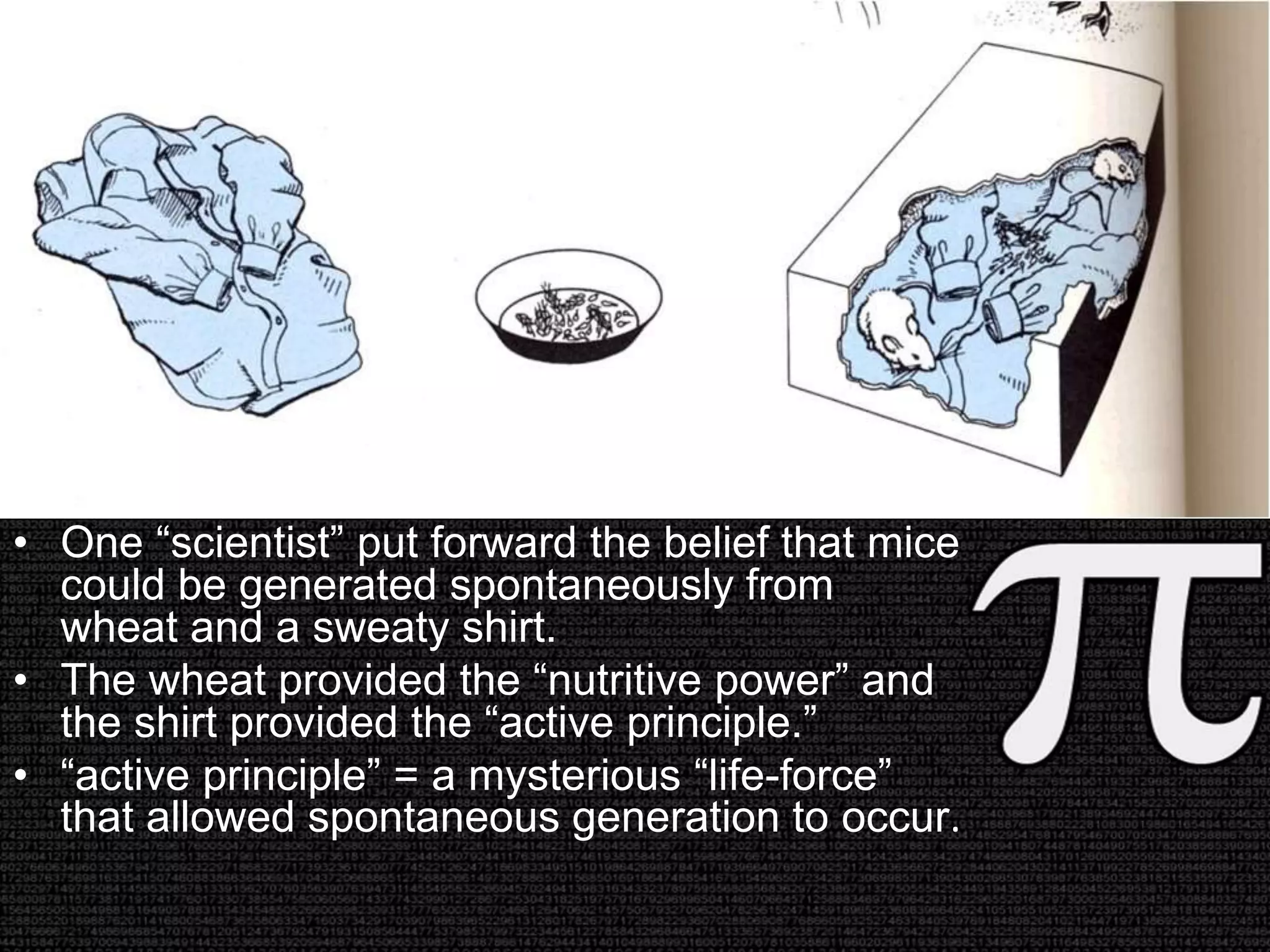
• One “scientist” put forward the belief that mice
could be generated spontaneously from
wheat and a sweaty shirt.
• The wheat provided the “nutritive power” and
the shirt provided the “active principle.”
• “active principle” = a mysterious “life-force”
that allowed spontaneous generation to occur.
1668 -- Francisco Redi (Italian physician &
poet)-- attempted to disprove the theory of
Spontaneous Generation.
“The flesh of dead animals cannot engender
worms unless the eggs of the living being
deposited therein”
• Put dead snakes, eels, and veal in large
wide mouthed vessels. Sealed one set
with wax and left the other set open to air.
• Decaying meat was teeming with
maggots, sealed meat had no maggots
• Wax sealed vessels failed to produce
maggots because flies were unable to
reach the meat
Redi part 2 – answer to critics
• flies laid eggs on top
of mesh
• no maggots in meat
fine mesh allows in air, but not flies
John Needham (English Clergyman) wondered if
this would work with micro organisms in1745
• Everyone knew that boiling killed organisms.
• Needham prepared various broths and showed
that they contained microbes.
• Then he boiled them, and showed that there were
no longer any microbes.
• He ensured the stoppers were loose, so that air
would not be excluded
• Then, after a few days, microbes had reappeared!
• This was “proof” that the microbes had
spontaneously generated from the non-living
broth.
Spallanzani’s (Italian Naturalist) -- 1745
• Disagreed with Needham
• Claimed he didn’t seal jars well enough
• He said microbes could have come from the air
• He repeated Needham’s experiment, but changed two things:
• -boiled flasks longer, and
• -SEALED THEM after boiling by fusing the glass tops shut
• -(hermetically sealed – absolutely airtight)
• Result: NO growth in ANY flask
Group 1 Spontaneous Generation (How Life Begins ?)

Group 1 Spontaneous Generation (How Life Begins ?)

  • 1.
  • 2.
    Spontaneous Generation • thehypothetical process by which living organisms develop from nonliving matter; also, the archaic theory that utilized this process to explain the origin of life. According to this theory, pieces of cheese and bread wrapped in rags and left in a dark corner, for example, were thus thought to produce mice, because after several weeks there were mice in the rags. Many believed in spontaneous generation because it explained such occurrences as the appearance of maggots on decaying meat.
  • 4.
    • One “scientist”put forward the belief that mice could be generated spontaneously from wheat and a sweaty shirt. • The wheat provided the “nutritive power” and the shirt provided the “active principle.” • “active principle” = a mysterious “life-force” that allowed spontaneous generation to occur.
  • 5.
    1668 -- FranciscoRedi (Italian physician & poet)-- attempted to disprove the theory of Spontaneous Generation.
  • 6.
    “The flesh ofdead animals cannot engender worms unless the eggs of the living being deposited therein” • Put dead snakes, eels, and veal in large wide mouthed vessels. Sealed one set with wax and left the other set open to air. • Decaying meat was teeming with maggots, sealed meat had no maggots • Wax sealed vessels failed to produce maggots because flies were unable to reach the meat
  • 7.
    Redi part 2– answer to critics • flies laid eggs on top of mesh • no maggots in meat fine mesh allows in air, but not flies
  • 8.
    John Needham (EnglishClergyman) wondered if this would work with micro organisms in1745 • Everyone knew that boiling killed organisms. • Needham prepared various broths and showed that they contained microbes. • Then he boiled them, and showed that there were no longer any microbes. • He ensured the stoppers were loose, so that air would not be excluded • Then, after a few days, microbes had reappeared! • This was “proof” that the microbes had spontaneously generated from the non-living broth.
  • 9.
    Spallanzani’s (Italian Naturalist)-- 1745 • Disagreed with Needham • Claimed he didn’t seal jars well enough • He said microbes could have come from the air • He repeated Needham’s experiment, but changed two things: • -boiled flasks longer, and • -SEALED THEM after boiling by fusing the glass tops shut • -(hermetically sealed – absolutely airtight) • Result: NO growth in ANY flask