ANWESA KAR
M.TECH(THERMAL ENGG.)
 Thermo means Heat
 Dynamics means motion under the action
of force
 Thermodynamics is the branch of science
dealing with heat or work (Broadly energy
interaction) and related changes in the
physical properties of substance.
Macroscopic
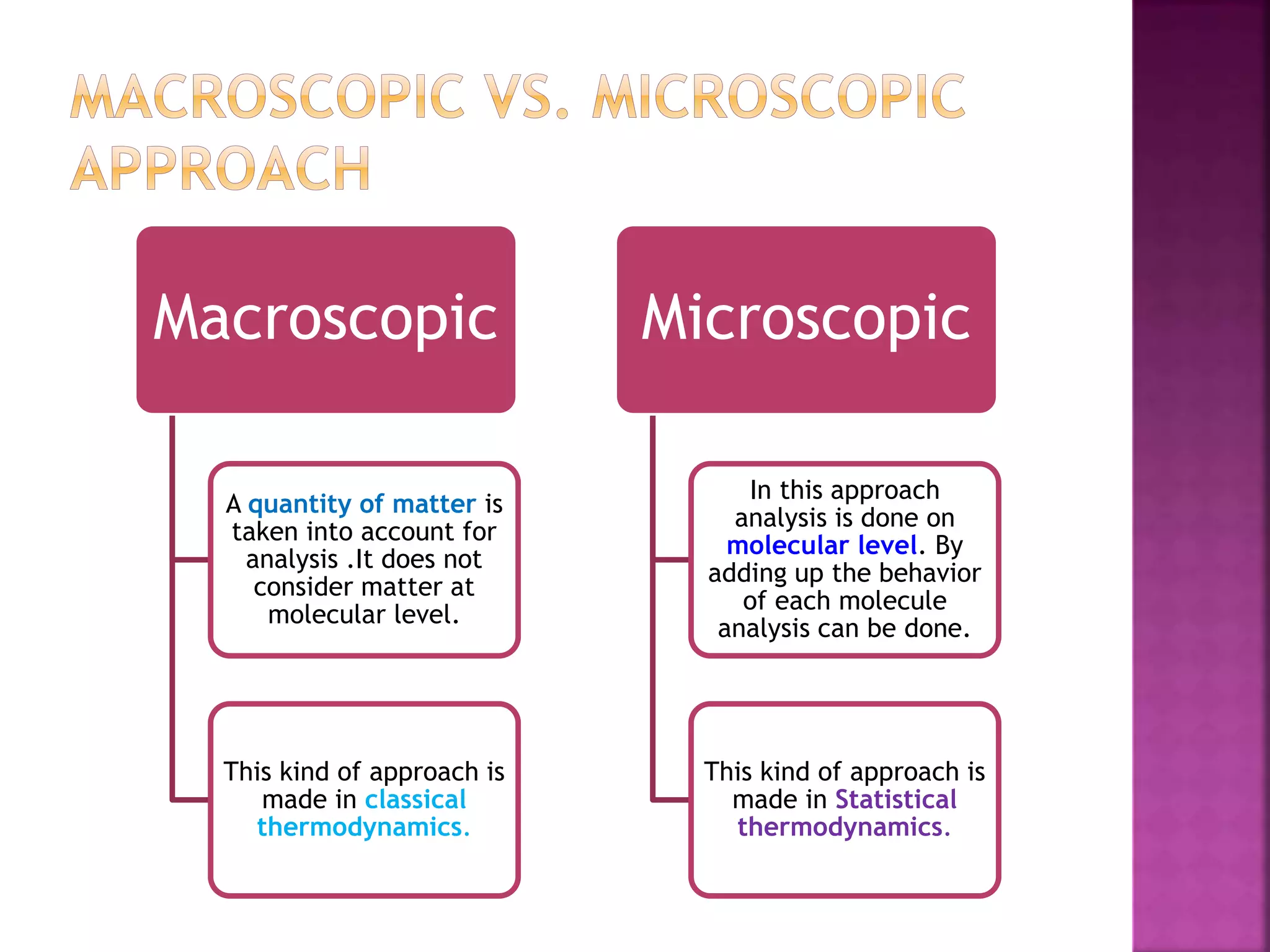
A quantity of matter is
taken into account for
analysis .It does not
consider matter at
molecular level.
This kind of approach is
made in classical
thermodynamics.
Microscopic
In this approach
analysis is done on
molecular level. By
adding up the behavior
of each molecule
analysis can be done.
This kind of approach is
made in Statistical
thermodynamics.
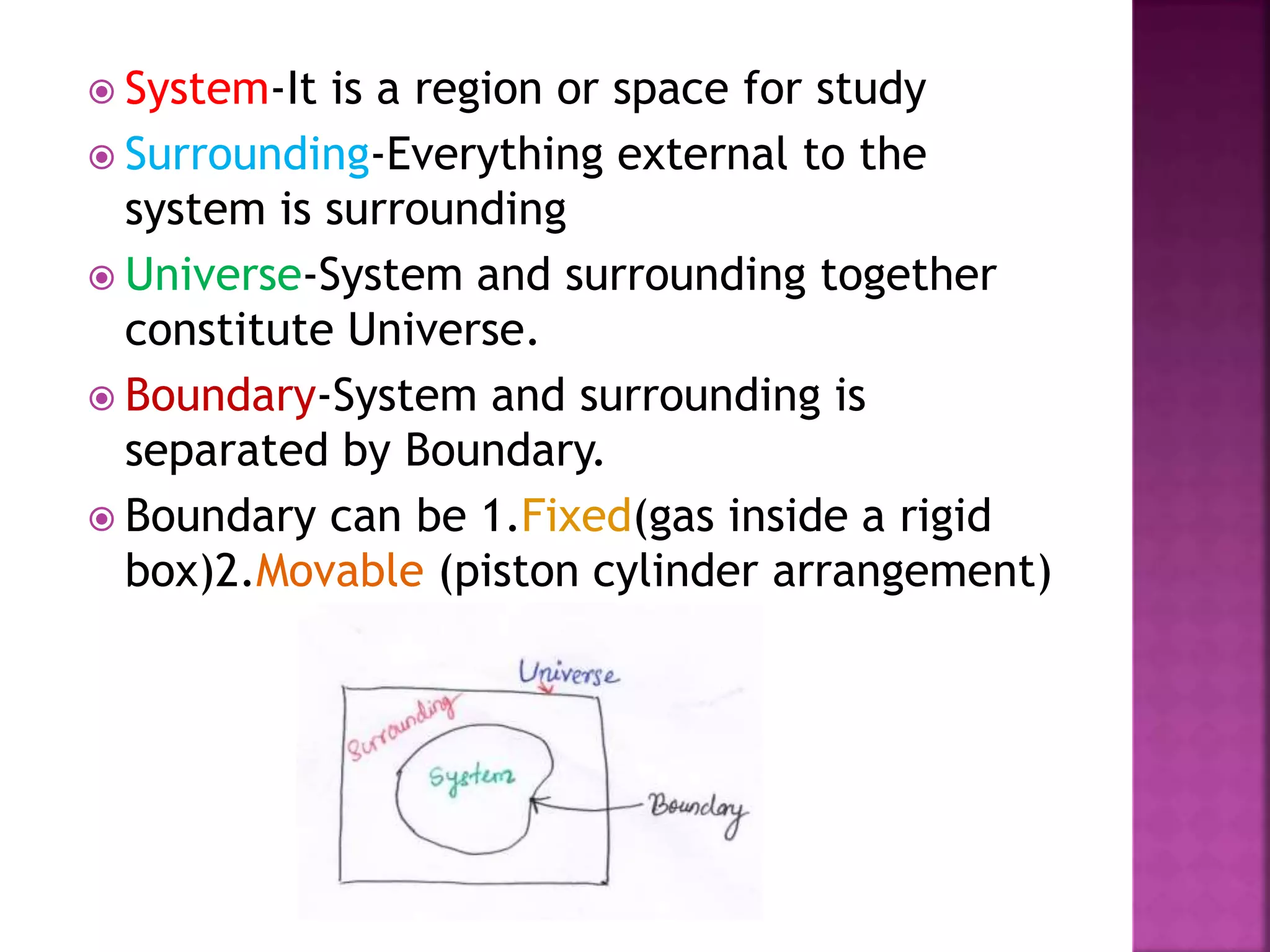
 System-It is a region or space for study
 Surrounding-Everything external to the
system is surrounding
 Universe-System and surrounding together
constitute Universe.
 Boundary-System and surrounding is
separated by Boundary.
 Boundary can be 1.Fixed(gas inside a rigid
box)2.Movable (piston cylinder arrangement)
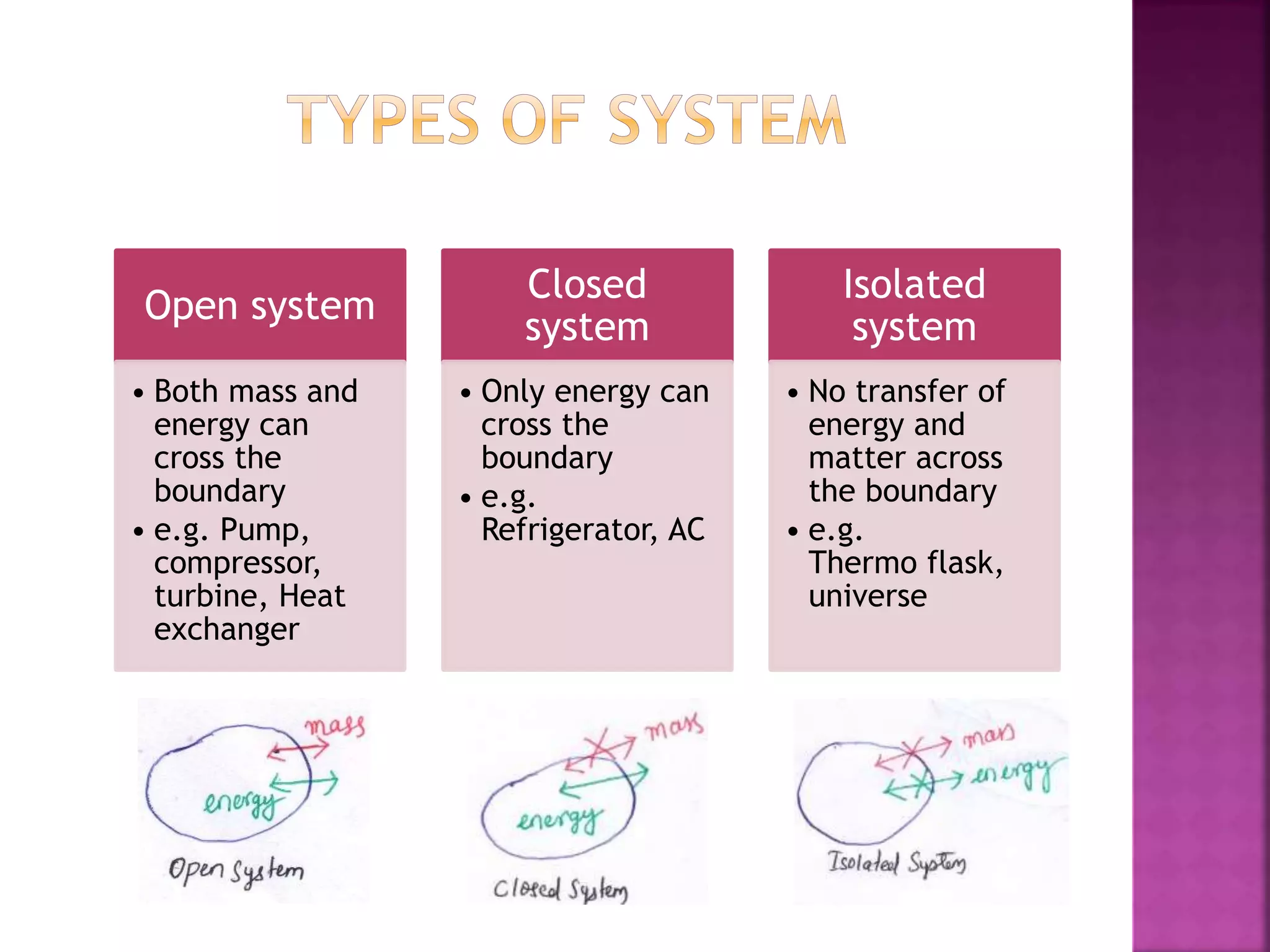
Open system
• Both mass and
energy can
cross the
boundary
• e.g. Pump,
compressor,
turbine, Heat
exchanger
Closed
system
• Only energy can
cross the
boundary
• e.g.
Refrigerator, AC
Isolated
system
• No transfer of
energy and
matter across
the boundary
• e.g.
Thermo flask,
universe
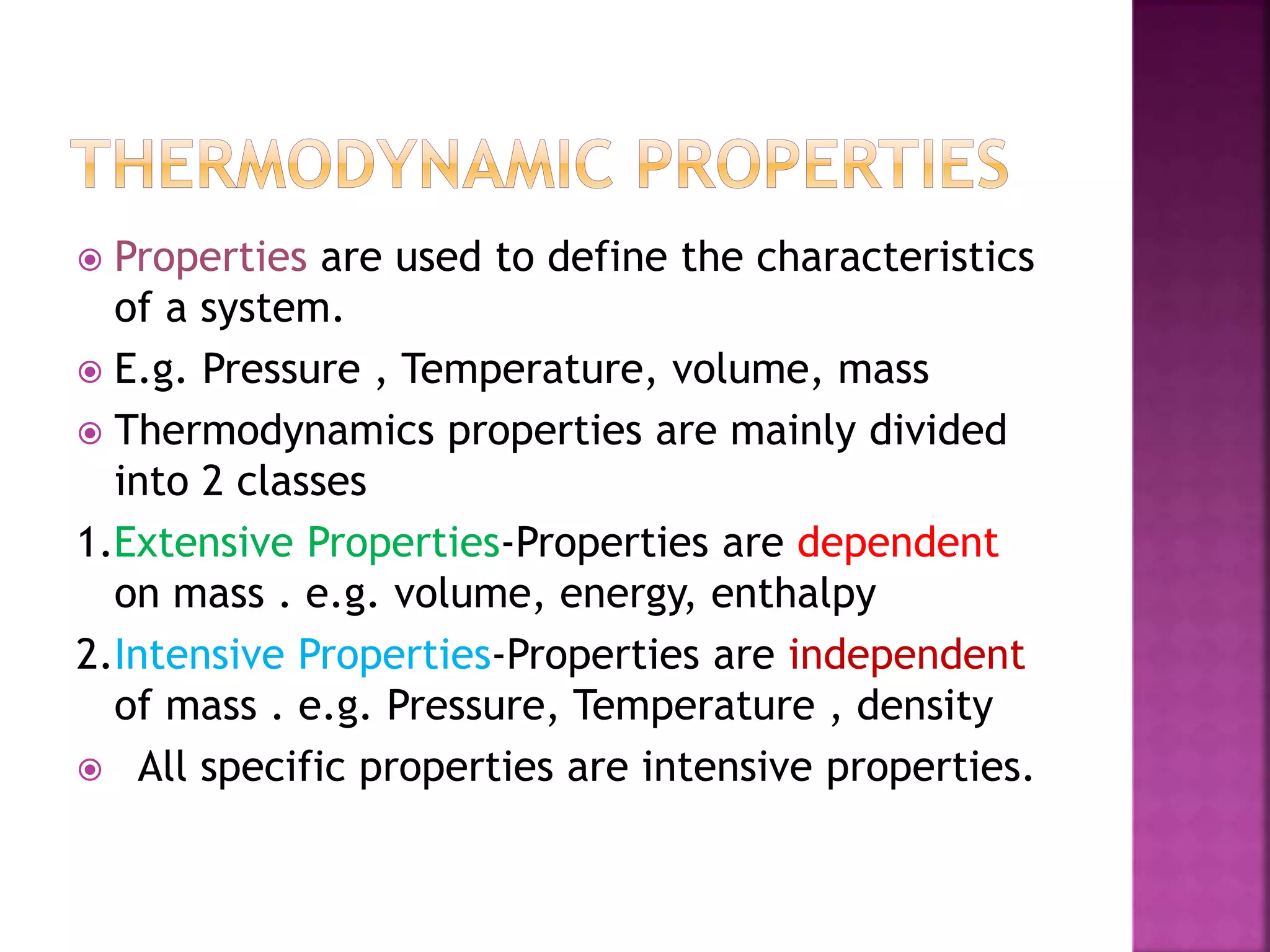
 Properties are used to define the characteristics
of a system.
 E.g. Pressure , Temperature, volume, mass
 Thermodynamics properties are mainly divided
into 2 classes
1.Extensive Properties-Properties are dependent
on mass . e.g. volume, energy, enthalpy
2.Intensive Properties-Properties are independent
of mass . e.g. Pressure, Temperature , density
 All specific properties are intensive properties.
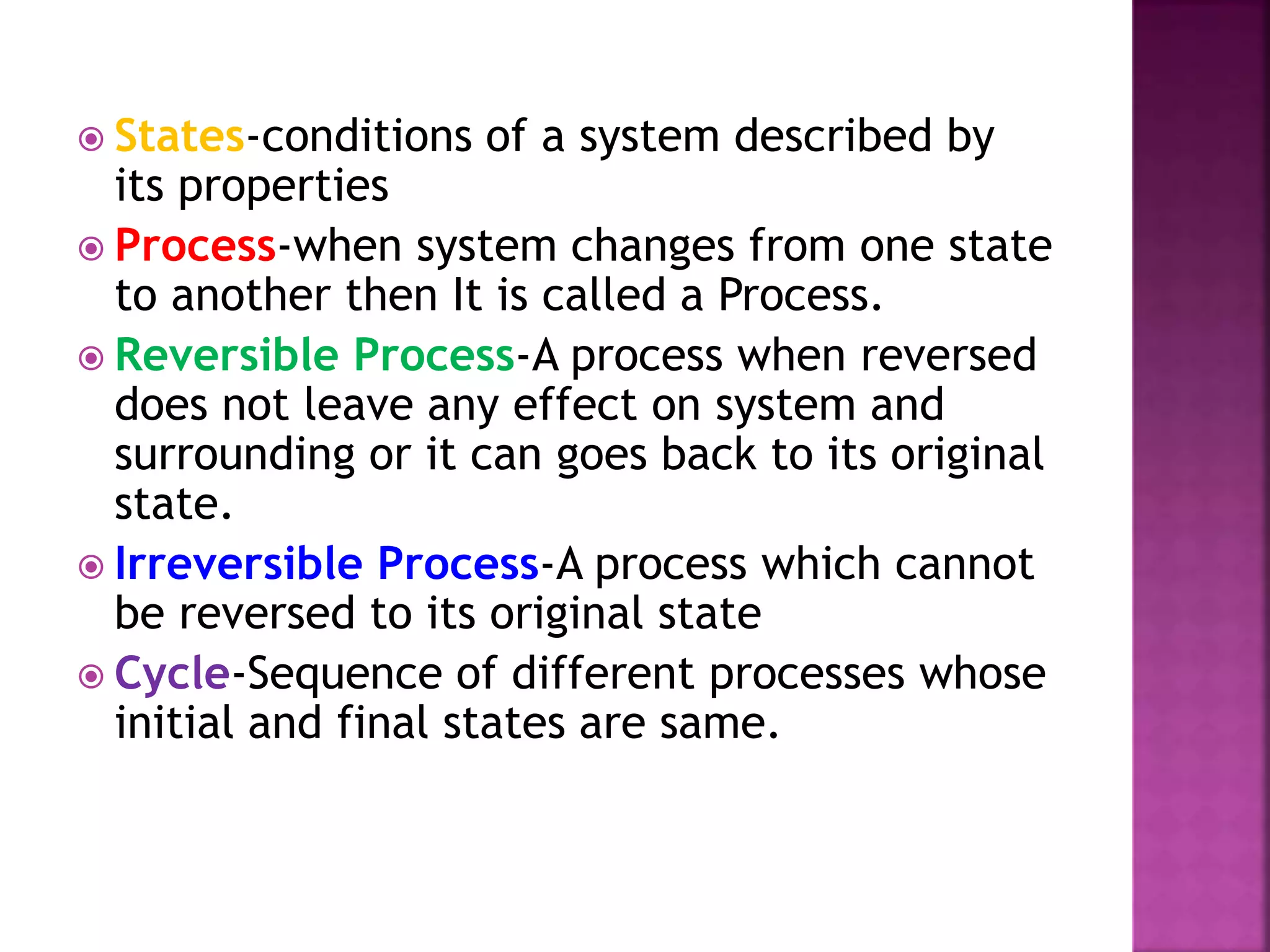
 States-conditions of a system described by
its properties
 Process-when system changes from one state
to another then It is called a Process.
 Reversible Process-A process when reversed
does not leave any effect on system and
surrounding or it can goes back to its original
state.
 Irreversible Process-A process which cannot
be reversed to its original state
 Cycle-Sequence of different processes whose
initial and final states are same.
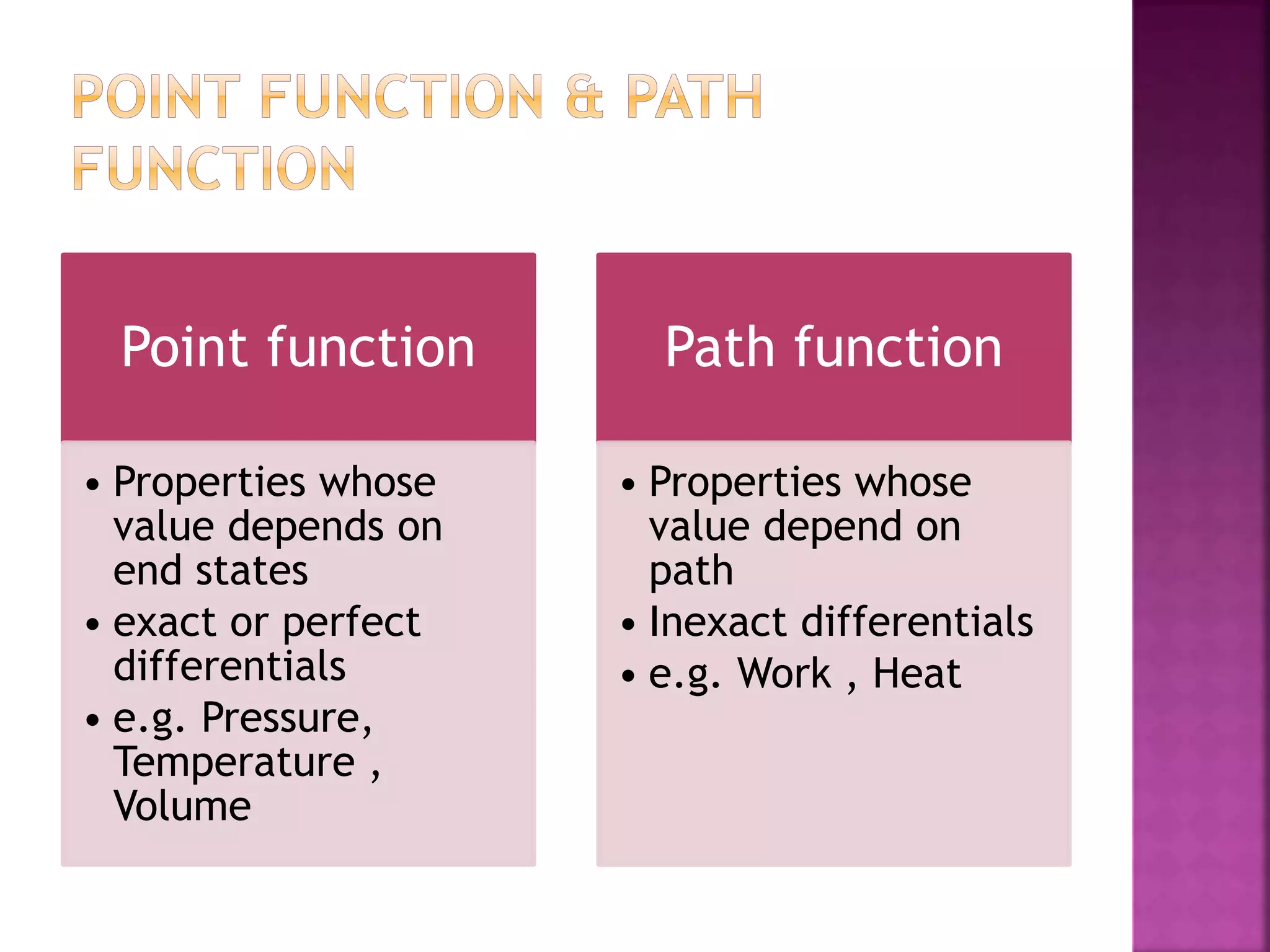
Point function
• Properties whose
value depends on
end states
• exact or perfect
differentials
• e.g. Pressure,
Temperature ,
Volume
Path function
• Properties whose
value depend on
path
• Inexact differentials
• e.g. Work , Heat
 A system is said to be in thermodynamic
equilibrium if it satisfies the following three
conditions
1. Thermal Equilibrium-No temperature
difference between system and surrounding
2. Mechanical equilibrium-no unbalanced
forces within the system or with the
surrounding
3. Chemical equilibrium-no chemical reaction
and no change in chemical composition
Basic concepts of thermodynamics

Basic concepts of thermodynamics

  • 1.
  • 2.
     Thermo meansHeat  Dynamics means motion under the action of force  Thermodynamics is the branch of science dealing with heat or work (Broadly energy interaction) and related changes in the physical properties of substance.
  • 3.
    Macroscopic A quantity ofmatter is taken into account for analysis .It does not consider matter at molecular level. This kind of approach is made in classical thermodynamics. Microscopic In this approach analysis is done on molecular level. By adding up the behavior of each molecule analysis can be done. This kind of approach is made in Statistical thermodynamics.
  • 4.
     System-It isa region or space for study  Surrounding-Everything external to the system is surrounding  Universe-System and surrounding together constitute Universe.  Boundary-System and surrounding is separated by Boundary.  Boundary can be 1.Fixed(gas inside a rigid box)2.Movable (piston cylinder arrangement)
  • 5.
    Open system • Bothmass and energy can cross the boundary • e.g. Pump, compressor, turbine, Heat exchanger Closed system • Only energy can cross the boundary • e.g. Refrigerator, AC Isolated system • No transfer of energy and matter across the boundary • e.g. Thermo flask, universe
  • 6.
     Properties areused to define the characteristics of a system.  E.g. Pressure , Temperature, volume, mass  Thermodynamics properties are mainly divided into 2 classes 1.Extensive Properties-Properties are dependent on mass . e.g. volume, energy, enthalpy 2.Intensive Properties-Properties are independent of mass . e.g. Pressure, Temperature , density  All specific properties are intensive properties.
  • 7.
     States-conditions ofa system described by its properties  Process-when system changes from one state to another then It is called a Process.  Reversible Process-A process when reversed does not leave any effect on system and surrounding or it can goes back to its original state.  Irreversible Process-A process which cannot be reversed to its original state  Cycle-Sequence of different processes whose initial and final states are same.
  • 8.
    Point function • Propertieswhose value depends on end states • exact or perfect differentials • e.g. Pressure, Temperature , Volume Path function • Properties whose value depend on path • Inexact differentials • e.g. Work , Heat
  • 9.
     A systemis said to be in thermodynamic equilibrium if it satisfies the following three conditions 1. Thermal Equilibrium-No temperature difference between system and surrounding 2. Mechanical equilibrium-no unbalanced forces within the system or with the surrounding 3. Chemical equilibrium-no chemical reaction and no change in chemical composition