Thermal detectors
BY: A.M. NASEEFA.
AZEEZ. MYMOONA. NASEEFA
Thermal detectors
• Thermopiles
• Pyroelectric detectors
• Bolometers
# Metallic and thermistor bolometers
# Semiconductor and micromachined bolometers
# Superconducting bolometers
AZEEZ. MYMOONA. NASEEFA
Thermal detectors are of low manufacturing costs in comparison to
photon detectors.The quality of these detectors was greatly
improved after introduction of micromachining technology.
Recently the uncooled arrays of these detectors working in the IR
region (thermovision cameras) are commercially available.
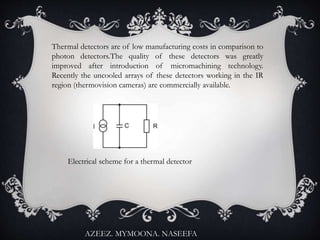
Electrical scheme for a thermal detector
AZEEZ. MYMOONA. NASEEFA
Thermopiles
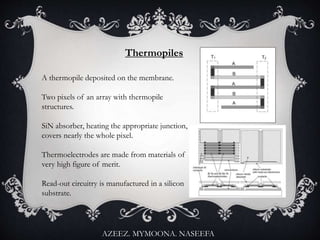
A thermopile deposited on the membrane.
Two pixels of an array with thermopile
structures.
SiN absorber, heating the appropriate junction,
covers nearly the whole pixel.
Thermoelectrodes are made from materials of
very high figure of merit.
Read-out circuitry is manufactured in a silicon
substrate.
AZEEZ. MYMOONA. NASEEFA
Pyroelectric detectors
One uses the dependence of spontaneous polarization on temperature for the
pyroelectric material and also the dependence of elecrical permittivity on
temperature (dielectric bolometer).
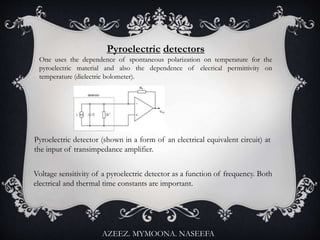
Pyroelectric detector (shown in a form of an electrical equivalent circuit) at
the input of transimpedance amplifier.
Voltage sensitivity of a pyroelectric detector as a function of frequency. Both
electrical and thermal time constants are important.
AZEEZ. MYMOONA. NASEEFA
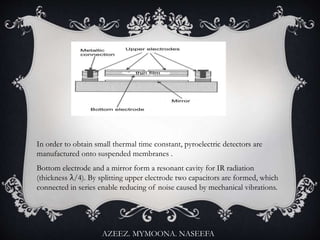
In order to obtain small thermal time constant, pyroelectric detectors are
manufactured onto suspended membranes .
Bottom electrode and a mirror form a resonant cavity for IR radiation
(thickness λ/4). By splitting upper electrode two capacitors are formed, which
connected in series enable reducing of noise caused by mechanical vibrations.
AZEEZ. MYMOONA. NASEEFA
Bolometers
Bolometer is a resistance element with a high TCR (temperature coefficient
of resistance) and a small heat capacity. Absorbed infrared radiation
changes the temperature and then the resistance of a bolometer.
Metallic and thermistor bolometers
Bolometers in a form of thin metallic films (Ni, Bi, Sb) with moderate TCR
(typ. 0.3%/K) but high stability and low noise are still manufactured.
Thermistor bolometers (Co, Mn, Ni,V oxide sinterings) have one order of
magnitude higher TCR but also higher current noise.
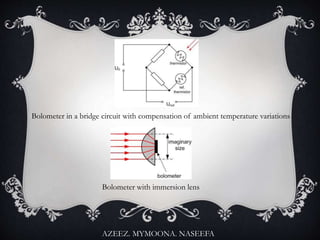
To increase the detectivity one uses sometimes immersion lenses as radiation
concentrators. In this case the signal to noise ratio increases n2 times due to
n-th increase of a detector area
(n- refractive index of a lens material, eg. Si, Ge).
AZEEZ. MYMOONA. NASEEFA
Bolometer in a bridge circuit with compensation of ambient temperature variations
Bolometer with immersion lens
AZEEZ. MYMOONA. NASEEFA
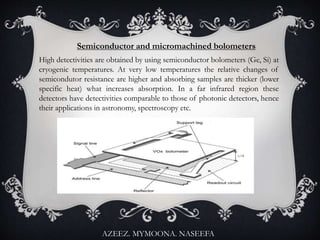
Semiconductor and micromachined bolometers
High detectivities are obtained by using semiconductor bolometers (Ge, Si) at
cryogenic temperatures. At very low temperatures the relative changes of
semicondutor resistance are higher and absorbing samples are thicker (lower
specific heat) what increases absorption. In a far infrared region these
detectors have detectivities comparable to those of photonic detectors, hence
their applications in astronomy, spectroscopy etc.
AZEEZ. MYMOONA. NASEEFA
Application of micromachining enabled manufacturing of
microbolometers with a high thermal resistance (1x 10⁸ K/W) , close
to the theoretical limit caused by radiation.
Bipolar CMOS input amplifiers are used in readout circuits.
AZEEZ. MYMOONA. NASEEFA
Superconducting bolometers
Very high variation of resistance for a small change in temperature is
obtained for superconductors in the vicinity of critical temperature Tc.
The development of this technology was possible due to the discovery of
high temperature semiconductors, HTSC.
The typical HTSC material is YbBa2Cu3O7-x (YBaCuO{Yttrium barium
copper oxide}) with transition temp. ca 90 K.
Using this material and micromachining technology it was possible to obtain
bolometers with detectivities close to
1010 cmHz1/2/W (better than for photonic detectors at 77 K).
AZEEZ. MYMOONA. NASEEFA
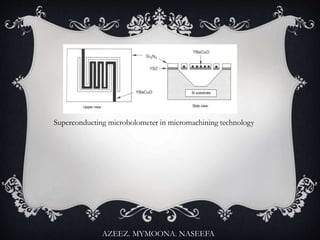
Superconducting microbolometer in micromachining technology
AZEEZ. MYMOONA. NASEEFA

Thermal detectors

  • 1.
    Thermal detectors BY: A.M.NASEEFA. AZEEZ. MYMOONA. NASEEFA
  • 2.
    Thermal detectors • Thermopiles •Pyroelectric detectors • Bolometers # Metallic and thermistor bolometers # Semiconductor and micromachined bolometers # Superconducting bolometers AZEEZ. MYMOONA. NASEEFA
  • 3.
    Thermal detectors areof low manufacturing costs in comparison to photon detectors.The quality of these detectors was greatly improved after introduction of micromachining technology. Recently the uncooled arrays of these detectors working in the IR region (thermovision cameras) are commercially available. Electrical scheme for a thermal detector AZEEZ. MYMOONA. NASEEFA
  • 4.
    Thermopiles A thermopile depositedon the membrane. Two pixels of an array with thermopile structures. SiN absorber, heating the appropriate junction, covers nearly the whole pixel. Thermoelectrodes are made from materials of very high figure of merit. Read-out circuitry is manufactured in a silicon substrate. AZEEZ. MYMOONA. NASEEFA
  • 5.
    Pyroelectric detectors One usesthe dependence of spontaneous polarization on temperature for the pyroelectric material and also the dependence of elecrical permittivity on temperature (dielectric bolometer). Pyroelectric detector (shown in a form of an electrical equivalent circuit) at the input of transimpedance amplifier. Voltage sensitivity of a pyroelectric detector as a function of frequency. Both electrical and thermal time constants are important. AZEEZ. MYMOONA. NASEEFA
  • 6.
    In order toobtain small thermal time constant, pyroelectric detectors are manufactured onto suspended membranes . Bottom electrode and a mirror form a resonant cavity for IR radiation (thickness λ/4). By splitting upper electrode two capacitors are formed, which connected in series enable reducing of noise caused by mechanical vibrations. AZEEZ. MYMOONA. NASEEFA
  • 7.
    Bolometers Bolometer is aresistance element with a high TCR (temperature coefficient of resistance) and a small heat capacity. Absorbed infrared radiation changes the temperature and then the resistance of a bolometer. Metallic and thermistor bolometers Bolometers in a form of thin metallic films (Ni, Bi, Sb) with moderate TCR (typ. 0.3%/K) but high stability and low noise are still manufactured. Thermistor bolometers (Co, Mn, Ni,V oxide sinterings) have one order of magnitude higher TCR but also higher current noise. To increase the detectivity one uses sometimes immersion lenses as radiation concentrators. In this case the signal to noise ratio increases n2 times due to n-th increase of a detector area (n- refractive index of a lens material, eg. Si, Ge). AZEEZ. MYMOONA. NASEEFA
  • 8.
    Bolometer in abridge circuit with compensation of ambient temperature variations Bolometer with immersion lens AZEEZ. MYMOONA. NASEEFA
  • 9.
    Semiconductor and micromachinedbolometers High detectivities are obtained by using semiconductor bolometers (Ge, Si) at cryogenic temperatures. At very low temperatures the relative changes of semicondutor resistance are higher and absorbing samples are thicker (lower specific heat) what increases absorption. In a far infrared region these detectors have detectivities comparable to those of photonic detectors, hence their applications in astronomy, spectroscopy etc. AZEEZ. MYMOONA. NASEEFA
  • 10.
    Application of micromachiningenabled manufacturing of microbolometers with a high thermal resistance (1x 10⁸ K/W) , close to the theoretical limit caused by radiation. Bipolar CMOS input amplifiers are used in readout circuits. AZEEZ. MYMOONA. NASEEFA
  • 11.
    Superconducting bolometers Very highvariation of resistance for a small change in temperature is obtained for superconductors in the vicinity of critical temperature Tc. The development of this technology was possible due to the discovery of high temperature semiconductors, HTSC. The typical HTSC material is YbBa2Cu3O7-x (YBaCuO{Yttrium barium copper oxide}) with transition temp. ca 90 K. Using this material and micromachining technology it was possible to obtain bolometers with detectivities close to 1010 cmHz1/2/W (better than for photonic detectors at 77 K). AZEEZ. MYMOONA. NASEEFA
  • 12.
    Superconducting microbolometer inmicromachining technology AZEEZ. MYMOONA. NASEEFA
  • 13.