TemperatureTemperature
measurementsmeasurements
MADE BY:- Uttam TrasadiyaMADE BY:- Uttam Trasadiya
trasadiyauttam@gmail.comtrasadiyauttam@gmail.com
OutlineOutline
1. Liquid-in-glass thermometres1. Liquid-in-glass thermometres
2. Bimaterial thermometres2. Bimaterial thermometres
3. Electrical thermometres3. Electrical thermometres
4. IR-thermometres4. IR-thermometres
5. Pyrometres5. Pyrometres
6. Summary6. Summary
7. Other measurement methods7. Other measurement methods
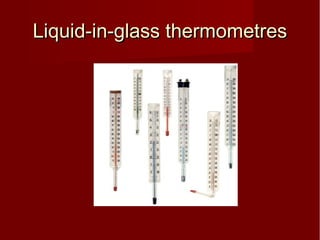
Liquid-in-glass thermometresLiquid-in-glass thermometres
The “traditional” thermometresThe “traditional” thermometres
Measurement scale from -190Measurement scale from -190 °C to +600°C to +600
°C°C
Used mainly in calibrationUsed mainly in calibration
Mercury: -39 °C … +357 °CMercury: -39 °C … +357 °C
Spirit: -14 °C … +78 °CSpirit: -14 °C … +78 °C
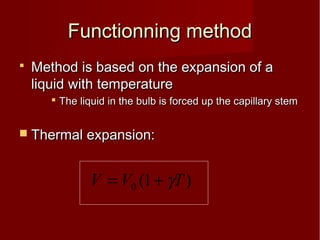
Functionning methodFunctionning method
 Method is based on the expansion of aMethod is based on the expansion of a
liquid with temperatureliquid with temperature
 The liquid in the bulb is forced up the capillary stemThe liquid in the bulb is forced up the capillary stem
 Thermal expansion:Thermal expansion:
)1(0 TVV γ+=
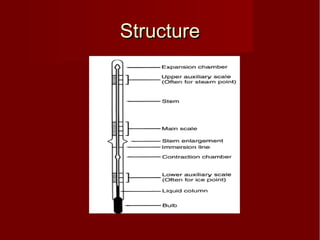
StructureStructure
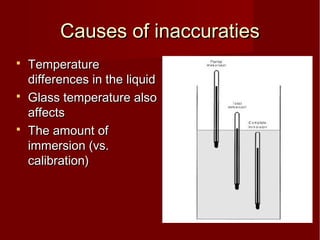
Causes of inaccuratiesCauses of inaccuraties
 TemperatureTemperature
differences in the liquiddifferences in the liquid
 Glass temperature alsoGlass temperature also
affectsaffects
 The amount ofThe amount of
immersion (vs.immersion (vs.
calibration)calibration)
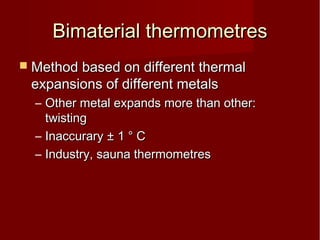
Bimaterial thermometresBimaterial thermometres
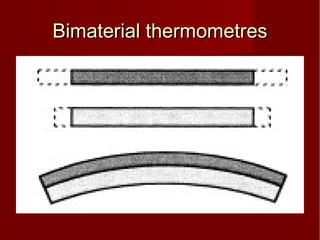
 Method based on different thermalMethod based on different thermal
expansions of different metalsexpansions of different metals
– Other metal expands more than other:Other metal expands more than other:
twistingtwisting
– InaccuraryInaccurary ± 1 ° C± 1 ° C
– Industry, sauna thermometresIndustry, sauna thermometres
Bimaterial thermometresBimaterial thermometres
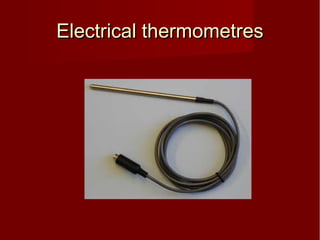
Electrical thermometresElectrical thermometres
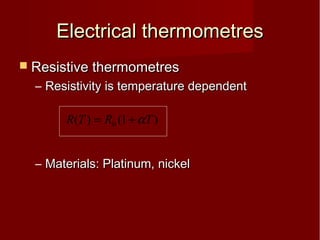
 Resistive thermometresResistive thermometres
– Resistivity is temperature dependentResistivity is temperature dependent
– Materials: Platinum, nickelMaterials: Platinum, nickel
)1()( 0 TRTR α+=
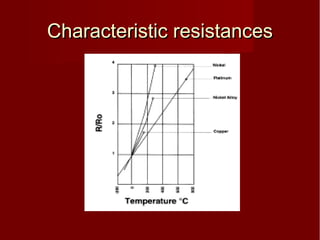
Characteristic resistancesCharacteristic resistances
Thermistor thermometresThermistor thermometres
 Semiconductor materialsSemiconductor materials
 Based on the temperature dependence ofBased on the temperature dependence of
resistanceresistance
 Thermal coefficient non-linear, 10 timesThermal coefficient non-linear, 10 times
bigger than for metal resistorbigger than for metal resistor
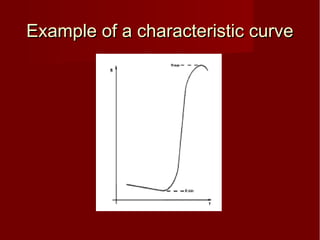
 NTC, (PTC): temperature coefficient’s signNTC, (PTC): temperature coefficient’s sign
Example of a characteristic curveExample of a characteristic curve
Limitations of electricalLimitations of electrical
thermometresthermometres
 Sensor cable’s resistance and its temperatureSensor cable’s resistance and its temperature
dependencydependency
 Junction resistancesJunction resistances
 Thermal voltagesThermal voltages
 Thermal noise in resistorsThermal noise in resistors
 Measurement currentMeasurement current
 Non-linear temperature dependenciesNon-linear temperature dependencies
 Electrical perturbationsElectrical perturbations
 Inaccuracy at leastInaccuracy at least ± 0.1 °C± 0.1 °C
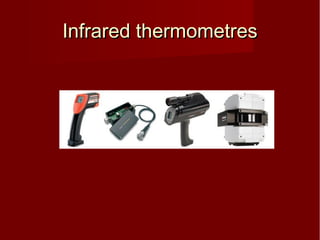
Infrared thermometresInfrared thermometres
Thermal radiationThermal radiation
 Every atom and molecule exists inEvery atom and molecule exists in
perpetual motionperpetual motion
 A moving charge is associated with anA moving charge is associated with an
electric field and thus becomes a radiatorelectric field and thus becomes a radiator
 This radiation can be used to determineThis radiation can be used to determine
object's temperatureobject's temperature
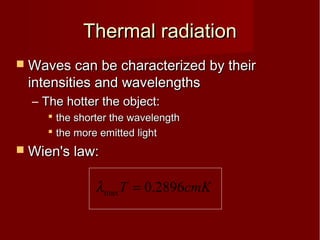
Thermal radiationThermal radiation
 Waves can be characterized by theirWaves can be characterized by their
intensities and wavelengthsintensities and wavelengths
– The hotter the object:The hotter the object:
 the shorter the wavelengththe shorter the wavelength
 the more emitted lightthe more emitted light
 Wien's law:Wien's law:
cmKT 2896.0max =λ
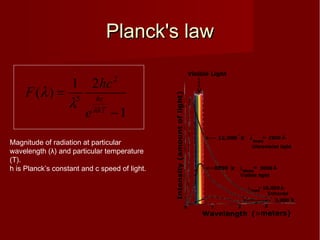
Planck's lawPlanck's law
1
21
)(
2
5
−
=
kT
hc
e
hc
F
λ
λ
λ
Magnitude of radiation at particular
wavelength (λ) and particular temperature
(T).
h is Planck’s constant and c speed of light.
BlackbodyBlackbody
 An ideal emitter of electromagnetic radiationAn ideal emitter of electromagnetic radiation
– opaqueopaque
– non-reflectivenon-reflective
– for practical blackbodiesfor practical blackbodies εε = 0.9= 0.9
 Cavity effectCavity effect
– em-radiation measured from a cavity of anem-radiation measured from a cavity of an
objectobject
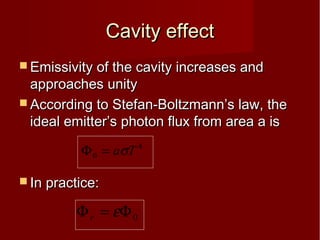
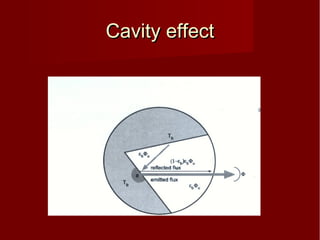
Cavity effectCavity effect
 Emissivity of the cavity increases andEmissivity of the cavity increases and
approaches unityapproaches unity
 According to Stefan-Boltzmann’s law, theAccording to Stefan-Boltzmann’s law, the
ideal emitter’s photon flux from area a isideal emitter’s photon flux from area a is
 In practice:In practice:
4
0 Taσ=Φ
0Φ=Φ εr
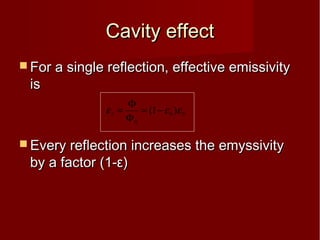
Cavity effectCavity effect
 For a single reflection, effective emissivityFor a single reflection, effective emissivity
isis
 Every reflection increases the emyssivityEvery reflection increases the emyssivity
by a factor (1-by a factor (1-εε))
bbr εεε )1(
0
−=
Φ
Φ
=
Cavity effectCavity effect
Practical blackbodiesPractical blackbodies
 Copper most common materialCopper most common material
 The shape of the cavity defines the numberThe shape of the cavity defines the number
of reflectionsof reflections
– Emissivity can be increasedEmissivity can be increased
DetectorsDetectors
 Quantum detectorsQuantum detectors
– interaction of individual photons and crystallineinteraction of individual photons and crystalline
latticelattice
– photon striking the surface can result to thephoton striking the surface can result to the
generation of free electrongeneration of free electron
– free electron is pushed from valency tofree electron is pushed from valency to
conduction bandconduction band
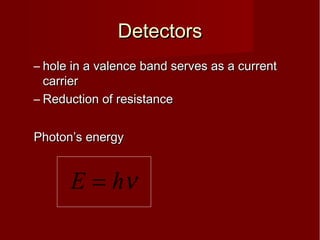
DetectorsDetectors
– hole in a valence band serves as a currenthole in a valence band serves as a current
carriercarrier
– Reduction of resistanceReduction of resistance
Photon’s energyPhoton’s energy
νhE =
DetectorsDetectors
 Thermal detectorsThermal detectors
– Response to heat resulting from absorption ofResponse to heat resulting from absorption of
the sensing surfacethe sensing surface
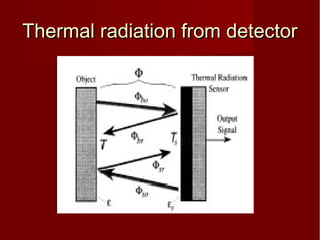
– The radiation to opposite direction (from coldThe radiation to opposite direction (from cold
detector to measured object) must be takendetector to measured object) must be taken
into accountinto account
Thermal radiation from detectorThermal radiation from detector
PyrometresPyrometres
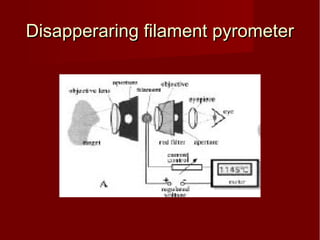
 Disappearing filament pyrometerDisappearing filament pyrometer
– Radiation from and object in knownRadiation from and object in known
temperature is balanced against an unknowntemperature is balanced against an unknown
targettarget
– The image of the known object (=filament) isThe image of the known object (=filament) is
superimposed on the image of targetsuperimposed on the image of target
PyrometresPyrometres
– The measurer adjusts the current of theThe measurer adjusts the current of the
filament to make it glow and then disappearfilament to make it glow and then disappear
– Disappearing means the filament and objectDisappearing means the filament and object
having the same temperaturehaving the same temperature
Disapperaring filament pyrometerDisapperaring filament pyrometer
PyrometresPyrometres
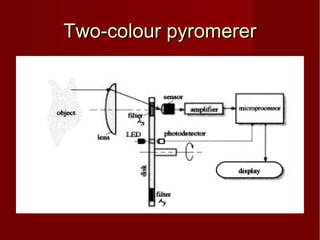
 Two-color pyrometerTwo-color pyrometer
– Since emissivities are not usually known, theSince emissivities are not usually known, the
measurement with disappearing filamentmeasurement with disappearing filament
pyrometer becomes impracticalpyrometer becomes impractical
– In two-color pyrometers, radiation is detectedIn two-color pyrometers, radiation is detected
at two separate wavelengths, for which theat two separate wavelengths, for which the
emissivity is approximately equalemissivity is approximately equal
Two-colour pyromererTwo-colour pyromerer
PyrometersPyrometers
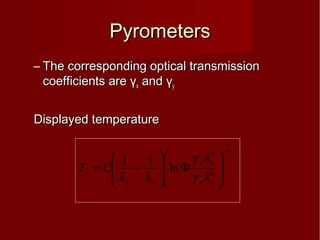
– The corresponding optical transmissionThe corresponding optical transmission
coefficients arecoefficients are γγxx andand γγyy
Displayed temperatureDisplayed temperature
1
5
5
ln
11
−








Φ








−=
yx
xy
xy
c CT
λγ
λγ
λλ
MeasurementsMeasurements
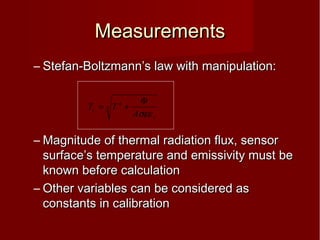
– Stefan-Boltzmann’s law with manipulation:Stefan-Boltzmann’s law with manipulation:
– Magnitude of thermal radiation flux, sensorMagnitude of thermal radiation flux, sensor
surface’s temperature and emissivity must besurface’s temperature and emissivity must be
known before calculationknown before calculation
– Other variables can be considered asOther variables can be considered as
constants in calibrationconstants in calibration
4
4
s
c
A
TT
σεε
Φ
+=
Error sourcesError sources
 Errors in detection of the radiant flux orErrors in detection of the radiant flux or
reference temperaturereference temperature
 Spurious heat sourcesSpurious heat sources
– Heat directly of by reflaction into the opticalHeat directly of by reflaction into the optical
systemsystem
 Reflectance of the object (e.g. 0.1)Reflectance of the object (e.g. 0.1)
But does not require contact to surfaceBut does not require contact to surface
measured!measured!
Pyroelectric thermometresPyroelectric thermometres
 Generate electric charce in response toGenerate electric charce in response to
heat fluxheat flux
– Crystal materialsCrystal materials
– Comparable to piezoelectric effect: theComparable to piezoelectric effect: the
polarity of crystals is re-orientedpolarity of crystals is re-oriented
SummarySummary
 Only some temperature measurementOnly some temperature measurement
methods presentedmethods presented
 Examples of phenomenons used: thermalExamples of phenomenons used: thermal
expansion, resistance’s thermalexpansion, resistance’s thermal
dependency, radiationdependency, radiation
 The type of meter depends onThe type of meter depends on
– Measurement object’s propertiesMeasurement object’s properties
– TemperatureTemperature
More temperature measurementMore temperature measurement
possibilitiespossibilities
 ThermocouplesThermocouples
 Semiconductor thermometresSemiconductor thermometres
 Temperature indicatorsTemperature indicators
– Crayons etc.Crayons etc.
 Manometric (gas pressure) sensorsManometric (gas pressure) sensors

Temperature measurement

  • 1.
    TemperatureTemperature measurementsmeasurements MADE BY:- UttamTrasadiyaMADE BY:- Uttam Trasadiya trasadiyauttam@gmail.comtrasadiyauttam@gmail.com
  • 2.
    OutlineOutline 1. Liquid-in-glass thermometres1.Liquid-in-glass thermometres 2. Bimaterial thermometres2. Bimaterial thermometres 3. Electrical thermometres3. Electrical thermometres 4. IR-thermometres4. IR-thermometres 5. Pyrometres5. Pyrometres 6. Summary6. Summary 7. Other measurement methods7. Other measurement methods
  • 3.
  • 4.
    Liquid-in-glass thermometresLiquid-in-glass thermometres The“traditional” thermometresThe “traditional” thermometres Measurement scale from -190Measurement scale from -190 °C to +600°C to +600 °C°C Used mainly in calibrationUsed mainly in calibration Mercury: -39 °C … +357 °CMercury: -39 °C … +357 °C Spirit: -14 °C … +78 °CSpirit: -14 °C … +78 °C
  • 5.
    Functionning methodFunctionning method Method is based on the expansion of aMethod is based on the expansion of a liquid with temperatureliquid with temperature  The liquid in the bulb is forced up the capillary stemThe liquid in the bulb is forced up the capillary stem  Thermal expansion:Thermal expansion: )1(0 TVV γ+=
  • 6.
  • 7.
    Causes of inaccuratiesCausesof inaccuraties  TemperatureTemperature differences in the liquiddifferences in the liquid  Glass temperature alsoGlass temperature also affectsaffects  The amount ofThe amount of immersion (vs.immersion (vs. calibration)calibration)
  • 8.
    Bimaterial thermometresBimaterial thermometres Method based on different thermalMethod based on different thermal expansions of different metalsexpansions of different metals – Other metal expands more than other:Other metal expands more than other: twistingtwisting – InaccuraryInaccurary ± 1 ° C± 1 ° C – Industry, sauna thermometresIndustry, sauna thermometres
  • 9.
  • 10.
  • 11.
    Electrical thermometresElectrical thermometres Resistive thermometresResistive thermometres – Resistivity is temperature dependentResistivity is temperature dependent – Materials: Platinum, nickelMaterials: Platinum, nickel )1()( 0 TRTR α+=
  • 12.
  • 13.
    Thermistor thermometresThermistor thermometres Semiconductor materialsSemiconductor materials  Based on the temperature dependence ofBased on the temperature dependence of resistanceresistance  Thermal coefficient non-linear, 10 timesThermal coefficient non-linear, 10 times bigger than for metal resistorbigger than for metal resistor  NTC, (PTC): temperature coefficient’s signNTC, (PTC): temperature coefficient’s sign
  • 14.
    Example of acharacteristic curveExample of a characteristic curve
  • 15.
    Limitations of electricalLimitationsof electrical thermometresthermometres  Sensor cable’s resistance and its temperatureSensor cable’s resistance and its temperature dependencydependency  Junction resistancesJunction resistances  Thermal voltagesThermal voltages  Thermal noise in resistorsThermal noise in resistors  Measurement currentMeasurement current  Non-linear temperature dependenciesNon-linear temperature dependencies  Electrical perturbationsElectrical perturbations  Inaccuracy at leastInaccuracy at least ± 0.1 °C± 0.1 °C
  • 16.
  • 17.
    Thermal radiationThermal radiation Every atom and molecule exists inEvery atom and molecule exists in perpetual motionperpetual motion  A moving charge is associated with anA moving charge is associated with an electric field and thus becomes a radiatorelectric field and thus becomes a radiator  This radiation can be used to determineThis radiation can be used to determine object's temperatureobject's temperature
  • 18.
    Thermal radiationThermal radiation Waves can be characterized by theirWaves can be characterized by their intensities and wavelengthsintensities and wavelengths – The hotter the object:The hotter the object:  the shorter the wavelengththe shorter the wavelength  the more emitted lightthe more emitted light  Wien's law:Wien's law: cmKT 2896.0max =λ
  • 19.
    Planck's lawPlanck's law 1 21 )( 2 5 − = kT hc e hc F λ λ λ Magnitudeof radiation at particular wavelength (λ) and particular temperature (T). h is Planck’s constant and c speed of light.
  • 20.
    BlackbodyBlackbody  An idealemitter of electromagnetic radiationAn ideal emitter of electromagnetic radiation – opaqueopaque – non-reflectivenon-reflective – for practical blackbodiesfor practical blackbodies εε = 0.9= 0.9  Cavity effectCavity effect – em-radiation measured from a cavity of anem-radiation measured from a cavity of an objectobject
  • 21.
    Cavity effectCavity effect Emissivity of the cavity increases andEmissivity of the cavity increases and approaches unityapproaches unity  According to Stefan-Boltzmann’s law, theAccording to Stefan-Boltzmann’s law, the ideal emitter’s photon flux from area a isideal emitter’s photon flux from area a is  In practice:In practice: 4 0 Taσ=Φ 0Φ=Φ εr
  • 22.
    Cavity effectCavity effect For a single reflection, effective emissivityFor a single reflection, effective emissivity isis  Every reflection increases the emyssivityEvery reflection increases the emyssivity by a factor (1-by a factor (1-εε)) bbr εεε )1( 0 −= Φ Φ =
  • 23.
  • 24.
    Practical blackbodiesPractical blackbodies Copper most common materialCopper most common material  The shape of the cavity defines the numberThe shape of the cavity defines the number of reflectionsof reflections – Emissivity can be increasedEmissivity can be increased
  • 25.
    DetectorsDetectors  Quantum detectorsQuantumdetectors – interaction of individual photons and crystallineinteraction of individual photons and crystalline latticelattice – photon striking the surface can result to thephoton striking the surface can result to the generation of free electrongeneration of free electron – free electron is pushed from valency tofree electron is pushed from valency to conduction bandconduction band
  • 26.
    DetectorsDetectors – hole ina valence band serves as a currenthole in a valence band serves as a current carriercarrier – Reduction of resistanceReduction of resistance Photon’s energyPhoton’s energy νhE =
  • 27.
    DetectorsDetectors  Thermal detectorsThermaldetectors – Response to heat resulting from absorption ofResponse to heat resulting from absorption of the sensing surfacethe sensing surface – The radiation to opposite direction (from coldThe radiation to opposite direction (from cold detector to measured object) must be takendetector to measured object) must be taken into accountinto account
  • 28.
    Thermal radiation fromdetectorThermal radiation from detector
  • 29.
    PyrometresPyrometres  Disappearing filamentpyrometerDisappearing filament pyrometer – Radiation from and object in knownRadiation from and object in known temperature is balanced against an unknowntemperature is balanced against an unknown targettarget – The image of the known object (=filament) isThe image of the known object (=filament) is superimposed on the image of targetsuperimposed on the image of target
  • 30.
    PyrometresPyrometres – The measureradjusts the current of theThe measurer adjusts the current of the filament to make it glow and then disappearfilament to make it glow and then disappear – Disappearing means the filament and objectDisappearing means the filament and object having the same temperaturehaving the same temperature
  • 31.
  • 32.
    PyrometresPyrometres  Two-color pyrometerTwo-colorpyrometer – Since emissivities are not usually known, theSince emissivities are not usually known, the measurement with disappearing filamentmeasurement with disappearing filament pyrometer becomes impracticalpyrometer becomes impractical – In two-color pyrometers, radiation is detectedIn two-color pyrometers, radiation is detected at two separate wavelengths, for which theat two separate wavelengths, for which the emissivity is approximately equalemissivity is approximately equal
  • 33.
  • 34.
    PyrometersPyrometers – The correspondingoptical transmissionThe corresponding optical transmission coefficients arecoefficients are γγxx andand γγyy Displayed temperatureDisplayed temperature 1 5 5 ln 11 −         Φ         −= yx xy xy c CT λγ λγ λλ
  • 35.
    MeasurementsMeasurements – Stefan-Boltzmann’s lawwith manipulation:Stefan-Boltzmann’s law with manipulation: – Magnitude of thermal radiation flux, sensorMagnitude of thermal radiation flux, sensor surface’s temperature and emissivity must besurface’s temperature and emissivity must be known before calculationknown before calculation – Other variables can be considered asOther variables can be considered as constants in calibrationconstants in calibration 4 4 s c A TT σεε Φ +=
  • 36.
    Error sourcesError sources Errors in detection of the radiant flux orErrors in detection of the radiant flux or reference temperaturereference temperature  Spurious heat sourcesSpurious heat sources – Heat directly of by reflaction into the opticalHeat directly of by reflaction into the optical systemsystem  Reflectance of the object (e.g. 0.1)Reflectance of the object (e.g. 0.1) But does not require contact to surfaceBut does not require contact to surface measured!measured!
  • 37.
    Pyroelectric thermometresPyroelectric thermometres Generate electric charce in response toGenerate electric charce in response to heat fluxheat flux – Crystal materialsCrystal materials – Comparable to piezoelectric effect: theComparable to piezoelectric effect: the polarity of crystals is re-orientedpolarity of crystals is re-oriented
  • 38.
    SummarySummary  Only sometemperature measurementOnly some temperature measurement methods presentedmethods presented  Examples of phenomenons used: thermalExamples of phenomenons used: thermal expansion, resistance’s thermalexpansion, resistance’s thermal dependency, radiationdependency, radiation  The type of meter depends onThe type of meter depends on – Measurement object’s propertiesMeasurement object’s properties – TemperatureTemperature
  • 39.
    More temperature measurementMoretemperature measurement possibilitiespossibilities  ThermocouplesThermocouples  Semiconductor thermometresSemiconductor thermometres  Temperature indicatorsTemperature indicators – Crayons etc.Crayons etc.  Manometric (gas pressure) sensorsManometric (gas pressure) sensors