Presented By-
ROHIT
M.Pharmacy
(Pharmaceutics)






INTRODUCTION
DEFINITION
THEORY
FACTORS AFFECTING FLOURESCENCE
APPLICATIONS IN PHARMACY
INSTRUMENTATION
Luminescence is the emission of light
by a substance. It occurs when an
electron returns to the electronic
ground state from an excited state
and loses its excess energy as a
photon.
It is of 3 types.
Fluorescence spectroscopy.
Phosphorescence
spectroscopy.
Chemiluminescence
When a beam of light is incident on
certain substances they emit visible
light or radiations. This is known as
fluorescence.
Fluorescence starts immediately after
the absorption of light and stops as
soon as the incident light is cut off.
The substances showing this
phenomenon are known as flourescent
When light radiation is incident on
certain substances they emit light
continuously even after the incident
light is cut off.
This type of delayed fluorescence is
called phosphorescence.
Substances showing
phosphorescence arephosphorescent
substances.
 A molecular electronic state in which all of the
electrons are paired are called singletstate.
In a singlet state molecules are diamagnetic.
Mostof the molecules in their ground state are paired.
When such a mole cule absorbs uv/visible radiation,
one or more of the paired electron raised to anexcited
singlet state /excited tripletstate.
tripletstate
spins unpaired
Ground
singlet
states
excited singlet
state
spin paired
no net mag.field net mag.field
Fluorescence
Phosphorescence
Radiation less
processes
Vibration
relaxation
Internal
LIGHT EMITING AT ONCE SOURCE STARTS & STOPS
WHEM SOURCE STOPS
JABLONSKI ENERGY
DIAGRAM
FLUORESCENCE & THEIR
CHEMICAL STRUCTURE
Fluorescence is most commonly
observed in compounds containing
aromatic functional groups with low
energy.
Most unsubstituted aromatic
hydrocarbons show fluorescence -
quantum efficiency increases with the
no: of rings and degree of
condensation.
CONTD…
Simple heterocyclic do not
exhibit fluorescence.
Fusion of heterocyclic nucleus to
benzene ring increases fluorescence.
Fluorescence is favored in
molecules with structural
rigidity.
organic chelating agents complexed
with metal ion increases
fluorescence.(A chelating agent is a
substance whose molecules can form
Nature of molecule
Nature of substituent
Effect of concentration
Adsorption
 Light
Oxygen
pH
Temp . &viscosity
Intensity of incident light
Path length
1.Temperature:it is inversely proportional to
luminescence.
Increasein temp. causes increase
in collision
of
molecules and finally increase in F & P.
Decrease in temp. Causes decrease
in collision of molecules and
finally decrease in F & P.
2.Viscosity : It is directly proportional
to luminescence.
Increase in viscosity causes
decrease in molecule collision
and finally increase in F & P.
3. Oxygen: It decrease the fluorescence in 2
ways;
Oxidises the fluorescent substance to
non fluorescent substance.
Decreasefluorescence because of
paramagnetic property as it has
triplet ground state.
4. pH: its effects depends on chemical
structure of molecules. E.g-
Aniline in neutral & alkaline medium gives
visible flourescence & in acidic medium
gives fluorescence in uv region only.
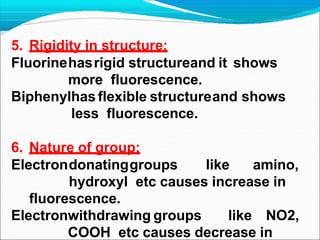
5. Rigidity in structure:
Fluorinehasrigid structureand it shows
more fluorescence.
Biphenylhas flexible structureand shows
less fluorescence.
6. Nature of group:
Electrondonatinggroups like amino,
hydroxyl etc causes increase in
fluorescence.
Electronwithdrawing groups like NO2,
COOH etc causes decrease in
Decrease in fluorescence intensity due to
specific effects of constituents of the
solution.
Due to concentration, pH, pressure of
chemical substances, temperature,
viscosity, etc.
Types of quenching
Self quenching
Chemical quenching
Static quenching
Collision quenching
Fluorescenc
e
Concentration of
fluorescing species
Deviations at higher concentrations can be
attributed to self- quenching or self-
absorption.
Fluorescenc
e
Concentration of
fluorescing species
Calibration curve
(Low con)
calibration curve
(High con)
Here decrease in fluorescence intensity due to the
factors like change in pH,presence of oxygen,halides
&heavy metals.
 pH- aniline at pH 5-13 gives fluorescence but atpH
<5 &>13 it does not exhibitfluorescence.
 Halides- like chloride,bromide,iodide & electron
withdrawing groups like NO2,COOH etc. leads to
quenching.
 Heavy metals -leads to quenching, because of
collisions of triplet groundstate.
of riboflavin by
This occurs due to complexformation.
e.g- caffeine reduces flourescence
complex formation.
COLLISIONAL QUENCHING
It reduces fluorescence by collision. where no. of
collisions increased hence quenching takes place.
Types of flourescence
(when excited by
1. Chemiluminescence (when excited by chemicals)
2. Electrochemiluminescence
electrochemical reaction)
3. Photoluminescence (when excited by
electromagnetic radiation)
 Based on the wavelength of emitted radiation
1. Stroke’s flourescence (wavelength of the emitted
radiation is longer than the absorbedradiation)
Contd.
2. Anti-stroke’s Flourescence (wavelength of
emitted radiation is shorter than absorbedradiation)
3. Resonance Flourescence (wavelength of emitted
radiation = absorbed radiation)
 Based on Phenomena:
1. Sensitised flourescence (when elements like Th, Zn,
Cd or an alkali metal are added to mercury vapour
these elements are sensitised & thus gives
fluorescence.
2. Thermally assisted Flourescence (the excitation is
partly by electromagnetic radiation and partly by
thermal energy)
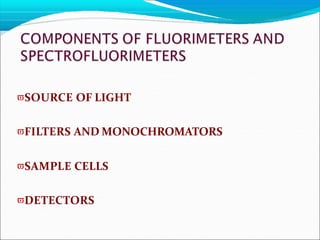
INSTRUMENTATION
SOURCE OF LIGHT
FILTERS AND MONOCHROMATORS
SAMPLE CELLS
DETECTORS
MERCURY ARCLAMP.
XENON ARCLAMP.
TUNGSTEN LAMP.
TUNABLE DYELASERS.
MERCURY ARC LAMP
Produce intense line spectrum above
350nm.
High pressure lamps give lines at
366,405, 436, 546,577,691,734nm.
Low pressure lamps give additional
radiation at 254nm.
 Intense radiation by passage of current
through
an atmosphere of xenon.
Spectrumis continuous over the range between
over 250- 600nm,peak intensity about 470nm.
Intensity of the lamp is low.
If excitation is done in the
visible region this lamp is
used.
It does not offer UV radiation.
Pulsed nitrogen laser as
the primary source.
Radiation in the range
between 360 and 650 nm is
produced.
FILTERS
Primary filter-absorbs visible light & transmits uv light.
Secondary filter-absorbs uv radiations & transmits
visible light.
MONOCHROMATORS
Exitation monochromaters-isolates only the radiation
which is absorbed by the molecule.
Emission monochromaters-isolates only the radiation
emitted by the molecule.
The majority of fluorescence assays are
carried out in solution.
Cylindrical or rectangular cells fabricated of silica
or glass used.
Path length is usually 10mm or 1cm.
All the surfaces of the sample holder are
polished in fluorimetry.
PHOTOVOLTAIC CELL
PHOTO TUBE
PHOTOMULTIPLIER TUBES –
Best
and accurate.
SINGLE BEAM FLUORIMETER
DOUBLE BEAM FLUORIMETER
SPECTROFLUORIMETER(DOUBL
E BEAM)
Tungsten lamp as source of light.
The primary filter absorbs visible
radiation and transmits uv radiation.
Emitted radiation measured at
90oby secondary filter.
Secondary filter absorbs uv
radiation and transmits visible
radiation.
Similar to single beam instrument.
Two incident beams from light source pass
through primary filters separately and fall on
either sample or reference solution.
The emitted radiation from sample or
reference pass separately through secondary
filter.
Power
supply
Source primary filter
Sample cell
Slit
secondary filter
Detector
Data processor
 The primary filter in double beam
fluorimeter is replaced by excitation
monochromaters.
 The secondary filter is replaced by
emission monochromaters.
 The incident beam is split into sample and
reference beam using a beam splitter.
 The detector is photomultiplier tube.
Power
supply
Source Excitation
monochromator
Emission
monochromator
Detector
Sample
cell
Data processor
1] Determination of inorganic
substances
Determination of ruthenium ions in
presence of other platinum metals.
Determination of aluminum (III) in alloys.
Determination of boron in steel by
complex formed with benzoin.
2]Nuclear research
Field determination of uranium salts.
3]Fluorescent indicators
Mainly used in acid-base titration.
e.g.:
eosin- colorless-green.
Fluorescein:colourless-green.
Quinine sulphate: blue-violet.
Acridine: green-violet
5] organic analysis
Qualitative and quantitative analysis of
organic aromatic compounds present in
cigarette smoke, air pollutants, automobile
exhausts etc.
6] Liquid chromatography
Fluorescence is an imp method of
determining compounds as they appear at
the end of chromatogram or capillary
electrophoresis column.
7] determination of vitamin B1 &B2.
Fluorimetry/ Fluoroscences

Fluorimetry/ Fluoroscences

  • 1.
  • 2.
  • 3.
    Luminescence is theemission of light by a substance. It occurs when an electron returns to the electronic ground state from an excited state and loses its excess energy as a photon. It is of 3 types. Fluorescence spectroscopy. Phosphorescence spectroscopy. Chemiluminescence
  • 4.
    When a beamof light is incident on certain substances they emit visible light or radiations. This is known as fluorescence. Fluorescence starts immediately after the absorption of light and stops as soon as the incident light is cut off. The substances showing this phenomenon are known as flourescent
  • 5.
    When light radiationis incident on certain substances they emit light continuously even after the incident light is cut off. This type of delayed fluorescence is called phosphorescence. Substances showing phosphorescence arephosphorescent substances.
  • 6.
     A molecularelectronic state in which all of the electrons are paired are called singletstate. In a singlet state molecules are diamagnetic. Mostof the molecules in their ground state are paired. When such a mole cule absorbs uv/visible radiation, one or more of the paired electron raised to anexcited singlet state /excited tripletstate.
  • 7.
  • 8.
  • 9.
    LIGHT EMITING ATONCE SOURCE STARTS & STOPS WHEM SOURCE STOPS
  • 10.
  • 11.
    FLUORESCENCE & THEIR CHEMICALSTRUCTURE Fluorescence is most commonly observed in compounds containing aromatic functional groups with low energy. Most unsubstituted aromatic hydrocarbons show fluorescence - quantum efficiency increases with the no: of rings and degree of condensation.
  • 12.
    CONTD… Simple heterocyclic donot exhibit fluorescence.
  • 13.
    Fusion of heterocyclicnucleus to benzene ring increases fluorescence.
  • 14.
    Fluorescence is favoredin molecules with structural rigidity. organic chelating agents complexed with metal ion increases fluorescence.(A chelating agent is a substance whose molecules can form
  • 15.
    Nature of molecule Natureof substituent Effect of concentration Adsorption  Light Oxygen pH Temp . &viscosity Intensity of incident light Path length
  • 16.
    1.Temperature:it is inverselyproportional to luminescence. Increasein temp. causes increase in collision of molecules and finally increase in F & P. Decrease in temp. Causes decrease in collision of molecules and finally decrease in F & P. 2.Viscosity : It is directly proportional to luminescence. Increase in viscosity causes decrease in molecule collision and finally increase in F & P.
  • 17.
    3. Oxygen: Itdecrease the fluorescence in 2 ways; Oxidises the fluorescent substance to non fluorescent substance. Decreasefluorescence because of paramagnetic property as it has triplet ground state. 4. pH: its effects depends on chemical structure of molecules. E.g- Aniline in neutral & alkaline medium gives visible flourescence & in acidic medium gives fluorescence in uv region only.
  • 18.
    5. Rigidity instructure: Fluorinehasrigid structureand it shows more fluorescence. Biphenylhas flexible structureand shows less fluorescence. 6. Nature of group: Electrondonatinggroups like amino, hydroxyl etc causes increase in fluorescence. Electronwithdrawing groups like NO2, COOH etc causes decrease in
  • 19.
    Decrease in fluorescenceintensity due to specific effects of constituents of the solution. Due to concentration, pH, pressure of chemical substances, temperature, viscosity, etc. Types of quenching Self quenching Chemical quenching Static quenching Collision quenching
  • 20.
    Fluorescenc e Concentration of fluorescing species Deviationsat higher concentrations can be attributed to self- quenching or self- absorption. Fluorescenc e Concentration of fluorescing species Calibration curve (Low con) calibration curve (High con)
  • 21.
    Here decrease influorescence intensity due to the factors like change in pH,presence of oxygen,halides &heavy metals.  pH- aniline at pH 5-13 gives fluorescence but atpH <5 &>13 it does not exhibitfluorescence.  Halides- like chloride,bromide,iodide & electron withdrawing groups like NO2,COOH etc. leads to quenching.  Heavy metals -leads to quenching, because of collisions of triplet groundstate.
  • 22.
    of riboflavin by Thisoccurs due to complexformation. e.g- caffeine reduces flourescence complex formation. COLLISIONAL QUENCHING It reduces fluorescence by collision. where no. of collisions increased hence quenching takes place.
  • 23.
    Types of flourescence (whenexcited by 1. Chemiluminescence (when excited by chemicals) 2. Electrochemiluminescence electrochemical reaction) 3. Photoluminescence (when excited by electromagnetic radiation)  Based on the wavelength of emitted radiation 1. Stroke’s flourescence (wavelength of the emitted radiation is longer than the absorbedradiation)
  • 24.
    Contd. 2. Anti-stroke’s Flourescence(wavelength of emitted radiation is shorter than absorbedradiation) 3. Resonance Flourescence (wavelength of emitted radiation = absorbed radiation)  Based on Phenomena: 1. Sensitised flourescence (when elements like Th, Zn, Cd or an alkali metal are added to mercury vapour these elements are sensitised & thus gives fluorescence. 2. Thermally assisted Flourescence (the excitation is partly by electromagnetic radiation and partly by thermal energy)
  • 25.
  • 26.
    SOURCE OF LIGHT FILTERSAND MONOCHROMATORS SAMPLE CELLS DETECTORS
  • 27.
  • 28.
    MERCURY ARC LAMP Produceintense line spectrum above 350nm. High pressure lamps give lines at 366,405, 436, 546,577,691,734nm. Low pressure lamps give additional radiation at 254nm.
  • 29.
     Intense radiationby passage of current through an atmosphere of xenon. Spectrumis continuous over the range between over 250- 600nm,peak intensity about 470nm.
  • 30.
    Intensity of thelamp is low. If excitation is done in the visible region this lamp is used. It does not offer UV radiation.
  • 31.
    Pulsed nitrogen laseras the primary source. Radiation in the range between 360 and 650 nm is produced.
  • 32.
    FILTERS Primary filter-absorbs visiblelight & transmits uv light. Secondary filter-absorbs uv radiations & transmits visible light. MONOCHROMATORS Exitation monochromaters-isolates only the radiation which is absorbed by the molecule. Emission monochromaters-isolates only the radiation emitted by the molecule.
  • 33.
    The majority offluorescence assays are carried out in solution. Cylindrical or rectangular cells fabricated of silica or glass used. Path length is usually 10mm or 1cm. All the surfaces of the sample holder are polished in fluorimetry.
  • 34.
  • 35.
    SINGLE BEAM FLUORIMETER DOUBLEBEAM FLUORIMETER SPECTROFLUORIMETER(DOUBL E BEAM)
  • 36.
    Tungsten lamp assource of light. The primary filter absorbs visible radiation and transmits uv radiation. Emitted radiation measured at 90oby secondary filter. Secondary filter absorbs uv radiation and transmits visible radiation.
  • 37.
    Similar to singlebeam instrument. Two incident beams from light source pass through primary filters separately and fall on either sample or reference solution. The emitted radiation from sample or reference pass separately through secondary filter.
  • 38.
    Power supply Source primary filter Samplecell Slit secondary filter Detector Data processor
  • 39.
     The primaryfilter in double beam fluorimeter is replaced by excitation monochromaters.  The secondary filter is replaced by emission monochromaters.  The incident beam is split into sample and reference beam using a beam splitter.  The detector is photomultiplier tube.
  • 40.
  • 42.
    1] Determination ofinorganic substances Determination of ruthenium ions in presence of other platinum metals. Determination of aluminum (III) in alloys. Determination of boron in steel by complex formed with benzoin.
  • 43.
    2]Nuclear research Field determinationof uranium salts. 3]Fluorescent indicators Mainly used in acid-base titration. e.g.: eosin- colorless-green. Fluorescein:colourless-green. Quinine sulphate: blue-violet. Acridine: green-violet
  • 44.
    5] organic analysis Qualitativeand quantitative analysis of organic aromatic compounds present in cigarette smoke, air pollutants, automobile exhausts etc. 6] Liquid chromatography Fluorescence is an imp method of determining compounds as they appear at the end of chromatogram or capillary electrophoresis column. 7] determination of vitamin B1 &B2.