Monochromators
10/29/2020 ANALYTICAL II CHEMISTRY PRESENTATION 1
Group Members
Asad Aziz ~ 7204
Majid Ashiq ~ 7205
Sufian Raza ~ 7206
Arooj Mansha ~ 7234
Ain-ul- Batool ~ 7213
10/29/2020 ANALYTICAL II CHEMISTRY PRESENTATION 2
Outline
1-Definition
2-Terminology
3-Principle
4-Types
Prism Monochromator.
Diffraction grating Monochromator.
Optical Filters
5-Applications.
10/29/2020 ANALYTICAL II CHEMISTRY PRESENTATION 3
Definition
A Monochromator is an
optical device that transmits
a mechanically selectable
narrow band of wavelengths
of light chosen from a wider
range of wavelengths
available at the input. And
the unwanted radiations are
blocked by the slit allowing
only the desired ray to pass
(monochromatic).
10/29/2020 ANALYTICAL II CHEMISTRY PRESENTATION 4
Terminology
 Mono Single
 Chroma Colour
 Ator Donating Agent
10/29/2020 ANALYTICAL II CHEMISTRY PRESENTATION 5
Principle
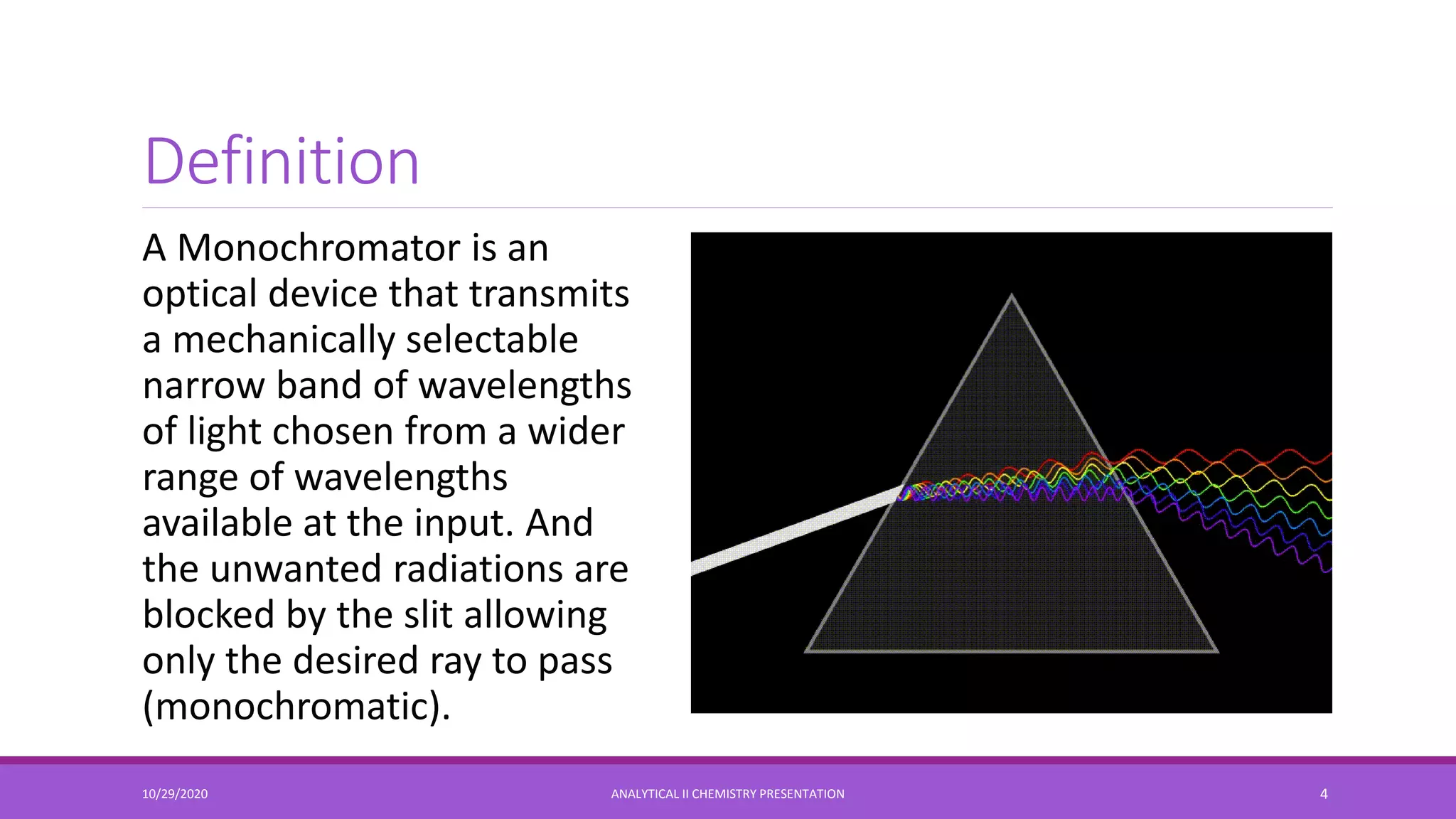
 A dispersive element disperse the
polychromatic light into several bands
of single wavelength and then a slit is
used which stops the unwanted bands
of light, allowing only the desired
monochromatic light to pass through its
exit point.
 By fixing the slit and rotating the
dispersive element, the direction of the
dispersed light is turned so that the
colour of the resulting monochromatic
light changes.
10/29/2020 ANALYTICAL II CHEMISTRY PRESENTATION 6
Types of Monochromators
Monochromators are of following
three types.
Prism
Monochrom
ator
Diffraction
Grating
Monochromator
Optical
Filters
10/29/2020 ANALYTICAL II CHEMISTRY PRESENTATION 7
1- Prism Monochromator
When electromagnetic radiation
passes through a prism, it is
refracted because the index of
refraction of the prism material is
different from that of air.
Shorter wavelengths are refracted
more than longer wavelengths.
By rotation of the prism, different
wavelengths of the spectrum can
be made to pass through an exit
slit and through the sample.
10/29/2020 ANALYTICAL II CHEMISTRY PRESENTATION 8
Features of Prism Monochromators.
A prism works satisfactorily in the ultraviolet and visible regions
and can also be used in the infrared region.
Because of its nonlinear dispersion, it works more effectively for
the shorter wavelengths.
Glass prisms and lenses can be used in the visible region.
Quartz or fused silica must be used in the ultraviolet region.
The entire monochromatic compartment must be kept dry.
10/29/2020 ANALYTICAL II CHEMISTRY PRESENTATION 9
10/29/2020 ANALYTICAL II CHEMISTRY PRESENTATION 10
Diffraction Grating Monochromator
The dispersive element in grating monochromator is a reflecting
diffraction grating. It provides a constant dispersion for all
wavelengths and a low dependence on temperature. However, they
produce relatively large amounts of scattered light and require the
use of filters to block higher order light.
Diffraction gratings are often used in modern instruments due to
their superior dispersion properties.
The most popular design for grating is the Czerny-Turner
monochromator
10/29/2020 ANALYTICAL II CHEMISTRY PRESENTATION 11
Czerny-Turner Monochromator
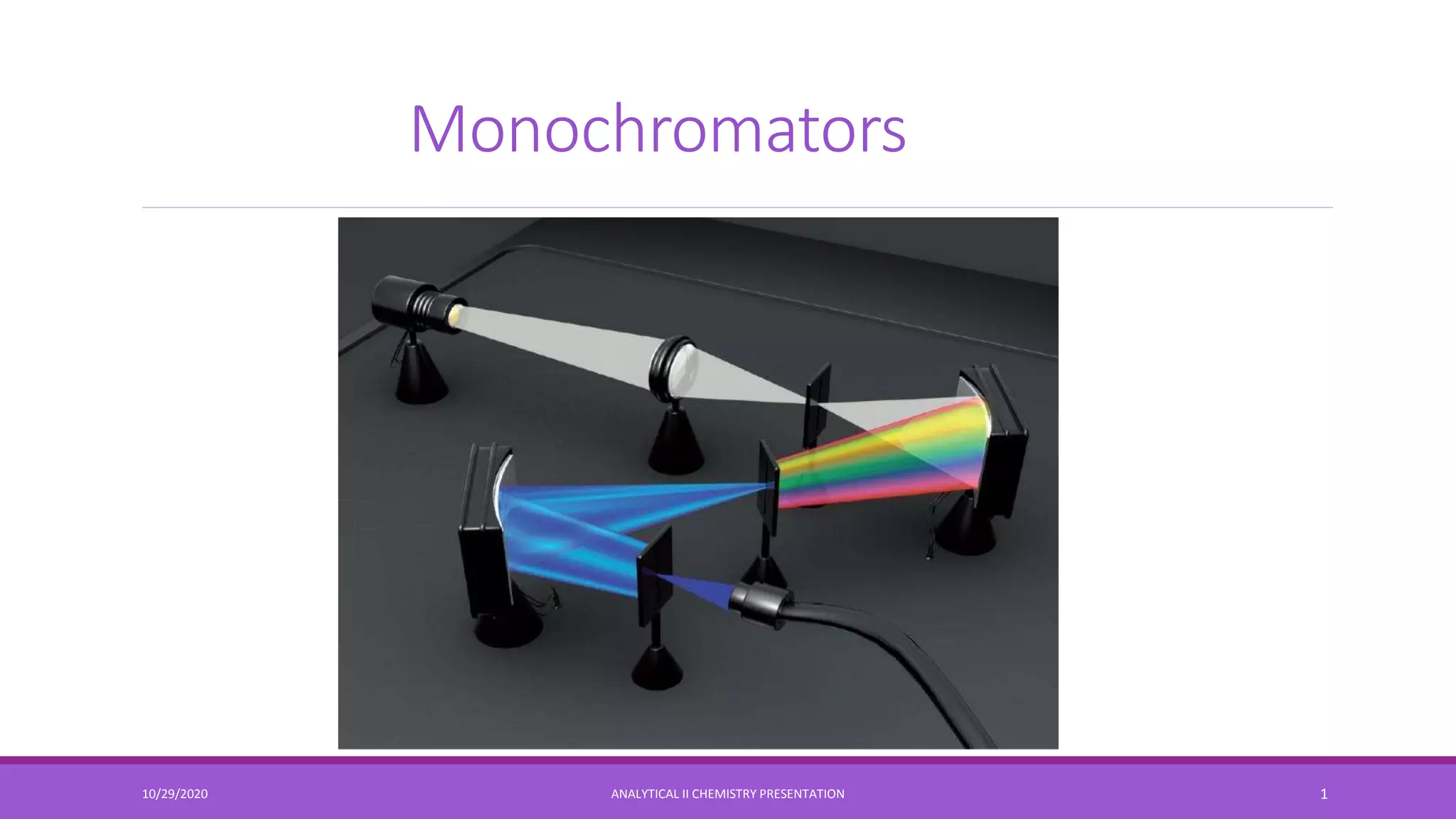
The input light is focused onto the input slit and therefore divergent after the slit. It
is collimated by a curved mirror and hits a diffraction grating, which deflects
different wavelength components in slightly different directions. A second curved
mirror translates different beam directions into different positions on the exit slit,
so that only light in a narrow wavelength region can get through that slit.
10/29/2020 ANALYTICAL II CHEMISTRY PRESENTATION 12
10/29/2020 ANALYTICAL II CHEMISTRY PRESENTATION 13
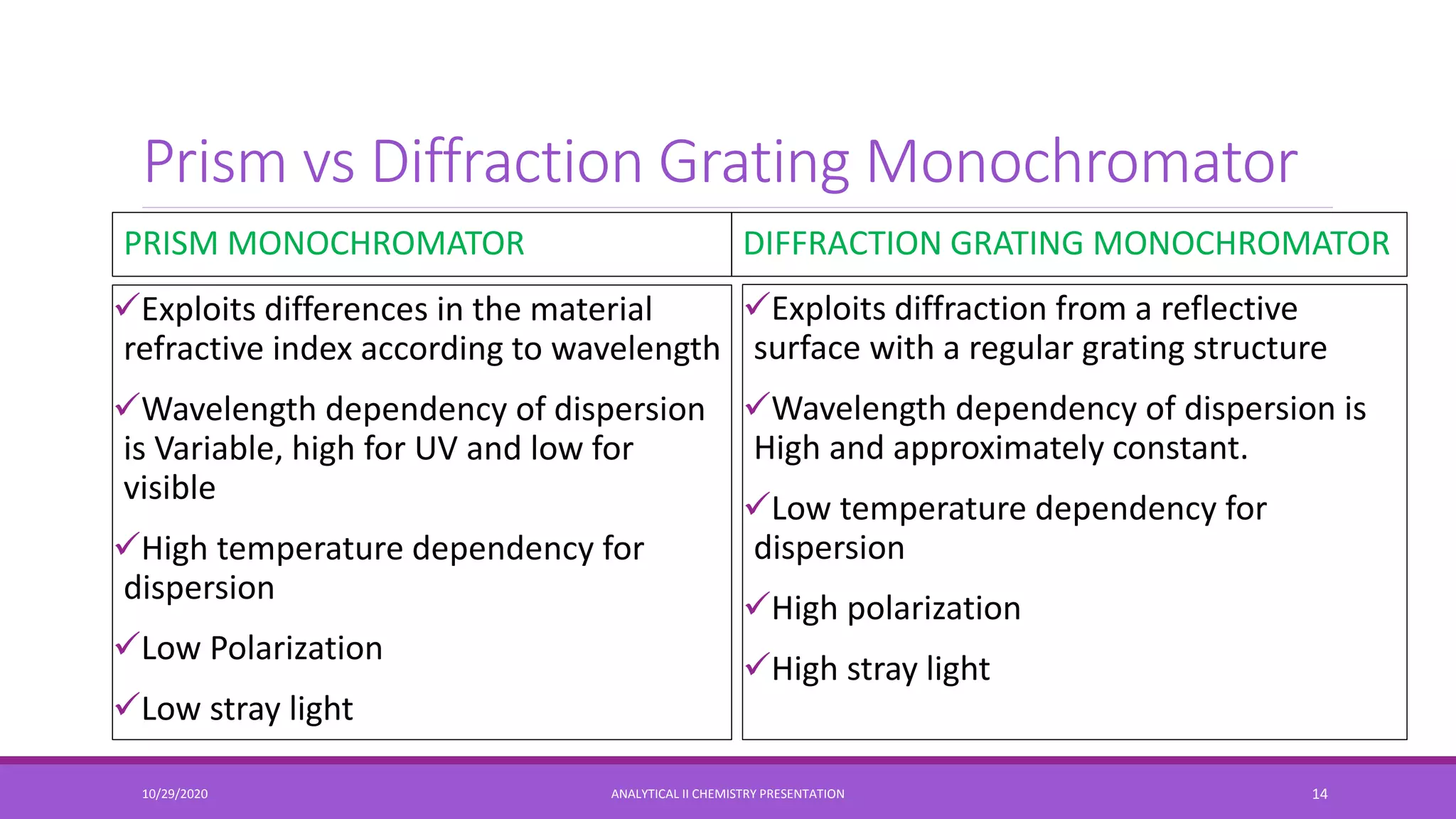
Prism vs Diffraction Grating Monochromator
PRISM MONOCHROMATOR
Exploits differences in the material
refractive index according to wavelength
Wavelength dependency of dispersion
is Variable, high for UV and low for
visible
High temperature dependency for
dispersion
Low Polarization
Low stray light
DIFFRACTION GRATING MONOCHROMATOR
Exploits diffraction from a reflective
surface with a regular grating structure
Wavelength dependency of dispersion is
High and approximately constant.
Low temperature dependency for
dispersion
High polarization
High stray light
10/29/2020 ANALYTICAL II CHEMISTRY PRESENTATION 14
Optical filters
Optical Filters are used to selectively
transmit wavelength or range of
wavelengths while rejecting the
remainders.
They are of following two categories
1) Absorptive optical filters
2) Dichroic optical filters
10/29/2020 ANALYTICAL II CHEMISTRY PRESENTATION 15
Absorptive and Dichroic Optical filters
ABSORPTIVE OPTICAL FILTER
Absorptive filters have a coating of
different organic and inorganic
materials that absorb certain
wavelengths of light, thus allowing
the desired wavelengths to pass
through. Since they absorb light
energy, the temperature of these
filters increases during operation.
DICHROIC OPTICAL FILTER
Dichroic filters are more
complicated in their operation. They
consist of a series of optical
coatings with precise thicknesses
that are designed to reflect
unwanted wavelengths and
transmit the desired wavelength
range.
10/29/2020 ANALYTICAL II CHEMISTRY PRESENTATION 16
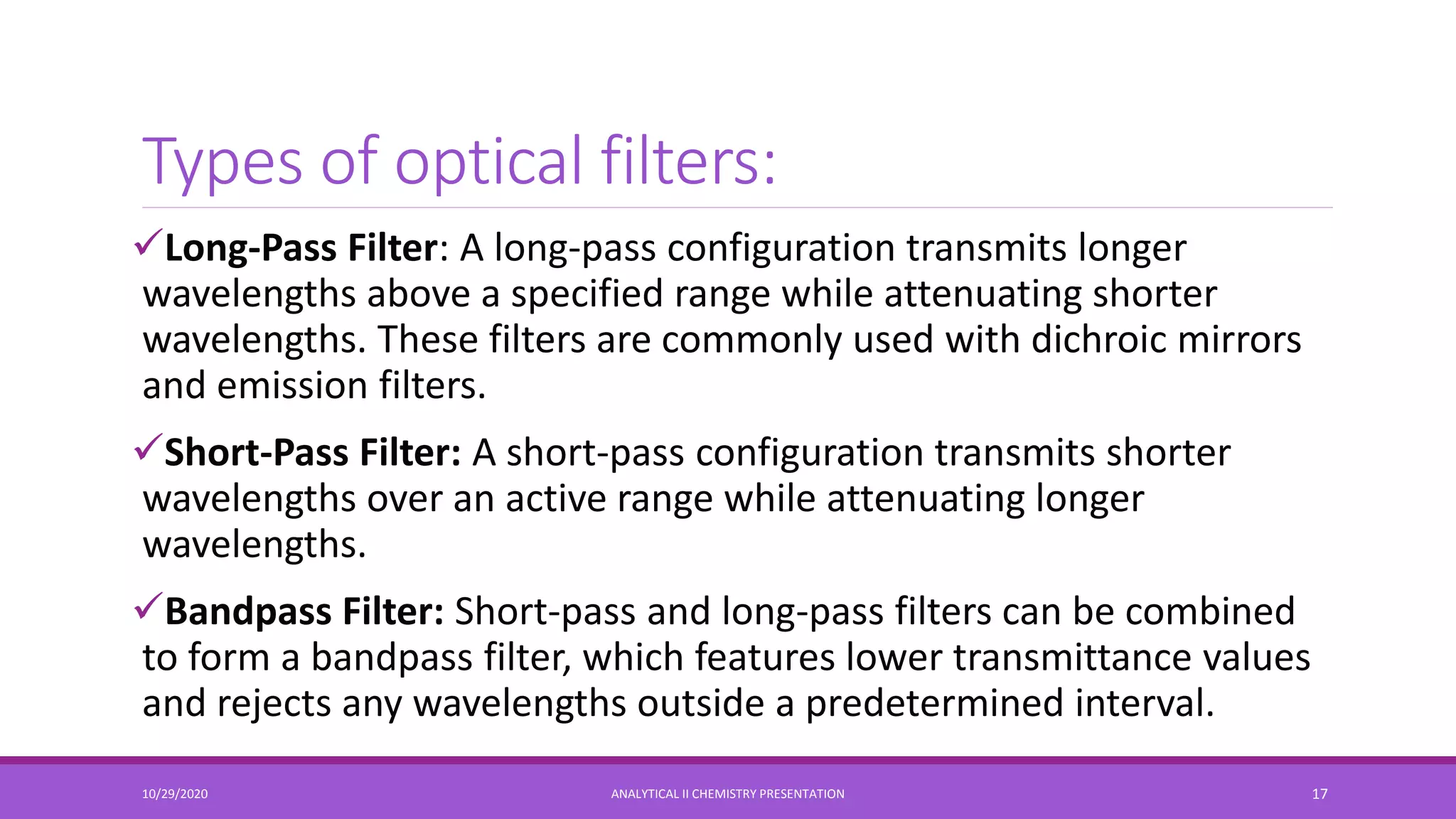
Types of optical filters:
Long-Pass Filter: A long-pass configuration transmits longer
wavelengths above a specified range while attenuating shorter
wavelengths. These filters are commonly used with dichroic mirrors
and emission filters.
Short-Pass Filter: A short-pass configuration transmits shorter
wavelengths over an active range while attenuating longer
wavelengths.
Bandpass Filter: Short-pass and long-pass filters can be combined
to form a bandpass filter, which features lower transmittance values
and rejects any wavelengths outside a predetermined interval.
10/29/2020 ANALYTICAL II CHEMISTRY PRESENTATION 17
Applications of Monochromators.
Monochromators are often used in spectroscopy.
Monochromators are commonly used in measurement devices such as
spectrometers or microplate readers. They are a popular device for wavelength
selection in a range of detection technologies, such as absorption and
fluorescence intensity
In spectrophotometers for measuring the wavelength-
dependent absorbance or reflectance of a sample
A common application is in combination with a photodetector with such a
setup one can record the optical spectrum of a light source
10/29/2020 ANALYTICAL II CHEMISTRY PRESENTATION 18

Monochromators

  • 1.
  • 2.
    Group Members Asad Aziz~ 7204 Majid Ashiq ~ 7205 Sufian Raza ~ 7206 Arooj Mansha ~ 7234 Ain-ul- Batool ~ 7213 10/29/2020 ANALYTICAL II CHEMISTRY PRESENTATION 2
  • 3.
    Outline 1-Definition 2-Terminology 3-Principle 4-Types Prism Monochromator. Diffraction gratingMonochromator. Optical Filters 5-Applications. 10/29/2020 ANALYTICAL II CHEMISTRY PRESENTATION 3
  • 4.
    Definition A Monochromator isan optical device that transmits a mechanically selectable narrow band of wavelengths of light chosen from a wider range of wavelengths available at the input. And the unwanted radiations are blocked by the slit allowing only the desired ray to pass (monochromatic). 10/29/2020 ANALYTICAL II CHEMISTRY PRESENTATION 4
  • 5.
    Terminology  Mono Single Chroma Colour  Ator Donating Agent 10/29/2020 ANALYTICAL II CHEMISTRY PRESENTATION 5
  • 6.
    Principle  A dispersiveelement disperse the polychromatic light into several bands of single wavelength and then a slit is used which stops the unwanted bands of light, allowing only the desired monochromatic light to pass through its exit point.  By fixing the slit and rotating the dispersive element, the direction of the dispersed light is turned so that the colour of the resulting monochromatic light changes. 10/29/2020 ANALYTICAL II CHEMISTRY PRESENTATION 6
  • 7.
    Types of Monochromators Monochromatorsare of following three types. Prism Monochrom ator Diffraction Grating Monochromator Optical Filters 10/29/2020 ANALYTICAL II CHEMISTRY PRESENTATION 7
  • 8.
    1- Prism Monochromator Whenelectromagnetic radiation passes through a prism, it is refracted because the index of refraction of the prism material is different from that of air. Shorter wavelengths are refracted more than longer wavelengths. By rotation of the prism, different wavelengths of the spectrum can be made to pass through an exit slit and through the sample. 10/29/2020 ANALYTICAL II CHEMISTRY PRESENTATION 8
  • 9.
    Features of PrismMonochromators. A prism works satisfactorily in the ultraviolet and visible regions and can also be used in the infrared region. Because of its nonlinear dispersion, it works more effectively for the shorter wavelengths. Glass prisms and lenses can be used in the visible region. Quartz or fused silica must be used in the ultraviolet region. The entire monochromatic compartment must be kept dry. 10/29/2020 ANALYTICAL II CHEMISTRY PRESENTATION 9
  • 10.
    10/29/2020 ANALYTICAL IICHEMISTRY PRESENTATION 10
  • 11.
    Diffraction Grating Monochromator Thedispersive element in grating monochromator is a reflecting diffraction grating. It provides a constant dispersion for all wavelengths and a low dependence on temperature. However, they produce relatively large amounts of scattered light and require the use of filters to block higher order light. Diffraction gratings are often used in modern instruments due to their superior dispersion properties. The most popular design for grating is the Czerny-Turner monochromator 10/29/2020 ANALYTICAL II CHEMISTRY PRESENTATION 11
  • 12.
    Czerny-Turner Monochromator The inputlight is focused onto the input slit and therefore divergent after the slit. It is collimated by a curved mirror and hits a diffraction grating, which deflects different wavelength components in slightly different directions. A second curved mirror translates different beam directions into different positions on the exit slit, so that only light in a narrow wavelength region can get through that slit. 10/29/2020 ANALYTICAL II CHEMISTRY PRESENTATION 12
  • 13.
    10/29/2020 ANALYTICAL IICHEMISTRY PRESENTATION 13
  • 14.
    Prism vs DiffractionGrating Monochromator PRISM MONOCHROMATOR Exploits differences in the material refractive index according to wavelength Wavelength dependency of dispersion is Variable, high for UV and low for visible High temperature dependency for dispersion Low Polarization Low stray light DIFFRACTION GRATING MONOCHROMATOR Exploits diffraction from a reflective surface with a regular grating structure Wavelength dependency of dispersion is High and approximately constant. Low temperature dependency for dispersion High polarization High stray light 10/29/2020 ANALYTICAL II CHEMISTRY PRESENTATION 14
  • 15.
    Optical filters Optical Filtersare used to selectively transmit wavelength or range of wavelengths while rejecting the remainders. They are of following two categories 1) Absorptive optical filters 2) Dichroic optical filters 10/29/2020 ANALYTICAL II CHEMISTRY PRESENTATION 15
  • 16.
    Absorptive and DichroicOptical filters ABSORPTIVE OPTICAL FILTER Absorptive filters have a coating of different organic and inorganic materials that absorb certain wavelengths of light, thus allowing the desired wavelengths to pass through. Since they absorb light energy, the temperature of these filters increases during operation. DICHROIC OPTICAL FILTER Dichroic filters are more complicated in their operation. They consist of a series of optical coatings with precise thicknesses that are designed to reflect unwanted wavelengths and transmit the desired wavelength range. 10/29/2020 ANALYTICAL II CHEMISTRY PRESENTATION 16
  • 17.
    Types of opticalfilters: Long-Pass Filter: A long-pass configuration transmits longer wavelengths above a specified range while attenuating shorter wavelengths. These filters are commonly used with dichroic mirrors and emission filters. Short-Pass Filter: A short-pass configuration transmits shorter wavelengths over an active range while attenuating longer wavelengths. Bandpass Filter: Short-pass and long-pass filters can be combined to form a bandpass filter, which features lower transmittance values and rejects any wavelengths outside a predetermined interval. 10/29/2020 ANALYTICAL II CHEMISTRY PRESENTATION 17
  • 18.
    Applications of Monochromators. Monochromatorsare often used in spectroscopy. Monochromators are commonly used in measurement devices such as spectrometers or microplate readers. They are a popular device for wavelength selection in a range of detection technologies, such as absorption and fluorescence intensity In spectrophotometers for measuring the wavelength- dependent absorbance or reflectance of a sample A common application is in combination with a photodetector with such a setup one can record the optical spectrum of a light source 10/29/2020 ANALYTICAL II CHEMISTRY PRESENTATION 18