TEMPERATURE
MEASUREMENT
TEMPERATURE MEASUREMENT
• On the whole, the temperature is the most important variable in industry processing,
primarily because its is fundamental condition characteristic of the thermal state of body.
• The thermometer is, the most widely used instrument processing of all kinds.
• it is simple to use and economical and provides reliable performance under a variety of
application conditions.
• Thermometers are employed for the measurement of temperature.
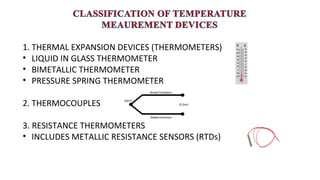
1. THERMAL EXPANSION DEVICES (THERMOMETERS):
• LIQUID IN GLASS THERMOMETER
• BIMETALLIC THERMOMETER
• PRESSURE SPRING THERMOMETER
2. THERMOCOUPLES
3. RESISTANCE THERMOMETERS
• INCLUDES METALLIC RESISTANCE SENSORS (RTDs)
MFMcGraw Ch13c-Temperature-Revised-4/25/10 4
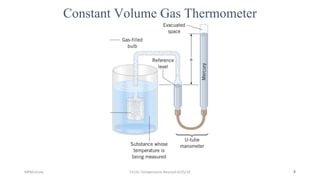
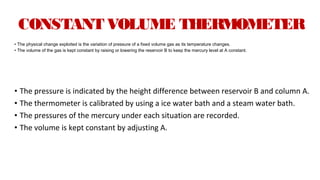
Constant Volume Gas Thermometer
CONSTANT VOLUME THERMOMETER
• The physical change exploited is the variation of pressure of a fixed volume gas as its temperature changes.
• The volume of the gas is kept constant by raising or lowering the reservoir B to keep the mercury level at A constant.
• The pressure is indicated by the height difference between reservoir B and column A.
• The thermometer is calibrated by using a ice water bath and a steam water bath.
• The pressures of the mercury under each situation are recorded.
• The volume is kept constant by adjusting A.
MERCURY IN GLASS
THERMOMETER
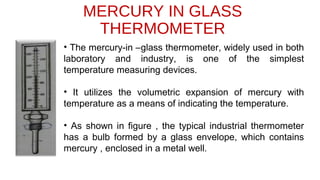
• The mercury-in –glass thermometer, widely used in both
laboratory and industry, is one of the simplest
temperature measuring devices.
• It utilizes the volumetric expansion of mercury with
temperature as a means of indicating the temperature.
• As shown in figure , the typical industrial thermometer
has a bulb formed by a glass envelope, which contains
mercury , enclosed in a metal well.
MERCURY IN GLASS
THERMOMETER
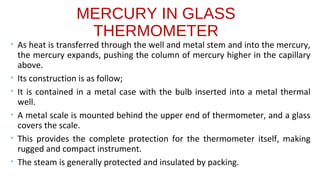
• As heat is transferred through the well and metal stem and into the mercury,
the mercury expands, pushing the column of mercury higher in the capillary
above.
• Its construction is as follow;
• It is contained in a metal case with the bulb inserted into a metal thermal
well.
• A metal scale is mounted behind the upper end of thermometer, and a glass
covers the scale.
• This provides the complete protection for the thermometer itself, making
rugged and compact instrument.
• The steam is generally protected and insulated by packing.
MERCURY IN GLASS
THERMOMETER
• Thermal is well provided for purpose of preventing breakage and
providing a sealing means at the point of installation.
• It is generally of brass or steal although cast iron, Monel, stainless
steal, and aluminium are sometimes used.
• The temperature range in which the industrial mercury-in-glass
thermometer is used is -38 to 950 degree F.
BIMETALLIC THERMOMETERS
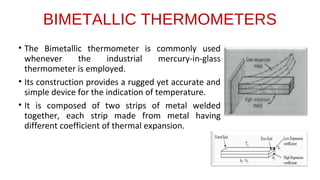
• The Bimetallic thermometer is commonly used
whenever the industrial mercury-in-glass
thermometer is employed.
• Its construction provides a rugged yet accurate and
simple device for the indication of temperature.
• It is composed of two strips of metal welded
together, each strip made from metal having
different coefficient of thermal expansion.
BIMETALLIC THERMOMETERS
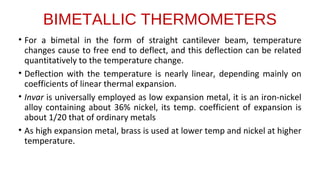
• For a bimetal in the form of straight cantilever beam, temperature
changes cause to free end to deflect, and this deflection can be related
quantitatively to the temperature change.
• Deflection with the temperature is nearly linear, depending mainly on
coefficients of linear thermal expansion.
• Invar is universally employed as low expansion metal, it is an iron-nickel
alloy containing about 36% nickel, its temp. coefficient of expansion is
about 1/20 that of ordinary metals
• As high expansion metal, brass is used at lower temp and nickel at higher
temperature.
PRESSURE SPRING
THERMOMETER
• The liquid expansion thermometer utilizes the
cubical expansion of liquid, generally mercury to
indicate the temperature.
• The gas expansion thermometer operates at
substantially constant volume , the pressure of the
gas being proportional for temperature.
• Vapor-actuated thermometer is operated by vapor
pressure of liquid.
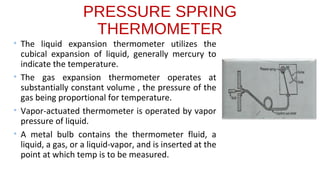
• A metal bulb contains the thermometer fluid, a
liquid, a gas, or a liquid-vapor, and is inserted at the
point at which temp is to be measured.
PRESSURE SPRING
THERMOMETER
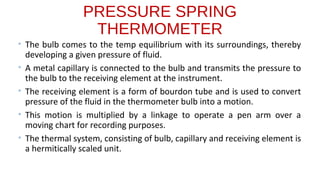
• The bulb comes to the temp equilibrium with its surroundings, thereby
developing a given pressure of fluid.
• A metal capillary is connected to the bulb and transmits the pressure to
the bulb to the receiving element at the instrument.
• The receiving element is a form of bourdon tube and is used to convert
pressure of the fluid in the thermometer bulb into a motion.
• This motion is multiplied by a linkage to operate a pen arm over a
moving chart for recording purposes.
• The thermal system, consisting of bulb, capillary and receiving element is
a hermitically scaled unit.
PRESSURE SPRING
THERMOMETER
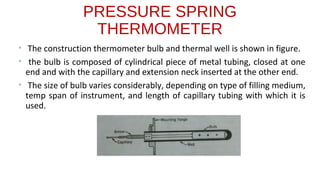
• The construction thermometer bulb and thermal well is shown in figure.
• the bulb is composed of cylindrical piece of metal tubing, closed at one
end and with the capillary and extension neck inserted at the other end.
• The size of bulb varies considerably, depending on type of filling medium,
temp span of instrument, and length of capillary tubing with which it is
used.
THERMOCOUPLE MEASURING
DEVICES
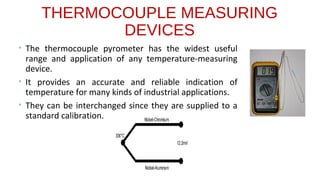
• The thermocouple pyrometer has the widest useful
range and application of any temperature-measuring
device.
• It provides an accurate and reliable indication of
temperature for many kinds of industrial applications.
• They can be interchanged since they are supplied to a
standard calibration.
THERMOELECTRICITY
• A thermocouple is composed of two dissimilar wires
joined together so as to produce thermal emf.
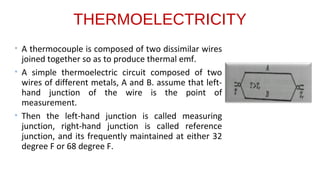
• A simple thermoelectric circuit composed of two
wires of different metals, A and B. assume that left-
hand junction of the wire is the point of
measurement.
• Then the left-hand junction is called measuring
junction, right-hand junction is called reference
junction, and its frequently maintained at either 32
degree F or 68 degree F.
THERMOELECTRICITY
• The THOMSON EFFECT is a relation between emf generated in a
single homogeneous wire and temp difference between the ends of
wire.
• The thomson emf is propotional to temp and the temp difference in
wire and differs for different metals.
• The PELTIER EFFECT relates the absorption and evolution of heat at
the junction of a thermocouple to the current flow in the circuit.
• It is proportional to current alone and is different from joule heating
effect , which is proportional to the square of the current times the
resistance.
• Thus thermocouple employs both PELTIER EFFECT and THOMSON
LAWS OF THERMOELECTRIC
CIRCUITS
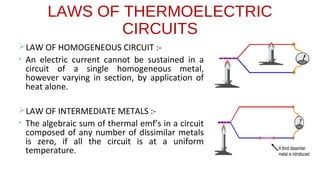
LAW OF HOMOGENEOUS CIRCUIT :-
• An electric current cannot be sustained in a
circuit of a single homogeneous metal,
however varying in section, by application of
heat alone.
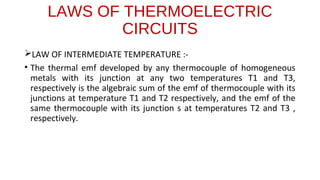
LAW OF INTERMEDIATE METALS :-
• The algebraic sum of thermal emf’s in a circuit
composed of any number of dissimilar metals
is zero, if all the circuit is at a uniform
temperature.
LAWS OF THERMOELECTRIC
CIRCUITS
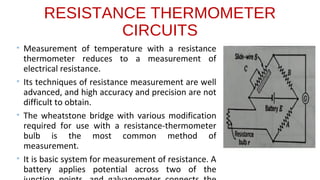
LAW OF INTERMEDIATE TEMPERATURE :-
• The thermal emf developed by any thermocouple of homogeneous
metals with its junction at any two temperatures T1 and T3,
respectively is the algebraic sum of the emf of thermocouple with its
junctions at temperature T1 and T2 respectively, and the emf of the
same thermocouple with its junction s at temperatures T2 and T3 ,
respectively.
RESISTANCE THERMOMETER
CIRCUITS
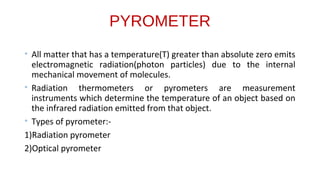
• Measurement of temperature with a resistance
thermometer reduces to a measurement of
electrical resistance.
• Its techniques of resistance measurement are well
advanced, and high accuracy and precision are not
difficult to obtain.
• The wheatstone bridge with various modification
required for use with a resistance-thermometer
bulb is the most common method of
measurement.
• It is basic system for measurement of resistance. A
battery applies potential across two of the
PYROMETER
• All matter that has a temperature(T) greater than absolute zero emits
electromagnetic radiation(photon particles) due to the internal
mechanical movement of molecules.
• Radiation thermometers or pyrometers are measurement
instruments which determine the temperature of an object based on
the infrared radiation emitted from that object.
• Types of pyrometer:-
1)Radiation pyrometer
2)Optical pyrometer
RADIATION PYROMETER
• Principle :
Temperature measurement is based on the measurement of
radiation either directly by a sensor or by comparing with the
radiation of a body of known temperature.
The radiation pyrometer is non-contact type of temperature
measurement.
The wavelength region having high intensity is between 0.1 to 10
micrometer.
In this region, 0.1 to 0.4 micrometer is known as ultraviolet region.
RADIATION PYROMETER
• 0.4 to 0.7 micrometer is known as the visible region. 0.7 micrometer
onwards is the infrared region.
• With the increasing temperature, the radiation intensity is stronger
towards shorter wavelengths.
• The temperature measurement by radiation pyrometer is limited
within 0.5 to 8 micrometer wave length region.
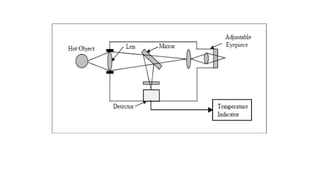
• Radiation pyrometer consist of optical component to collect the
radiation energy emitted by object , a radiation detector that
converts the radiant energy in to an electrical signal and an indicator
to read the measurement.
OPTICAL PYROMETER
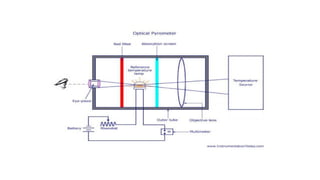
• This pyrometer is also known as disappearing filament pyrometer.
• Main principle :
• In this type of pyrometer, the tungsten filament of an electric bulb is
used as radiator.
• The intensity of radiation of filament is compared with the intensity
of the radiation of the hot surface.
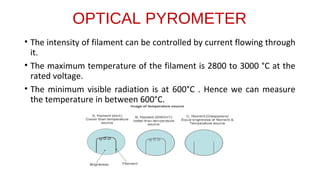
• When both the intensity match, the filament of bulb is disappears
against the background.
OPTICAL PYROMETER
• The intensity of filament can be controlled by current flowing through
it.
• The maximum temperature of the filament is 2800 to 3000 °C at the
rated voltage.
• The minimum visible radiation is at 600°C . Hence we can measure
the temperature in between 600°C.
REFERENCES
• INDUSTRIAL INSTRUMENTATION, by Donald Eckman.
Temperature measurement

Temperature measurement

  • 1.
  • 2.
    TEMPERATURE MEASUREMENT • Onthe whole, the temperature is the most important variable in industry processing, primarily because its is fundamental condition characteristic of the thermal state of body. • The thermometer is, the most widely used instrument processing of all kinds. • it is simple to use and economical and provides reliable performance under a variety of application conditions. • Thermometers are employed for the measurement of temperature.
  • 3.
    1. THERMAL EXPANSIONDEVICES (THERMOMETERS): • LIQUID IN GLASS THERMOMETER • BIMETALLIC THERMOMETER • PRESSURE SPRING THERMOMETER 2. THERMOCOUPLES 3. RESISTANCE THERMOMETERS • INCLUDES METALLIC RESISTANCE SENSORS (RTDs)
  • 4.
  • 5.
    CONSTANT VOLUME THERMOMETER •The physical change exploited is the variation of pressure of a fixed volume gas as its temperature changes. • The volume of the gas is kept constant by raising or lowering the reservoir B to keep the mercury level at A constant. • The pressure is indicated by the height difference between reservoir B and column A. • The thermometer is calibrated by using a ice water bath and a steam water bath. • The pressures of the mercury under each situation are recorded. • The volume is kept constant by adjusting A.
  • 6.
    MERCURY IN GLASS THERMOMETER •The mercury-in –glass thermometer, widely used in both laboratory and industry, is one of the simplest temperature measuring devices. • It utilizes the volumetric expansion of mercury with temperature as a means of indicating the temperature. • As shown in figure , the typical industrial thermometer has a bulb formed by a glass envelope, which contains mercury , enclosed in a metal well.
  • 7.
    MERCURY IN GLASS THERMOMETER •As heat is transferred through the well and metal stem and into the mercury, the mercury expands, pushing the column of mercury higher in the capillary above. • Its construction is as follow; • It is contained in a metal case with the bulb inserted into a metal thermal well. • A metal scale is mounted behind the upper end of thermometer, and a glass covers the scale. • This provides the complete protection for the thermometer itself, making rugged and compact instrument. • The steam is generally protected and insulated by packing.
  • 8.
    MERCURY IN GLASS THERMOMETER •Thermal is well provided for purpose of preventing breakage and providing a sealing means at the point of installation. • It is generally of brass or steal although cast iron, Monel, stainless steal, and aluminium are sometimes used. • The temperature range in which the industrial mercury-in-glass thermometer is used is -38 to 950 degree F.
  • 9.
    BIMETALLIC THERMOMETERS • TheBimetallic thermometer is commonly used whenever the industrial mercury-in-glass thermometer is employed. • Its construction provides a rugged yet accurate and simple device for the indication of temperature. • It is composed of two strips of metal welded together, each strip made from metal having different coefficient of thermal expansion.
  • 10.
    BIMETALLIC THERMOMETERS • Fora bimetal in the form of straight cantilever beam, temperature changes cause to free end to deflect, and this deflection can be related quantitatively to the temperature change. • Deflection with the temperature is nearly linear, depending mainly on coefficients of linear thermal expansion. • Invar is universally employed as low expansion metal, it is an iron-nickel alloy containing about 36% nickel, its temp. coefficient of expansion is about 1/20 that of ordinary metals • As high expansion metal, brass is used at lower temp and nickel at higher temperature.
  • 11.
    PRESSURE SPRING THERMOMETER • Theliquid expansion thermometer utilizes the cubical expansion of liquid, generally mercury to indicate the temperature. • The gas expansion thermometer operates at substantially constant volume , the pressure of the gas being proportional for temperature. • Vapor-actuated thermometer is operated by vapor pressure of liquid. • A metal bulb contains the thermometer fluid, a liquid, a gas, or a liquid-vapor, and is inserted at the point at which temp is to be measured.
  • 12.
    PRESSURE SPRING THERMOMETER • Thebulb comes to the temp equilibrium with its surroundings, thereby developing a given pressure of fluid. • A metal capillary is connected to the bulb and transmits the pressure to the bulb to the receiving element at the instrument. • The receiving element is a form of bourdon tube and is used to convert pressure of the fluid in the thermometer bulb into a motion. • This motion is multiplied by a linkage to operate a pen arm over a moving chart for recording purposes. • The thermal system, consisting of bulb, capillary and receiving element is a hermitically scaled unit.
  • 13.
    PRESSURE SPRING THERMOMETER • Theconstruction thermometer bulb and thermal well is shown in figure. • the bulb is composed of cylindrical piece of metal tubing, closed at one end and with the capillary and extension neck inserted at the other end. • The size of bulb varies considerably, depending on type of filling medium, temp span of instrument, and length of capillary tubing with which it is used.
  • 14.
    THERMOCOUPLE MEASURING DEVICES • Thethermocouple pyrometer has the widest useful range and application of any temperature-measuring device. • It provides an accurate and reliable indication of temperature for many kinds of industrial applications. • They can be interchanged since they are supplied to a standard calibration.
  • 15.
    THERMOELECTRICITY • A thermocoupleis composed of two dissimilar wires joined together so as to produce thermal emf. • A simple thermoelectric circuit composed of two wires of different metals, A and B. assume that left- hand junction of the wire is the point of measurement. • Then the left-hand junction is called measuring junction, right-hand junction is called reference junction, and its frequently maintained at either 32 degree F or 68 degree F.
  • 16.
    THERMOELECTRICITY • The THOMSONEFFECT is a relation between emf generated in a single homogeneous wire and temp difference between the ends of wire. • The thomson emf is propotional to temp and the temp difference in wire and differs for different metals. • The PELTIER EFFECT relates the absorption and evolution of heat at the junction of a thermocouple to the current flow in the circuit. • It is proportional to current alone and is different from joule heating effect , which is proportional to the square of the current times the resistance. • Thus thermocouple employs both PELTIER EFFECT and THOMSON
  • 17.
    LAWS OF THERMOELECTRIC CIRCUITS LAWOF HOMOGENEOUS CIRCUIT :- • An electric current cannot be sustained in a circuit of a single homogeneous metal, however varying in section, by application of heat alone. LAW OF INTERMEDIATE METALS :- • The algebraic sum of thermal emf’s in a circuit composed of any number of dissimilar metals is zero, if all the circuit is at a uniform temperature.
  • 18.
    LAWS OF THERMOELECTRIC CIRCUITS LAWOF INTERMEDIATE TEMPERATURE :- • The thermal emf developed by any thermocouple of homogeneous metals with its junction at any two temperatures T1 and T3, respectively is the algebraic sum of the emf of thermocouple with its junctions at temperature T1 and T2 respectively, and the emf of the same thermocouple with its junction s at temperatures T2 and T3 , respectively.
  • 19.
    RESISTANCE THERMOMETER CIRCUITS • Measurementof temperature with a resistance thermometer reduces to a measurement of electrical resistance. • Its techniques of resistance measurement are well advanced, and high accuracy and precision are not difficult to obtain. • The wheatstone bridge with various modification required for use with a resistance-thermometer bulb is the most common method of measurement. • It is basic system for measurement of resistance. A battery applies potential across two of the
  • 20.
    PYROMETER • All matterthat has a temperature(T) greater than absolute zero emits electromagnetic radiation(photon particles) due to the internal mechanical movement of molecules. • Radiation thermometers or pyrometers are measurement instruments which determine the temperature of an object based on the infrared radiation emitted from that object. • Types of pyrometer:- 1)Radiation pyrometer 2)Optical pyrometer
  • 21.
    RADIATION PYROMETER • Principle: Temperature measurement is based on the measurement of radiation either directly by a sensor or by comparing with the radiation of a body of known temperature. The radiation pyrometer is non-contact type of temperature measurement. The wavelength region having high intensity is between 0.1 to 10 micrometer. In this region, 0.1 to 0.4 micrometer is known as ultraviolet region.
  • 22.
    RADIATION PYROMETER • 0.4to 0.7 micrometer is known as the visible region. 0.7 micrometer onwards is the infrared region. • With the increasing temperature, the radiation intensity is stronger towards shorter wavelengths. • The temperature measurement by radiation pyrometer is limited within 0.5 to 8 micrometer wave length region. • Radiation pyrometer consist of optical component to collect the radiation energy emitted by object , a radiation detector that converts the radiant energy in to an electrical signal and an indicator to read the measurement.
  • 24.
    OPTICAL PYROMETER • Thispyrometer is also known as disappearing filament pyrometer. • Main principle : • In this type of pyrometer, the tungsten filament of an electric bulb is used as radiator. • The intensity of radiation of filament is compared with the intensity of the radiation of the hot surface. • When both the intensity match, the filament of bulb is disappears against the background.
  • 26.
    OPTICAL PYROMETER • Theintensity of filament can be controlled by current flowing through it. • The maximum temperature of the filament is 2800 to 3000 °C at the rated voltage. • The minimum visible radiation is at 600°C . Hence we can measure the temperature in between 600°C.
  • 27.