Thyroid TTThhhyyyrrroooiiiddd aaaannnndddd AAAAnnnnttttiiii----tttthhhhyyyyrrrrooooiiiidddd ddddrrrruuuussss 
By: A.M.NASEEFA 
JSS COLLEGE OF 
PHARMACY, MYSORE
Thyroid & Antithyroid 
drug Introduction: 
@ Thyroid releases T3 & T4 
@ The ratio of T4 to T3 is 5:1, so most of the hormone released is 
thyroxine 
@ Most of the T3 in the blood is derived from thyroxine 
@ T3 is three to four times more potent than T4 
@ The affinity of the receptor site for T3 is about ten times higher than 
that for T4 
Thyroid gland secretes thyroid hormones— 
* Triiodothyronine (T3) 
* Tetraiodothyronine (T4, thyroxine) 
* Calcitonin 
Although the thyroid gland is not essential for life, inadequate secretion 
of thyroid hormone (hypothyroidism) results in bradycardia, poor 
resistance to cold, and mental and physical slowing (in children, this can 
cause mental retardation and dwarfism). 
•If, however, an excess of thyroid hormones is secreted 
(hyperthyroidism), then tachycardia and cardiac arrhythmias, body 
wasting, nervousness, tremor, and excess heat production can occur. 
•The thyroid gland also secretes the hormone “calcitonin” a serum 
calcium-lowering hormone.
Synthesis of thyroid hormones 
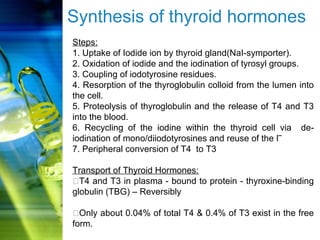
Steps: 
1. Uptake of Iodide ion by thyroid gland(NaI-symporter). 
2. Oxidation of iodide and the iodination of tyrosyl groups. 
3. Coupling of iodotyrosine residues. 
4. Resorption of the thyroglobulin colloid from the lumen into 
the cell. 
5. Proteolysis of thyroglobulin and the release of T4 and T3 
into the blood. 
6. Recycling of the iodine within the thyroid cell via de-iodination 
of mono/diiodotyrosines and reuse of the I‾ 
7. Peripheral conversion of T4 to T3 
Transport of Thyroid Hormones: 
T4 and T3 in plasma - bound to protein - thyroxine-binding 
globulin (TBG) – Reversibly 
Only about 0.04% of total T4 & 0.4% of T3 exist in the free 
form.
Mechanism of action: 
 Thyroid hormones have effects on virtually every cell 
of the body 
 Both T4 and T3 must dissociate from thyroxine-binding 
plasma proteins prior to entry into cells, 
either by diffusion or by active transport. 
 In the cell, T4 is enzymatically deiodinated 
(iodothyronine5’-deiodinase) to T3, which enters the 
nucleus and attaches to thyroid (TR) receptors. 
 TRs are proteins containing thyroid hormone-binding, 
DNA-binding, and dimerization domains 
 The activation of these receptors promotes the 
formation of RNA and subsequent protein synthesis, 
which is responsible for the effects of T4.
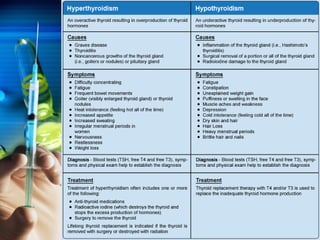
Disease of Thyroid gland: 
Hyperthyroidism/Thyrotoxicosis/Grave’s 
disease 
Hypothyroidism – 
# Cretinism (in children) 
# Myxoedema (in adult)
PHARMACOLOGICAL ACTION 
the actions of T4 &T3 are qualitativelysimilar & 
are nicely depicted in the features of hypo and 
hyperthyroidism. They affect the function of 
practically all body cells. 
Growth and development: T4 and T3 are 
essential for normal growth and development. 
• In adults, hypothyroidism results in intelligence 
impairment and slow movements. 
▲Insufficiency→ cretinism (infant & child), and myxedema 
(adult); 
▲Excess→hyperthyroid
Metabolic function: 
CHO metabolism: 
• increase glycogenolysis & gluconeogensis in liver 
• increase glucose absorption from GIT 
• Enhance glycolysis – rapid uptake of glucose by the cell. 
• Net result – increse in blood glucose level. Hyperglycaemia and 
diabetic-like state with insulin resistance occur in hyperthyroidism. 
On protein metabolism: 
• increase protein catabolism 
• prolong action results in negative nitrogen balance and tissue 
wasting. 
• Weight loss is a feature of hyperthyroidism. 
• T3/T4 in low concentration inhibits mucoprotien synthesis which is 
so characteristically accumulates in myoedema (hypothyrodism). 
On lipids: 
• T3/T4 indirectly enhance lipolysis by potentiating the action of 
catecholamines & other lipolytic harmones probably by 
suppressing a phophodiesterases. 
• Lipogenesisis also stimulated. 
• Plasma free fatty acid levels are elevated, 
• All phases of cholesterol metabolism are accelerated but its 
conversion to bile acids dominates. 
Thus, Hyperthyroidism is characterized by hypocholestrolemia.LDL 
levels in blood are reduced.
Calorigenesis: 
• T3/T4 increase BMR by stimulation of cellular metabolism. this is 
important for maintaining body temperature. 
• The mechanism of calorigenesis was believed to be uncoupling of 
oxidative phosporylation : excess energy being released as heat. 
However this occurs only at high doses and is not involved in 
mediating the physiological actions of T3/T4. 
Nervous system: 
T3/T4 have profound functional effect on CNS. Mental retardation is the 
hallmark of cretinism, sluggishness & other behavioral 
features are seen myxoedema.Hyperthyroid individuals are anxious , 
nervous,excitable, exhibit tremours and hyperreflexia. 
Skeletal muscle: 
muscles are flabby & weak in myxoedema while thyrotoxicosis 
produces increased muscle tone , tremors & weakness due to 
myopathy.
CVS : 
• T3 and T4 cause a hyperdynamicstate of circulation 
which is partly secondary to increased peripheral 
demand and partly due to direct cardiac actions. 
• Heart rate, contractility and output are increased 
resulting in a fast pulse. 
• T3 and T4 stimulate heart by direct action on 
contractile elements (increasing the myosin fraction 
having greater Ca2+ATPase activity) and 
probably by up regulation of β1 adrenergic receptors. 
• Atrial fibrillation and other irregularities are common in 
hyperthyroidism. 
• Thyroid hormones can also precipitate CHF and 
angina. BP, specially systolic, is often raised.
GIT: 
• Propulsive activity is increased by T3/T4. Hypothyroid 
patients often constipated while diarrhoea is common on 
hyperthyroidism. 
Kidney: 
• T3/T4 donot cause diuresis in euthyroid individuals but the 
rate of urine flow often increased when myxoedematous 
patients are treated with it. 
Haemopoiesis: 
• hypothyroid patients suffer from some degreeof anaemia 
which is restored only by T4 treatment. Thus T4 appears to 
be facilitatory to erythropoiesis. 
Reproduction: 
• thyroid has indirect effect on reproduction. Fertility is 
impaired in hypothyroidism & women suffer from 
oligomenorrhoea. Normal thyroid function is required for 
maintainence of pregnancy and lactation.
Pharmacokinetics: 
easily absorbed Orally ; the bioavalibility of T4 is 80% and 
T3 is 95%. Drugs that induce hepatic microsomal 
enzymes 
(e.g.,rifampin, phenbarbital, phenytoin, and etc) improve 
their metabolism. 
USES: The most important uses of thyroid hormone are 
as replacement therapy in deficiency states 
–Cretinism: Levothyroxine (T4) (8-12 pg/kg) 
–Adult hypothyroidism: T4 50pg daily 
–Nontoxic goiter 
–Myxoedemacoma 
–Thyroid nodules 
–Papillary carcinoma of thyroid
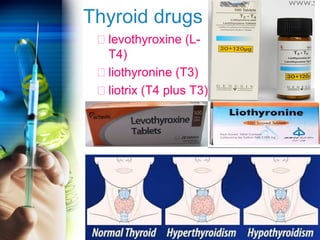
Thyroid drugs 
 levothyroxine (L-T4) 
 liothyronine (T3) 
 liotrix (T4 plus T3)
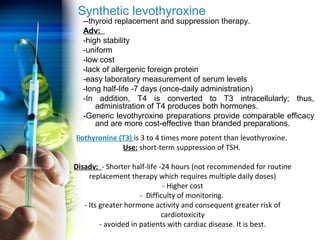
Synthetic levothyroxine 
--thyroid replacement and suppression therapy. 
Adv: 
-high stability 
-uniform 
-low cost 
-lack of allergenic foreign protein 
-easy laboratory measurement of serum levels 
-long half-life -7 days (once-daily administration) 
-In addition, T4 is converted to T3 intracellularly; thus, 
administration of T4 produces both hormones. 
-Generic levothyroxine preparations provide comparable efficacy 
and are more cost-effective than branded preparations. 
liothyronine (T3) is 3 to 4 times more potent than levothyroxine. 
Use: short-term suppression of TSH. 
Disadv: - Shorter half-life -24 hours (not recommended for routine 
replacement therapy which requires multiple daily doses) 
- Higher cost 
- Difficulty of monitoring. 
- Its greater hormone activity and consequent greater risk of 
cardiotoxicity 
- avoided in patients with cardiac disease. It is best.
Liotrix 
Mixture of thyroxine and liothyronine . 
- Expensive 
- Oral administration of T3 is unnecessary ,so 
combination is not required ( levothyroxine 
preferable) 
Adverse reactions 
* Overmuch leads to thyrotoxicosis 
* Angina or myocardial infarction usually 
appears in aged 
Clinical use 
* Hypothyroidism: cretinism & myxedema; 
* simple goiter: for pathogeny remaining 
unclear (endemic goiter directly supply 
iodine) &Others:
Treatment of hyperthyroidism 
(thyrotoxicosis): 
•Excessive amounts of thyroid hormones in the 
circulation are associated with a number of disease 
states, including Graves' disease, toxic adenoma 
and goiter. 
• In these situations, TSH levels are reduced. 
• The goal of therapy is to decrease synthesis and/or 
release of additional hormone. 
• This can be accomplished by removing part or all of 
the thyroid gland, by inhibiting synthesis of the 
hormones, or by blocking release of the hormones 
from the follicle.
Classification 
1. Inhibitors of iodine uptake (lonicinhibitors) 
eg: –Thiocyanates(-SCN), Perchlorates (-ClO4), Nitrates 
(-NO3,). 
2.Inhibitors of thyroid hormones synthesis 
(antithyroiddrugs)eg: –Propylthiouracil, Methimazole, 
Carbimazole. 
3.Inhibit hormone release 
eg: –Iodine, Iodides of Na and K, Organic iodide. 
4.Destroy thyroid tissue 
eg:–Radioactive iodine (131I, 125I, 123I) 
5.Inhibitors of peripheral conversion of T4 to T3 
eg:–Propylthiouracil, beta blockers and ipodate
1. Inhibitors of iodine uptake 
 Thiocyanates(-SCN), Perchlorates (-ClO4), Nitrates (-NO3,). 
 These monovalent anions inhibit iodide trapping by the thyroid probably because 
of similar hydrated ionic size as a result T3/T4 cannot be synthesized. 
 They are toxic and not used now 
2. ANTITHYROID DRUGS (Inhibitors of thyroid hormone synthesis) 
 The thioamines such as propylthiouracil, methimazole and carbimazole, compete 
with thyroglobulin for oxidized iodide and thereby prevent the organification 
process catalyzed by thyroid peroxidase. 
 In addition, they also inhibit the coupling of thyroid hormone precursors, and 
thereby inhibits thyroid hormone synthesis 
 They do not interfere with trapping of iodide and do not modify the action of T3 
and T4 on peripheral tissues or on pituitary. 
 Propylthiouracil also inhibits peripheral conversion of T4 to T3 
Pharmacokinetics: quikly absorbed orally , widely distributed in body, enters milk, 
cross placenta.Metabolized in liver and excreated in urine as primary metabolite. 
Adverse effects: Hypothyroidism due to overtreatment is common but reversible on 
stopping the drug. G.I intolerence, skin rashes , joint pain,Loss/graying of hair, fever 
and liver damage are rare. 
Uses: anti-thyroid drugs control thyrotoxicosis in both Grave’s disease and toxic 
nodular goiter.
3. Inhibitors of hormone release 
•  Iodine, Iodides of Na and K, organic iodide. 
•  Though iodine is a constituent of thyroid hormones, it is 
the fastest acting thyroid inhibitor. 
•  A pharmacologic dose of iodide inhibits the iodination of 
tyrosines, but this effect lasts only a few days. What is more 
important, iodide inhibits the release of thyroid hormones from 
thyroglobulin by mechanisms not yet understood. 
•  Today, iodide is rarely used as the sole therapy. 
•  However, it is employed to treat potentially fatal 
thyrotoxiccrisis (thyroid storm) or prior to surgery, because it 
decreases the vascularity of the thyroid gland. 
•  Iodide is not useful for long-term therapy, because the 
thyroid ceases to respond to the drug after a few weeks. 
•  Iodide is administered orally.
4. Destroy thyroid tissue 
 This can be accomplished either surgically or by destruction of the 
gland by beta particles emitted by radioactive iodine (131I), which is 
selectively taken up by the thyroid follicular cells. 
 Radioactive iodine (131I, 125I, 123I) 
131I - t1/2 8days (most commonly used) 
125I - t1/2 13hours (rarely used diagnostically) 
123I - t1/2 60days 
Uses: in thyrotoxicosis in both Grave’s disease and toxic nodular goiter. 
Average therapeutic dose 3-6m curie. 
Advantage: 
Treatment is simple, inexpensive. 
No surgical risk, 
once hyperthyroidism is controlled ,cure is permanent 
Disadvantage: 
May cause hypothyroidism 
Long latent period of response 
Contraindicated during pregnancy- foetal thyroid will be destroyed-cretinism 
other abnormallities occur if given in first trimester 
Not suitable for young patients
5. Inhibitors of peripheral 
conversion of T4 to T3 
• –Propylthiouracil, beta blockers and ipodate 
• –beta-adrenergic blockers such as esmolol, decrease 
the clinical features of hyperthyroidism such as 
sweating, tremor, tachycardia. 
• –It has also been demonstrated that beta blockers can 
reduce peripheral conversion of T4 to T3. 
• –Ipodateis a radiocontrastagent. It significantly inhibits 
conversion of T4 to T3 by inhibiting the enzyme 5’- 
deiodinase.
Thyroid storm 
is a life-threatening health condition that is associated with untreated or 
undertreated hyperthyroidism. During thyroid storm, an individual's heart 
rate,blood pressure, and body temperature can soar to dangerously high 
levels. 
 β-Blockers that lack sympathomimetic activity, such as propranolol, 
are effective in blunting the widespread sympathetic stimulation that 
occurs in hyperthyroidism. 
 Intravenous administration is effective in treating thyroid storm. 
 An alternative in patients suffering from severe heart failure or 
asthma is the calcium-channel blocker, diltiazem 
 Other agents used in the treatment of thyroid storm include 
Propylthiouracil(because it inhibits the peripheral conversion of T4to 
T3 but methimazole does not), iodides, and glucocorticoids (to 
protect against shock).
thyroid and antithyroid drugs

thyroid and antithyroid drugs

  • 1.
    Thyroid TTThhhyyyrrroooiiiddd aaaannnnddddAAAAnnnnttttiiii----tttthhhhyyyyrrrrooooiiiidddd ddddrrrruuuussss By: A.M.NASEEFA JSS COLLEGE OF PHARMACY, MYSORE
  • 2.
    Thyroid & Antithyroid drug Introduction: @ Thyroid releases T3 & T4 @ The ratio of T4 to T3 is 5:1, so most of the hormone released is thyroxine @ Most of the T3 in the blood is derived from thyroxine @ T3 is three to four times more potent than T4 @ The affinity of the receptor site for T3 is about ten times higher than that for T4 Thyroid gland secretes thyroid hormones— * Triiodothyronine (T3) * Tetraiodothyronine (T4, thyroxine) * Calcitonin Although the thyroid gland is not essential for life, inadequate secretion of thyroid hormone (hypothyroidism) results in bradycardia, poor resistance to cold, and mental and physical slowing (in children, this can cause mental retardation and dwarfism). •If, however, an excess of thyroid hormones is secreted (hyperthyroidism), then tachycardia and cardiac arrhythmias, body wasting, nervousness, tremor, and excess heat production can occur. •The thyroid gland also secretes the hormone “calcitonin” a serum calcium-lowering hormone.
  • 3.
    Synthesis of thyroidhormones Steps: 1. Uptake of Iodide ion by thyroid gland(NaI-symporter). 2. Oxidation of iodide and the iodination of tyrosyl groups. 3. Coupling of iodotyrosine residues. 4. Resorption of the thyroglobulin colloid from the lumen into the cell. 5. Proteolysis of thyroglobulin and the release of T4 and T3 into the blood. 6. Recycling of the iodine within the thyroid cell via de-iodination of mono/diiodotyrosines and reuse of the I‾ 7. Peripheral conversion of T4 to T3 Transport of Thyroid Hormones: T4 and T3 in plasma - bound to protein - thyroxine-binding globulin (TBG) – Reversibly Only about 0.04% of total T4 & 0.4% of T3 exist in the free form.
  • 4.
    Mechanism of action:  Thyroid hormones have effects on virtually every cell of the body  Both T4 and T3 must dissociate from thyroxine-binding plasma proteins prior to entry into cells, either by diffusion or by active transport.  In the cell, T4 is enzymatically deiodinated (iodothyronine5’-deiodinase) to T3, which enters the nucleus and attaches to thyroid (TR) receptors.  TRs are proteins containing thyroid hormone-binding, DNA-binding, and dimerization domains  The activation of these receptors promotes the formation of RNA and subsequent protein synthesis, which is responsible for the effects of T4.
  • 5.
    Disease of Thyroidgland: Hyperthyroidism/Thyrotoxicosis/Grave’s disease Hypothyroidism – # Cretinism (in children) # Myxoedema (in adult)
  • 7.
    PHARMACOLOGICAL ACTION theactions of T4 &T3 are qualitativelysimilar & are nicely depicted in the features of hypo and hyperthyroidism. They affect the function of practically all body cells. Growth and development: T4 and T3 are essential for normal growth and development. • In adults, hypothyroidism results in intelligence impairment and slow movements. ▲Insufficiency→ cretinism (infant & child), and myxedema (adult); ▲Excess→hyperthyroid
  • 8.
    Metabolic function: CHOmetabolism: • increase glycogenolysis & gluconeogensis in liver • increase glucose absorption from GIT • Enhance glycolysis – rapid uptake of glucose by the cell. • Net result – increse in blood glucose level. Hyperglycaemia and diabetic-like state with insulin resistance occur in hyperthyroidism. On protein metabolism: • increase protein catabolism • prolong action results in negative nitrogen balance and tissue wasting. • Weight loss is a feature of hyperthyroidism. • T3/T4 in low concentration inhibits mucoprotien synthesis which is so characteristically accumulates in myoedema (hypothyrodism). On lipids: • T3/T4 indirectly enhance lipolysis by potentiating the action of catecholamines & other lipolytic harmones probably by suppressing a phophodiesterases. • Lipogenesisis also stimulated. • Plasma free fatty acid levels are elevated, • All phases of cholesterol metabolism are accelerated but its conversion to bile acids dominates. Thus, Hyperthyroidism is characterized by hypocholestrolemia.LDL levels in blood are reduced.
  • 9.
    Calorigenesis: • T3/T4increase BMR by stimulation of cellular metabolism. this is important for maintaining body temperature. • The mechanism of calorigenesis was believed to be uncoupling of oxidative phosporylation : excess energy being released as heat. However this occurs only at high doses and is not involved in mediating the physiological actions of T3/T4. Nervous system: T3/T4 have profound functional effect on CNS. Mental retardation is the hallmark of cretinism, sluggishness & other behavioral features are seen myxoedema.Hyperthyroid individuals are anxious , nervous,excitable, exhibit tremours and hyperreflexia. Skeletal muscle: muscles are flabby & weak in myxoedema while thyrotoxicosis produces increased muscle tone , tremors & weakness due to myopathy.
  • 10.
    CVS : •T3 and T4 cause a hyperdynamicstate of circulation which is partly secondary to increased peripheral demand and partly due to direct cardiac actions. • Heart rate, contractility and output are increased resulting in a fast pulse. • T3 and T4 stimulate heart by direct action on contractile elements (increasing the myosin fraction having greater Ca2+ATPase activity) and probably by up regulation of β1 adrenergic receptors. • Atrial fibrillation and other irregularities are common in hyperthyroidism. • Thyroid hormones can also precipitate CHF and angina. BP, specially systolic, is often raised.
  • 11.
    GIT: • Propulsiveactivity is increased by T3/T4. Hypothyroid patients often constipated while diarrhoea is common on hyperthyroidism. Kidney: • T3/T4 donot cause diuresis in euthyroid individuals but the rate of urine flow often increased when myxoedematous patients are treated with it. Haemopoiesis: • hypothyroid patients suffer from some degreeof anaemia which is restored only by T4 treatment. Thus T4 appears to be facilitatory to erythropoiesis. Reproduction: • thyroid has indirect effect on reproduction. Fertility is impaired in hypothyroidism & women suffer from oligomenorrhoea. Normal thyroid function is required for maintainence of pregnancy and lactation.
  • 12.
    Pharmacokinetics: easily absorbedOrally ; the bioavalibility of T4 is 80% and T3 is 95%. Drugs that induce hepatic microsomal enzymes (e.g.,rifampin, phenbarbital, phenytoin, and etc) improve their metabolism. USES: The most important uses of thyroid hormone are as replacement therapy in deficiency states –Cretinism: Levothyroxine (T4) (8-12 pg/kg) –Adult hypothyroidism: T4 50pg daily –Nontoxic goiter –Myxoedemacoma –Thyroid nodules –Papillary carcinoma of thyroid
  • 13.
    Thyroid drugs levothyroxine (L-T4)  liothyronine (T3)  liotrix (T4 plus T3)
  • 14.
    Synthetic levothyroxine --thyroidreplacement and suppression therapy. Adv: -high stability -uniform -low cost -lack of allergenic foreign protein -easy laboratory measurement of serum levels -long half-life -7 days (once-daily administration) -In addition, T4 is converted to T3 intracellularly; thus, administration of T4 produces both hormones. -Generic levothyroxine preparations provide comparable efficacy and are more cost-effective than branded preparations. liothyronine (T3) is 3 to 4 times more potent than levothyroxine. Use: short-term suppression of TSH. Disadv: - Shorter half-life -24 hours (not recommended for routine replacement therapy which requires multiple daily doses) - Higher cost - Difficulty of monitoring. - Its greater hormone activity and consequent greater risk of cardiotoxicity - avoided in patients with cardiac disease. It is best.
  • 15.
    Liotrix Mixture ofthyroxine and liothyronine . - Expensive - Oral administration of T3 is unnecessary ,so combination is not required ( levothyroxine preferable) Adverse reactions * Overmuch leads to thyrotoxicosis * Angina or myocardial infarction usually appears in aged Clinical use * Hypothyroidism: cretinism & myxedema; * simple goiter: for pathogeny remaining unclear (endemic goiter directly supply iodine) &Others:
  • 16.
    Treatment of hyperthyroidism (thyrotoxicosis): •Excessive amounts of thyroid hormones in the circulation are associated with a number of disease states, including Graves' disease, toxic adenoma and goiter. • In these situations, TSH levels are reduced. • The goal of therapy is to decrease synthesis and/or release of additional hormone. • This can be accomplished by removing part or all of the thyroid gland, by inhibiting synthesis of the hormones, or by blocking release of the hormones from the follicle.
  • 17.
    Classification 1. Inhibitorsof iodine uptake (lonicinhibitors) eg: –Thiocyanates(-SCN), Perchlorates (-ClO4), Nitrates (-NO3,). 2.Inhibitors of thyroid hormones synthesis (antithyroiddrugs)eg: –Propylthiouracil, Methimazole, Carbimazole. 3.Inhibit hormone release eg: –Iodine, Iodides of Na and K, Organic iodide. 4.Destroy thyroid tissue eg:–Radioactive iodine (131I, 125I, 123I) 5.Inhibitors of peripheral conversion of T4 to T3 eg:–Propylthiouracil, beta blockers and ipodate
  • 18.
    1. Inhibitors ofiodine uptake  Thiocyanates(-SCN), Perchlorates (-ClO4), Nitrates (-NO3,).  These monovalent anions inhibit iodide trapping by the thyroid probably because of similar hydrated ionic size as a result T3/T4 cannot be synthesized.  They are toxic and not used now 2. ANTITHYROID DRUGS (Inhibitors of thyroid hormone synthesis)  The thioamines such as propylthiouracil, methimazole and carbimazole, compete with thyroglobulin for oxidized iodide and thereby prevent the organification process catalyzed by thyroid peroxidase.  In addition, they also inhibit the coupling of thyroid hormone precursors, and thereby inhibits thyroid hormone synthesis  They do not interfere with trapping of iodide and do not modify the action of T3 and T4 on peripheral tissues or on pituitary.  Propylthiouracil also inhibits peripheral conversion of T4 to T3 Pharmacokinetics: quikly absorbed orally , widely distributed in body, enters milk, cross placenta.Metabolized in liver and excreated in urine as primary metabolite. Adverse effects: Hypothyroidism due to overtreatment is common but reversible on stopping the drug. G.I intolerence, skin rashes , joint pain,Loss/graying of hair, fever and liver damage are rare. Uses: anti-thyroid drugs control thyrotoxicosis in both Grave’s disease and toxic nodular goiter.
  • 19.
    3. Inhibitors ofhormone release •  Iodine, Iodides of Na and K, organic iodide. •  Though iodine is a constituent of thyroid hormones, it is the fastest acting thyroid inhibitor. •  A pharmacologic dose of iodide inhibits the iodination of tyrosines, but this effect lasts only a few days. What is more important, iodide inhibits the release of thyroid hormones from thyroglobulin by mechanisms not yet understood. •  Today, iodide is rarely used as the sole therapy. •  However, it is employed to treat potentially fatal thyrotoxiccrisis (thyroid storm) or prior to surgery, because it decreases the vascularity of the thyroid gland. •  Iodide is not useful for long-term therapy, because the thyroid ceases to respond to the drug after a few weeks. •  Iodide is administered orally.
  • 20.
    4. Destroy thyroidtissue  This can be accomplished either surgically or by destruction of the gland by beta particles emitted by radioactive iodine (131I), which is selectively taken up by the thyroid follicular cells.  Radioactive iodine (131I, 125I, 123I) 131I - t1/2 8days (most commonly used) 125I - t1/2 13hours (rarely used diagnostically) 123I - t1/2 60days Uses: in thyrotoxicosis in both Grave’s disease and toxic nodular goiter. Average therapeutic dose 3-6m curie. Advantage: Treatment is simple, inexpensive. No surgical risk, once hyperthyroidism is controlled ,cure is permanent Disadvantage: May cause hypothyroidism Long latent period of response Contraindicated during pregnancy- foetal thyroid will be destroyed-cretinism other abnormallities occur if given in first trimester Not suitable for young patients
  • 21.
    5. Inhibitors ofperipheral conversion of T4 to T3 • –Propylthiouracil, beta blockers and ipodate • –beta-adrenergic blockers such as esmolol, decrease the clinical features of hyperthyroidism such as sweating, tremor, tachycardia. • –It has also been demonstrated that beta blockers can reduce peripheral conversion of T4 to T3. • –Ipodateis a radiocontrastagent. It significantly inhibits conversion of T4 to T3 by inhibiting the enzyme 5’- deiodinase.
  • 22.
    Thyroid storm isa life-threatening health condition that is associated with untreated or undertreated hyperthyroidism. During thyroid storm, an individual's heart rate,blood pressure, and body temperature can soar to dangerously high levels.  β-Blockers that lack sympathomimetic activity, such as propranolol, are effective in blunting the widespread sympathetic stimulation that occurs in hyperthyroidism.  Intravenous administration is effective in treating thyroid storm.  An alternative in patients suffering from severe heart failure or asthma is the calcium-channel blocker, diltiazem  Other agents used in the treatment of thyroid storm include Propylthiouracil(because it inhibits the peripheral conversion of T4to T3 but methimazole does not), iodides, and glucocorticoids (to protect against shock).