Detectors used in IR
Spectroscopy
Dr. Tambe V.S.
(PES Modern College of Pharmacy,
for Ladies)
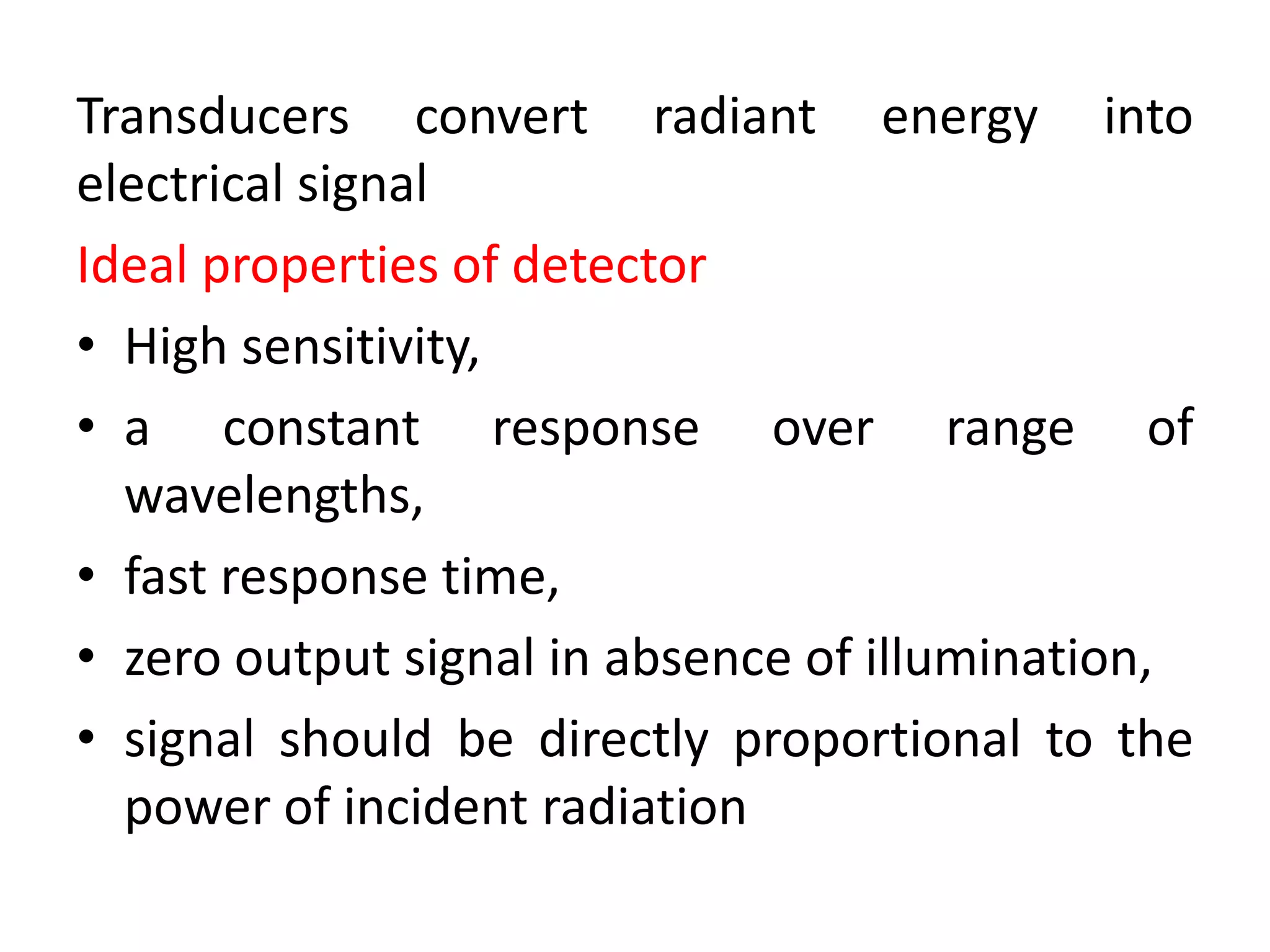
Transducers convert radiant energy into
electrical signal
Ideal properties of detector
• High sensitivity,
• a constant response over range of
wavelengths,
• fast response time,
• zero output signal in absence of illumination,
• signal should be directly proportional to the
power of incident radiation
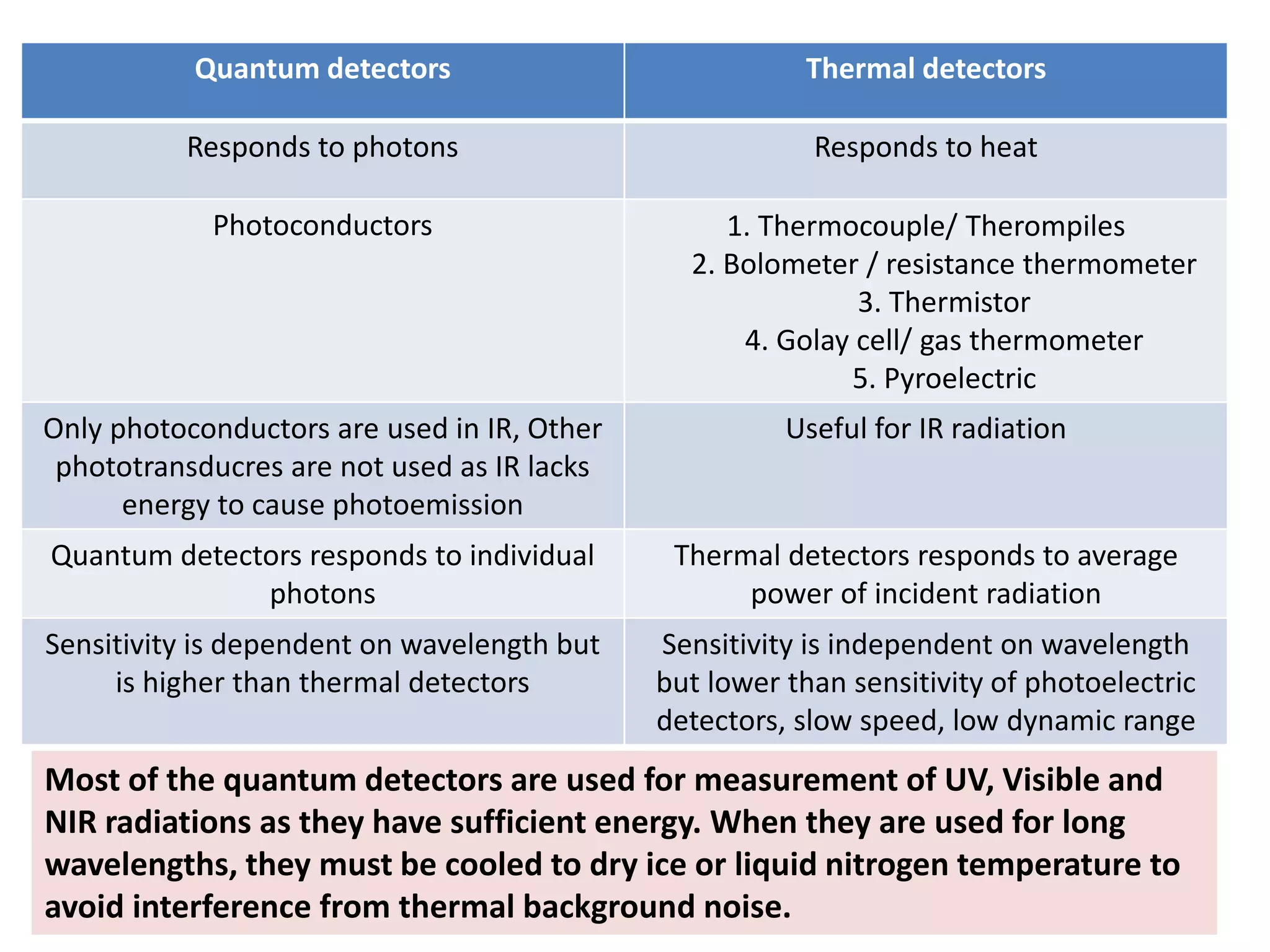
Quantum detectors Thermal detectors
Responds to photons Responds to heat
Photoconductors 1. Thermocouple/ Therompiles
2. Bolometer / resistance thermometer
3. Thermistor
4. Golay cell/ gas thermometer
5. Pyroelectric
Only photoconductors are used in IR, Other
phototransducres are not used as IR lacks
energy to cause photoemission
Useful for IR radiation
Quantum detectors responds to individual
photons
Thermal detectors responds to average
power of incident radiation
Sensitivity is dependent on wavelength but
is higher than thermal detectors
Sensitivity is independent on wavelength
but lower than sensitivity of photoelectric
detectors, slow speed, low dynamic range
Most of the quantum detectors are used for measurement of UV, Visible and
NIR radiations as they have sufficient energy. When they are used for long
wavelengths, they must be cooled to dry ice or liquid nitrogen temperature to
avoid interference from thermal background noise.
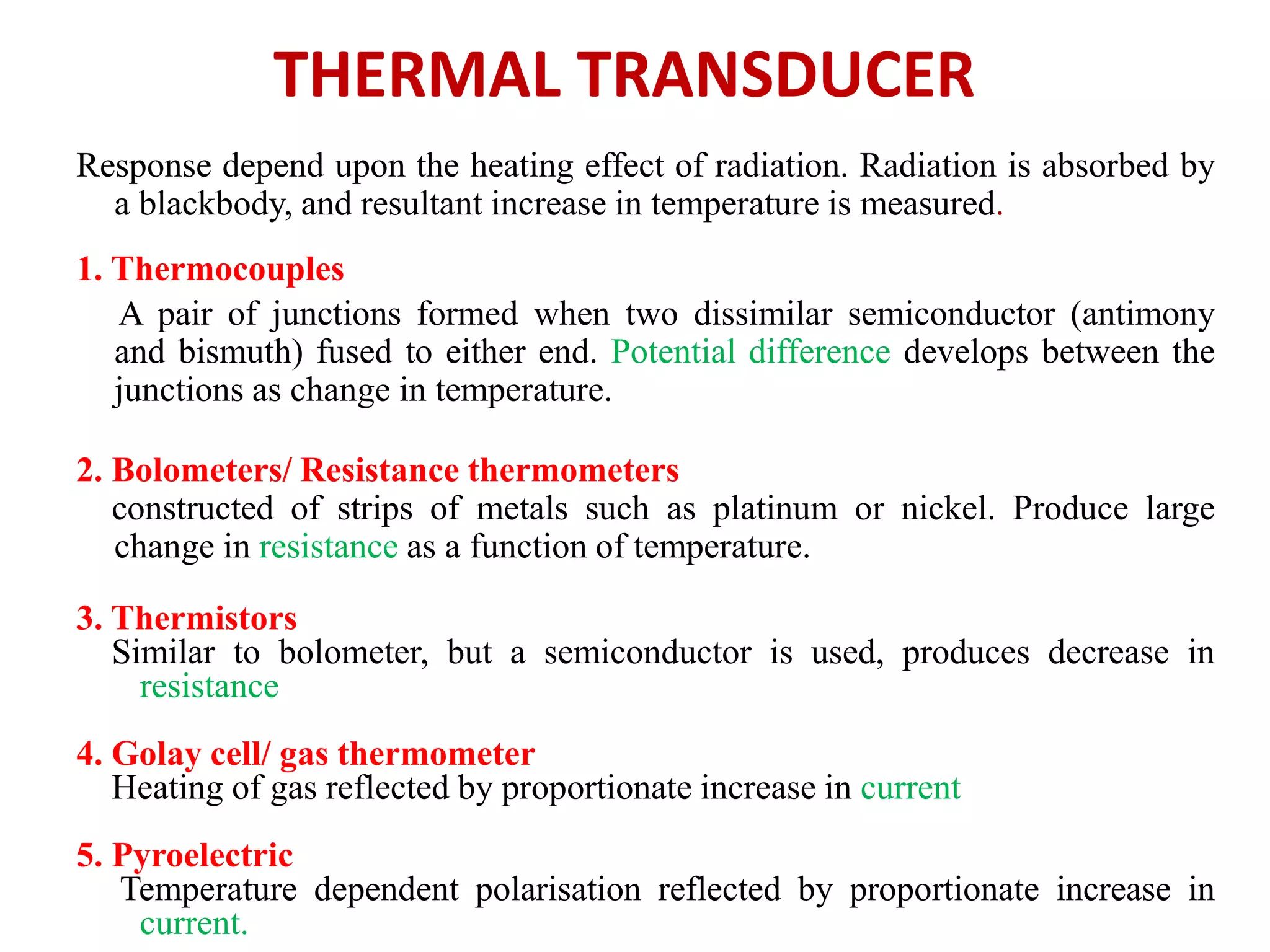
THERMAL TRANSDUCER
Response depend upon the heating effect of radiation. Radiation is absorbed by
a blackbody, and resultant increase in temperature is measured.
1. Thermocouples
A pair of junctions formed when two dissimilar semiconductor (antimony
and bismuth) fused to either end. Potential difference develops between the
junctions as change in temperature.
2. Bolometers/ Resistance thermometers
constructed of strips of metals such as platinum or nickel. Produce large
change in resistance as a function of temperature.
3. Thermistors
Similar to bolometer, but a semiconductor is used, produces decrease in
resistance
4. Golay cell/ gas thermometer
Heating of gas reflected by proportionate increase in current
5. Pyroelectric
Temperature dependent polarisation reflected by proportionate increase in
current.
Thermal noise from surrounding should be
minimized by
• Housing the detector in vacuum
• Beams are chopped to minimize the effects of
extraneous heat source.
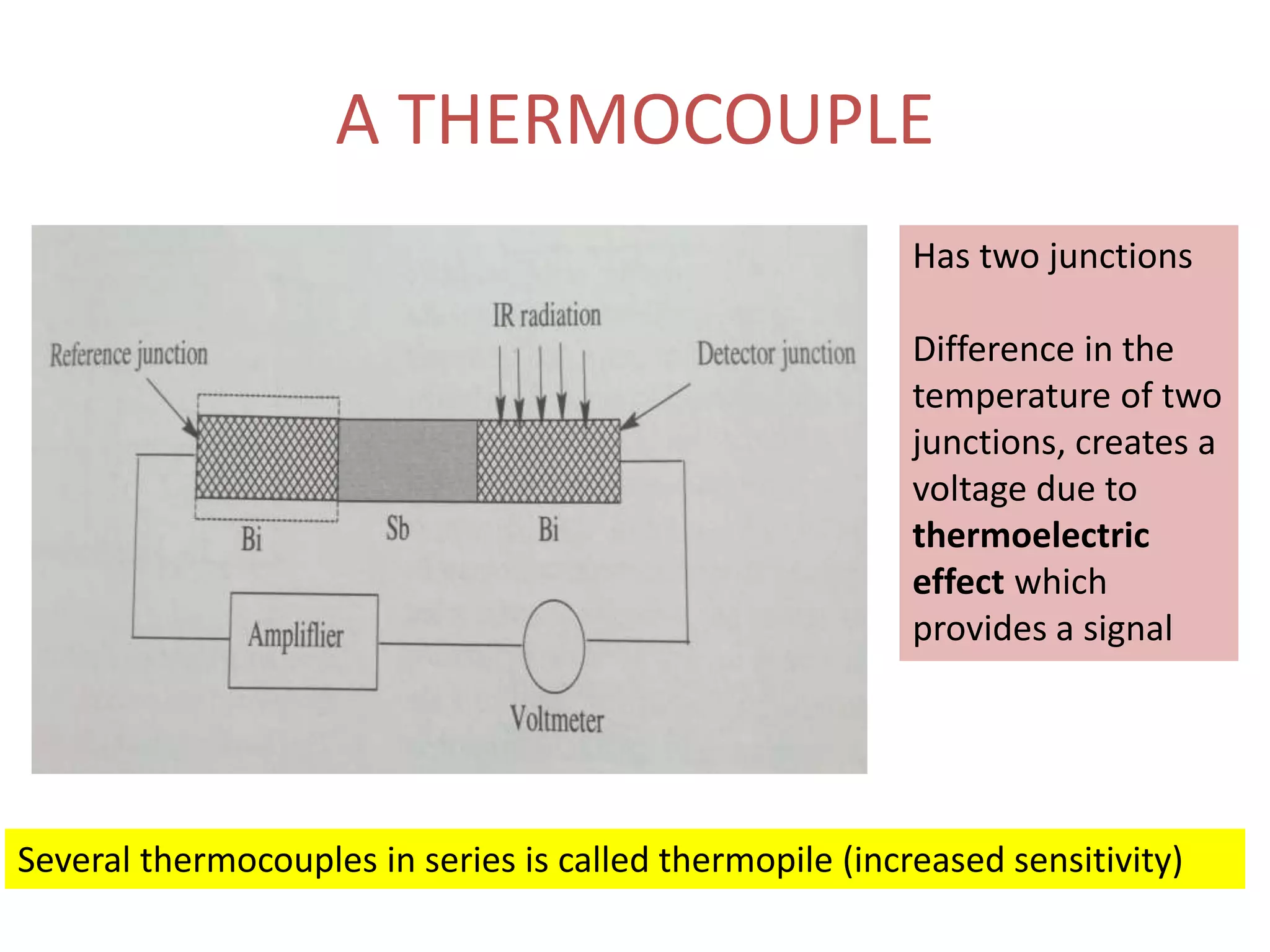
A THERMOCOUPLE
Several thermocouples in series is called thermopile (increased sensitivity)
Has two junctions
Difference in the
temperature of two
junctions, creates a
voltage due to
thermoelectric
effect which
provides a signal
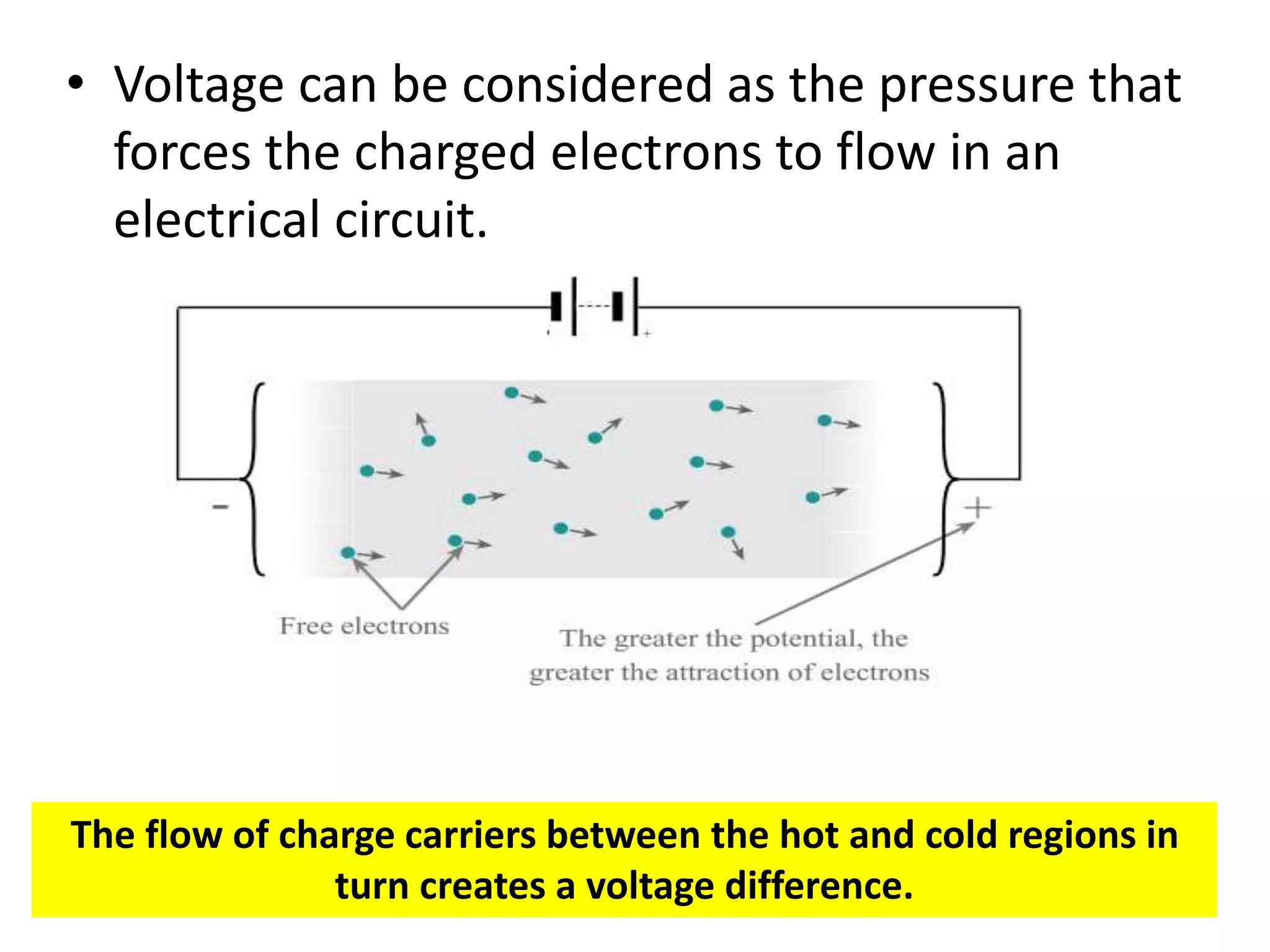
• Voltage can be considered as the pressure that
forces the charged electrons to flow in an
electrical circuit.
The flow of charge carriers between the hot and cold regions in
turn creates a voltage difference.
A Reference junction
1. Temperature of reference junction should remain
constant
2. Protected from IR radiation
3. Covered junction in insulating chamber
4. Its temperature should not change
5. High heat capacity: when heated, it is associated with
small temperature rise
6. It is cooled in ice to get a measureable difference
between reference and detector junction
A detector junction
• Detects the intensity of radiation falling on it
• Should absorb the heat completely from the IR radiation incident on it
• Formed from a very fine metal wire such as platinum, silver, antimony or
bismuth
• A thin layer of metal can be deposited on a nonconducting material.
• The junction is blackened as black bodies absorb maximum heat.
• Junction has small heat capacity which causes large temperature change with
small changes in heat.
• The detector junction is sealed in an evacuated chamber having transparent
window, entire IR beam is concentrated on its surface, so that the temperature
change can be measured.
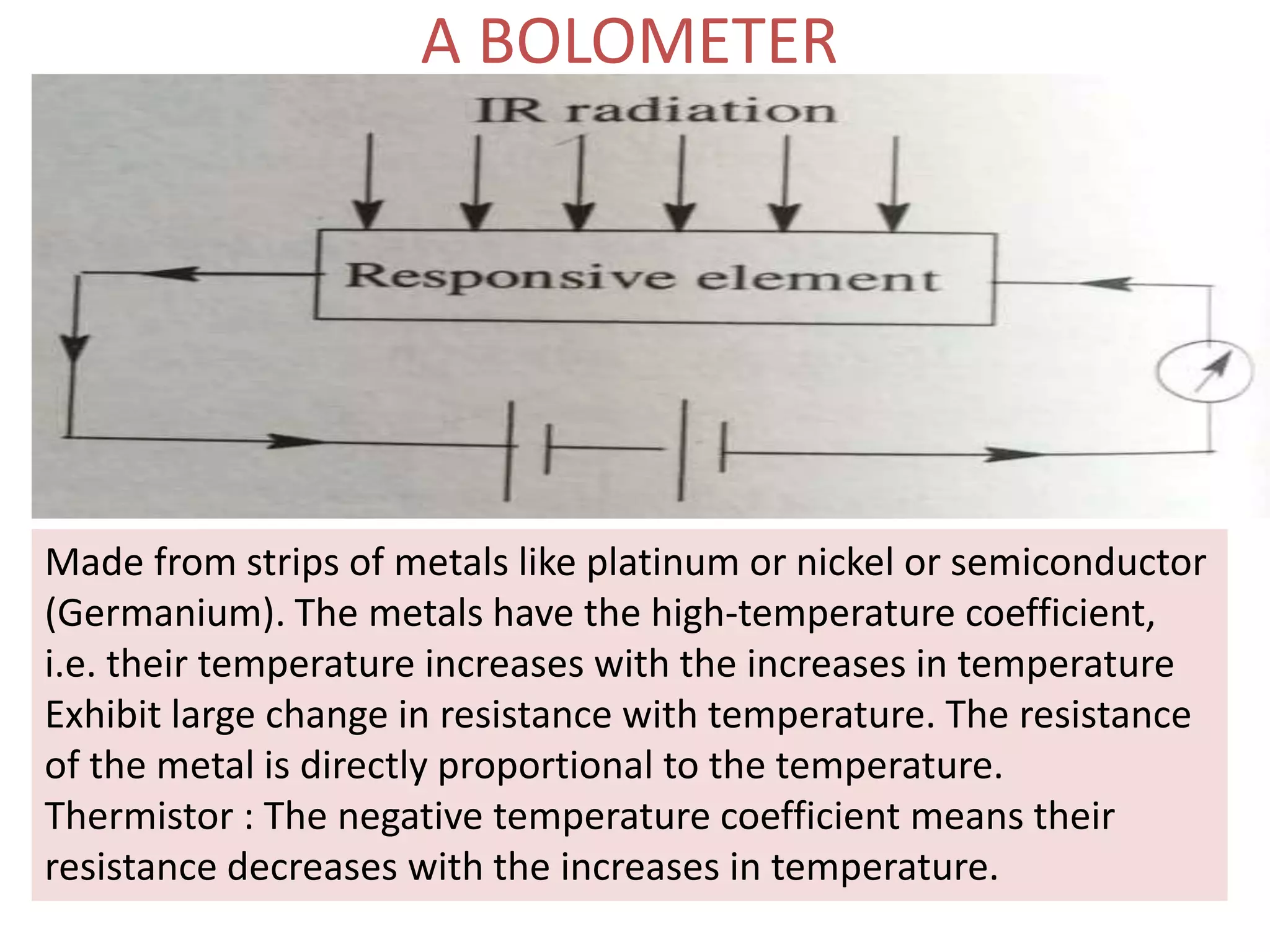
A BOLOMETER
Made from strips of metals like platinum or nickel or semiconductor
(Germanium). The metals have the high-temperature coefficient,
i.e. their temperature increases with the increases in temperature
Exhibit large change in resistance with temperature. The resistance
of the metal is directly proportional to the temperature.
Thermistor : The negative temperature coefficient means their
resistance decreases with the increases in temperature.
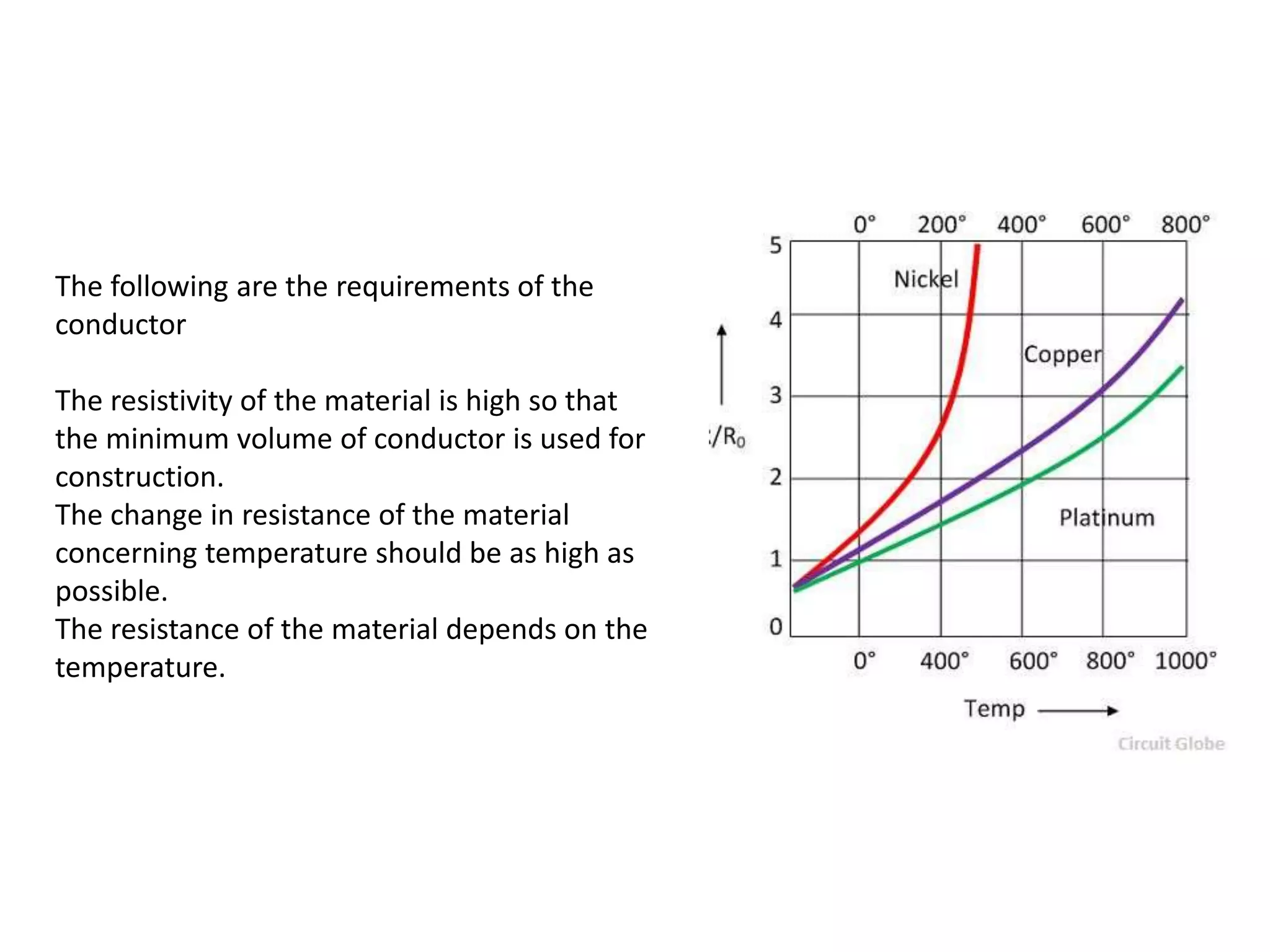
The following are the requirements of the
conductor
The resistivity of the material is high so that
the minimum volume of conductor is used for
construction.
The change in resistance of the material
concerning temperature should be as high as
possible.
The resistance of the material depends on the
temperature.
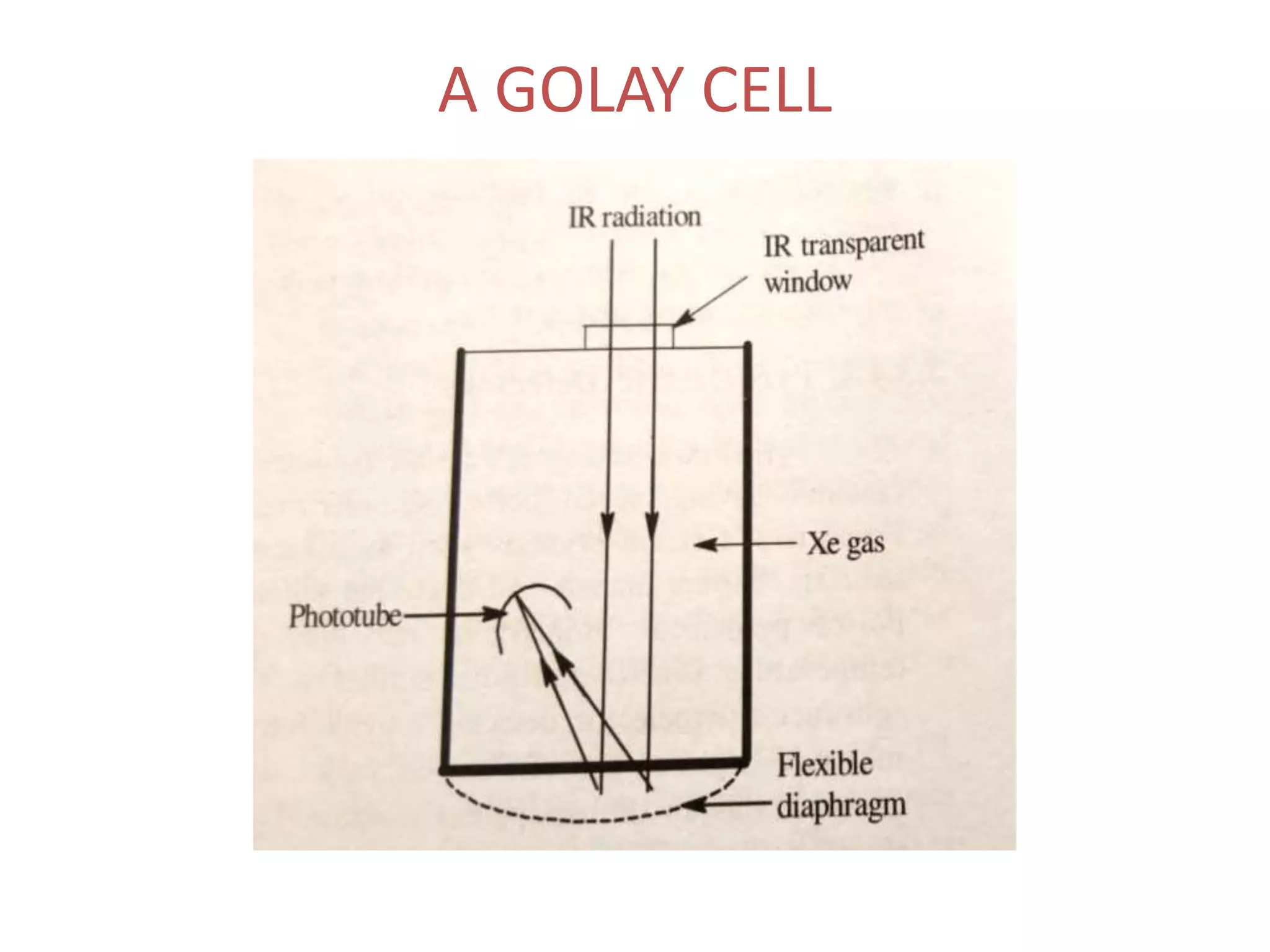
A GOLAY CELL
• Consists of a gas-filled enclosure with an infrared absorbing
material and a flexible diaphragm or membrane.
• When infrared radiation is absorbed, it heats the gas, causing it
to expand.
• The resulting increase in pressure deforms the membrane. Light
reflected off the membrane is detected by a photodiode, and
motion of the membrane produces a change in the signal on the
photodiode.
• The concept was originally described by Marcel J. E. Golay after
whom it was named.
Pyroelectric detector
 Temperature fluctuations produce a charge change on the surface of
pyroelectric crystals, which produces a corresponding electrical signal.
This temperature gradient can be created by the absorption of light.
 Materials with special electric and thermal properties eg. DTGS
(Deuterated Triglycine Sulphate), LiTaO3 Lithium tantalate, LiNbO3,
Lithium Nibonate, Barium titanate
 Insulators (dielectric materials) and develop temperature dependent
polarisation/ internal electric field below their curie point
 Pyroelectric material is sandwiched in the form of single crystalline wafers
between two electrodes, one of which is IR transparent,
 a temperature dependent capacitor is formed.
 On absorption of IR, temperature changes, and alters the charge
distribution across the crystal. This change in charge distribution can be
detected as current in an external electric circuit connecting the two sides
of the capacitor. Pyroelectric crystals lose their residual polarization when
heated to a temperature called the Curie point. For TGS, Curie pt is 47
deg Celcius
Desired Properties of Pyroelectric materials:
• The pyroelectric coefficient determines the ability to produce
current from IR radiation. If it is bigger, the better.
• The dielectricity constant determines the capacitance, thereby
affecting the noise. The larger the capacitance, the lower the noise.
• The specific heat capacity determines the temperature increase in the
crystal depending on the absorbed radiation. A low value indicates
larger temperature increase and thus a better signal.
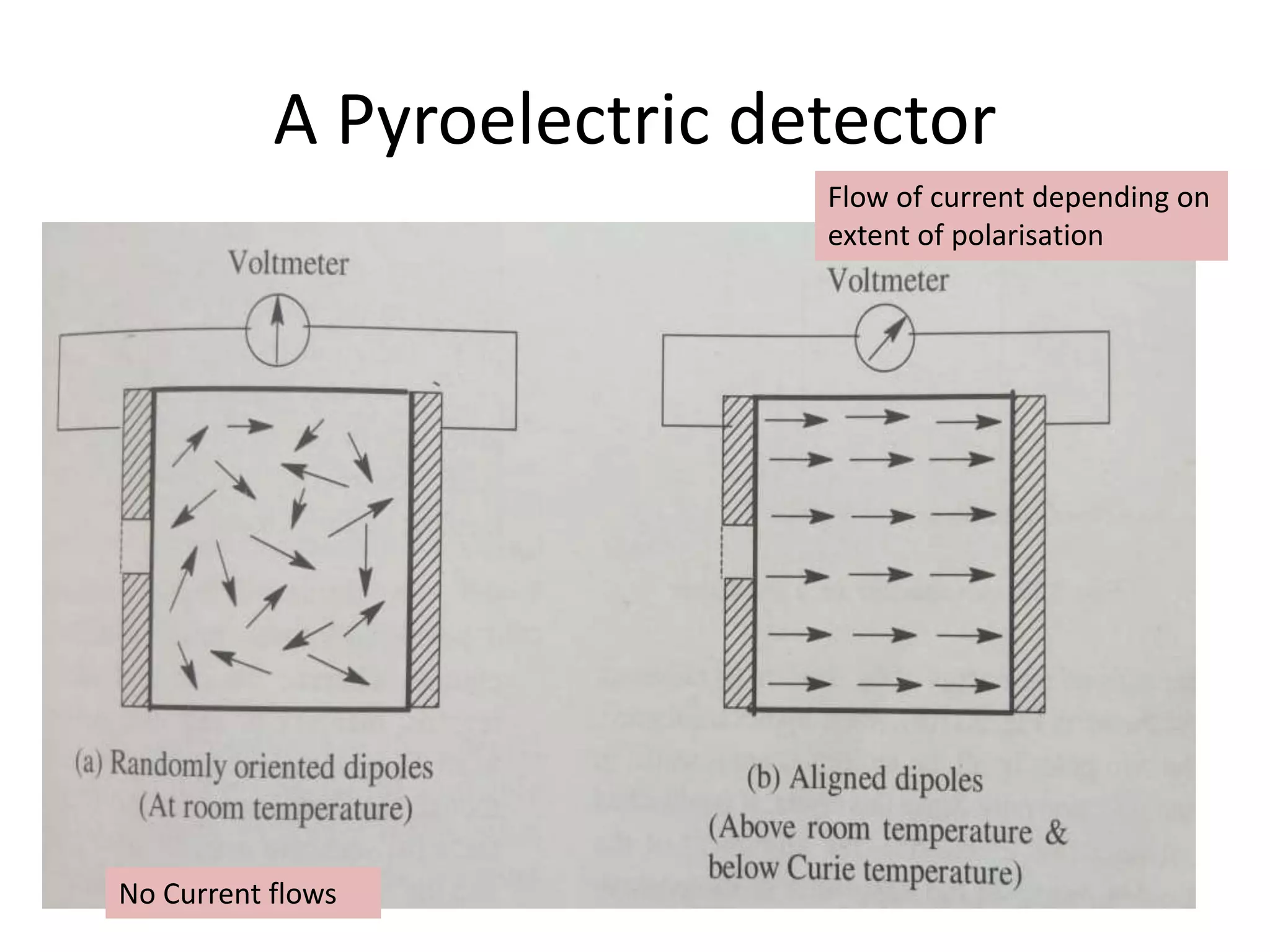
A Pyroelectric detector
No Current flows
Flow of current depending on
extent of polarisation
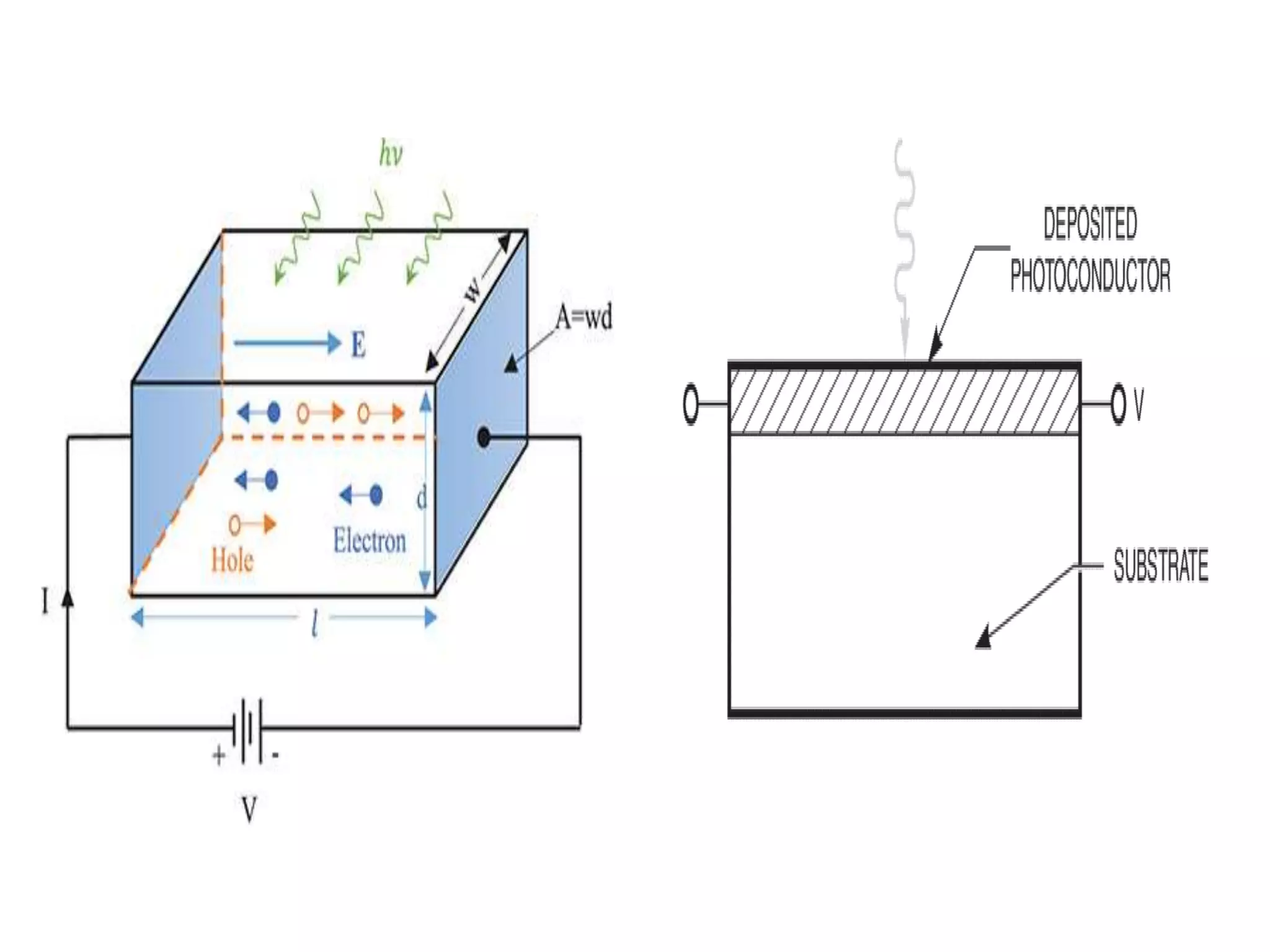
Photo conducting transducers
 These consists of a thin film of a semiconductor
material , such as lead sulfide, mercury/cadmium
telluride (MCT), or indium antimonide, deposited on
a nonconducting glass surface and sealed into an
evacuated envelope.
 Absorption of radiation by these materials promotes
nonconducting valence electrons to a higher energy
conducting state, thus decreasing the electrical
resistance of the semiconductor.
 Must be cooled with liquid nitrogen to minimize
thermal noise.
Intrinsic and Extrinsic Photoconductors
• Intrinsic Materials
When the photon energy is above the band gap energy, i.e.,
for a sufficiently short optical wavelengths, interband
transitions, (optical transitions across the band gap from the
valence band to the conduction band) takes place
For example, lead salt, cadmium sulfide and mercury
cadmium selenide detectors are based on this operation
principle.
• Extrinsic Materials
In an extrinsic material additional energy levels are introduced
by impurities. These are introduced by doping with additional
chemical species and provide additional excitation pathways.
Thank You…

Instrumentation IR Spectroscopy: Detectors

  • 1.
    Detectors used inIR Spectroscopy Dr. Tambe V.S. (PES Modern College of Pharmacy, for Ladies)
  • 2.
    Transducers convert radiantenergy into electrical signal Ideal properties of detector • High sensitivity, • a constant response over range of wavelengths, • fast response time, • zero output signal in absence of illumination, • signal should be directly proportional to the power of incident radiation
  • 3.
    Quantum detectors Thermaldetectors Responds to photons Responds to heat Photoconductors 1. Thermocouple/ Therompiles 2. Bolometer / resistance thermometer 3. Thermistor 4. Golay cell/ gas thermometer 5. Pyroelectric Only photoconductors are used in IR, Other phototransducres are not used as IR lacks energy to cause photoemission Useful for IR radiation Quantum detectors responds to individual photons Thermal detectors responds to average power of incident radiation Sensitivity is dependent on wavelength but is higher than thermal detectors Sensitivity is independent on wavelength but lower than sensitivity of photoelectric detectors, slow speed, low dynamic range Most of the quantum detectors are used for measurement of UV, Visible and NIR radiations as they have sufficient energy. When they are used for long wavelengths, they must be cooled to dry ice or liquid nitrogen temperature to avoid interference from thermal background noise.
  • 4.
    THERMAL TRANSDUCER Response dependupon the heating effect of radiation. Radiation is absorbed by a blackbody, and resultant increase in temperature is measured. 1. Thermocouples A pair of junctions formed when two dissimilar semiconductor (antimony and bismuth) fused to either end. Potential difference develops between the junctions as change in temperature. 2. Bolometers/ Resistance thermometers constructed of strips of metals such as platinum or nickel. Produce large change in resistance as a function of temperature. 3. Thermistors Similar to bolometer, but a semiconductor is used, produces decrease in resistance 4. Golay cell/ gas thermometer Heating of gas reflected by proportionate increase in current 5. Pyroelectric Temperature dependent polarisation reflected by proportionate increase in current.
  • 5.
    Thermal noise fromsurrounding should be minimized by • Housing the detector in vacuum • Beams are chopped to minimize the effects of extraneous heat source.
  • 6.
    A THERMOCOUPLE Several thermocouplesin series is called thermopile (increased sensitivity) Has two junctions Difference in the temperature of two junctions, creates a voltage due to thermoelectric effect which provides a signal
  • 7.
    • Voltage canbe considered as the pressure that forces the charged electrons to flow in an electrical circuit. The flow of charge carriers between the hot and cold regions in turn creates a voltage difference.
  • 8.
    A Reference junction 1.Temperature of reference junction should remain constant 2. Protected from IR radiation 3. Covered junction in insulating chamber 4. Its temperature should not change 5. High heat capacity: when heated, it is associated with small temperature rise 6. It is cooled in ice to get a measureable difference between reference and detector junction
  • 9.
    A detector junction •Detects the intensity of radiation falling on it • Should absorb the heat completely from the IR radiation incident on it • Formed from a very fine metal wire such as platinum, silver, antimony or bismuth • A thin layer of metal can be deposited on a nonconducting material. • The junction is blackened as black bodies absorb maximum heat. • Junction has small heat capacity which causes large temperature change with small changes in heat. • The detector junction is sealed in an evacuated chamber having transparent window, entire IR beam is concentrated on its surface, so that the temperature change can be measured.
  • 10.
    A BOLOMETER Made fromstrips of metals like platinum or nickel or semiconductor (Germanium). The metals have the high-temperature coefficient, i.e. their temperature increases with the increases in temperature Exhibit large change in resistance with temperature. The resistance of the metal is directly proportional to the temperature. Thermistor : The negative temperature coefficient means their resistance decreases with the increases in temperature.
  • 11.
    The following arethe requirements of the conductor The resistivity of the material is high so that the minimum volume of conductor is used for construction. The change in resistance of the material concerning temperature should be as high as possible. The resistance of the material depends on the temperature.
  • 12.
  • 13.
    • Consists ofa gas-filled enclosure with an infrared absorbing material and a flexible diaphragm or membrane. • When infrared radiation is absorbed, it heats the gas, causing it to expand. • The resulting increase in pressure deforms the membrane. Light reflected off the membrane is detected by a photodiode, and motion of the membrane produces a change in the signal on the photodiode. • The concept was originally described by Marcel J. E. Golay after whom it was named.
  • 14.
    Pyroelectric detector  Temperaturefluctuations produce a charge change on the surface of pyroelectric crystals, which produces a corresponding electrical signal. This temperature gradient can be created by the absorption of light.  Materials with special electric and thermal properties eg. DTGS (Deuterated Triglycine Sulphate), LiTaO3 Lithium tantalate, LiNbO3, Lithium Nibonate, Barium titanate  Insulators (dielectric materials) and develop temperature dependent polarisation/ internal electric field below their curie point  Pyroelectric material is sandwiched in the form of single crystalline wafers between two electrodes, one of which is IR transparent,  a temperature dependent capacitor is formed.  On absorption of IR, temperature changes, and alters the charge distribution across the crystal. This change in charge distribution can be detected as current in an external electric circuit connecting the two sides of the capacitor. Pyroelectric crystals lose their residual polarization when heated to a temperature called the Curie point. For TGS, Curie pt is 47 deg Celcius
  • 15.
    Desired Properties ofPyroelectric materials: • The pyroelectric coefficient determines the ability to produce current from IR radiation. If it is bigger, the better. • The dielectricity constant determines the capacitance, thereby affecting the noise. The larger the capacitance, the lower the noise. • The specific heat capacity determines the temperature increase in the crystal depending on the absorbed radiation. A low value indicates larger temperature increase and thus a better signal.
  • 16.
    A Pyroelectric detector NoCurrent flows Flow of current depending on extent of polarisation
  • 17.
    Photo conducting transducers These consists of a thin film of a semiconductor material , such as lead sulfide, mercury/cadmium telluride (MCT), or indium antimonide, deposited on a nonconducting glass surface and sealed into an evacuated envelope.  Absorption of radiation by these materials promotes nonconducting valence electrons to a higher energy conducting state, thus decreasing the electrical resistance of the semiconductor.  Must be cooled with liquid nitrogen to minimize thermal noise.
  • 20.
    Intrinsic and ExtrinsicPhotoconductors • Intrinsic Materials When the photon energy is above the band gap energy, i.e., for a sufficiently short optical wavelengths, interband transitions, (optical transitions across the band gap from the valence band to the conduction band) takes place For example, lead salt, cadmium sulfide and mercury cadmium selenide detectors are based on this operation principle. • Extrinsic Materials In an extrinsic material additional energy levels are introduced by impurities. These are introduced by doping with additional chemical species and provide additional excitation pathways.
  • 21.