
Temperature
Measurement
By : Ayman Ahmed widaa
April 2017
Outline
 introduction
 The Second Law of Thermodynamics
 Thermometer Physical Principles
-Mechanical
-Thermo junctive
-Thermo resistive
-Radioactive
1.Introduction
o Temperature scales were defined originally
in terms of certain fixed points, usually an easily
reproduced phase transition such as melting of
ice or boiling of water.
o Only a finite number of fixed points are
readily available, and we need some means of
interpolation
3
2.The Second Law of Thermodynamics
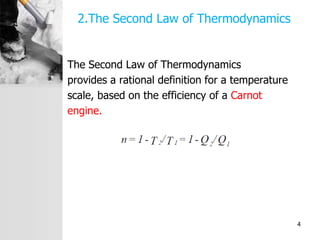
The Second Law of Thermodynamics
provides a rational definition for a temperature
scale, based on the efficiency of a Carnot
engine.
4
2.The Second Law of Thermodynamics
The Second Law provides not only a definition of
the zero point but also a conceptual way of
defining the intermediate temperatures.
Since only the ratio of two temperatures is
specified, we still need to establish the size of a
degree, defined by the temperature difference
between two fixed points
5
2.The Second Law of Thermodynamics
Two scales are commonly used, the Kelvin scale
and the Rankine scale.
The Kelvin scale has 100 between the
temperatures melting ice and boiling water.
Rankine scale has 180o Because temperatures we
normally encounter are well above the zero on
the Kelvin and Rankine scales
we also use the Celsius and
Fahrenheit scales.
6
2.The Second Law of Thermodynamics
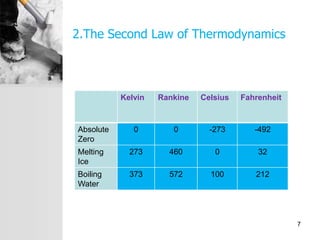
Kelvin Rankine Celsius Fahrenheit
Absolute
Zero
0 0 -273 -492
Melting
Ice
273 460 0 32
Boiling
Water
373 572 100 212
7
2.The Second Law of Thermodynamics
These latter two scales are not thermodynamic
scales, so cannot be used, for example, in the
ideal gas equation of state.
Unfortunately Carnot engines do not exist, so we
need a practical alternative. This is provided by
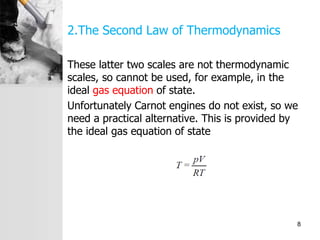
the ideal gas equation of state
8
3.Thermometer Physical Principles
Temperature can be measured via a diverse array of sensors. All
of them infer temperature by sensing some change in a physical
characteristic. There are four basic types of temperature
measuring devices,
each of which uses a different principle:
1) Mechanical (liquid-in-glass thermometers, bimetallic
strips, bulb & capillary etc.)
2) Thermojunctive (thermocouples)
3) Thermoresistive (RTDs and thermistors)
4) Radiative (infrared and optical pyrometers)
9
3.Thermometer Physical Principles
1.Mechanical Temperature Measuring devices:
Principle of Operation: A change in temperature causes some
kind of mechanical motion, typically due to the fact that most
materials expand with a rise in temperature. Mechanical
thermometers can be constructed which use
liquids, solids, or even gases as the temperature-sensitive
material
The mechanical motion is read on a physical scale to infer the
temperature. The examples include:
1) Liquid-in-glass thermometer
2) Bimetallic strip thermometer
3) Sealed Bellows
4) Bulb and Capillary Sensor
10
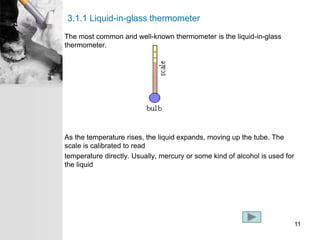
3.1.1 Liquid-in-glass thermometer
The most common and well-known thermometer is the liquid-in-glass
thermometer.
As the temperature rises, the liquid expands, moving up the tube. The
scale is calibrated to read
temperature directly. Usually, mercury or some kind of alcohol is used for
the liquid
11
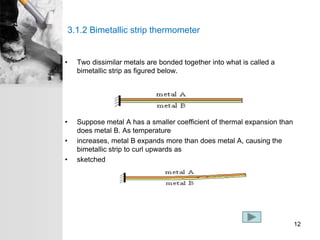
3.1.2 Bimetallic strip thermometer
• Two dissimilar metals are bonded together into what is called a
bimetallic strip as figured below.
• Suppose metal A has a smaller coefficient of thermal expansion than
does metal B. As temperature
• increases, metal B expands more than does metal A, causing the
bimetallic strip to curl upwards as
• sketched
12
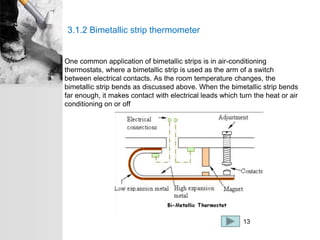
3.1.2 Bimetallic strip thermometer
One common application of bimetallic strips is in air-conditioning
thermostats, where a bimetallic strip is used as the arm of a switch
between electrical contacts. As the room temperature changes, the
bimetallic strip bends as discussed above. When the bimetallic strip bends
far enough, it makes contact with electrical leads which turn the heat or air
conditioning on or off
13
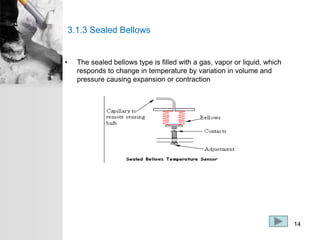
3.1.3 Sealed Bellows
• The sealed bellows type is filled with a gas, vapor or liquid, which
responds to change in temperature by variation in volume and
pressure causing expansion or contraction
14
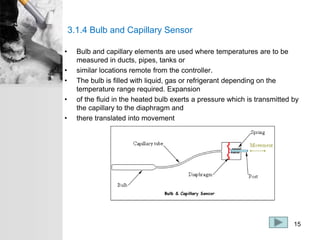
3.1.4 Bulb and Capillary Sensor
• Bulb and capillary elements are used where temperatures are to be
measured in ducts, pipes, tanks or
• similar locations remote from the controller.
• The bulb is filled with liquid, gas or refrigerant depending on the
temperature range required. Expansion
• of the fluid in the heated bulb exerts a pressure which is transmitted by
the capillary to the diaphragm and
• there translated into movement
15
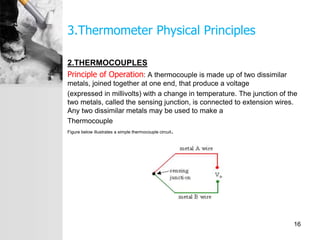
3.Thermometer Physical Principles
2.THERMOCOUPLES
Principle of Operation: A thermocouple is made up of two dissimilar
metals, joined together at one end, that produce a voltage
(expressed in millivolts) with a change in temperature. The junction of the
two metals, called the sensing junction, is connected to extension wires.
Any two dissimilar metals may be used to make a
Thermocouple
Figure below illustrates a simple thermocouple circuit.
16
3.Thermometer Physical Principles
3.Thermo-resistive Temperature Measuring Devices
A change in temperature causes the electrical resistance of a material to
change. The resistance change
is measured to infer the temperature change.
There are two types of thermo-resistive measuring devices:
1) Resistance temperature detectors (RTD)
2) Thermistors
17
3.3.1 Resistance Temperature Detectors
A resistance temperature detector (abbreviated RTD) is basically either a
long, small diameter metal wire
wound in a coil or an etched grid on a substrate, much like a strain gage.
Platinum is the most common
metal used for RTDs.
Principle of Operation:
Resistance Temperature Detectors (RTD) operates on the principle that
the electrical resistance of a metal changes predictably in an essentially
linear and repeatable manner with changes in temperature. RTD have a
positive temperature coefficient (resistance increases with temperature).
The resistance of the element at a base temperature is proportional to the
length of the element and the inverse of the
cross sectional area
18
• A typical electrical circuit designed to measure temperature with RTDs
actually measures a change in resistance of the RTD, which is then
used to calculate a change in temperature. The resistance of an
• RTD increases with increasing temperature, just as the resistance of a
strain gage increases with increasing strain.
19
3.3.2 Thermistors
• Thermistors are temperature sensitive semiconductors that exhibit a
large change in resistance over a relatively small range of temperature.
There are two main types of thermistors,
• - positive temperature coefficient (PTC)
• - negative temperature coefficient (NTC). NTC thermistors exhibit the
characteristic of resistance falling with increasing temperature.
• These are most commonly used for temperature measurement.
20
3.3.2 Thermistors
• A thermistor is similar to an RTD, but a semiconductor material is used
instead of a metal. A thermistor is
• a solid state device and has larger sensitivity than does an RTD.
Unlike RTD's, the temperature resistance
• characteristic of a thermistor is non-linear, and cannot be characterized
by a single coefficient.
• Furthermore, unlike RTDs, the resistance of a thermistor decreases
with increasing temperature.
• Thermistors cannot be used to measure high temperatures compared
to RTDs. In fact, the maximum temperature of operation is sometimes
only 100 or 200°C.
21
3.3.2 Thermistors
• Advantages: Large resistance change with temperature, rapid
response time, good stability, High
• resistance eliminates difficulties caused by lead resistance, Low cost
and interchangeable
• Disadvantages: Non-linear, limited operating temperature range, may
be subjected to inaccuracy due to
• overheating, current source required
22
3.Thermometer Physical Principles
• 4. Radioactive Temperature Measuring Devices
• Two types of radioactive measuring devices are
• 1) Infrared pyrometers
• 2) Optical pyrometers.
23
3.4.1 Infrared Pyrometer
• Infrared temperature sensors also known as pyrometers or non-
contact temperature sensors are used to
• measure the temperature of an object without contact. This is different
from most temperature
• measurement devices, which require direct contact with the measured
media. Non-contact methods of temperature measurement are
advantageous when contact methods are impossible or impractical,
such as when the target is inaccessible or so hot that contact devices
will not survive
•
24
3.4.1 Infrared Pyrometer
• Principle of Operation: Infrared temperature sensors use the principle
that any object emits an amount of energy that is a
• function of its temperature. This function dictates that as the
temperature of an object rises, so does the
• amount of energy it emits.
• “An infrared temperature sensor determines temperature by measuring
the intensity of energy given off
• by an object.”
25
3.4.1 Infrared Pyrometer
• …Calculating the temperature of an object from the measured emitted
energy seems straightforward.
• However, the quantity of energy emitted by an object is not a function
of temperature only. The other
• variable besides temperature that affects emissions is emissivity. From
a practical standpoint, emissivity
• is an inherent surface characteristic that can fluctuate with changes to
surface oxidation, texture ,composition, and microstructure. When it
comes to non-contact temperature measurement all that is
• really important is knowing, that emissivity is a correction factor greater
than 0 but less than 1 that enables infrared temperature sensors to
output the correct surface temperature.
26
3.4.2 Optical Pyrometer
• An optical pyrometer is useful for measuring very high temperatures
(even flames). The optical pyrometer
• uses an infrared radiation-sensitive sensor, e.g. a photodiode or a
photoresistor, to compare the radiation
• from the unknown with that of the radiation from an internal
incandescent source. The accuracy of the
• optical pyrometer is very much a function of the emissivity of the
device that is radiating the heat. The
• obvious advantage in using an optical pyrometer at very high
temperatures is that the measurement is
• non-contacting.
27
3.4.2 Optical Pyrometer
• This approach is very expensive, and due to the variability in emissivity
of many physical bodies, it is not
• very accurate. However, for making non-contact measurements on
very high temperature bodies such as
• molten glass and molten steel, the optical pyrometer excels.
• Basic Characteristics are as follows:
• • Infrared Radiation-sensitive
• • Photodiode or photoresistor
• • Accuracy= f{emissivity}
• • Useful @ very high temperatures
• • Non-contacting
• • Very expensive
• • Not very accurate
28
Conclusion
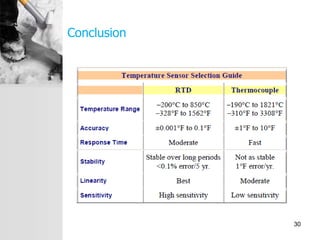
• Two most common type of temperature sensors are Thermocouples
and RTD’s. Although these sensors
• have overlapping temperature ranges, each has certain application-
dependent advantages. These are
• summarized in below
• An RTD is the sensor of choice when sensitivity and application
flexibility are the most important criteria.
• When it comes to component cost an RTD is more expensive than a
thermocouple
29
Conclusion
30
31

measurement :Temperature

  • 1.
    Temperature Measurement By : AymanAhmed widaa April 2017
  • 2.
    Outline  introduction  TheSecond Law of Thermodynamics  Thermometer Physical Principles -Mechanical -Thermo junctive -Thermo resistive -Radioactive
  • 3.
    1.Introduction o Temperature scaleswere defined originally in terms of certain fixed points, usually an easily reproduced phase transition such as melting of ice or boiling of water. o Only a finite number of fixed points are readily available, and we need some means of interpolation 3
  • 4.
    2.The Second Lawof Thermodynamics The Second Law of Thermodynamics provides a rational definition for a temperature scale, based on the efficiency of a Carnot engine. 4
  • 5.
    2.The Second Lawof Thermodynamics The Second Law provides not only a definition of the zero point but also a conceptual way of defining the intermediate temperatures. Since only the ratio of two temperatures is specified, we still need to establish the size of a degree, defined by the temperature difference between two fixed points 5
  • 6.
    2.The Second Lawof Thermodynamics Two scales are commonly used, the Kelvin scale and the Rankine scale. The Kelvin scale has 100 between the temperatures melting ice and boiling water. Rankine scale has 180o Because temperatures we normally encounter are well above the zero on the Kelvin and Rankine scales we also use the Celsius and Fahrenheit scales. 6
  • 7.
    2.The Second Lawof Thermodynamics Kelvin Rankine Celsius Fahrenheit Absolute Zero 0 0 -273 -492 Melting Ice 273 460 0 32 Boiling Water 373 572 100 212 7
  • 8.
    2.The Second Lawof Thermodynamics These latter two scales are not thermodynamic scales, so cannot be used, for example, in the ideal gas equation of state. Unfortunately Carnot engines do not exist, so we need a practical alternative. This is provided by the ideal gas equation of state 8
  • 9.
    3.Thermometer Physical Principles Temperaturecan be measured via a diverse array of sensors. All of them infer temperature by sensing some change in a physical characteristic. There are four basic types of temperature measuring devices, each of which uses a different principle: 1) Mechanical (liquid-in-glass thermometers, bimetallic strips, bulb & capillary etc.) 2) Thermojunctive (thermocouples) 3) Thermoresistive (RTDs and thermistors) 4) Radiative (infrared and optical pyrometers) 9
  • 10.
    3.Thermometer Physical Principles 1.MechanicalTemperature Measuring devices: Principle of Operation: A change in temperature causes some kind of mechanical motion, typically due to the fact that most materials expand with a rise in temperature. Mechanical thermometers can be constructed which use liquids, solids, or even gases as the temperature-sensitive material The mechanical motion is read on a physical scale to infer the temperature. The examples include: 1) Liquid-in-glass thermometer 2) Bimetallic strip thermometer 3) Sealed Bellows 4) Bulb and Capillary Sensor 10
  • 11.
    3.1.1 Liquid-in-glass thermometer Themost common and well-known thermometer is the liquid-in-glass thermometer. As the temperature rises, the liquid expands, moving up the tube. The scale is calibrated to read temperature directly. Usually, mercury or some kind of alcohol is used for the liquid 11
  • 12.
    3.1.2 Bimetallic stripthermometer • Two dissimilar metals are bonded together into what is called a bimetallic strip as figured below. • Suppose metal A has a smaller coefficient of thermal expansion than does metal B. As temperature • increases, metal B expands more than does metal A, causing the bimetallic strip to curl upwards as • sketched 12
  • 13.
    3.1.2 Bimetallic stripthermometer One common application of bimetallic strips is in air-conditioning thermostats, where a bimetallic strip is used as the arm of a switch between electrical contacts. As the room temperature changes, the bimetallic strip bends as discussed above. When the bimetallic strip bends far enough, it makes contact with electrical leads which turn the heat or air conditioning on or off 13
  • 14.
    3.1.3 Sealed Bellows •The sealed bellows type is filled with a gas, vapor or liquid, which responds to change in temperature by variation in volume and pressure causing expansion or contraction 14
  • 15.
    3.1.4 Bulb andCapillary Sensor • Bulb and capillary elements are used where temperatures are to be measured in ducts, pipes, tanks or • similar locations remote from the controller. • The bulb is filled with liquid, gas or refrigerant depending on the temperature range required. Expansion • of the fluid in the heated bulb exerts a pressure which is transmitted by the capillary to the diaphragm and • there translated into movement 15
  • 16.
    3.Thermometer Physical Principles 2.THERMOCOUPLES Principleof Operation: A thermocouple is made up of two dissimilar metals, joined together at one end, that produce a voltage (expressed in millivolts) with a change in temperature. The junction of the two metals, called the sensing junction, is connected to extension wires. Any two dissimilar metals may be used to make a Thermocouple Figure below illustrates a simple thermocouple circuit. 16
  • 17.
    3.Thermometer Physical Principles 3.Thermo-resistiveTemperature Measuring Devices A change in temperature causes the electrical resistance of a material to change. The resistance change is measured to infer the temperature change. There are two types of thermo-resistive measuring devices: 1) Resistance temperature detectors (RTD) 2) Thermistors 17
  • 18.
    3.3.1 Resistance TemperatureDetectors A resistance temperature detector (abbreviated RTD) is basically either a long, small diameter metal wire wound in a coil or an etched grid on a substrate, much like a strain gage. Platinum is the most common metal used for RTDs. Principle of Operation: Resistance Temperature Detectors (RTD) operates on the principle that the electrical resistance of a metal changes predictably in an essentially linear and repeatable manner with changes in temperature. RTD have a positive temperature coefficient (resistance increases with temperature). The resistance of the element at a base temperature is proportional to the length of the element and the inverse of the cross sectional area 18
  • 19.
    • A typicalelectrical circuit designed to measure temperature with RTDs actually measures a change in resistance of the RTD, which is then used to calculate a change in temperature. The resistance of an • RTD increases with increasing temperature, just as the resistance of a strain gage increases with increasing strain. 19
  • 20.
    3.3.2 Thermistors • Thermistorsare temperature sensitive semiconductors that exhibit a large change in resistance over a relatively small range of temperature. There are two main types of thermistors, • - positive temperature coefficient (PTC) • - negative temperature coefficient (NTC). NTC thermistors exhibit the characteristic of resistance falling with increasing temperature. • These are most commonly used for temperature measurement. 20
  • 21.
    3.3.2 Thermistors • Athermistor is similar to an RTD, but a semiconductor material is used instead of a metal. A thermistor is • a solid state device and has larger sensitivity than does an RTD. Unlike RTD's, the temperature resistance • characteristic of a thermistor is non-linear, and cannot be characterized by a single coefficient. • Furthermore, unlike RTDs, the resistance of a thermistor decreases with increasing temperature. • Thermistors cannot be used to measure high temperatures compared to RTDs. In fact, the maximum temperature of operation is sometimes only 100 or 200°C. 21
  • 22.
    3.3.2 Thermistors • Advantages:Large resistance change with temperature, rapid response time, good stability, High • resistance eliminates difficulties caused by lead resistance, Low cost and interchangeable • Disadvantages: Non-linear, limited operating temperature range, may be subjected to inaccuracy due to • overheating, current source required 22
  • 23.
    3.Thermometer Physical Principles •4. Radioactive Temperature Measuring Devices • Two types of radioactive measuring devices are • 1) Infrared pyrometers • 2) Optical pyrometers. 23
  • 24.
    3.4.1 Infrared Pyrometer •Infrared temperature sensors also known as pyrometers or non- contact temperature sensors are used to • measure the temperature of an object without contact. This is different from most temperature • measurement devices, which require direct contact with the measured media. Non-contact methods of temperature measurement are advantageous when contact methods are impossible or impractical, such as when the target is inaccessible or so hot that contact devices will not survive • 24
  • 25.
    3.4.1 Infrared Pyrometer •Principle of Operation: Infrared temperature sensors use the principle that any object emits an amount of energy that is a • function of its temperature. This function dictates that as the temperature of an object rises, so does the • amount of energy it emits. • “An infrared temperature sensor determines temperature by measuring the intensity of energy given off • by an object.” 25
  • 26.
    3.4.1 Infrared Pyrometer •…Calculating the temperature of an object from the measured emitted energy seems straightforward. • However, the quantity of energy emitted by an object is not a function of temperature only. The other • variable besides temperature that affects emissions is emissivity. From a practical standpoint, emissivity • is an inherent surface characteristic that can fluctuate with changes to surface oxidation, texture ,composition, and microstructure. When it comes to non-contact temperature measurement all that is • really important is knowing, that emissivity is a correction factor greater than 0 but less than 1 that enables infrared temperature sensors to output the correct surface temperature. 26
  • 27.
    3.4.2 Optical Pyrometer •An optical pyrometer is useful for measuring very high temperatures (even flames). The optical pyrometer • uses an infrared radiation-sensitive sensor, e.g. a photodiode or a photoresistor, to compare the radiation • from the unknown with that of the radiation from an internal incandescent source. The accuracy of the • optical pyrometer is very much a function of the emissivity of the device that is radiating the heat. The • obvious advantage in using an optical pyrometer at very high temperatures is that the measurement is • non-contacting. 27
  • 28.
    3.4.2 Optical Pyrometer •This approach is very expensive, and due to the variability in emissivity of many physical bodies, it is not • very accurate. However, for making non-contact measurements on very high temperature bodies such as • molten glass and molten steel, the optical pyrometer excels. • Basic Characteristics are as follows: • • Infrared Radiation-sensitive • • Photodiode or photoresistor • • Accuracy= f{emissivity} • • Useful @ very high temperatures • • Non-contacting • • Very expensive • • Not very accurate 28
  • 29.
    Conclusion • Two mostcommon type of temperature sensors are Thermocouples and RTD’s. Although these sensors • have overlapping temperature ranges, each has certain application- dependent advantages. These are • summarized in below • An RTD is the sensor of choice when sensitivity and application flexibility are the most important criteria. • When it comes to component cost an RTD is more expensive than a thermocouple 29
  • 30.
  • 31.