ECONOMICS
Theory of costs
Short revision series
Concepts of Cost
 Cost simply means cost of production.
 It is the expenses incurred in the production
of goods.
 Thus it includes all expenses from the time
the raw material are brought till the finished
products reach the wholesaler.
Continue …
 The cost concept which are relevant to
business operation and decision can be
grouped on the basis of their purpose under
two overlapping categories:
1. Concept used for accounting purpose
2. Concept used in economies analysis of the
business
Types of Cost
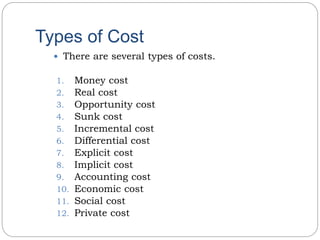
 There are several types of costs.
1. Money cost
2. Real cost
3. Opportunity cost
4. Sunk cost
5. Incremental cost
6. Differential cost
7. Explicit cost
8. Implicit cost
9. Accounting cost
10. Economic cost
11. Social cost
12. Private cost
Fixed Cost
 Fixed cost are those costs which do not vary
with the volume of production.
 Even if the production is zero, a firm will have to
incur fixed costs.
 Examples are rent, interest, depreciation,
insurance, salaries etc.
 It is also called supplementary costs, capacity
costs or period costs or overhead costs.
Variable Cost
 Variable costs are those costs which change with
the quantity of production.
 When the output increases, variable cost also
increases and when the output decreases, the
variable cost also decreases.
 Examples are materials, wages, power, stores
etc.
 Variable costs are also known as prime costs or
direct costs.
Business Cost
 Business cost include all the expenses which
are incurred to carry out a business.
 These cost concepts are used for calculating
business profits and losses and for filling
returns fro income-tax and also for other
legal purposes.
Full Cost
 The concept of full costs, includes business
costs, opportunity costs and normal profits.
Total Cost
 Total cost is the sum of total fixed cost and
total variable cost.
 In other words it is the aggregate money cost
of production of a commodity.
Average Cost
 Average cost is the cost per unit of output.
 That is the total cost divided by number of
units produced.
 Average cost = total average fixed cost + total
average variable cost
Marginal Cost
 Marginal cost is the additional cost to total
cost when an additional unit is produced.
Breakeven Analysis
 BEA is a technique that helps decision
makers understand the relationships among
sales volume, costs and revenues in any
organization.
 It is graphical method of analyzing and also
known as Cost Volume Profit (CVP) analysis.
 In this method, Break-even Point (BEP) i.e.
the level of sales volume to which total
revenues equal total costs is determined.
Assumptions under BEA
1. It assumes that the total cost is divided into two categories
i.e. i) fixed cost and ii) variable cost. It totally ignores the
semi-variable costs.
2. Fixed cost remains constant throughout the volume of
production.
3. The selling price if the product is constant throughout the
sale.
4. The variable cost changes proportionally (at constant rate)
with volume of production.
5. All the goods produced are sold, i.e. volume of production
and sales are equal or there is no closing stock.
6. The firm is producing only one type of product. In case of
multi-product firm, the product mix is stable.
Applications of BEA. . .
1. Break-even analysis is useful in determining
optimum level of output, below which it is not
profitable for the firm to produce its products.
2. To determine minimum cost for a given level of
output.
3. To determine impact of changes in cost or
selling price on break-even analysis.
4. Managerial decision on adding or dropping
product is done by break-even analysis.
. . .Applications of BEA
5. It also helps in choosing a product mix when
there ia a limiting factor.
6. Break-even analysis shoes likely profits and
losses at various levels of production.
7. It is useful in budgeting and profit planning.
8. Break-even chart portrays margin of safety.
9. It is a decision making tool in the hands of
management.
Limitations of Break-Even
Analysis. . .
1. The analysis is based on fixed costs,
variable costs and total revenue. Any
change in one variable affects break-even
point.
2. Semi-variable costs and depreciation are
not accounted which is significant in any
manufacturing firm.
3. Multiple charts are to be produced in case
of multi-product firm.
. . .Limitations of Break-Even
Analysis
4. The effect of technological development,
managerial effectiveness also determines
profitability. These factors are not
considered in break-even chart.
5. The break-even chart is based on fixed cost
concept and hence holds good for a short
period.
6. Break-even analysis is not suitable under
fluctuating business environment.
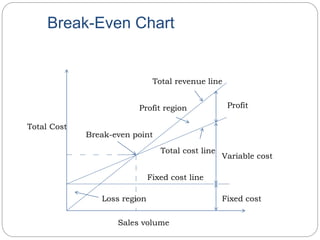
Break-Even Chart
Total Cost
Sales volume
Loss region
Fixed cost line
Fixed cost
Variable cost
Profit
Total revenue line
Total cost line
Profit region
Break-even point
Terminologies used in BEA. . .
 Fixed Costs (FC): Costs that remain the same
regardless of volume of output.
 Cost of land/building/machinery, top
management salary, taxes on property,
depreciation, insurance etc. are FC.
 Variable Costs (VC): Costs which are dependent
on volume of production.
 Cost of materials, wages, packaging costs,
transportation of finished products etc. are VC.
. . .Terminologies used in BEA. . .
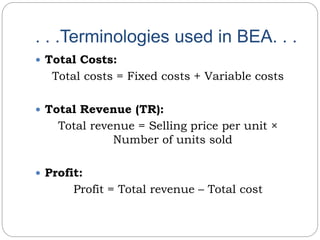
 Total Costs:
Total costs = Fixed costs + Variable costs
 Total Revenue (TR):
Total revenue = Selling price per unit ×
Number of units sold
 Profit:
Profit = Total revenue – Total cost
. . .Terminologies used in BEA. . .
 The point at which total cost line and total
revenue line intersect is known as break-even
point.
 Break-even Point in terms of sales value
(Rs.):
BEP(Rs.) = [Total fixed cost / (Total revenue –
Total variable cost)] × Selling price
 Break-even Point in terms of quantity
(units):
BEP(units) = [Total fixed cost / (Selling price per
unit - Variable cost per unit)]
. . .Terminologies used in BEA. . .
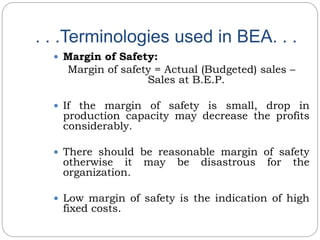
 Margin of Safety:
Margin of safety = Actual (Budgeted) sales –
Sales at B.E.P.
 If the margin of safety is small, drop in
production capacity may decrease the profits
considerably.
 There should be reasonable margin of safety
otherwise it may be disastrous for the
organization.
 Low margin of safety is the indication of high
fixed costs.
. . .Terminologies used in BEA. .
.
 Angle of incidence (ϴ): It is the angle at which
total revenue line intersects the total cost line.
 Large angle of incidence means higher profits.
 Small angle of incidence means less profits are
being made at less favorable conditions.
 Contribution: It is the difference between the
selling price per unit and variable cost per unit.
Contribution = [Selling price per unit – Variable cost
per unit]
OR
Contribution = [Fixed cost per unit + Profit per unit]
. . .Terminologies used in BEA
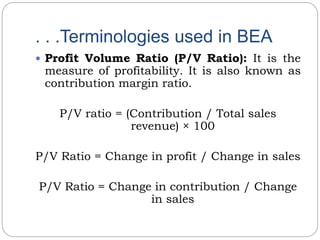
 Profit Volume Ratio (P/V Ratio): It is the
measure of profitability. It is also known as
contribution margin ratio.
P/V ratio = (Contribution / Total sales
revenue) × 100
P/V Ratio = Change in profit / Change in sales
P/V Ratio = Change in contribution / Change
in sales
Thank You

Theoryofcost

  • 1.
  • 2.
    Concepts of Cost Cost simply means cost of production.  It is the expenses incurred in the production of goods.  Thus it includes all expenses from the time the raw material are brought till the finished products reach the wholesaler.
  • 3.
    Continue …  Thecost concept which are relevant to business operation and decision can be grouped on the basis of their purpose under two overlapping categories: 1. Concept used for accounting purpose 2. Concept used in economies analysis of the business
  • 4.
    Types of Cost There are several types of costs. 1. Money cost 2. Real cost 3. Opportunity cost 4. Sunk cost 5. Incremental cost 6. Differential cost 7. Explicit cost 8. Implicit cost 9. Accounting cost 10. Economic cost 11. Social cost 12. Private cost
  • 5.
    Fixed Cost  Fixedcost are those costs which do not vary with the volume of production.  Even if the production is zero, a firm will have to incur fixed costs.  Examples are rent, interest, depreciation, insurance, salaries etc.  It is also called supplementary costs, capacity costs or period costs or overhead costs.
  • 6.
    Variable Cost  Variablecosts are those costs which change with the quantity of production.  When the output increases, variable cost also increases and when the output decreases, the variable cost also decreases.  Examples are materials, wages, power, stores etc.  Variable costs are also known as prime costs or direct costs.
  • 7.
    Business Cost  Businesscost include all the expenses which are incurred to carry out a business.  These cost concepts are used for calculating business profits and losses and for filling returns fro income-tax and also for other legal purposes.
  • 8.
    Full Cost  Theconcept of full costs, includes business costs, opportunity costs and normal profits.
  • 9.
    Total Cost  Totalcost is the sum of total fixed cost and total variable cost.  In other words it is the aggregate money cost of production of a commodity.
  • 10.
    Average Cost  Averagecost is the cost per unit of output.  That is the total cost divided by number of units produced.  Average cost = total average fixed cost + total average variable cost
  • 11.
    Marginal Cost  Marginalcost is the additional cost to total cost when an additional unit is produced.
  • 12.
    Breakeven Analysis  BEAis a technique that helps decision makers understand the relationships among sales volume, costs and revenues in any organization.  It is graphical method of analyzing and also known as Cost Volume Profit (CVP) analysis.  In this method, Break-even Point (BEP) i.e. the level of sales volume to which total revenues equal total costs is determined.
  • 13.
    Assumptions under BEA 1.It assumes that the total cost is divided into two categories i.e. i) fixed cost and ii) variable cost. It totally ignores the semi-variable costs. 2. Fixed cost remains constant throughout the volume of production. 3. The selling price if the product is constant throughout the sale. 4. The variable cost changes proportionally (at constant rate) with volume of production. 5. All the goods produced are sold, i.e. volume of production and sales are equal or there is no closing stock. 6. The firm is producing only one type of product. In case of multi-product firm, the product mix is stable.
  • 14.
    Applications of BEA.. . 1. Break-even analysis is useful in determining optimum level of output, below which it is not profitable for the firm to produce its products. 2. To determine minimum cost for a given level of output. 3. To determine impact of changes in cost or selling price on break-even analysis. 4. Managerial decision on adding or dropping product is done by break-even analysis.
  • 15.
    . . .Applicationsof BEA 5. It also helps in choosing a product mix when there ia a limiting factor. 6. Break-even analysis shoes likely profits and losses at various levels of production. 7. It is useful in budgeting and profit planning. 8. Break-even chart portrays margin of safety. 9. It is a decision making tool in the hands of management.
  • 16.
    Limitations of Break-Even Analysis.. . 1. The analysis is based on fixed costs, variable costs and total revenue. Any change in one variable affects break-even point. 2. Semi-variable costs and depreciation are not accounted which is significant in any manufacturing firm. 3. Multiple charts are to be produced in case of multi-product firm.
  • 17.
    . . .Limitationsof Break-Even Analysis 4. The effect of technological development, managerial effectiveness also determines profitability. These factors are not considered in break-even chart. 5. The break-even chart is based on fixed cost concept and hence holds good for a short period. 6. Break-even analysis is not suitable under fluctuating business environment.
  • 18.
    Break-Even Chart Total Cost Salesvolume Loss region Fixed cost line Fixed cost Variable cost Profit Total revenue line Total cost line Profit region Break-even point
  • 19.
    Terminologies used inBEA. . .  Fixed Costs (FC): Costs that remain the same regardless of volume of output.  Cost of land/building/machinery, top management salary, taxes on property, depreciation, insurance etc. are FC.  Variable Costs (VC): Costs which are dependent on volume of production.  Cost of materials, wages, packaging costs, transportation of finished products etc. are VC.
  • 20.
    . . .Terminologiesused in BEA. . .  Total Costs: Total costs = Fixed costs + Variable costs  Total Revenue (TR): Total revenue = Selling price per unit × Number of units sold  Profit: Profit = Total revenue – Total cost
  • 21.
    . . .Terminologiesused in BEA. . .  The point at which total cost line and total revenue line intersect is known as break-even point.  Break-even Point in terms of sales value (Rs.): BEP(Rs.) = [Total fixed cost / (Total revenue – Total variable cost)] × Selling price  Break-even Point in terms of quantity (units): BEP(units) = [Total fixed cost / (Selling price per unit - Variable cost per unit)]
  • 22.
    . . .Terminologiesused in BEA. . .  Margin of Safety: Margin of safety = Actual (Budgeted) sales – Sales at B.E.P.  If the margin of safety is small, drop in production capacity may decrease the profits considerably.  There should be reasonable margin of safety otherwise it may be disastrous for the organization.  Low margin of safety is the indication of high fixed costs.
  • 23.
    . . .Terminologiesused in BEA. . .  Angle of incidence (ϴ): It is the angle at which total revenue line intersects the total cost line.  Large angle of incidence means higher profits.  Small angle of incidence means less profits are being made at less favorable conditions.  Contribution: It is the difference between the selling price per unit and variable cost per unit. Contribution = [Selling price per unit – Variable cost per unit] OR Contribution = [Fixed cost per unit + Profit per unit]
  • 24.
    . . .Terminologiesused in BEA  Profit Volume Ratio (P/V Ratio): It is the measure of profitability. It is also known as contribution margin ratio. P/V ratio = (Contribution / Total sales revenue) × 100 P/V Ratio = Change in profit / Change in sales P/V Ratio = Change in contribution / Change in sales
  • 25.