PHYSICS
SIMPLE HARMONIC MOTION
Short revision series
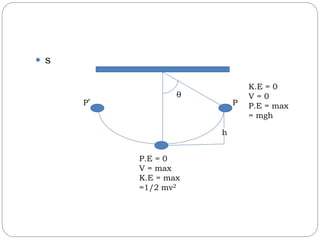
 s
θ
PP’
K.E = 0
V = 0
P.E = max
= mgh
P.E = 0
V = max
K.E = max
=1/2 mv2
h
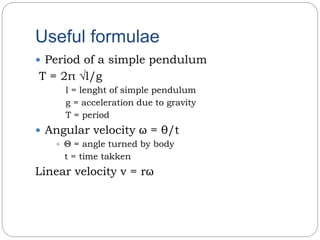
Useful formulae
 Period of a simple pendulum
T = 2π √l/g
l = lenght of simple pendulum
g = acceleration due to gravity
T = period
 Angular velocity ω = θ/t
 Θ = angle turned by body
t = time takken
Linear velocity v = rω
 Acceleration of SHM
 Angular acceleration is the rate of change of
angular velocity with time
 α = a/r
 a = αr
 Frequency – number of complete revolutions
per min
 f = 1/T
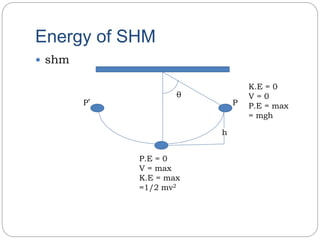
Energy of SHM
 shm
θ
PP’
K.E = 0
V = 0
P.E = max
= mgh
P.E = 0
V = max
K.E = max
=1/2 mv2
h
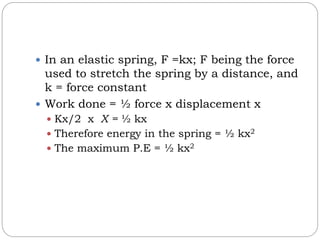
 In an elastic spring, F =kx; F being the force
used to stretch the spring by a distance, and
k = force constant
 Work done = ½ force x displacement x
 Kx/2 x X = ½ kx
 Therefore energy in the spring = ½ kx2
 The maximum P.E = ½ kx2
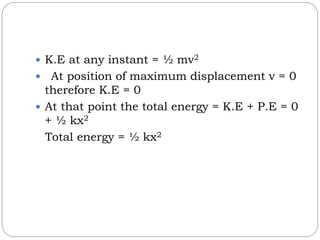
 K.E at any instant = ½ mv2
 At position of maximum displacement v = 0
therefore K.E = 0
 At that point the total energy = K.E + P.E = 0
+ ½ kx2
Total energy = ½ kx2
 At equilibrum when K.E is max, P.E = 0
 Total energy will be = K.E + P.E = ½ mv2 + 0
= ½ mv2
 But at any other positions besides position of
maximum displacement and position of
equilibrum
total energy = KE + PE = ½ mv2 + ½ kx2
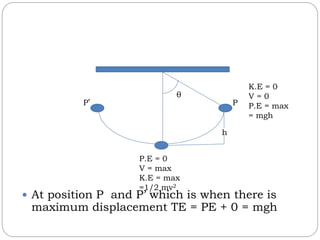
 At position P and P’ which is when there is
maximum displacement TE = PE + 0 = mgh
θ
PP’
K.E = 0
V = 0
P.E = max
= mgh
P.E = 0
V = max
K.E = max
=1/2 mv2
h
End

Simpleharmonicmotion

  • 1.
  • 2.
     s θ PP’ K.E =0 V = 0 P.E = max = mgh P.E = 0 V = max K.E = max =1/2 mv2 h
  • 3.
    Useful formulae  Periodof a simple pendulum T = 2π √l/g l = lenght of simple pendulum g = acceleration due to gravity T = period  Angular velocity ω = θ/t  Θ = angle turned by body t = time takken Linear velocity v = rω
  • 4.
     Acceleration ofSHM  Angular acceleration is the rate of change of angular velocity with time  α = a/r  a = αr  Frequency – number of complete revolutions per min  f = 1/T
  • 5.
    Energy of SHM shm θ PP’ K.E = 0 V = 0 P.E = max = mgh P.E = 0 V = max K.E = max =1/2 mv2 h
  • 6.
     In anelastic spring, F =kx; F being the force used to stretch the spring by a distance, and k = force constant  Work done = ½ force x displacement x  Kx/2 x X = ½ kx  Therefore energy in the spring = ½ kx2  The maximum P.E = ½ kx2
  • 7.
     K.E atany instant = ½ mv2  At position of maximum displacement v = 0 therefore K.E = 0  At that point the total energy = K.E + P.E = 0 + ½ kx2 Total energy = ½ kx2
  • 8.
     At equilibrumwhen K.E is max, P.E = 0  Total energy will be = K.E + P.E = ½ mv2 + 0 = ½ mv2  But at any other positions besides position of maximum displacement and position of equilibrum total energy = KE + PE = ½ mv2 + ½ kx2
  • 9.
     At positionP and P’ which is when there is maximum displacement TE = PE + 0 = mgh θ PP’ K.E = 0 V = 0 P.E = max = mgh P.E = 0 V = max K.E = max =1/2 mv2 h
  • 10.