CHEMISTRY
ACIDS and BASES
Short revision series
Acids
 An acid is a substance which produces
hydrogen ions (protons) as the only positive
ions when dissolved in water
 2 classes
 Organic
 mineral or inorganic
 Can also be
 Strong: completely ionise in water
HCl -- H+ + Cl-
 Weak: partially ionise in water
H2CO3 2H+ + CO3
2-
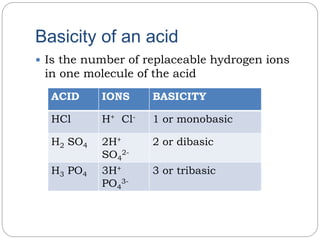
Basicity of an acid
 Is the number of replaceable hydrogen ions
in one molecule of the acid
ACID IONS BASICITY
HCl H+ Cl- 1 or monobasic
H2 SO4 2H+
SO4
2-
2 or dibasic
H3 PO4 3H+
PO4
3-
3 or tribasic
Properties of acids
 Physical properties
1. Dilute acids have sour taste
2. Turns blue litmus red
3. Concentrated acid are corrosive
Chemical properties
 Reacts with metal to give hydrogen gas.
(except dilute trioxonitrate (V) acid)
2HCl(aq) + Zn(s)  ZnCl2(aq) + H2(g)
 Reacts with bases to form salt and water
2HCl(aq) + CaO(s)  CaCl2(aq) + H2O(l)
 Reacts with trioxocarbonates to give CO2
2HCl(aq) + Na2CO3(aq)  2NaCl(aq) + H2O(l) +
CO2(g)
How do you prepare acids?
1. Dissolve acid anhydride in water
CO2 dissolves in water to form H2CO3
CO2 + H2O  H2CO3
2. Combine the constituent elements
H2 + Cl2 2HCl
Activated
charcoal
What is an alkali? What is a
base?
 An alkali is Basic hydroxide which is soluble
in water.
Such as sodium oxide Na2O which will dissolve
in water to give soduim hydroxide NaOH
 A base is a substance that will neutralize an
aid to yeild salt and water.
What is neutralization?
 Acid + base  salt + water
 HCl + NaOH  NaCl + water
Properties of alkalis
 Physical properties
1. Have bitter taste
2. Soapy to touch
3. Turn red litmus blue
4. Can be corrosive in conc form eg sodium
hydroxide and pottassium hydroxide
Chemical properties of bases and
alkalis
 React with acids to form salt and water
 2HCl(aq) + CaO(s)  CaCl2(aq) + H2O(l)
 Reacts with ammonium salts to generate
ammonia gas in the presence of heat.
 NaOH(aq) + NH4NO3(aq) NaNO3 (aq)+ H2O(l) +
NH3(g)
Measurement of acidity and alkalinity
 On the pH scale 7 is neutral
 Below 7 is increasingly acidic
 Above 7 is increasingly alkaline
 pH= - log {H+}
Calculations
 Calculate the pH of of a solution of
concentration of 1 x 10-12
{H+} = 1 x 10-12
pH= - log {H+}
= -log10 1 x 10-12 = -(-12) = 12
 Find the H+ and OH- in 0.02M solution of
H2SO4
 First breakdown H2SO4 to individual ions
H2SO4  2H+ + SO2
2-
{H+} = 2 x 0.02 = 0.04 mol dm-3
 How many {OH-} does it contain?
{H+}{OH-} = 1 x 10-14
{OH} = 1 x 10-14 /{H}
= 1 x 10-14 / 0.04 = 2.5 x 10 -13 moldm-3
What are buffer solutions?
 Solutions which resist changes in pH on
addition of small amounts of acids or alkalis.
 They usually consist of a weak acid or weak
base in the presence of one of its salts.
 Egs
 Ethanoic acid and soduim ethanoate
 Aq ammonia and ammonium chloride

Acids,basesandsalts acids

  • 1.
  • 2.
    Acids  An acidis a substance which produces hydrogen ions (protons) as the only positive ions when dissolved in water  2 classes  Organic  mineral or inorganic  Can also be  Strong: completely ionise in water HCl -- H+ + Cl-  Weak: partially ionise in water H2CO3 2H+ + CO3 2-
  • 3.
    Basicity of anacid  Is the number of replaceable hydrogen ions in one molecule of the acid ACID IONS BASICITY HCl H+ Cl- 1 or monobasic H2 SO4 2H+ SO4 2- 2 or dibasic H3 PO4 3H+ PO4 3- 3 or tribasic
  • 4.
    Properties of acids Physical properties 1. Dilute acids have sour taste 2. Turns blue litmus red 3. Concentrated acid are corrosive
  • 5.
    Chemical properties  Reactswith metal to give hydrogen gas. (except dilute trioxonitrate (V) acid) 2HCl(aq) + Zn(s)  ZnCl2(aq) + H2(g)  Reacts with bases to form salt and water 2HCl(aq) + CaO(s)  CaCl2(aq) + H2O(l)  Reacts with trioxocarbonates to give CO2 2HCl(aq) + Na2CO3(aq)  2NaCl(aq) + H2O(l) + CO2(g)
  • 6.
    How do youprepare acids? 1. Dissolve acid anhydride in water CO2 dissolves in water to form H2CO3 CO2 + H2O  H2CO3 2. Combine the constituent elements H2 + Cl2 2HCl Activated charcoal
  • 7.
    What is analkali? What is a base?  An alkali is Basic hydroxide which is soluble in water. Such as sodium oxide Na2O which will dissolve in water to give soduim hydroxide NaOH  A base is a substance that will neutralize an aid to yeild salt and water.
  • 8.
    What is neutralization? Acid + base  salt + water  HCl + NaOH  NaCl + water
  • 9.
    Properties of alkalis Physical properties 1. Have bitter taste 2. Soapy to touch 3. Turn red litmus blue 4. Can be corrosive in conc form eg sodium hydroxide and pottassium hydroxide
  • 10.
    Chemical properties ofbases and alkalis  React with acids to form salt and water  2HCl(aq) + CaO(s)  CaCl2(aq) + H2O(l)  Reacts with ammonium salts to generate ammonia gas in the presence of heat.  NaOH(aq) + NH4NO3(aq) NaNO3 (aq)+ H2O(l) + NH3(g)
  • 11.
    Measurement of acidityand alkalinity  On the pH scale 7 is neutral  Below 7 is increasingly acidic  Above 7 is increasingly alkaline  pH= - log {H+}
  • 12.
    Calculations  Calculate thepH of of a solution of concentration of 1 x 10-12 {H+} = 1 x 10-12 pH= - log {H+} = -log10 1 x 10-12 = -(-12) = 12
  • 13.
     Find theH+ and OH- in 0.02M solution of H2SO4
  • 14.
     First breakdownH2SO4 to individual ions H2SO4  2H+ + SO2 2- {H+} = 2 x 0.02 = 0.04 mol dm-3  How many {OH-} does it contain? {H+}{OH-} = 1 x 10-14 {OH} = 1 x 10-14 /{H} = 1 x 10-14 / 0.04 = 2.5 x 10 -13 moldm-3
  • 15.
    What are buffersolutions?  Solutions which resist changes in pH on addition of small amounts of acids or alkalis.  They usually consist of a weak acid or weak base in the presence of one of its salts.  Egs  Ethanoic acid and soduim ethanoate  Aq ammonia and ammonium chloride