PHYSICS
THERMAL EXPANSION
Short revision series
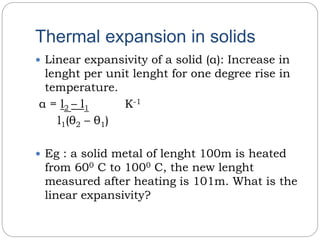
Thermal expansion in solids
 Linear expansivity of a solid (α): Increase in
lenght per unit lenght for one degree rise in
temperature.
α = l2 – l1 K-1
l1(θ2 – θ1)
 Eg : a solid metal of lenght 100m is heated
from 600 C to 1000 C, the new lenght
measured after heating is 101m. What is the
linear expansivity?
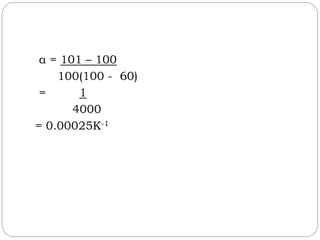
α = 101 – 100
100(100 - 60)
= 1
4000
= 0.00025K-1
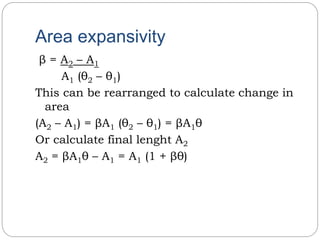
Area expansivity
β = A2 – A1
A1 (θ2 – θ1)
This can be rearranged to calculate change in
area
(A2 – A1) = βA1 (θ2 – θ1) = βA1θ
Or calculate final lenght A2
A2 = βA1θ – A1 = A1 (1 + βθ)
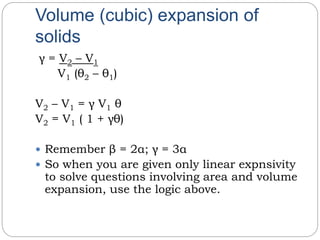
Volume (cubic) expansion of
solids
γ = V2 – V1
V1 (θ2 – θ1)
V2 – V1 = γ V1 θ
V2 = V1 ( 1 + γθ)
 Remember β = 2α; γ = 3α
 So when you are given only linear expnsivity
to solve questions involving area and volume
expansion, use the logic above.
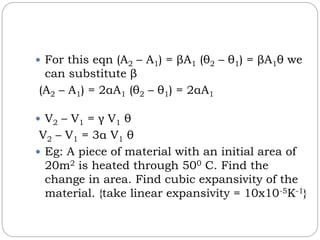
 For this eqn (A2 – A1) = βA1 (θ2 – θ1) = βA1θ we
can substitute β
(A2 – A1) = 2αA1 (θ2 – θ1) = 2αA1
 V2 – V1 = γ V1 θ
V2 – V1 = 3α V1 θ
 Eg: A piece of material with an initial area of
20m2 is heated through 500 C. Find the
change in area. Find cubic expansivity of the
material. {take linear expansivity = 10x10-5K-1}
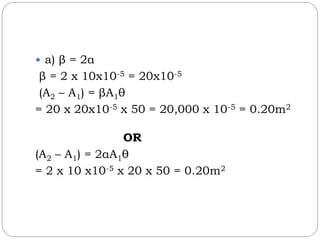
 a) β = 2α
β = 2 x 10x10-5 = 20x10-5
(A2 – A1) = βA1θ
= 20 x 20x10-5 x 50 = 20,000 x 10-5 = 0.20m2
OR
(A2 – A1) = 2αA1θ
= 2 x 10 x10-5 x 20 x 50 = 0.20m2
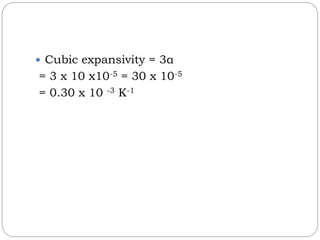
 Cubic expansivity = 3α
= 3 x 10 x10-5 = 30 x 10-5
= 0.30 x 10 -3 K-1
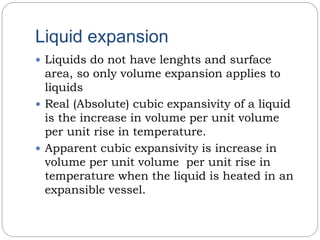
Liquid expansion
 Liquids do not have lenghts and surface
area, so only volume expansion applies to
liquids
 Real (Absolute) cubic expansivity of a liquid
is the increase in volume per unit volume
per unit rise in temperature.
 Apparent cubic expansivity is increase in
volume per unit volume per unit rise in
temperature when the liquid is heated in an
expansible vessel.
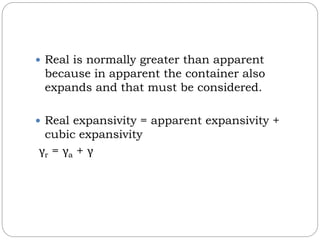
 Real is normally greater than apparent
because in apparent the container also
expands and that must be considered.
 Real expansivity = apparent expansivity +
cubic expansivity
γr = γa + γ
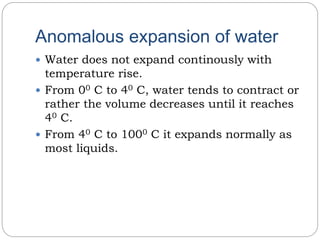
Anomalous expansion of water
 Water does not expand continously with
temperature rise.
 From 00 C to 40 C, water tends to contract or
rather the volume decreases until it reaches
40 C.
 From 40 C to 1000 C it expands normally as
most liquids.
END

Thermalexpansion

  • 1.
  • 2.
    Thermal expansion insolids  Linear expansivity of a solid (α): Increase in lenght per unit lenght for one degree rise in temperature. α = l2 – l1 K-1 l1(θ2 – θ1)  Eg : a solid metal of lenght 100m is heated from 600 C to 1000 C, the new lenght measured after heating is 101m. What is the linear expansivity?
  • 3.
    α = 101– 100 100(100 - 60) = 1 4000 = 0.00025K-1
  • 4.
    Area expansivity β =A2 – A1 A1 (θ2 – θ1) This can be rearranged to calculate change in area (A2 – A1) = βA1 (θ2 – θ1) = βA1θ Or calculate final lenght A2 A2 = βA1θ – A1 = A1 (1 + βθ)
  • 5.
    Volume (cubic) expansionof solids γ = V2 – V1 V1 (θ2 – θ1) V2 – V1 = γ V1 θ V2 = V1 ( 1 + γθ)  Remember β = 2α; γ = 3α  So when you are given only linear expnsivity to solve questions involving area and volume expansion, use the logic above.
  • 6.
     For thiseqn (A2 – A1) = βA1 (θ2 – θ1) = βA1θ we can substitute β (A2 – A1) = 2αA1 (θ2 – θ1) = 2αA1  V2 – V1 = γ V1 θ V2 – V1 = 3α V1 θ  Eg: A piece of material with an initial area of 20m2 is heated through 500 C. Find the change in area. Find cubic expansivity of the material. {take linear expansivity = 10x10-5K-1}
  • 7.
     a) β= 2α β = 2 x 10x10-5 = 20x10-5 (A2 – A1) = βA1θ = 20 x 20x10-5 x 50 = 20,000 x 10-5 = 0.20m2 OR (A2 – A1) = 2αA1θ = 2 x 10 x10-5 x 20 x 50 = 0.20m2
  • 8.
     Cubic expansivity= 3α = 3 x 10 x10-5 = 30 x 10-5 = 0.30 x 10 -3 K-1
  • 9.
    Liquid expansion  Liquidsdo not have lenghts and surface area, so only volume expansion applies to liquids  Real (Absolute) cubic expansivity of a liquid is the increase in volume per unit volume per unit rise in temperature.  Apparent cubic expansivity is increase in volume per unit volume per unit rise in temperature when the liquid is heated in an expansible vessel.
  • 10.
     Real isnormally greater than apparent because in apparent the container also expands and that must be considered.  Real expansivity = apparent expansivity + cubic expansivity γr = γa + γ
  • 11.
    Anomalous expansion ofwater  Water does not expand continously with temperature rise.  From 00 C to 40 C, water tends to contract or rather the volume decreases until it reaches 40 C.  From 40 C to 1000 C it expands normally as most liquids.
  • 12.