CHEMISTRY
CHEMICAL COMBINATIONS:
balancing chemical equations and laws
of chemical combination
Short revision series
Law of conservation of mass
 Matter can neither be created nor destroyed
during a chemical reaction but can be
converted from one form to another
Law of definite proportions
 States that all pure samples of a particular
chemical compound contain similar
elements combined in the same proportion
by mass
Law of multiple proportions
 The law of multiple proportions states that if
two elements A and B combine to form more
than one chemical compound, then the
various masses of one element A, which
combine separately with a fixed mass of the
other element B, are in simple multiple ratio.
Law of reciprocal proportions
 States that the masses of several elements A,
B, C, which combine separately with a fixed
mass of another element D, are the same as,
or simple multiples of, the masses in which
A, B, C, themselves combine with one
another.
Valency
 Is the combining power of an element.
 The number of moles of H atoms that will
combine with one mole of an element gives
the valency of that element.
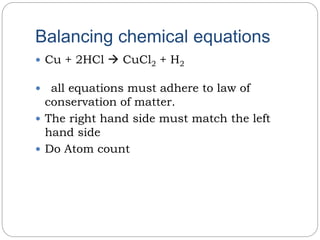
Balancing chemical equations
 Cu + 2HCl  CuCl2 + H2
 all equations must adhere to law of
conservation of matter.
 The right hand side must match the left
hand side
 Do Atom count
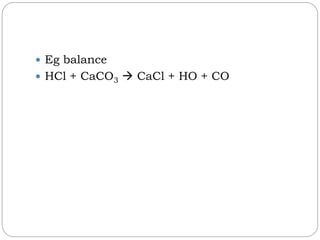
 Eg balance
 HCl + CaCO3  CaCl + HO + CO
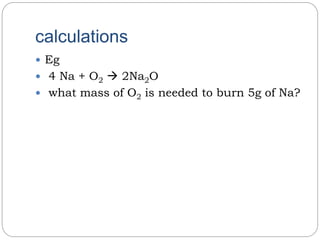
calculations
 Eg
 4 Na + O2  2Na2O
 what mass of O2 is needed to burn 5g of Na?
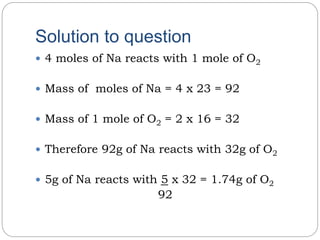
Solution to question
 4 moles of Na reacts with 1 mole of O2
 Mass of moles of Na = 4 x 23 = 92
 Mass of 1 mole of O2 = 2 x 16 = 32
 Therefore 92g of Na reacts with 32g of O2
 5g of Na reacts with 5 x 32 = 1.74g of O2
92

Chemicalcombinationsbalancingchemeqns

  • 1.
    CHEMISTRY CHEMICAL COMBINATIONS: balancing chemicalequations and laws of chemical combination Short revision series
  • 2.
    Law of conservationof mass  Matter can neither be created nor destroyed during a chemical reaction but can be converted from one form to another
  • 3.
    Law of definiteproportions  States that all pure samples of a particular chemical compound contain similar elements combined in the same proportion by mass
  • 4.
    Law of multipleproportions  The law of multiple proportions states that if two elements A and B combine to form more than one chemical compound, then the various masses of one element A, which combine separately with a fixed mass of the other element B, are in simple multiple ratio.
  • 5.
    Law of reciprocalproportions  States that the masses of several elements A, B, C, which combine separately with a fixed mass of another element D, are the same as, or simple multiples of, the masses in which A, B, C, themselves combine with one another.
  • 6.
    Valency  Is thecombining power of an element.  The number of moles of H atoms that will combine with one mole of an element gives the valency of that element.
  • 7.
    Balancing chemical equations Cu + 2HCl  CuCl2 + H2  all equations must adhere to law of conservation of matter.  The right hand side must match the left hand side  Do Atom count
  • 8.
     Eg balance HCl + CaCO3  CaCl + HO + CO
  • 9.
    calculations  Eg  4Na + O2  2Na2O  what mass of O2 is needed to burn 5g of Na?
  • 10.
    Solution to question 4 moles of Na reacts with 1 mole of O2  Mass of moles of Na = 4 x 23 = 92  Mass of 1 mole of O2 = 2 x 16 = 32  Therefore 92g of Na reacts with 32g of O2  5g of Na reacts with 5 x 32 = 1.74g of O2 92