CHEMISTRY
GAS LAWS
Short revision series
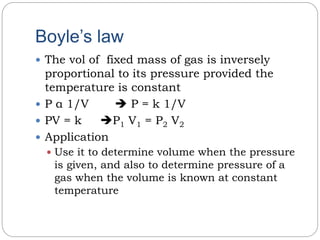
Boyle’s law
 The vol of fixed mass of gas is inversely
proportional to its pressure provided the
temperature is constant
 P α 1/V  P = k 1/V
 PV = k P1 V1 = P2 V2
 Application
 Use it to determine volume when the pressure
is given, and also to determine pressure of a
gas when the volume is known at constant
temperature
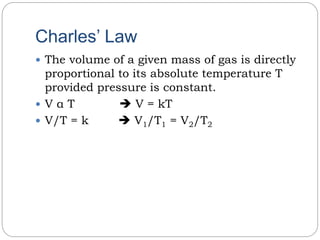
Charles’ Law
 The volume of a given mass of gas is directly
proportional to its absolute temperature T
provided pressure is constant.
 V α T  V = kT
 V/T = k  V1/T1 = V2/T2
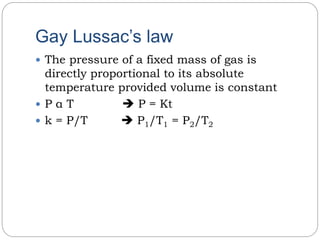
Gay Lussac’s law
 The pressure of a fixed mass of gas is
directly proportional to its absolute
temperature provided volume is constant
 P α T  P = Kt
 k = P/T  P1/T1 = P2/T2
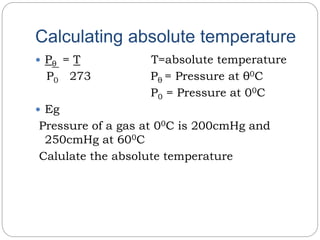
Calculating absolute temperature
 Pθ = T T=absolute temperature
P0 273 Pθ = Pressure at θ0C
P0 = Pressure at 00C
 Eg
Pressure of a gas at 00C is 200cmHg and
250cmHg at 600C
Calulate the absolute temperature
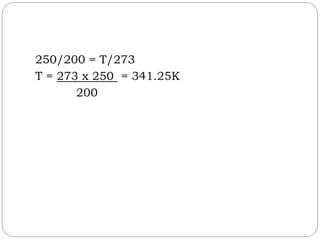
250/200 = T/273
T = 273 x 250 = 341.25K
200
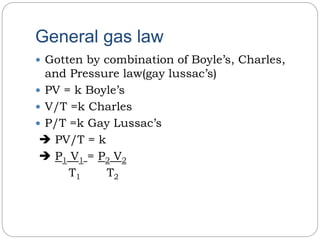
General gas law
 Gotten by combination of Boyle’s, Charles,
and Pressure law(gay lussac’s)
 PV = k Boyle’s
 V/T =k Charles
 P/T =k Gay Lussac’s
 PV/T = k
 P1 V1 = P2 V2
T1 T2
Eg
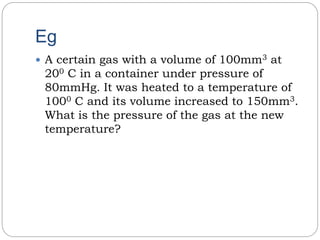
 A certain gas with a volume of 100mm3 at
200 C in a container under pressure of
80mmHg. It was heated to a temperature of
1000 C and its volume increased to 150mm3.
What is the pressure of the gas at the new
temperature?
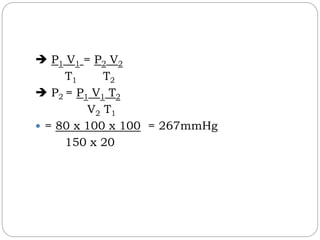
 P1 V1 = P2 V2
T1 T2
 P2 = P1 V1 T2
V2 T1
 = 80 x 100 x 100 = 267mmHg
150 x 20
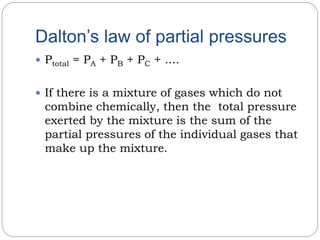
Dalton’s law of partial pressures
 Ptotal = PA + PB + PC + ....
 If there is a mixture of gases which do not
combine chemically, then the total pressure
exerted by the mixture is the sum of the
partial pressures of the individual gases that
make up the mixture.
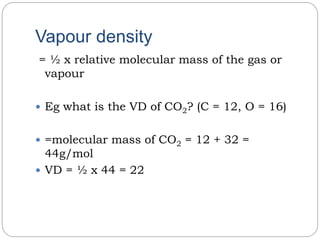
Vapour density
= ½ x relative molecular mass of the gas or
vapour
 Eg what is the VD of CO2? (C = 12, O = 16)
 =molecular mass of CO2 = 12 + 32 =
44g/mol
 VD = ½ x 44 = 22
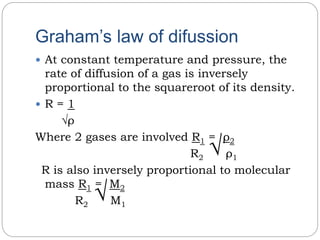
Graham’s law of difussion
 At constant temperature and pressure, the
rate of diffusion of a gas is inversely
proportional to the squareroot of its density.
 R = 1
√ρ
Where 2 gases are involved R1 = ρ2
R2 ρ1
R is also inversely proportional to molecular
mass R1 = M2
R2 M1
√
√

Gaslawsprep

  • 1.
  • 2.
    Boyle’s law  Thevol of fixed mass of gas is inversely proportional to its pressure provided the temperature is constant  P α 1/V  P = k 1/V  PV = k P1 V1 = P2 V2  Application  Use it to determine volume when the pressure is given, and also to determine pressure of a gas when the volume is known at constant temperature
  • 3.
    Charles’ Law  Thevolume of a given mass of gas is directly proportional to its absolute temperature T provided pressure is constant.  V α T  V = kT  V/T = k  V1/T1 = V2/T2
  • 4.
    Gay Lussac’s law The pressure of a fixed mass of gas is directly proportional to its absolute temperature provided volume is constant  P α T  P = Kt  k = P/T  P1/T1 = P2/T2
  • 5.
    Calculating absolute temperature Pθ = T T=absolute temperature P0 273 Pθ = Pressure at θ0C P0 = Pressure at 00C  Eg Pressure of a gas at 00C is 200cmHg and 250cmHg at 600C Calulate the absolute temperature
  • 6.
    250/200 = T/273 T= 273 x 250 = 341.25K 200
  • 7.
    General gas law Gotten by combination of Boyle’s, Charles, and Pressure law(gay lussac’s)  PV = k Boyle’s  V/T =k Charles  P/T =k Gay Lussac’s  PV/T = k  P1 V1 = P2 V2 T1 T2
  • 8.
    Eg  A certaingas with a volume of 100mm3 at 200 C in a container under pressure of 80mmHg. It was heated to a temperature of 1000 C and its volume increased to 150mm3. What is the pressure of the gas at the new temperature?
  • 9.
     P1 V1= P2 V2 T1 T2  P2 = P1 V1 T2 V2 T1  = 80 x 100 x 100 = 267mmHg 150 x 20
  • 10.
    Dalton’s law ofpartial pressures  Ptotal = PA + PB + PC + ....  If there is a mixture of gases which do not combine chemically, then the total pressure exerted by the mixture is the sum of the partial pressures of the individual gases that make up the mixture.
  • 11.
    Vapour density = ½x relative molecular mass of the gas or vapour  Eg what is the VD of CO2? (C = 12, O = 16)  =molecular mass of CO2 = 12 + 32 = 44g/mol  VD = ½ x 44 = 22
  • 12.
    Graham’s law ofdifussion  At constant temperature and pressure, the rate of diffusion of a gas is inversely proportional to the squareroot of its density.  R = 1 √ρ Where 2 gases are involved R1 = ρ2 R2 ρ1 R is also inversely proportional to molecular mass R1 = M2 R2 M1 √ √