CHEMISTRY
SALTS
Short revision series
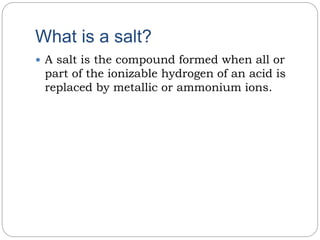
What is a salt?
 A salt is the compound formed when all or
part of the ionizable hydrogen of an acid is
replaced by metallic or ammonium ions.
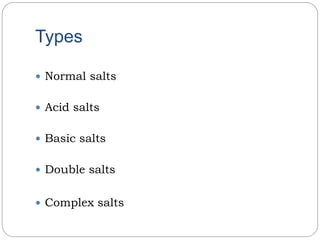
Types
 Normal salts
 Acid salts
 Basic salts
 Double salts
 Complex salts
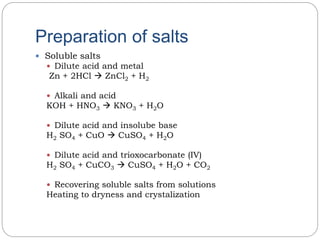
Preparation of salts
 Soluble salts
 Dilute acid and metal
Zn + 2HCl  ZnCl2 + H2
 Alkali and acid
KOH + HNO3  KNO3 + H2O
 Dilute acid and insolube base
H2 SO4 + CuO  CuSO4 + H2O
 Dilute acid and trioxocarbonate (IV)
H2 SO4 + CuCO3  CuSO4 + H2O + CO2
 Recovering soluble salts from solutions
Heating to dryness and crystalization
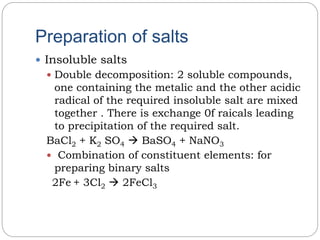
Preparation of salts
 Insoluble salts
 Double decomposition: 2 soluble compounds,
one containing the metalic and the other acidic
radical of the required insoluble salt are mixed
together . There is exchange 0f raicals leading
to precipitation of the required salt.
BaCl2 + K2 SO4  BaSO4 + NaNO3
 Combination of constituent elements: for
preparing binary salts
2Fe + 3Cl2  2FeCl3

Salts

  • 1.
  • 2.
    What is asalt?  A salt is the compound formed when all or part of the ionizable hydrogen of an acid is replaced by metallic or ammonium ions.
  • 3.
    Types  Normal salts Acid salts  Basic salts  Double salts  Complex salts
  • 4.
    Preparation of salts Soluble salts  Dilute acid and metal Zn + 2HCl  ZnCl2 + H2  Alkali and acid KOH + HNO3  KNO3 + H2O  Dilute acid and insolube base H2 SO4 + CuO  CuSO4 + H2O  Dilute acid and trioxocarbonate (IV) H2 SO4 + CuCO3  CuSO4 + H2O + CO2  Recovering soluble salts from solutions Heating to dryness and crystalization
  • 5.
    Preparation of salts Insoluble salts  Double decomposition: 2 soluble compounds, one containing the metalic and the other acidic radical of the required insoluble salt are mixed together . There is exchange 0f raicals leading to precipitation of the required salt. BaCl2 + K2 SO4  BaSO4 + NaNO3  Combination of constituent elements: for preparing binary salts 2Fe + 3Cl2  2FeCl3