PRESENTED BY
RAJEEV RANJAN
PRINCE MATHEW
SANDEEP BAKSHI
MOHAMMED ASRAR
ROHIT DHANRAJ PATIL
RAJESH PATEL
 A breakeven analysis is used to determine how much sales
volume your business needs to start making a profit.
 The breakeven analysis is especially useful when you're
developing a pricing strategy, either as part of a marketing
plan or a business plan.
 In economics & business, specifically cost accounting,
the break-even point (BEP) is the point at which cost or
expenses and revenue are equal: there is no net loss or gain,
and one has "broken even".
 Total cost = Total revenue = B.E.P.
INTRODUCTION
BREAK EVEN POINT
 There are two basic types of costs a company incurs.
• Variable Costs
• Fixed Costs
 Variable costs are costs that change with changes in
production levels or sales. Examples include: Costs of
materials used in the production of the goods.
 Fixed costs remain roughly the same regardless of
sales/output levels. Examples include: Rent, Insurance and
Wages
BREAK EVEN ANALYSIS
In order to calculate how profitable a product will be, we must
firstly look at the Costs Price and Revenue involved.
 Unit Price:
The amount of money charged to the customer for each unit of a
product or service.
 Total Cost:
The sum of the fixed cost and total variable cost for any given level of
production.
(Fixed Cost + Total Variable Cost )
 Total Variable Cost:
The product of expected unit sales and variable unit cost.
(Expected Unit Sales * Variable Unit Cost )
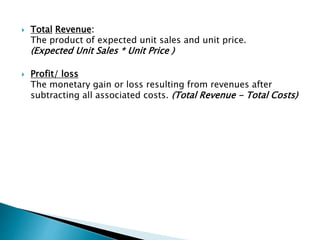
 Total Revenue:
The product of expected unit sales and unit price.
(Expected Unit Sales * Unit Price )
 Profit/ loss
The monetary gain or loss resulting from revenues after
subtracting all associated costs. (Total Revenue - Total Costs)
 All elements of cost i.e. production, administration and selling
distribution can be divided into fixed and variable components.
 Variable costs remain constant per unit of output.
 Fixed cost remain constant at all volume of output.
 Selling price per unit remains unchanged or constant at all levels
of output.
 Volume of production is the only factor that influences cost.
 There will be no change in the general price level.
 There is one product and in case of multi product, the sales
remain constant.
ASSUMPTIONS
 The break-even point (in terms of Unit Sales (X)) can be directly
computed in terms of Total Revenue (TR) and Total Costs (TC) as:
The quantity (P – V) is of interest in its own right, and is called
the Unit Contribution Margin (C): it is the marginal profit per unit,
or alternatively the portion of each sale that contributes to Fixed
Costs
COMPUTATION
where:
TFC is Total Fixed Costs,
P is Unit Sale Price, and
V is Unit Variable Cost
 For example, suppose that your fixed costs for producing
100,000 product were 30,000 Rs a year.
 Your variable costs are 2.20 R.s materials, 4.00 R.s labor, and
0.80 Rs overhead, for a total of 7.00 R.s per unit.
 If you choose a selling price of 12.00 Rs for each product, then:
 BEP= TFC/P-V
 30,000(TFC) divided by [12.00(P) - 7.00(V)] equals 6000 units.
 This is the number of products that have to be sold at a selling
price of 12.00 Rs before your business will start to make a profit.
EXAMPLES
 For example, if it costs R.s. 50 to produce a pen, and there
are fixed costs of R.s.1,000, the break-even point for selling
the widgets would be:
If selling for R.s. 100: 20 Widgets
(Calculated as 1000/(100-50)=20)
If selling for $200: 20 Widgets
(Calculated as 1000/(200-50)=6.7)
From this we can make out that the company should sell
products at higher price to reach BEP faster.
EXAMPLE
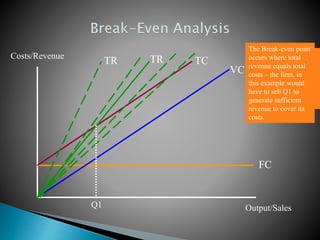
Costs/Revenue
Output/Sales
Initially a firm
will incur fixed
costs, these do
not depend on
output or sales.
FC
As output is
generated, the
firm will incur
variable costs –
these vary
directly with the
amount produced
VC
The total costs
therefore
(assuming
accurate
forecasts!) is the
sum of FC+VC
TC
Total revenue is
determined by the
price charged and
the quantity sold –
again this will be
determined by
expected forecast
sales initially.
TR
The lower the
price, the less
steep the total
revenue curve.
TR
Q1
The Break-even point
occurs where total
revenue equals total
costs – the firm, in
this example would
have to sell Q1 to
generate sufficient
revenue to cover its
costs.
Break-Even Analysis
Costs/Revenue
Output/Sales
FC
VC
TCTR (p = Rs.2)
Q1
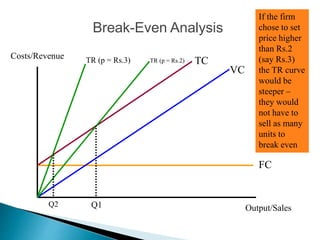
If the firm
chose to set
price higher
than Rs.2
(say Rs.3)
the TR curve
would be
steeper –
they would
not have to
sell as many
units to
break even
TR (p = Rs.3)
Q2
Break-Even Analysis
Costs/Revenue
Output/Sales
FC
VCTCTR (p = Rs.2)
Q1
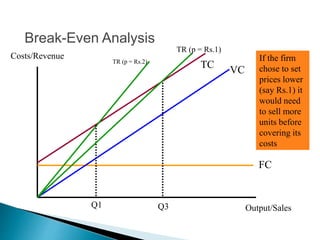
If the firm
chose to set
prices lower
(say Rs.1) it
would need
to sell more
units before
covering its
costs
TR (p = Rs.1)
Q3
Break-Even Analysis
Costs/Revenue
Output/Sales
FC
VC
TCTR (p = Rs.2)
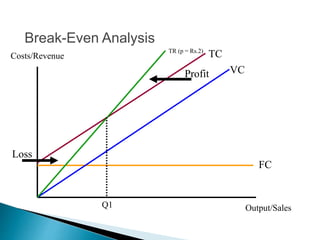
Q1
Loss
Profit
 Margin of safety represents the strength of the business. It
enables a business to know what is the exact amount it has
gained or lost and whether they are over or below the break
even point.
 margin of safety = (current output - breakeven output) OR
 Margin o safety = actual sales – BEP sales
 margin of safety% = (current output - breakeven
output)/current output × 100
MARGIN OF SAFETY
Break-Even Analysis
Costs/Revenue
Output/Sales
FC
VC
TCTR (p = Rs. 2)
Q1 Q2
Margin of Safety
Margin of
safety shows
how far sales
can fall before
losses made. If
Q1 = 1000 and
Q2 = 1800, sales
could fall by 800
units before a
loss would be
made
TR (p = Rs. 3)
Q3
A higher
price
would
lower the
break
even
point and
the
margin of
safety
would
widen
 Helpful in deciding the minimum quantity of sales
 Helpful in the determination of tender price.
 Helpful in examining effects upon organization’s
profitability.
 Helpful in deciding about the substitution of new plants.
 Helpful in sales price and quantity.
 Helpful in determining marginal cost.
USES OF BREAK EVEVN POINT
 Break-even analysis is only a supply side (costs only) analysis, as
it tells you nothing about what sales are actually likely to be for
the product at these various prices.
 It assumes that fixed costs (FC) are constant
 It assumes average variable costs are constant per unit of output,
at least in the range of likely quantities of sales.
 It assumes that the quantity of goods produced is equal to the
quantity of goods sold (i.e., there is no change in the quantity of
goods held in inventory at the beginning of the period and the
quantity of goods held in inventory at the end of the period.
 In multi-product companies, it assumes that the relative
proportions of each product sold and produced are constant.
LIMITATIONS
 A company should determine its break even point before
selling its products.
 In order to know how price your product, you first have to
know how to calculate breakeven point.
 Break-even analysis is a supply side analysis; that is it only
analyzes the costs of the sales.
 It does not analyze how demand may be affected at different
price levels.
CONCLUSION

BREAK-EVEN ANALYSIS

  • 1.
    PRESENTED BY RAJEEV RANJAN PRINCEMATHEW SANDEEP BAKSHI MOHAMMED ASRAR ROHIT DHANRAJ PATIL RAJESH PATEL
  • 2.
     A breakevenanalysis is used to determine how much sales volume your business needs to start making a profit.  The breakeven analysis is especially useful when you're developing a pricing strategy, either as part of a marketing plan or a business plan.  In economics & business, specifically cost accounting, the break-even point (BEP) is the point at which cost or expenses and revenue are equal: there is no net loss or gain, and one has "broken even".  Total cost = Total revenue = B.E.P. INTRODUCTION
  • 3.
  • 4.
     There aretwo basic types of costs a company incurs. • Variable Costs • Fixed Costs  Variable costs are costs that change with changes in production levels or sales. Examples include: Costs of materials used in the production of the goods.  Fixed costs remain roughly the same regardless of sales/output levels. Examples include: Rent, Insurance and Wages BREAK EVEN ANALYSIS In order to calculate how profitable a product will be, we must firstly look at the Costs Price and Revenue involved.
  • 5.
     Unit Price: Theamount of money charged to the customer for each unit of a product or service.  Total Cost: The sum of the fixed cost and total variable cost for any given level of production. (Fixed Cost + Total Variable Cost )  Total Variable Cost: The product of expected unit sales and variable unit cost. (Expected Unit Sales * Variable Unit Cost )
  • 6.
     Total Revenue: Theproduct of expected unit sales and unit price. (Expected Unit Sales * Unit Price )  Profit/ loss The monetary gain or loss resulting from revenues after subtracting all associated costs. (Total Revenue - Total Costs)
  • 7.
     All elementsof cost i.e. production, administration and selling distribution can be divided into fixed and variable components.  Variable costs remain constant per unit of output.  Fixed cost remain constant at all volume of output.  Selling price per unit remains unchanged or constant at all levels of output.  Volume of production is the only factor that influences cost.  There will be no change in the general price level.  There is one product and in case of multi product, the sales remain constant. ASSUMPTIONS
  • 8.
     The break-evenpoint (in terms of Unit Sales (X)) can be directly computed in terms of Total Revenue (TR) and Total Costs (TC) as: The quantity (P – V) is of interest in its own right, and is called the Unit Contribution Margin (C): it is the marginal profit per unit, or alternatively the portion of each sale that contributes to Fixed Costs COMPUTATION where: TFC is Total Fixed Costs, P is Unit Sale Price, and V is Unit Variable Cost
  • 9.
     For example,suppose that your fixed costs for producing 100,000 product were 30,000 Rs a year.  Your variable costs are 2.20 R.s materials, 4.00 R.s labor, and 0.80 Rs overhead, for a total of 7.00 R.s per unit.  If you choose a selling price of 12.00 Rs for each product, then:  BEP= TFC/P-V  30,000(TFC) divided by [12.00(P) - 7.00(V)] equals 6000 units.  This is the number of products that have to be sold at a selling price of 12.00 Rs before your business will start to make a profit. EXAMPLES
  • 10.
     For example,if it costs R.s. 50 to produce a pen, and there are fixed costs of R.s.1,000, the break-even point for selling the widgets would be: If selling for R.s. 100: 20 Widgets (Calculated as 1000/(100-50)=20) If selling for $200: 20 Widgets (Calculated as 1000/(200-50)=6.7) From this we can make out that the company should sell products at higher price to reach BEP faster. EXAMPLE
  • 11.
    Costs/Revenue Output/Sales Initially a firm willincur fixed costs, these do not depend on output or sales. FC As output is generated, the firm will incur variable costs – these vary directly with the amount produced VC The total costs therefore (assuming accurate forecasts!) is the sum of FC+VC TC Total revenue is determined by the price charged and the quantity sold – again this will be determined by expected forecast sales initially. TR The lower the price, the less steep the total revenue curve. TR Q1 The Break-even point occurs where total revenue equals total costs – the firm, in this example would have to sell Q1 to generate sufficient revenue to cover its costs.
  • 12.
    Break-Even Analysis Costs/Revenue Output/Sales FC VC TCTR (p= Rs.2) Q1 If the firm chose to set price higher than Rs.2 (say Rs.3) the TR curve would be steeper – they would not have to sell as many units to break even TR (p = Rs.3) Q2
  • 13.
    Break-Even Analysis Costs/Revenue Output/Sales FC VCTCTR (p= Rs.2) Q1 If the firm chose to set prices lower (say Rs.1) it would need to sell more units before covering its costs TR (p = Rs.1) Q3
  • 14.
  • 15.
     Margin ofsafety represents the strength of the business. It enables a business to know what is the exact amount it has gained or lost and whether they are over or below the break even point.  margin of safety = (current output - breakeven output) OR  Margin o safety = actual sales – BEP sales  margin of safety% = (current output - breakeven output)/current output × 100 MARGIN OF SAFETY
  • 16.
    Break-Even Analysis Costs/Revenue Output/Sales FC VC TCTR (p= Rs. 2) Q1 Q2 Margin of Safety Margin of safety shows how far sales can fall before losses made. If Q1 = 1000 and Q2 = 1800, sales could fall by 800 units before a loss would be made TR (p = Rs. 3) Q3 A higher price would lower the break even point and the margin of safety would widen
  • 17.
     Helpful indeciding the minimum quantity of sales  Helpful in the determination of tender price.  Helpful in examining effects upon organization’s profitability.  Helpful in deciding about the substitution of new plants.  Helpful in sales price and quantity.  Helpful in determining marginal cost. USES OF BREAK EVEVN POINT
  • 18.
     Break-even analysisis only a supply side (costs only) analysis, as it tells you nothing about what sales are actually likely to be for the product at these various prices.  It assumes that fixed costs (FC) are constant  It assumes average variable costs are constant per unit of output, at least in the range of likely quantities of sales.  It assumes that the quantity of goods produced is equal to the quantity of goods sold (i.e., there is no change in the quantity of goods held in inventory at the beginning of the period and the quantity of goods held in inventory at the end of the period.  In multi-product companies, it assumes that the relative proportions of each product sold and produced are constant. LIMITATIONS
  • 19.
     A companyshould determine its break even point before selling its products.  In order to know how price your product, you first have to know how to calculate breakeven point.  Break-even analysis is a supply side analysis; that is it only analyzes the costs of the sales.  It does not analyze how demand may be affected at different price levels. CONCLUSION