MARGINAL COSTING & PROFIT PLANNING  AFTERSCHO ☺ OL   –  DEVELOPING CHANGE MAKERS  CENTRE FOR SOCIAL ENTREPRENEURSHIP  PGPSE PROGRAMME –  World’ Most Comprehensive programme in social entrepreneurship & spiritual entrepreneurship OPEN FOR ALL FREE FOR ALL www.afterschoool.tk  AFTERSCHO☺OL's  MATERIAL FOR PGPSE PARTICIPANTS
MARGINAL COSTING & PROFIT PLANNING Dr. T.K. Jain. AFTERSCHO ☺ OL   Centre for social entrepreneurship Bikaner  M: 9414430763 [email_address] www.afterschool.tk ,  www.afterschoool.tk www.afterschoool.tk  AFTERSCHO☺OL's  MATERIAL FOR PGPSE PARTICIPANTS
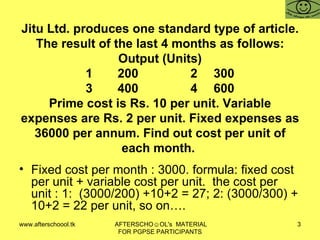
Jitu Ltd. produces one standard type of article. The result of the last 4 months as follows: Output (Units) 1 200  2 300 3 400  4 600 Prime cost is Rs. 10 per unit. Variable expenses are Rs. 2 per unit. Fixed expenses as 36000 per annum. Find out cost per unit of each month.  Fixed cost per month : 3000. formula: fixed cost per unit + variable cost per unit.  the cost per unit : 1:  (3000/200) +10+2 = 27; 2: (3000/300) + 10+2 = 22 per unit, so on….
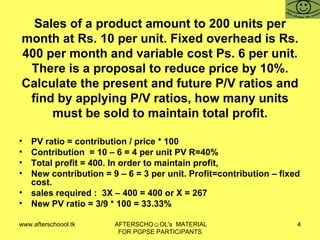
Sales of a product amount to 200 units per month at Rs. 10 per unit. Fixed overhead is Rs. 400 per month and variable cost Ps. 6 per unit. There is a proposal to reduce price by 10%. Calculate the present and future P/V ratios and find by applying P/V ratios, how many units must be sold to maintain total profit. PV ratio = contribution / price * 100 Contribution  = 10 – 6 = 4 per unit PV R=40%  Total profit = 400. In order to maintain profit,  New contribution = 9 – 6 = 3 per unit. Profit=contribution – fixed cost.  sales required :  3X – 400 = 400 or X = 267 New PV ratio = 3/9 * 100 = 33.33%
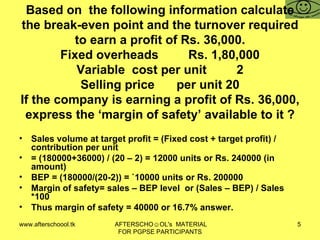
Based on  the following information calculate the break-even point and the turnover required to earn a profit of Rs. 36,000. Fixed overheads Rs. 1,80,000 Variable  cost per unit 2 Selling price per unit 20 If the company is earning a profit of Rs. 36,000, express the ‘margin of safety’ available to it ? Sales volume at target profit = (Fixed cost + target profit) / contribution per unit = (180000+36000) / (20 – 2) = 12000 units or Rs. 240000 (in amount)  BEP = (180000/(20-2)) = `10000 units or Rs. 200000  Margin of safety= sales – BEP level  or (Sales – BEP) / Sales *100 Thus margin of safety = 40000 or 16.7% answer.
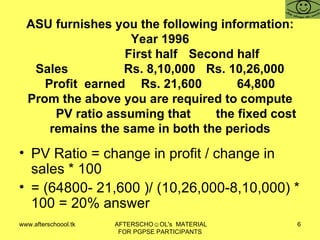
ASU furnishes you the following information: Year 1996 First half Second half Sales   Rs. 8,10,000   Rs. 10,26,000 Profit  earned Rs. 21,600  64,800 Prom the above you are required to compute PV ratio assuming that the fixed cost remains the same in both the periods PV Ratio = change in profit / change in sales * 100 = (64800- 21,600 )/ (10,26,000-8,10,000) * 100 = 20% answer
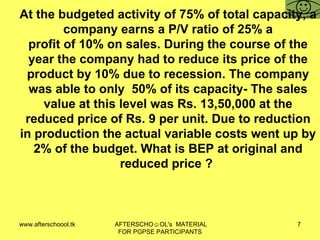
At the budgeted activity of 75% of total capacity, a company earns a P/V ratio of 25% a profit of 10% on sales. During the course of the year the company had to reduce its price of the product by 10% due to recession. The company was able to only  50% of its capacity- The sales value at this level was Rs. 13,50,000 at the reduced price of Rs. 9 per unit. Due to reduction in production the actual variable costs went up by 2% of the budget. What is BEP at original and reduced price ?
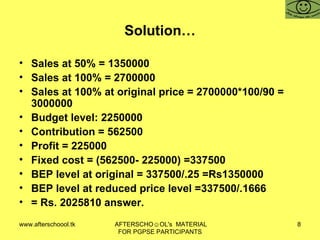
Solution… Sales at 50% = 1350000 Sales at 100% = 2700000 Sales at 100% at original price = 2700000*100/90 = 3000000 Budget level: 2250000  Contribution = 562500 Profit = 225000 Fixed cost = (562500- 225000) =337500 BEP level at original = 337500/.25 =Rs1350000 BEP level at reduced price level =337500/.1666 = Rs. 2025810 answer.
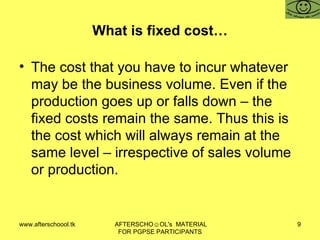
What is fixed cost… The cost that you have to incur whatever may be the business volume. Even if the production goes up or falls down – the fixed costs remain the same. Thus this is the cost which will always remain at the same level – irrespective of sales volume or production.
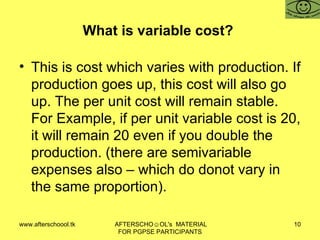
What is variable cost?  This is cost which varies with production. If production goes up, this cost will also go up. The per unit cost will remain stable. For Example, if per unit variable cost is 20, it will remain 20 even if you double the production. (there are semivariable expenses also – which do donot vary in the same proportion).
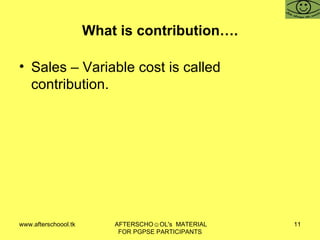
What is contribution…. Sales – Variable cost is called contribution.
How do you calculate BEP?  There are two ways –  BEP in volume (in units) BEP in money terms (in Rupees)
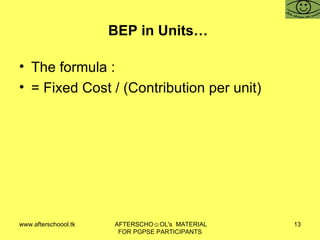
BEP in Units…  The formula :  = Fixed Cost / (Contribution per unit)
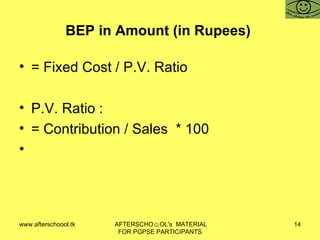
BEP in Amount (in Rupees)  = Fixed Cost / P.V. Ratio P.V. Ratio :  = Contribution / Sales  * 100
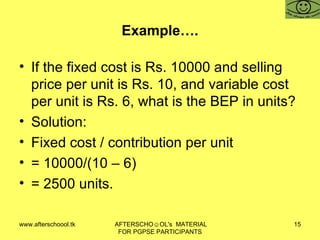
Example…. If the fixed cost is Rs. 10000 and selling price per unit is Rs. 10, and variable cost per unit is Rs. 6, what is the BEP in units?  Solution:  Fixed cost / contribution per unit = 10000/(10 – 6)  = 2500 units.
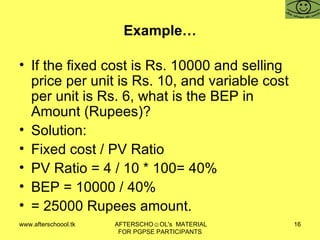
Example… If the fixed cost is Rs. 10000 and selling price per unit is Rs. 10, and variable cost per unit is Rs. 6, what is the BEP in Amount (Rupees)?  Solution:  Fixed cost / PV Ratio PV Ratio = 4 / 10 * 100= 40% BEP = 10000 / 40%  = 25000 Rupees amount.
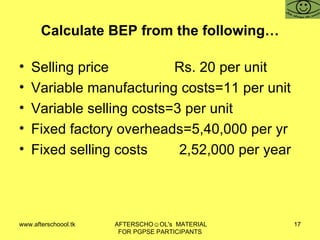
Calculate BEP from the following… Selling price   Rs. 20 per unit Variable manufacturing costs=11 per unit Variable selling costs=3 per unit Fixed factory overheads=5,40,000 per yr Fixed selling costs 2,52,000 per year
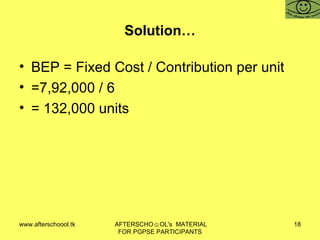
Solution… BEP = Fixed Cost / Contribution per unit =7,92,000 / 6 = 132,000 units
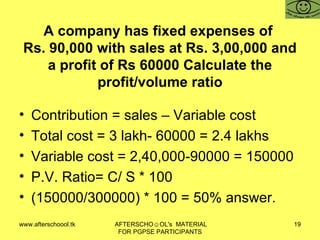
A company has fixed expenses of  Rs. 90,000 with sales at Rs. 3,00,000 and a profit of Rs 60000 Calculate the profit/volume ratio Contribution = sales – Variable cost Total cost = 3 lakh- 60000 = 2.4 lakhs Variable cost = 2,40,000-90000 = 150000 P.V. Ratio= C/ S * 100  (150000/300000) * 100 = 50% answer.
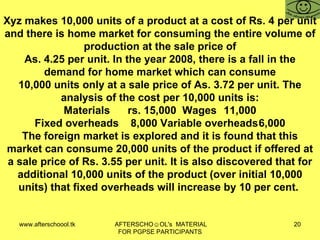
Xyz makes 10,000 units of a product at a cost of Rs. 4 per unit and there is home market for consuming the entire volume of production at the sale price of As. 4.25 per unit. In the year 2008, there is a fall in the demand for home market which can consume 10,000 units only at a sale price of As. 3.72 per unit. The analysis of the cost per 10,000 units is: Materials rs. 15,000  Wages 11,000 Fixed overheads 8,000 Variable overheads 6,000 The foreign market is explored and it is found that this market can consume 20,000 units of the product if offered at a sale price of Rs. 3.55 per unit. It is also discovered that for additional 10,000 units of the product (over initial 10,000 units) that fixed overheads will increase by 10 per cent.
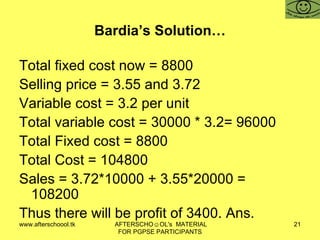
Bardia’s Solution… Total fixed cost now = 8800 Selling price = 3.55 and 3.72 Variable cost = 3.2 per unit  Total variable cost = 30000 * 3.2= 96000 Total Fixed cost = 8800  Total Cost = 104800 Sales = 3.72*10000 + 3.55*20000 =  108200 Thus there will be profit of 3400. Ans.
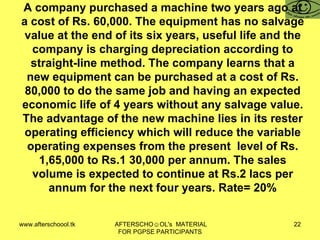
A company purchased a machine two years ago at a cost of Rs. 60,000. The equipment has no salvage value at the end of its six years, useful life and the company is charging depreciation according to straight-line method. The company learns that a new equipment can be purchased at a cost of Rs. 80,000 to do the same job and having an expected economic life of 4 years without any salvage value. The advantage of the new machine lies in its rester operating efficiency which will reduce the variable operating expenses from the present  level of Rs. 1,65,000 to Rs.1 30,000 per annum. The sales volume is expected to continue at Rs.2 lacs per annum for the next four years. Rate= 20%
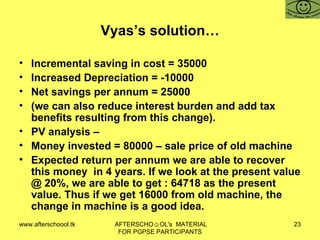
Vyas’s solution… Incremental saving in cost = 35000 Increased Depreciation = -10000 Net savings per annum = 25000 (we can also reduce interest burden and add tax benefits resulting from this change).  PV analysis –  Money invested = 80000 – sale price of old machine  Expected return per annum we are able to recover this money  in 4 years. If we look at the present value @ 20%, we are able to get : 64718 as the present value. Thus if we get 16000 from old machine, the change in machine is a good idea.
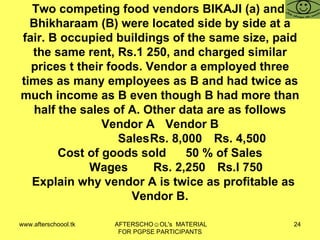
Two competing food vendors BIKAJI (a) and  Bhikharaam (B) were located side by side at a fair. B occupied buildings of the same size, paid the same rent, Rs.1 250, and charged similar prices t their foods. Vendor a employed three times as many employees as B and had twice as much income as B even though B had more than half the sales of A. Other data are as follows Vendor A Vendor B Sales Rs. 8,000 Rs. 4,500 Cost of goods sold 50 % of Sales Wages Rs. 2,250 Rs.l 750   Explain why vendor A is twice as profitable as Vendor B.
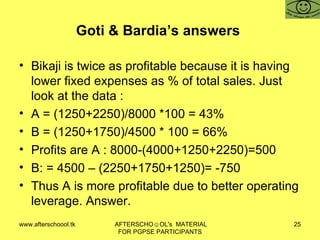
Goti & Bardia’s answers  Bikaji is twice as profitable because it is having lower fixed expenses as % of total sales. Just look at the data :  A = (1250+2250)/8000 *100 = 43% B = (1250+1750)/4500 * 100 = 66% Profits are A : 8000-(4000+1250+2250)=500 B: = 4500 – (2250+1750+1250)= -750 Thus A is more profitable due to better operating leverage. Answer.
About AFTERSCHO☺OL  PGPSE - World’s most comprehensive programme on social entrepreneurship – after class 12 th Flexible – fast changing to meet the requirements  Admission open throughout the year  Complete support from beginning to the end – from idea generation to making the project viable.
Branches of AFTERSCHO☺OL  PGPSE programme is open all over the world as free online programme.  Those who complete PSPSE have the freedom to start branches of AFTERSCHO☺OL  A few branches have already started  - one such branch is at KOTA (Rajasthan).
Workshop on social entrepreneurship  We conduct workshop on social entrepreneurship – all over India and out of India also  - in school, college, club, association or any such place  - just send us a call and we will come to conduct the workshop on social entrepreeurship. These workshops are great moments of learning, sharing, and commitments.
FREE ONLINE PROGRAMME  AFTERSCHO☺OL  is absolutely free programme available online – any person can join it. The programme has four components :  1. case studies – writing and analysing – using latest tools of management 2. articles / reports writing & presentation of them in conferences / seminars 3. Study material / books / ebooks / audio / audio visual material to support the study 4. business plan preparation and presentations of those plans in conferences / seminars
100% placement / entrepreneurship  AFTERSCHO☺OL has the record of 100% placement / entrepreneurship till date Be assured of a bright career – if you join AFTERSCHO☺OL
Pursue professional courses along with PGPSE  AFTERSCHO☺OL permits you to pursue distance education based professional / vocational courses and gives you support for that also. Many students are doing CA / CS/ ICWA / CMA / FRM / CFP / CFA and other courses along with PGPSE.  Come and join AFTERSCHO☺OL

Marginal Costing & Profit Planning

  • 1.
    MARGINAL COSTING &PROFIT PLANNING AFTERSCHO ☺ OL – DEVELOPING CHANGE MAKERS CENTRE FOR SOCIAL ENTREPRENEURSHIP PGPSE PROGRAMME – World’ Most Comprehensive programme in social entrepreneurship & spiritual entrepreneurship OPEN FOR ALL FREE FOR ALL www.afterschoool.tk AFTERSCHO☺OL's MATERIAL FOR PGPSE PARTICIPANTS
  • 2.
    MARGINAL COSTING &PROFIT PLANNING Dr. T.K. Jain. AFTERSCHO ☺ OL Centre for social entrepreneurship Bikaner M: 9414430763 [email_address] www.afterschool.tk , www.afterschoool.tk www.afterschoool.tk AFTERSCHO☺OL's MATERIAL FOR PGPSE PARTICIPANTS
  • 3.
    Jitu Ltd. producesone standard type of article. The result of the last 4 months as follows: Output (Units) 1 200 2 300 3 400 4 600 Prime cost is Rs. 10 per unit. Variable expenses are Rs. 2 per unit. Fixed expenses as 36000 per annum. Find out cost per unit of each month. Fixed cost per month : 3000. formula: fixed cost per unit + variable cost per unit. the cost per unit : 1: (3000/200) +10+2 = 27; 2: (3000/300) + 10+2 = 22 per unit, so on….
  • 4.
    Sales of aproduct amount to 200 units per month at Rs. 10 per unit. Fixed overhead is Rs. 400 per month and variable cost Ps. 6 per unit. There is a proposal to reduce price by 10%. Calculate the present and future P/V ratios and find by applying P/V ratios, how many units must be sold to maintain total profit. PV ratio = contribution / price * 100 Contribution = 10 – 6 = 4 per unit PV R=40% Total profit = 400. In order to maintain profit, New contribution = 9 – 6 = 3 per unit. Profit=contribution – fixed cost. sales required : 3X – 400 = 400 or X = 267 New PV ratio = 3/9 * 100 = 33.33%
  • 5.
    Based on the following information calculate the break-even point and the turnover required to earn a profit of Rs. 36,000. Fixed overheads Rs. 1,80,000 Variable cost per unit 2 Selling price per unit 20 If the company is earning a profit of Rs. 36,000, express the ‘margin of safety’ available to it ? Sales volume at target profit = (Fixed cost + target profit) / contribution per unit = (180000+36000) / (20 – 2) = 12000 units or Rs. 240000 (in amount) BEP = (180000/(20-2)) = `10000 units or Rs. 200000 Margin of safety= sales – BEP level or (Sales – BEP) / Sales *100 Thus margin of safety = 40000 or 16.7% answer.
  • 6.
    ASU furnishes youthe following information: Year 1996 First half Second half Sales Rs. 8,10,000 Rs. 10,26,000 Profit earned Rs. 21,600 64,800 Prom the above you are required to compute PV ratio assuming that the fixed cost remains the same in both the periods PV Ratio = change in profit / change in sales * 100 = (64800- 21,600 )/ (10,26,000-8,10,000) * 100 = 20% answer
  • 7.
    At the budgetedactivity of 75% of total capacity, a company earns a P/V ratio of 25% a profit of 10% on sales. During the course of the year the company had to reduce its price of the product by 10% due to recession. The company was able to only 50% of its capacity- The sales value at this level was Rs. 13,50,000 at the reduced price of Rs. 9 per unit. Due to reduction in production the actual variable costs went up by 2% of the budget. What is BEP at original and reduced price ?
  • 8.
    Solution… Sales at50% = 1350000 Sales at 100% = 2700000 Sales at 100% at original price = 2700000*100/90 = 3000000 Budget level: 2250000 Contribution = 562500 Profit = 225000 Fixed cost = (562500- 225000) =337500 BEP level at original = 337500/.25 =Rs1350000 BEP level at reduced price level =337500/.1666 = Rs. 2025810 answer.
  • 9.
    What is fixedcost… The cost that you have to incur whatever may be the business volume. Even if the production goes up or falls down – the fixed costs remain the same. Thus this is the cost which will always remain at the same level – irrespective of sales volume or production.
  • 10.
    What is variablecost? This is cost which varies with production. If production goes up, this cost will also go up. The per unit cost will remain stable. For Example, if per unit variable cost is 20, it will remain 20 even if you double the production. (there are semivariable expenses also – which do donot vary in the same proportion).
  • 11.
    What is contribution….Sales – Variable cost is called contribution.
  • 12.
    How do youcalculate BEP? There are two ways – BEP in volume (in units) BEP in money terms (in Rupees)
  • 13.
    BEP in Units… The formula : = Fixed Cost / (Contribution per unit)
  • 14.
    BEP in Amount(in Rupees) = Fixed Cost / P.V. Ratio P.V. Ratio : = Contribution / Sales * 100
  • 15.
    Example…. If thefixed cost is Rs. 10000 and selling price per unit is Rs. 10, and variable cost per unit is Rs. 6, what is the BEP in units? Solution: Fixed cost / contribution per unit = 10000/(10 – 6) = 2500 units.
  • 16.
    Example… If thefixed cost is Rs. 10000 and selling price per unit is Rs. 10, and variable cost per unit is Rs. 6, what is the BEP in Amount (Rupees)? Solution: Fixed cost / PV Ratio PV Ratio = 4 / 10 * 100= 40% BEP = 10000 / 40% = 25000 Rupees amount.
  • 17.
    Calculate BEP fromthe following… Selling price Rs. 20 per unit Variable manufacturing costs=11 per unit Variable selling costs=3 per unit Fixed factory overheads=5,40,000 per yr Fixed selling costs 2,52,000 per year
  • 18.
    Solution… BEP =Fixed Cost / Contribution per unit =7,92,000 / 6 = 132,000 units
  • 19.
    A company hasfixed expenses of Rs. 90,000 with sales at Rs. 3,00,000 and a profit of Rs 60000 Calculate the profit/volume ratio Contribution = sales – Variable cost Total cost = 3 lakh- 60000 = 2.4 lakhs Variable cost = 2,40,000-90000 = 150000 P.V. Ratio= C/ S * 100 (150000/300000) * 100 = 50% answer.
  • 20.
    Xyz makes 10,000units of a product at a cost of Rs. 4 per unit and there is home market for consuming the entire volume of production at the sale price of As. 4.25 per unit. In the year 2008, there is a fall in the demand for home market which can consume 10,000 units only at a sale price of As. 3.72 per unit. The analysis of the cost per 10,000 units is: Materials rs. 15,000 Wages 11,000 Fixed overheads 8,000 Variable overheads 6,000 The foreign market is explored and it is found that this market can consume 20,000 units of the product if offered at a sale price of Rs. 3.55 per unit. It is also discovered that for additional 10,000 units of the product (over initial 10,000 units) that fixed overheads will increase by 10 per cent.
  • 21.
    Bardia’s Solution… Totalfixed cost now = 8800 Selling price = 3.55 and 3.72 Variable cost = 3.2 per unit Total variable cost = 30000 * 3.2= 96000 Total Fixed cost = 8800 Total Cost = 104800 Sales = 3.72*10000 + 3.55*20000 = 108200 Thus there will be profit of 3400. Ans.
  • 22.
    A company purchaseda machine two years ago at a cost of Rs. 60,000. The equipment has no salvage value at the end of its six years, useful life and the company is charging depreciation according to straight-line method. The company learns that a new equipment can be purchased at a cost of Rs. 80,000 to do the same job and having an expected economic life of 4 years without any salvage value. The advantage of the new machine lies in its rester operating efficiency which will reduce the variable operating expenses from the present level of Rs. 1,65,000 to Rs.1 30,000 per annum. The sales volume is expected to continue at Rs.2 lacs per annum for the next four years. Rate= 20%
  • 23.
    Vyas’s solution… Incrementalsaving in cost = 35000 Increased Depreciation = -10000 Net savings per annum = 25000 (we can also reduce interest burden and add tax benefits resulting from this change). PV analysis – Money invested = 80000 – sale price of old machine Expected return per annum we are able to recover this money in 4 years. If we look at the present value @ 20%, we are able to get : 64718 as the present value. Thus if we get 16000 from old machine, the change in machine is a good idea.
  • 24.
    Two competing foodvendors BIKAJI (a) and Bhikharaam (B) were located side by side at a fair. B occupied buildings of the same size, paid the same rent, Rs.1 250, and charged similar prices t their foods. Vendor a employed three times as many employees as B and had twice as much income as B even though B had more than half the sales of A. Other data are as follows Vendor A Vendor B Sales Rs. 8,000 Rs. 4,500 Cost of goods sold 50 % of Sales Wages Rs. 2,250 Rs.l 750 Explain why vendor A is twice as profitable as Vendor B.
  • 25.
    Goti & Bardia’sanswers Bikaji is twice as profitable because it is having lower fixed expenses as % of total sales. Just look at the data : A = (1250+2250)/8000 *100 = 43% B = (1250+1750)/4500 * 100 = 66% Profits are A : 8000-(4000+1250+2250)=500 B: = 4500 – (2250+1750+1250)= -750 Thus A is more profitable due to better operating leverage. Answer.
  • 26.
    About AFTERSCHO☺OL PGPSE - World’s most comprehensive programme on social entrepreneurship – after class 12 th Flexible – fast changing to meet the requirements Admission open throughout the year Complete support from beginning to the end – from idea generation to making the project viable.
  • 27.
    Branches of AFTERSCHO☺OL PGPSE programme is open all over the world as free online programme. Those who complete PSPSE have the freedom to start branches of AFTERSCHO☺OL A few branches have already started - one such branch is at KOTA (Rajasthan).
  • 28.
    Workshop on socialentrepreneurship We conduct workshop on social entrepreneurship – all over India and out of India also - in school, college, club, association or any such place - just send us a call and we will come to conduct the workshop on social entrepreeurship. These workshops are great moments of learning, sharing, and commitments.
  • 29.
    FREE ONLINE PROGRAMME AFTERSCHO☺OL is absolutely free programme available online – any person can join it. The programme has four components : 1. case studies – writing and analysing – using latest tools of management 2. articles / reports writing & presentation of them in conferences / seminars 3. Study material / books / ebooks / audio / audio visual material to support the study 4. business plan preparation and presentations of those plans in conferences / seminars
  • 30.
    100% placement /entrepreneurship AFTERSCHO☺OL has the record of 100% placement / entrepreneurship till date Be assured of a bright career – if you join AFTERSCHO☺OL
  • 31.
    Pursue professional coursesalong with PGPSE AFTERSCHO☺OL permits you to pursue distance education based professional / vocational courses and gives you support for that also. Many students are doing CA / CS/ ICWA / CMA / FRM / CFP / CFA and other courses along with PGPSE. Come and join AFTERSCHO☺OL