Relevant Techniques for
Decision Making
Dr.R.VASANTHAGOPAL
January 15, 2016 Dr.R.Vasanthagopal University of Kerala 2
Marginal Costing
 Marginal costing is a technique of costing largely employed for
cost control
 Marginal costing is defined as the ascertainment of marginal cost
and effect of changes in volume or type of out put on the
company’s profit, by segregating total costs into variable and
fixed costs (CIMA)
 Marginal cost is the additional cost of producing an additional
unit of a product.
 Marginal cost is the amount to any given volume of output by
which aggregate costs are changed if the volume of output is
increased or decreased by one unit (ICMA).
January 15, 2016 Dr.R.Vasanthagopal University of Kerala 3
Features of Marginal Costing
 Marginal costing is a technique of control or decision
making.
 Under marginal costing the total cost is classified as
fixed and variable cost.
 Fixed costs are treated as period cost and charged
to profit and loss a/c for the period for which they are
incurred.
 The variable costs are regarded as the costs of the
products.
 The stock of finished goods and work-in-progress
are valued at marginal costs only.
 Prices are determined on the basis of marginal cost.
January 15, 2016 Dr.R.Vasanthagopal University of Kerala 4
Assumptions of Marginal Costing
 All costs can be classified into two categories – Fixed and
Variable
 Fixed costs remain constant at all levels of activity
 Variable costs vary in total, but remain constant per unit
 Level of efficiency of operations is uniform
 Product risk remains unaltered, unless specified otherwise.
 Selling price remains constant at different levels of activity.
January 15, 2016 Dr.R.Vasanthagopal University of Kerala 5
Advantages of Marginal Costing
 Simplicity
 Stock valuation
 Meaningful reporting
 Fixation of selling price
 Profit planning
 Cost control and cost reduction
 Pricing policy
 Helpful to management
 Production Planning
 Make or Buy Decisions
January 15, 2016 Dr.R.Vasanthagopal University of Kerala 6
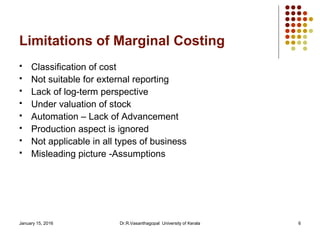
Limitations of Marginal Costing
 Classification of cost
 Not suitable for external reporting
 Lack of log-term perspective
 Under valuation of stock
 Automation – Lack of Advancement
 Production aspect is ignored
 Not applicable in all types of business
 Misleading picture -Assumptions
January 15, 2016 Dr.R.Vasanthagopal University of Kerala 7
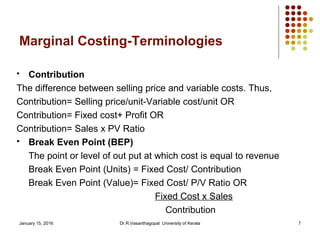
Marginal Costing-Terminologies
 Contribution
The difference between selling price and variable costs. Thus,
Contribution= Selling price/unit-Variable cost/unit OR
Contribution= Fixed cost+ Profit OR
Contribution= Sales x PV Ratio
 Break Even Point (BEP)
The point or level of out put at which cost is equal to revenue
Break Even Point (Units) = Fixed Cost/ Contribution
Break Even Point (Value)= Fixed Cost/ P/V Ratio OR
Fixed Cost x Sales
Contribution
January 15, 2016 Dr.R.Vasanthagopal University of Kerala 8
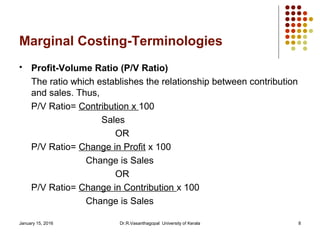
Marginal Costing-Terminologies
 Profit-Volume Ratio (P/V Ratio)
The ratio which establishes the relationship between contribution
and sales. Thus,
P/V Ratio= Contribution x 100
Sales
OR
P/V Ratio= Change in Profit x 100
Change is Sales
OR
P/V Ratio= Change in Contribution x 100
Change is Sales
January 15, 2016 Dr.R.Vasanthagopal University of Kerala 9
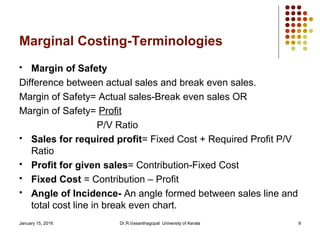
Marginal Costing-Terminologies
 Margin of Safety
Difference between actual sales and break even sales.
Margin of Safety= Actual sales-Break even sales OR
Margin of Safety= Profit
P/V Ratio
 Sales for required profit= Fixed Cost + Required Profit P/V
Ratio
 Profit for given sales= Contribution-Fixed Cost
 Fixed Cost = Contribution – Profit
 Angle of Incidence- An angle formed between sales line and
total cost line in break even chart.
January 15, 2016 Dr.R.Vasanthagopal University of Kerala 10
Marginal Costing-Terminologies
Cost-Volume-Profit (C-V-P) Analysis
 CVP is a management accounting tool that expresses
relationship among sale volume, cost and profit.
 CVP can be used in the form of a graph (break even chart) or an
equation.
 CVP Analysis is also called Break-even analysis
 Break-even analysis is used in two ways- Narrow sense and
broader sense
 In narrow sense break-even analysis is the determination of
break-even point
 In broader sense break-even analysis refers to the analysis of
impact of costs, price and volume on profit
cont’d
January 15, 2016 Dr.R.Vasanthagopal University of Kerala 11
Marginal Costing-Terminologies
 CVP analysis can answer a number of analytical
questions.
 Some of the questions are as follows:
 What is the breakeven revenue of an organization?
 How much revenue does an organization need to achieve a
budgeted profit?
 What level of price change affects the achievement of budgeted
profit?
 What is the effect of cost changes on the profitability of an
operation?
 Cost-volume-profit analysis can also answer many other “what if”
type of questions.

Marginal Costing for Decision Making Techniques

  • 1.
    Relevant Techniques for DecisionMaking Dr.R.VASANTHAGOPAL
  • 2.
    January 15, 2016Dr.R.Vasanthagopal University of Kerala 2 Marginal Costing  Marginal costing is a technique of costing largely employed for cost control  Marginal costing is defined as the ascertainment of marginal cost and effect of changes in volume or type of out put on the company’s profit, by segregating total costs into variable and fixed costs (CIMA)  Marginal cost is the additional cost of producing an additional unit of a product.  Marginal cost is the amount to any given volume of output by which aggregate costs are changed if the volume of output is increased or decreased by one unit (ICMA).
  • 3.
    January 15, 2016Dr.R.Vasanthagopal University of Kerala 3 Features of Marginal Costing  Marginal costing is a technique of control or decision making.  Under marginal costing the total cost is classified as fixed and variable cost.  Fixed costs are treated as period cost and charged to profit and loss a/c for the period for which they are incurred.  The variable costs are regarded as the costs of the products.  The stock of finished goods and work-in-progress are valued at marginal costs only.  Prices are determined on the basis of marginal cost.
  • 4.
    January 15, 2016Dr.R.Vasanthagopal University of Kerala 4 Assumptions of Marginal Costing  All costs can be classified into two categories – Fixed and Variable  Fixed costs remain constant at all levels of activity  Variable costs vary in total, but remain constant per unit  Level of efficiency of operations is uniform  Product risk remains unaltered, unless specified otherwise.  Selling price remains constant at different levels of activity.
  • 5.
    January 15, 2016Dr.R.Vasanthagopal University of Kerala 5 Advantages of Marginal Costing  Simplicity  Stock valuation  Meaningful reporting  Fixation of selling price  Profit planning  Cost control and cost reduction  Pricing policy  Helpful to management  Production Planning  Make or Buy Decisions
  • 6.
    January 15, 2016Dr.R.Vasanthagopal University of Kerala 6 Limitations of Marginal Costing  Classification of cost  Not suitable for external reporting  Lack of log-term perspective  Under valuation of stock  Automation – Lack of Advancement  Production aspect is ignored  Not applicable in all types of business  Misleading picture -Assumptions
  • 7.
    January 15, 2016Dr.R.Vasanthagopal University of Kerala 7 Marginal Costing-Terminologies  Contribution The difference between selling price and variable costs. Thus, Contribution= Selling price/unit-Variable cost/unit OR Contribution= Fixed cost+ Profit OR Contribution= Sales x PV Ratio  Break Even Point (BEP) The point or level of out put at which cost is equal to revenue Break Even Point (Units) = Fixed Cost/ Contribution Break Even Point (Value)= Fixed Cost/ P/V Ratio OR Fixed Cost x Sales Contribution
  • 8.
    January 15, 2016Dr.R.Vasanthagopal University of Kerala 8 Marginal Costing-Terminologies  Profit-Volume Ratio (P/V Ratio) The ratio which establishes the relationship between contribution and sales. Thus, P/V Ratio= Contribution x 100 Sales OR P/V Ratio= Change in Profit x 100 Change is Sales OR P/V Ratio= Change in Contribution x 100 Change is Sales
  • 9.
    January 15, 2016Dr.R.Vasanthagopal University of Kerala 9 Marginal Costing-Terminologies  Margin of Safety Difference between actual sales and break even sales. Margin of Safety= Actual sales-Break even sales OR Margin of Safety= Profit P/V Ratio  Sales for required profit= Fixed Cost + Required Profit P/V Ratio  Profit for given sales= Contribution-Fixed Cost  Fixed Cost = Contribution – Profit  Angle of Incidence- An angle formed between sales line and total cost line in break even chart.
  • 10.
    January 15, 2016Dr.R.Vasanthagopal University of Kerala 10 Marginal Costing-Terminologies Cost-Volume-Profit (C-V-P) Analysis  CVP is a management accounting tool that expresses relationship among sale volume, cost and profit.  CVP can be used in the form of a graph (break even chart) or an equation.  CVP Analysis is also called Break-even analysis  Break-even analysis is used in two ways- Narrow sense and broader sense  In narrow sense break-even analysis is the determination of break-even point  In broader sense break-even analysis refers to the analysis of impact of costs, price and volume on profit cont’d
  • 11.
    January 15, 2016Dr.R.Vasanthagopal University of Kerala 11 Marginal Costing-Terminologies  CVP analysis can answer a number of analytical questions.  Some of the questions are as follows:  What is the breakeven revenue of an organization?  How much revenue does an organization need to achieve a budgeted profit?  What level of price change affects the achievement of budgeted profit?  What is the effect of cost changes on the profitability of an operation?  Cost-volume-profit analysis can also answer many other “what if” type of questions.