Nature of Working Capital
 Working capital management is concerned with the problems
  that arise in attempting to manage the current assets, the current
  liabilities and the interrelations that exist between them.
 Current assets refer to those assets which in the ordinary course
  of business can be, or will be, converted into cash within one
  year without undergoing a diminution in value and without
  disrupting the operations of the firm.
  Examples- cash, marketable securities, accounts receivable and
  inventory.
 Current liabilities are those liabilities which are intended, at
  their inception, to be paid in the ordinary course of business,
  within a year, out of the current assets or the earnings of the
  concern.
  Examples- accounts payable, bills payable, bank overdraft and
  outstanding expenses.
Objective of Working Capital
              Management
 The goal of working capital management is to manage
  the firm’s current assets and liabilities in such a way
  that a satisfactory level of working capital is
  maintained.
 The interaction between current assets and current
  liabilities is, therefore the main theme of the theory of
  the working capital management.
Concepts and Definitions of Working
              Capital
 There are two concepts of working capital:
  Gross and Net.
 Gross working capital- means the total current
  assets.
 Net working capital- can be defined in two ways-
o The difference between current assets and current
  liabilities.
o The portion of current assets which is financed
  with long term funds.
Determining Financing-mix
 There are two sources from which funds can be raised
  for current assets financing-
o Short term sources, like current liabilities and,
o long term sources, such as share capital, long term
  borrowings, internally generated resources like
  retained earnings, etc.
The Operating-cycle and Working
              Capital Needs
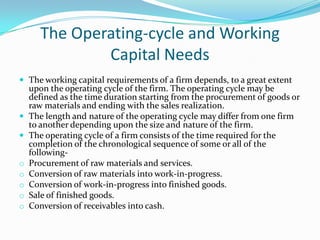
 The working capital requirements of a firm depends, to a great extent
    upon the operating cycle of the firm. The operating cycle may be
    defined as the time duration starting from the procurement of goods or
    raw materials and ending with the sales realization.
   The length and nature of the operating cycle may differ from one firm
    to another depending upon the size and nature of the firm.
   The operating cycle of a firm consists of the time required for the
    completion of the chronological sequence of some or all of the
    following-
o   Procurement of raw materials and services.
o   Conversion of raw materials into work-in-progress.
o   Conversion of work-in-progress into finished goods.
o   Sale of finished goods.
o   Conversion of receivables into cash.
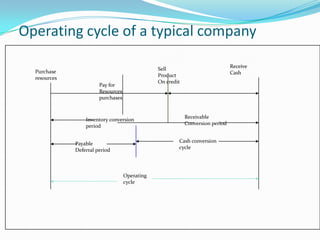
Operating cycle of a typical company

                                                                                Receive
                                                Sell
  Purchase                                                                      Cash
                                                Product
  resources
                                                On credit
                        Pay for
                        Resources
                        purchases


                                                            Receivable
                  Inventory conversion
                                                            Conversion period
                  period

                                                        Cash conversion
              Payable
                                                        cycle
              Deferral period


                                    Operating
                                    cycle
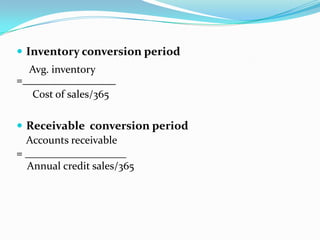
 Inventory conversion period
   Avg. inventory
= _________________
   Cost of sales/365

 Receivable conversion period
  Accounts receivable
= ___________________
  Annual credit sales/365
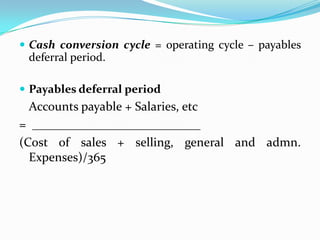
 Cash conversion cycle = operating cycle – payables
 deferral period.

 Payables deferral period
  Accounts payable + Salaries, etc
= ___________________________
(Cost of sales + selling, general and admn.
  Expenses)/365
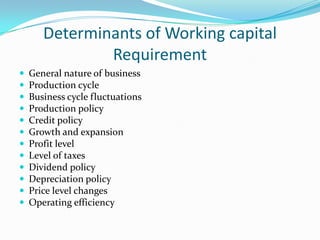
Determinants of Working capital
               Requirement
   General nature of business
   Production cycle
   Business cycle fluctuations
   Production policy
   Credit policy
   Growth and expansion
   Profit level
   Level of taxes
   Dividend policy
   Depreciation policy
   Price level changes
   Operating efficiency
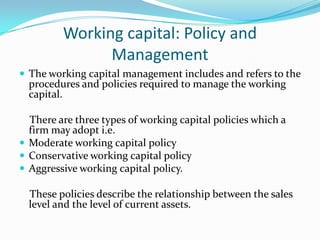
Working capital: Policy and
               Management
 The working capital management includes and refers to the
  procedures and policies required to manage the working
  capital.

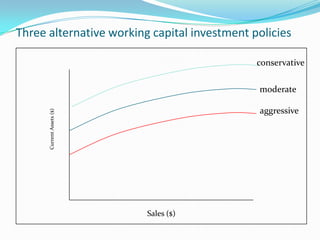
  There are three types of working capital policies which a
  firm may adopt i.e.
 Moderate working capital policy
 Conservative working capital policy
 Aggressive working capital policy.

  These policies describe the relationship between the sales
  level and the level of current assets.
Three alternative working capital investment policies

                                              conservative

                                              moderate

                                              aggressive
      Current Assets ($)


                           Sales ($)
Liquidity versus Profitability- A Risk-
            Return Trade-off
 An important aspect of a working capital policy is to
 maintain and provide sufficient liquidity to the firm.
 The decision on how much working capital be
 maintained involves a trade-off i.e., having a large net
 working capital may reduce the liquidity-risk faced by
 the firm, but it can have a negative effect on the cash
 flows. Therefore, the net effect on the value of the firm
 should be used to determine the optimal amount of
 working capital.
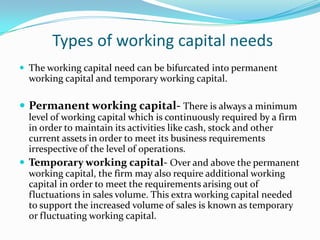
Types of working capital needs
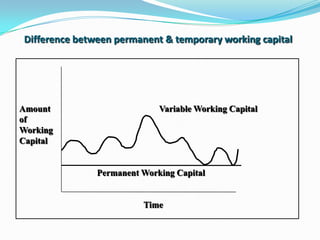
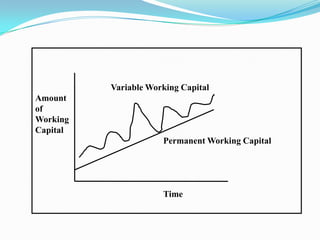
 The working capital need can be bifurcated into permanent
  working capital and temporary working capital.

 Permanent working capital- There is always a minimum
  level of working capital which is continuously required by a firm
  in order to maintain its activities like cash, stock and other
  current assets in order to meet its business requirements
  irrespective of the level of operations.
 Temporary working capital- Over and above the permanent
  working capital, the firm may also require additional working
  capital in order to meet the requirements arising out of
  fluctuations in sales volume. This extra working capital needed
  to support the increased volume of sales is known as temporary
  or fluctuating working capital.
Difference between permanent & temporary working capital


Amount                       Variable Working Capital
of
Working
Capital


               Permanent Working Capital


                         Time
Variable Working Capital
Amount
of
Working
Capital
                      Permanent Working Capital


                      Time
Approaches to determine an
        appropriate Financing-mix
 There are three basic approaches to determine an
 appropriate financing mix:

• Hedging approach, also called the matching approach,
• Conservative approach,
• Aggressive approach.
Hedging Approach/ Matching Approach
• According to this approach, the maturity of the sources of the
    funds should match the nature of the assets to be financed. For
    the purpose of analysis, the current assets can be broadly
    classified into two classes-
o   those which are required in a certain amount for a given level of
    operation and, hence, do not vary over time.
o   those which fluctuate over time.
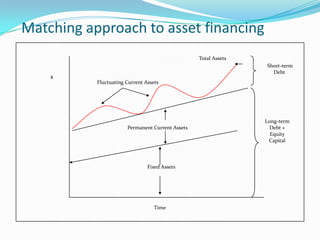
•    The Hedging approach suggests that long term funds should be
    used to finance the fixed portion of current assets requirements
    in a manner similar to the financing of fixed assets.
•   The purely temporary requirements, that is, the seasonal
    variations over and above the permanent financing needs should
    be appropriately financed with short term funds.
•   This approach, therefore, divides the requirements of total funds
    into permanent and seasonal components, each being financed
    by a different source.
Matching approach to asset financing
                                                  Total Assets
                                                                 Short-term
                                                                   Debt
    $
           Fluctuating Current Assets


                                                                 Long-term
                       Permanent Current Assets                    Debt +
                                                                   Equity
                                                                  Capital


                                Fixed Assets


                                   Time
Conservative Approach
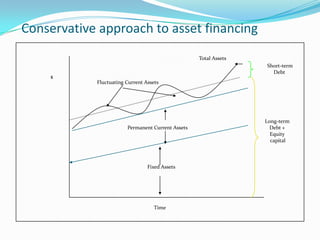
 This approach suggests that the estimated
 requirement of total funds should be met from long
 term sources; the use of short term funds should be
 restricted to only emergency situations or when there
 is an unexpected outflow of funds.
Conservative approach to asset financing
                                                   Total Assets
                                                                  Short-term
                                                                    Debt
    $
            Fluctuating Current Assets


                                                                  Long-term
                        Permanent Current Assets                    Debt +
                                                                    Equity
                                                                    capital


                                 Fixed Assets


                                    Time
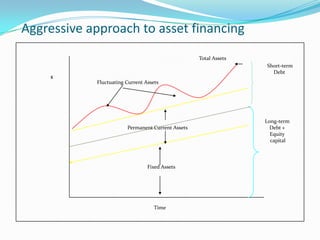
Aggressive approach
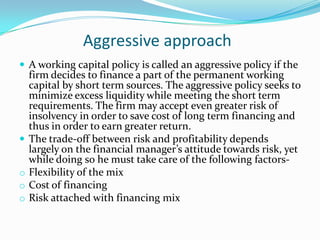
 A working capital policy is called an aggressive policy if the
    firm decides to finance a part of the permanent working
    capital by short term sources. The aggressive policy seeks to
    minimize excess liquidity while meeting the short term
    requirements. The firm may accept even greater risk of
    insolvency in order to save cost of long term financing and
    thus in order to earn greater return.
   The trade-off between risk and profitability depends
    largely on the financial manager’s attitude towards risk, yet
    while doing so he must take care of the following factors-
o   Flexibility of the mix
o   Cost of financing
o   Risk attached with financing mix
Aggressive approach to asset financing
                                                   Total Assets
                                                                  Short-term
                                                                    Debt
    $
            Fluctuating Current Assets


                                                                  Long-term
                        Permanent Current Assets                    Debt +
                                                                    Equity
                                                                    capital


                                 Fixed Assets


                                    Time
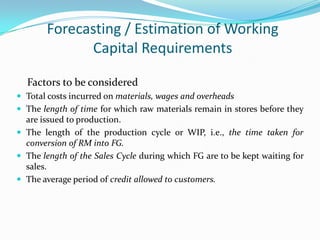
Forecasting / Estimation of Working
              Capital Requirements

  Factors to be considered
 Total costs incurred on materials, wages and overheads
 The length of time for which raw materials remain in stores before they
  are issued to production.
 The length of the production cycle or WIP, i.e., the time taken for
  conversion of RM into FG.
 The length of the Sales Cycle during which FG are to be kept waiting for
  sales.
 The average period of credit allowed to customers.
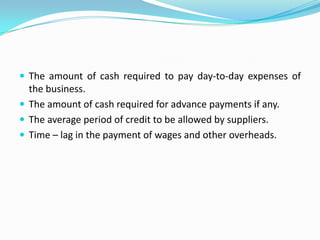
 The amount of cash required to pay day-to-day expenses of
  the business.
 The amount of cash required for advance payments if any.
 The average period of credit to be allowed by suppliers.
 Time – lag in the payment of wages and other overheads.
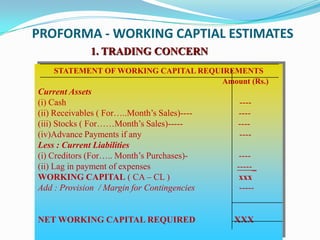
PROFORMA - WORKING CAPTIAL ESTIMATES
              1. TRADING CONCERN
    STATEMENT OF WORKING CAPITAL REQUIREMENTS
                                     Amount (Rs.)
Current Assets
(i) Cash                                      ----
(ii) Receivables ( For…..Month’s Sales)----   ----
(iii) Stocks ( For……Month’s Sales)-----       ----
(iv)Advance Payments if any                   ----
Less : Current Liabilities
(i) Creditors (For….. Month’s Purchases)-      ----
(ii) Lag in payment of expenses               -----_
WORKING CAPITAL ( CA – CL )                    xxx
Add : Provision / Margin for Contingencies     -----


NET WORKING CAPITAL REQUIRED                  XXX
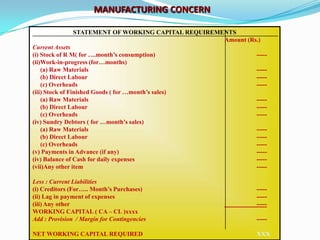
MANUFACTURING CONCERN

               STATEMENT OF WORKING CAPITAL REQUIREMENTS
                                                     Amount (Rs.)
Current Assets
(i) Stock of R M( for ….month’s consumption)                   -----
(ii)Work-in-progress (for…months)
    (a) Raw Materials                                          -----
    (b) Direct Labour                                          -----
    (c) Overheads                                              -----
(iii) Stock of Finished Goods ( for …month’s sales)
    (a) Raw Materials                                          -----
    (b) Direct Labour                                          -----
    (c) Overheads                                              -----
(iv) Sundry Debtors ( for …month’s sales)
    (a) Raw Materials                                          -----
    (b) Direct Labour                                          -----
    (c) Overheads                                              -----
(v) Payments in Advance (if any)                               -----
(iv) Balance of Cash for daily expenses                        -----
(vii)Any other item                                            -----

Less : Current Liabilities
(i) Creditors (For….. Month’s Purchases)                       -----
(ii) Lag in payment of expenses                                -----
(iii) Any other                                                -----
WORKING CAPITAL ( CA – CL )xxxx
Add : Provision / Margin for Contingencies                     -----

NET WORKING CAPITAL REQUIRED                                   XXX
Trends in Working Capital Management and its impact
on Firms’ Performance: An Analysis of Mauritian Small
Manufacturing Firms

Kessseven Padachi (2006)
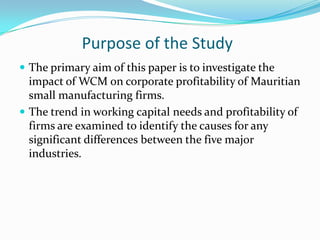
Purpose of the Study
 The primary aim of this paper is to investigate the
  impact of WCM on corporate profitability of Mauritian
  small manufacturing firms.
 The trend in working capital needs and profitability of
  firms are examined to identify the causes for any
  significant differences between the five major
  industries.
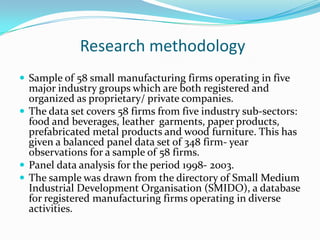
Research methodology
 Sample of 58 small manufacturing firms operating in five
  major industry groups which are both registered and
  organized as proprietary/ private companies.
 The data set covers 58 firms from five industry sub-sectors:
  food and beverages, leather garments, paper products,
  prefabricated metal products and wood furniture. This has
  given a balanced panel data set of 348 firm- year
  observations for a sample of 58 firms.
 Panel data analysis for the period 1998- 2003.
 The sample was drawn from the directory of Small Medium
  Industrial Development Organisation (SMIDO), a database
  for registered manufacturing firms operating in diverse
  activities.
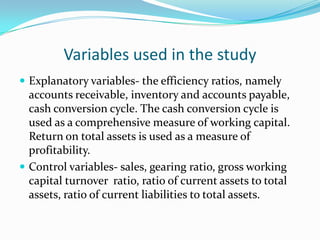
Variables used in the study
 Explanatory variables- the efficiency ratios, namely
  accounts receivable, inventory and accounts payable,
  cash conversion cycle. The cash conversion cycle is
  used as a comprehensive measure of working capital.
  Return on total assets is used as a measure of
  profitability.
 Control variables- sales, gearing ratio, gross working
  capital turnover ratio, ratio of current assets to total
  assets, ratio of current liabilities to total assets.
Notations used in the study
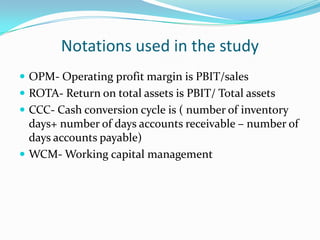
 OPM- Operating profit margin is PBIT/sales
 ROTA- Return on total assets is PBIT/ Total assets
 CCC- Cash conversion cycle is ( number of inventory
  days+ number of days accounts receivable – number of
  days accounts payable)
 WCM- Working capital management
Empirical results
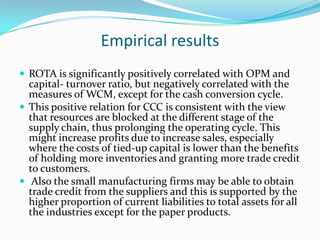
 ROTA is significantly positively correlated with OPM and
  capital- turnover ratio, but negatively correlated with the
  measures of WCM, except for the cash conversion cycle.
 This positive relation for CCC is consistent with the view
  that resources are blocked at the different stage of the
  supply chain, thus prolonging the operating cycle. This
  might increase profits due to increase sales, especially
  where the costs of tied-up capital is lower than the benefits
  of holding more inventories and granting more trade credit
  to customers.
 Also the small manufacturing firms may be able to obtain
  trade credit from the suppliers and this is supported by the
  higher proportion of current liabilities to total assets for all
  the industries except for the paper products.
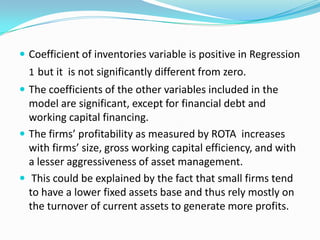
 Coefficient of inventories variable is positive in Regression
  1 but it is not significantly different from zero.
 The coefficients of the other variables included in the
  model are significant, except for financial debt and
  working capital financing.
 The firms’ profitability as measured by ROTA increases
  with firms’ size, gross working capital efficiency, and with
  a lesser aggressiveness of asset management.
 This could be explained by the fact that small firms tend
  to have a lower fixed assets base and thus rely mostly on
  the turnover of current assets to generate more profits.
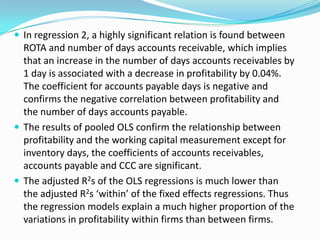
 In regression 2, a highly significant relation is found between
  ROTA and number of days accounts receivable, which implies
  that an increase in the number of days accounts receivables by
  1 day is associated with a decrease in profitability by 0.04%.
  The coefficient for accounts payable days is negative and
  confirms the negative correlation between profitability and
  the number of days accounts payable.
 The results of pooled OLS confirm the relationship between
  profitability and the working capital measurement except for
  inventory days, the coefficients of accounts receivables,
  accounts payable and CCC are significant.
 The adjusted R2s of the OLS regressions is much lower than
  the adjusted R2s ‘within’ of the fixed effects regressions. Thus
  the regression models explain a much higher proportion of the
  variations in profitability within firms than between firms.
Conclusions
 The small firms should ensure a good synchronization of its
  assets and liabilities.
 The paper and printing industry has been able to achieve high
  scores on the various components of working capital and this has
  positive impact on its profitability. On this premise this industry
  could thus be used as best practice among the SMEs.
 Further, this research concludes that there is a pressing need for
  further empirical studies to be undertaken on small business
  financial management, in particular their working capital
  practices by extending the sample size so that an industry- wise
  analysis can help to uncover the factors that explain the better
  performance for some industries and how these best practices
  could be extended to the other industries.

Working capital management

  • 2.
    Nature of WorkingCapital  Working capital management is concerned with the problems that arise in attempting to manage the current assets, the current liabilities and the interrelations that exist between them.  Current assets refer to those assets which in the ordinary course of business can be, or will be, converted into cash within one year without undergoing a diminution in value and without disrupting the operations of the firm. Examples- cash, marketable securities, accounts receivable and inventory.  Current liabilities are those liabilities which are intended, at their inception, to be paid in the ordinary course of business, within a year, out of the current assets or the earnings of the concern. Examples- accounts payable, bills payable, bank overdraft and outstanding expenses.
  • 3.
    Objective of WorkingCapital Management  The goal of working capital management is to manage the firm’s current assets and liabilities in such a way that a satisfactory level of working capital is maintained.  The interaction between current assets and current liabilities is, therefore the main theme of the theory of the working capital management.
  • 4.
    Concepts and Definitionsof Working Capital There are two concepts of working capital: Gross and Net.  Gross working capital- means the total current assets.  Net working capital- can be defined in two ways- o The difference between current assets and current liabilities. o The portion of current assets which is financed with long term funds.
  • 5.
    Determining Financing-mix  Thereare two sources from which funds can be raised for current assets financing- o Short term sources, like current liabilities and, o long term sources, such as share capital, long term borrowings, internally generated resources like retained earnings, etc.
  • 6.
    The Operating-cycle andWorking Capital Needs  The working capital requirements of a firm depends, to a great extent upon the operating cycle of the firm. The operating cycle may be defined as the time duration starting from the procurement of goods or raw materials and ending with the sales realization.  The length and nature of the operating cycle may differ from one firm to another depending upon the size and nature of the firm.  The operating cycle of a firm consists of the time required for the completion of the chronological sequence of some or all of the following- o Procurement of raw materials and services. o Conversion of raw materials into work-in-progress. o Conversion of work-in-progress into finished goods. o Sale of finished goods. o Conversion of receivables into cash.
  • 7.
    Operating cycle ofa typical company Receive Sell Purchase Cash Product resources On credit Pay for Resources purchases Receivable Inventory conversion Conversion period period Cash conversion Payable cycle Deferral period Operating cycle
  • 8.
     Inventory conversionperiod Avg. inventory = _________________ Cost of sales/365  Receivable conversion period Accounts receivable = ___________________ Annual credit sales/365
  • 9.
     Cash conversioncycle = operating cycle – payables deferral period.  Payables deferral period Accounts payable + Salaries, etc = ___________________________ (Cost of sales + selling, general and admn. Expenses)/365
  • 10.
    Determinants of Workingcapital Requirement  General nature of business  Production cycle  Business cycle fluctuations  Production policy  Credit policy  Growth and expansion  Profit level  Level of taxes  Dividend policy  Depreciation policy  Price level changes  Operating efficiency
  • 11.
    Working capital: Policyand Management  The working capital management includes and refers to the procedures and policies required to manage the working capital. There are three types of working capital policies which a firm may adopt i.e.  Moderate working capital policy  Conservative working capital policy  Aggressive working capital policy. These policies describe the relationship between the sales level and the level of current assets.
  • 12.
    Three alternative workingcapital investment policies conservative moderate aggressive Current Assets ($) Sales ($)
  • 13.
    Liquidity versus Profitability-A Risk- Return Trade-off  An important aspect of a working capital policy is to maintain and provide sufficient liquidity to the firm. The decision on how much working capital be maintained involves a trade-off i.e., having a large net working capital may reduce the liquidity-risk faced by the firm, but it can have a negative effect on the cash flows. Therefore, the net effect on the value of the firm should be used to determine the optimal amount of working capital.
  • 14.
    Types of workingcapital needs  The working capital need can be bifurcated into permanent working capital and temporary working capital.  Permanent working capital- There is always a minimum level of working capital which is continuously required by a firm in order to maintain its activities like cash, stock and other current assets in order to meet its business requirements irrespective of the level of operations.  Temporary working capital- Over and above the permanent working capital, the firm may also require additional working capital in order to meet the requirements arising out of fluctuations in sales volume. This extra working capital needed to support the increased volume of sales is known as temporary or fluctuating working capital.
  • 15.
    Difference between permanent& temporary working capital Amount Variable Working Capital of Working Capital Permanent Working Capital Time
  • 16.
  • 17.
    Approaches to determinean appropriate Financing-mix There are three basic approaches to determine an appropriate financing mix: • Hedging approach, also called the matching approach, • Conservative approach, • Aggressive approach.
  • 18.
    Hedging Approach/ MatchingApproach • According to this approach, the maturity of the sources of the funds should match the nature of the assets to be financed. For the purpose of analysis, the current assets can be broadly classified into two classes- o those which are required in a certain amount for a given level of operation and, hence, do not vary over time. o those which fluctuate over time. • The Hedging approach suggests that long term funds should be used to finance the fixed portion of current assets requirements in a manner similar to the financing of fixed assets. • The purely temporary requirements, that is, the seasonal variations over and above the permanent financing needs should be appropriately financed with short term funds. • This approach, therefore, divides the requirements of total funds into permanent and seasonal components, each being financed by a different source.
  • 19.
    Matching approach toasset financing Total Assets Short-term Debt $ Fluctuating Current Assets Long-term Permanent Current Assets Debt + Equity Capital Fixed Assets Time
  • 20.
    Conservative Approach  Thisapproach suggests that the estimated requirement of total funds should be met from long term sources; the use of short term funds should be restricted to only emergency situations or when there is an unexpected outflow of funds.
  • 21.
    Conservative approach toasset financing Total Assets Short-term Debt $ Fluctuating Current Assets Long-term Permanent Current Assets Debt + Equity capital Fixed Assets Time
  • 22.
    Aggressive approach  Aworking capital policy is called an aggressive policy if the firm decides to finance a part of the permanent working capital by short term sources. The aggressive policy seeks to minimize excess liquidity while meeting the short term requirements. The firm may accept even greater risk of insolvency in order to save cost of long term financing and thus in order to earn greater return.  The trade-off between risk and profitability depends largely on the financial manager’s attitude towards risk, yet while doing so he must take care of the following factors- o Flexibility of the mix o Cost of financing o Risk attached with financing mix
  • 23.
    Aggressive approach toasset financing Total Assets Short-term Debt $ Fluctuating Current Assets Long-term Permanent Current Assets Debt + Equity capital Fixed Assets Time
  • 24.
    Forecasting / Estimationof Working Capital Requirements Factors to be considered  Total costs incurred on materials, wages and overheads  The length of time for which raw materials remain in stores before they are issued to production.  The length of the production cycle or WIP, i.e., the time taken for conversion of RM into FG.  The length of the Sales Cycle during which FG are to be kept waiting for sales.  The average period of credit allowed to customers.
  • 25.
     The amountof cash required to pay day-to-day expenses of the business.  The amount of cash required for advance payments if any.  The average period of credit to be allowed by suppliers.  Time – lag in the payment of wages and other overheads.
  • 26.
    PROFORMA - WORKINGCAPTIAL ESTIMATES 1. TRADING CONCERN STATEMENT OF WORKING CAPITAL REQUIREMENTS Amount (Rs.) Current Assets (i) Cash ---- (ii) Receivables ( For…..Month’s Sales)---- ---- (iii) Stocks ( For……Month’s Sales)----- ---- (iv)Advance Payments if any ---- Less : Current Liabilities (i) Creditors (For….. Month’s Purchases)- ---- (ii) Lag in payment of expenses -----_ WORKING CAPITAL ( CA – CL ) xxx Add : Provision / Margin for Contingencies ----- NET WORKING CAPITAL REQUIRED XXX
  • 27.
    MANUFACTURING CONCERN STATEMENT OF WORKING CAPITAL REQUIREMENTS Amount (Rs.) Current Assets (i) Stock of R M( for ….month’s consumption) ----- (ii)Work-in-progress (for…months) (a) Raw Materials ----- (b) Direct Labour ----- (c) Overheads ----- (iii) Stock of Finished Goods ( for …month’s sales) (a) Raw Materials ----- (b) Direct Labour ----- (c) Overheads ----- (iv) Sundry Debtors ( for …month’s sales) (a) Raw Materials ----- (b) Direct Labour ----- (c) Overheads ----- (v) Payments in Advance (if any) ----- (iv) Balance of Cash for daily expenses ----- (vii)Any other item ----- Less : Current Liabilities (i) Creditors (For….. Month’s Purchases) ----- (ii) Lag in payment of expenses ----- (iii) Any other ----- WORKING CAPITAL ( CA – CL )xxxx Add : Provision / Margin for Contingencies ----- NET WORKING CAPITAL REQUIRED XXX
  • 28.
    Trends in WorkingCapital Management and its impact on Firms’ Performance: An Analysis of Mauritian Small Manufacturing Firms Kessseven Padachi (2006)
  • 29.
    Purpose of theStudy  The primary aim of this paper is to investigate the impact of WCM on corporate profitability of Mauritian small manufacturing firms.  The trend in working capital needs and profitability of firms are examined to identify the causes for any significant differences between the five major industries.
  • 30.
    Research methodology  Sampleof 58 small manufacturing firms operating in five major industry groups which are both registered and organized as proprietary/ private companies.  The data set covers 58 firms from five industry sub-sectors: food and beverages, leather garments, paper products, prefabricated metal products and wood furniture. This has given a balanced panel data set of 348 firm- year observations for a sample of 58 firms.  Panel data analysis for the period 1998- 2003.  The sample was drawn from the directory of Small Medium Industrial Development Organisation (SMIDO), a database for registered manufacturing firms operating in diverse activities.
  • 31.
    Variables used inthe study  Explanatory variables- the efficiency ratios, namely accounts receivable, inventory and accounts payable, cash conversion cycle. The cash conversion cycle is used as a comprehensive measure of working capital. Return on total assets is used as a measure of profitability.  Control variables- sales, gearing ratio, gross working capital turnover ratio, ratio of current assets to total assets, ratio of current liabilities to total assets.
  • 32.
    Notations used inthe study  OPM- Operating profit margin is PBIT/sales  ROTA- Return on total assets is PBIT/ Total assets  CCC- Cash conversion cycle is ( number of inventory days+ number of days accounts receivable – number of days accounts payable)  WCM- Working capital management
  • 33.
    Empirical results  ROTAis significantly positively correlated with OPM and capital- turnover ratio, but negatively correlated with the measures of WCM, except for the cash conversion cycle.  This positive relation for CCC is consistent with the view that resources are blocked at the different stage of the supply chain, thus prolonging the operating cycle. This might increase profits due to increase sales, especially where the costs of tied-up capital is lower than the benefits of holding more inventories and granting more trade credit to customers.  Also the small manufacturing firms may be able to obtain trade credit from the suppliers and this is supported by the higher proportion of current liabilities to total assets for all the industries except for the paper products.
  • 34.
     Coefficient ofinventories variable is positive in Regression 1 but it is not significantly different from zero.  The coefficients of the other variables included in the model are significant, except for financial debt and working capital financing.  The firms’ profitability as measured by ROTA increases with firms’ size, gross working capital efficiency, and with a lesser aggressiveness of asset management.  This could be explained by the fact that small firms tend to have a lower fixed assets base and thus rely mostly on the turnover of current assets to generate more profits.
  • 35.
     In regression2, a highly significant relation is found between ROTA and number of days accounts receivable, which implies that an increase in the number of days accounts receivables by 1 day is associated with a decrease in profitability by 0.04%. The coefficient for accounts payable days is negative and confirms the negative correlation between profitability and the number of days accounts payable.  The results of pooled OLS confirm the relationship between profitability and the working capital measurement except for inventory days, the coefficients of accounts receivables, accounts payable and CCC are significant.  The adjusted R2s of the OLS regressions is much lower than the adjusted R2s ‘within’ of the fixed effects regressions. Thus the regression models explain a much higher proportion of the variations in profitability within firms than between firms.
  • 36.
    Conclusions  The smallfirms should ensure a good synchronization of its assets and liabilities.  The paper and printing industry has been able to achieve high scores on the various components of working capital and this has positive impact on its profitability. On this premise this industry could thus be used as best practice among the SMEs.  Further, this research concludes that there is a pressing need for further empirical studies to be undertaken on small business financial management, in particular their working capital practices by extending the sample size so that an industry- wise analysis can help to uncover the factors that explain the better performance for some industries and how these best practices could be extended to the other industries.