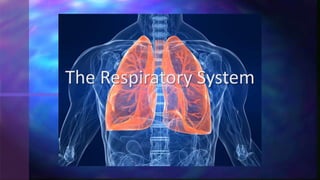
The Respiratory System
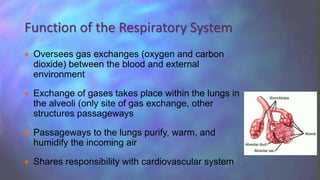
 Oversees gas exchanges (oxygen and carbon
dioxide) between the blood and external
environment
 Exchange of gases takes place within the lungs in
the alveoli (only site of gas exchange, other
structures passageways
 Passageways to the lungs purify, warm, and
humidify the incoming air
 Shares responsibility with cardiovascular system
Function of the Respiratory System
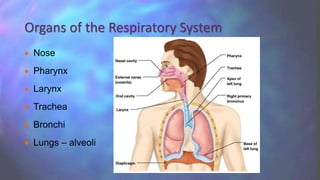
 Nose
 Pharynx
 Larynx
 Trachea
 Bronchi
 Lungs – alveoli
Organs of the Respiratory System
Upper Respiratory Tract
The Nose
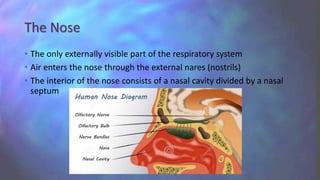
• The only externally visible part of the respiratory system
• Air enters the nose through the external nares (nostrils)
• The interior of the nose consists of a nasal cavity divided by a nasal
septum
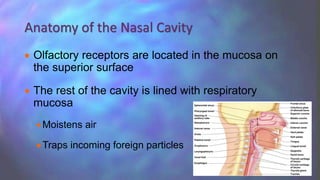
 Olfactory receptors are located in the mucosa on
the superior surface
 The rest of the cavity is lined with respiratory
mucosa
Moistens air
Traps incoming foreign particles
Anatomy of the Nasal Cavity
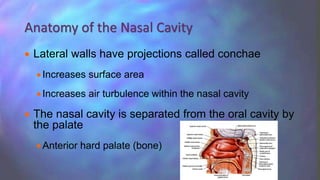
 Lateral walls have projections called conchae
Increases surface area
Increases air turbulence within the nasal cavity
 The nasal cavity is separated from the oral cavity by
the palate
Anterior hard palate (bone)
Anatomy of the Nasal Cavity
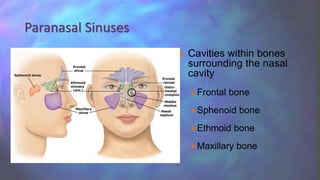
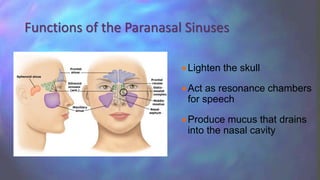
 Cavities within bones
surrounding the nasal
cavity
 Frontal bone
 Sphenoid bone
 Ethmoid bone
 Maxillary bone
Paranasal Sinuses
Lighten the skull
Act as resonance chambers
for speech
Produce mucus that drains
into the nasal cavity
Functions of the Paranasal Sinuses
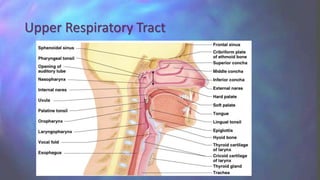
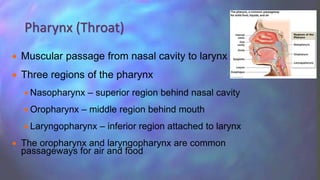
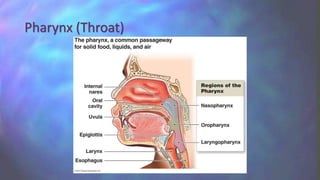
 Muscular passage from nasal cavity to larynx
 Three regions of the pharynx
 Nasopharynx – superior region behind nasal cavity
 Oropharynx – middle region behind mouth
 Laryngopharynx – inferior region attached to larynx
 The oropharynx and laryngopharynx are common
passageways for air and food
Pharynx (Throat)
Pharynx (Throat)
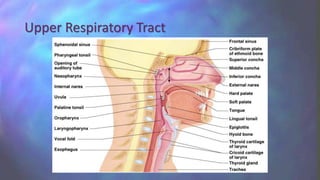
Upper Respiratory Tract
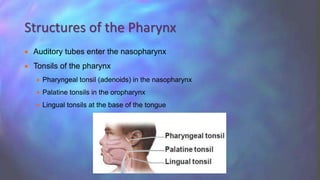
 Auditory tubes enter the nasopharynx
 Tonsils of the pharynx
 Pharyngeal tonsil (adenoids) in the nasopharynx
 Palatine tonsils in the oropharynx
 Lingual tonsils at the base of the tongue
Structures of the Pharynx
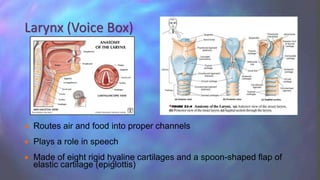
 Routes air and food into proper channels
 Plays a role in speech
 Made of eight rigid hyaline cartilages and a spoon-shaped flap of
elastic cartilage (epiglottis)
Larynx (Voice Box)
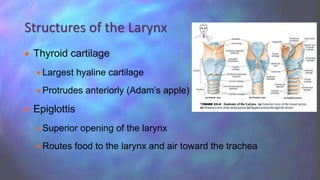
 Thyroid cartilage
 Largest hyaline cartilage
 Protrudes anteriorly (Adam’s apple)
 Epiglottis
 Superior opening of the larynx
 Routes food to the larynx and air toward the trachea
Structures of the Larynx
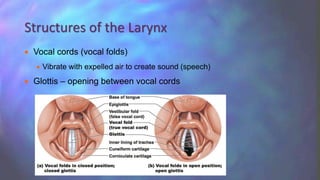
 Vocal cords (vocal folds)
 Vibrate with expelled air to create sound (speech)
 Glottis – opening between vocal cords
Structures of the Larynx
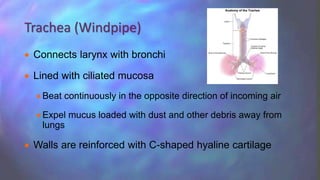
 Connects larynx with bronchi
 Lined with ciliated mucosa
 Beat continuously in the opposite direction of incoming air
 Expel mucus loaded with dust and other debris away from
lungs
 Walls are reinforced with C-shaped hyaline cartilage
Trachea (Windpipe)
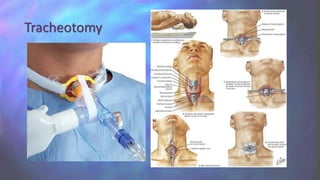
Tracheotomy
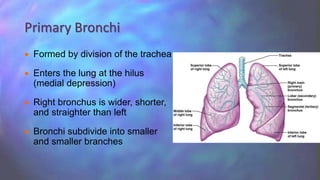
 Formed by division of the trachea
 Enters the lung at the hilus
(medial depression)
 Right bronchus is wider, shorter,
and straighter than left
 Bronchi subdivide into smaller
and smaller branches
Primary Bronchi
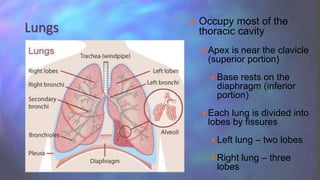
 Occupy most of the
thoracic cavity
 Apex is near the clavicle
(superior portion)
 Base rests on the
diaphragm (inferior
portion)
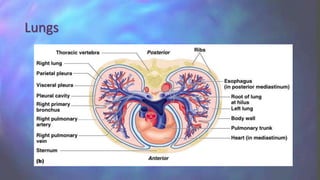
 Each lung is divided into
lobes by fissures
 Left lung – two lobes
 Right lung – three
lobes
Lungs
Lungs
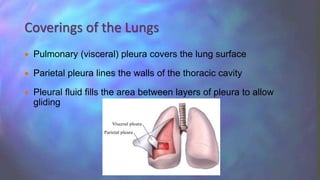
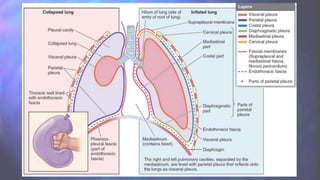
 Pulmonary (visceral) pleura covers the lung surface
 Parietal pleura lines the walls of the thoracic cavity
 Pleural fluid fills the area between layers of pleura to allow
gliding
Coverings of the Lungs
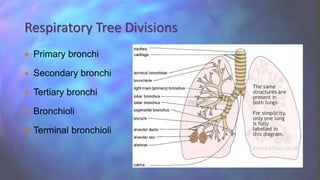
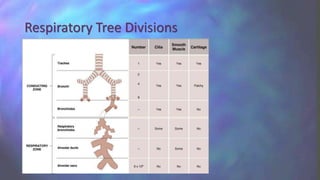
 Primary bronchi
 Secondary bronchi
 Tertiary bronchi
 Bronchioli
 Terminal bronchioli
Respiratory Tree Divisions
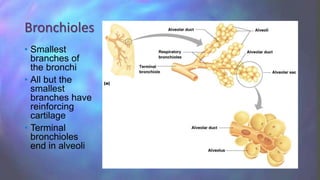
• Smallest
branches of
the bronchi
• All but the
smallest
branches have
reinforcing
cartilage
• Terminal
bronchioles
end in alveoli
Bronchioles
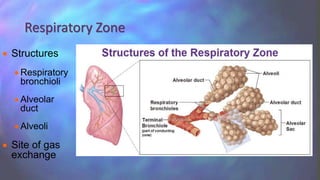
 Structures
 Respiratory
bronchioli
 Alveolar
duct
 Alveoli
 Site of gas
exchange
Respiratory Zone
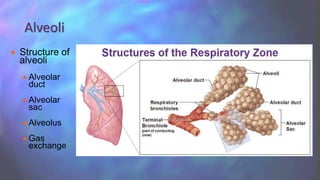
 Structure of
alveoli
 Alveolar
duct
 Alveolar
sac
 Alveolus
 Gas
exchange
Alveoli
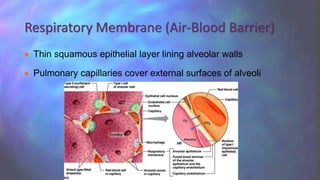
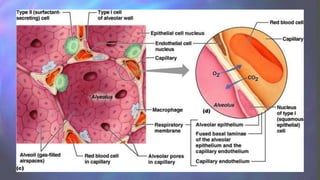
 Thin squamous epithelial layer lining alveolar walls
 Pulmonary capillaries cover external surfaces of alveoli
Respiratory Membrane (Air-Blood Barrier)
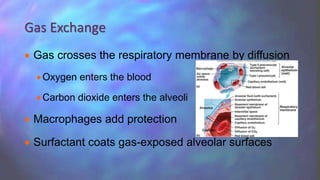
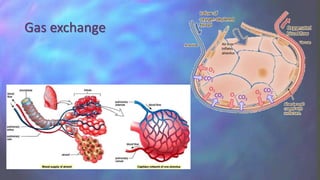
 Gas crosses the respiratory membrane by diffusion
Oxygen enters the blood
Carbon dioxide enters the alveoli
 Macrophages add protection
 Surfactant coats gas-exposed alveolar surfaces
Gas Exchange
Gas exchange
 Pulmonary ventilation – moving air in and out of the lungs
 External respiration – gas exchange between pulmonary blood
and alveoli
 Respiratory gas transport – transport of oxygen and carbon
dioxide via the bloodstream
 Internal respiration – gas exchange between blood and tissue
cells in systemic capillaries
Events of Respiration
 Completely mechanical process
 Depends on volume changes in the thoracic cavity
 Volume changes lead to pressure changes, which lead to the
flow of gases to equalize pressure
Mechanics of Breathing (Pulmonary Ventilation)
 Two phases
Inspiration – flow of air into lung
Expiration – air leaving lung
Mechanics of Breathing (Pulmonary Ventilation)
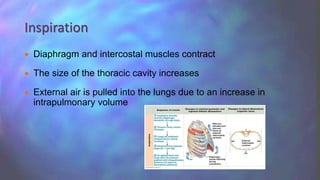
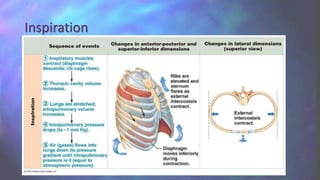
 Diaphragm and intercostal muscles contract
 The size of the thoracic cavity increases
 External air is pulled into the lungs due to an increase in
intrapulmonary volume
Inspiration
Inspiration
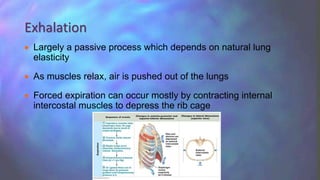
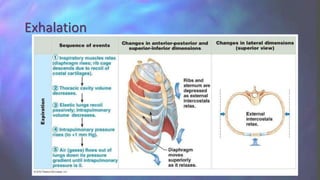
 Largely a passive process which depends on natural lung
elasticity
 As muscles relax, air is pushed out of the lungs
 Forced expiration can occur mostly by contracting internal
intercostal muscles to depress the rib cage
Exhalation
Exhalation
 Can be caused by reflexes or voluntary actions
 Examples
 Cough and sneeze – clears lungs of debris
 Laughing
 Crying
 Yawn
 Hiccup
Nonrespiratory Air Movements
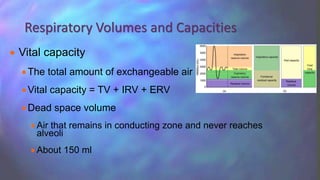
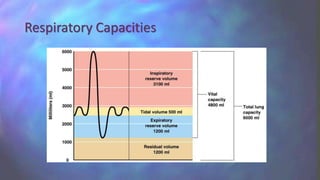
 Normal breathing moves about 500 ml of air with each breath (tidal
volume [TV])
 Many factors that affect respiratory capacity
 A person’s size
 Sex
 Age
 Physical condition
 Residual volume of air – after exhalation, about 1200 ml of air
remains in the lungs
Respiratory Volumes and Capacities
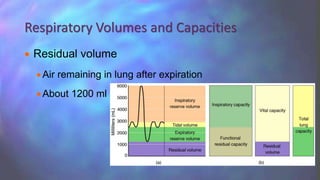
 Residual volume
Air remaining in lung after expiration
About 1200 ml
Respiratory Volumes and Capacities
 Vital capacity
The total amount of exchangeable air
Vital capacity = TV + IRV + ERV
Dead space volume
 Air that remains in conducting zone and never reaches
alveoli
 About 150 ml
Respiratory Volumes and Capacities
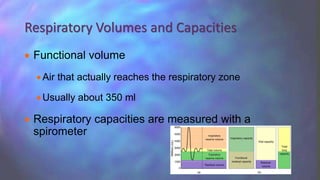
 Functional volume
Air that actually reaches the respiratory zone
Usually about 350 ml
 Respiratory capacities are measured with a
spirometer
Respiratory Volumes and Capacities
Respiratory Capacities
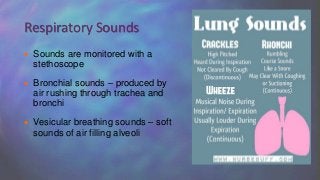
 Sounds are monitored with a
stethoscope
 Bronchial sounds – produced by
air rushing through trachea and
bronchi
 Vesicular breathing sounds – soft
sounds of air filling alveoli
Respiratory Sounds
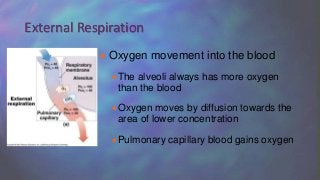
 Oxygen movement into the blood
The alveoli always has more oxygen
than the blood
Oxygen moves by diffusion towards the
area of lower concentration
Pulmonary capillary blood gains oxygen
External Respiration
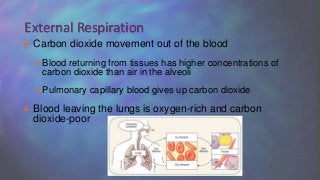
 Carbon dioxide movement out of the blood
 Blood returning from tissues has higher concentrations of
carbon dioxide than air in the alveoli
 Pulmonary capillary blood gives up carbon dioxide
 Blood leaving the lungs is oxygen-rich and carbon
dioxide-poor
External Respiration
 Oxygen transport in the blood
Inside red blood cells attached to
hemoglobin (oxyhemoglobin
[HbO2])
A small amount is carried dissolved
in the plasma
Gas Transport in the Blood
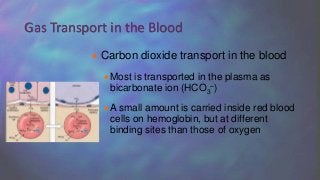
 Carbon dioxide transport in the blood
Most is transported in the plasma as
bicarbonate ion (HCO3
–)
A small amount is carried inside red blood
cells on hemoglobin, but at different
binding sites than those of oxygen
Gas Transport in the Blood
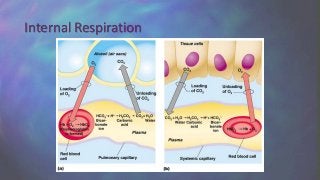
 Exchange of gases between blood and body cells
 An opposite reaction to what occurs in the lungs
Carbon dioxide diffuses out of tissue to blood
Oxygen diffuses from blood into tissue
Internal Respiration
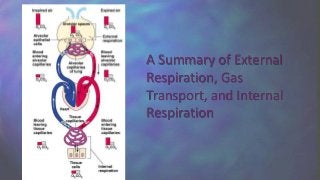
A Summary of External
Respiration, Gas
Transport, and Internal
Respiration
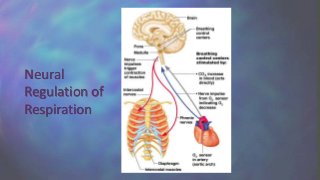
 Activity of respiratory muscles is transmitted to the brain by the
phrenic and intercostal nerves
 Neural centers that control rate and depth are located in the medulla
 The pons appears to smooth out respiratory rate
 Normal respiratory rate (eupnea) is 12–15 respirations per minute
 Hypernia is increased respiratory rate often due to extra oxygen
needs
Neural Regulation of Respiration
Neural
Regulation of
Respiration
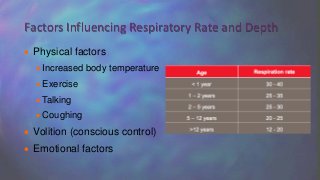
 Physical factors
 Increased body temperature
 Exercise
 Talking
 Coughing
 Volition (conscious control)
 Emotional factors
Factors Influencing Respiratory Rate and Depth
 Chemical factors
Carbon dioxide levels
 Level of carbon dioxide in the blood is the main regulatory
chemical for respiration
 Increased carbon dioxide increases respiration
 Changes in carbon dioxide act directly on the medulla
oblongata
Factors Influencing Respiratory Rate and Depth
 Chemical factors (continued)
Oxygen levels
 Changes in oxygen concentration in the blood are
detected by chemoreceptors in the aorta and carotid artery
 Information is sent to the medulla oblongata
Factors Influencing Respiratory Rate and Depth
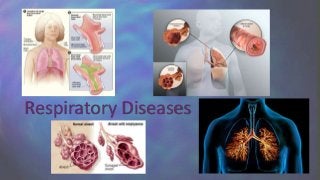
Respiratory Diseases
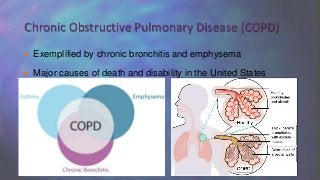
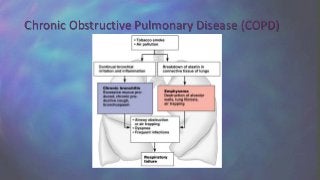
 Exemplified by chronic bronchitis and emphysema
 Major causes of death and disability in the United States
Chronic Obstructive Pulmonary Disease (COPD)
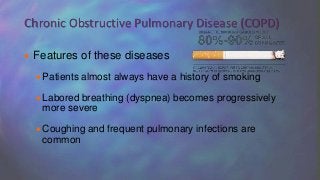
 Features of these diseases
Patients almost always have a history of smoking
Labored breathing (dyspnea) becomes progressively
more severe
Coughing and frequent pulmonary infections are
common
Chronic Obstructive Pulmonary Disease (COPD)
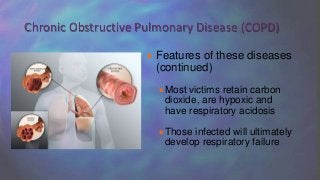
 Features of these diseases
(continued)
Most victims retain carbon
dioxide, are hypoxic and
have respiratory acidosis
Those infected will ultimately
develop respiratory failure
Chronic Obstructive Pulmonary Disease (COPD)
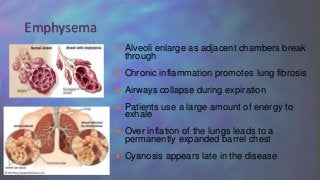
 Alveoli enlarge as adjacent chambers break
through
 Chronic inflammation promotes lung fibrosis
 Airways collapse during expiration
 Patients use a large amount of energy to
exhale
 Over inflation of the lungs leads to a
permanently expanded barrel chest
 Cyanosis appears late in the disease
Emphysema
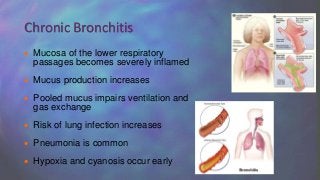
 Mucosa of the lower respiratory
passages becomes severely inflamed
 Mucus production increases
 Pooled mucus impairs ventilation and
gas exchange
 Risk of lung infection increases
 Pneumonia is common
 Hypoxia and cyanosis occur early
Chronic Bronchitis
Chronic Obstructive Pulmonary Disease (COPD)
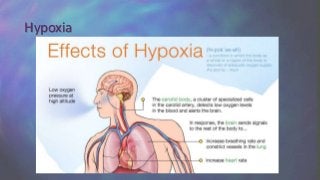
Hypoxia
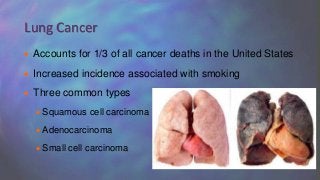
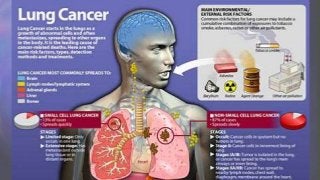
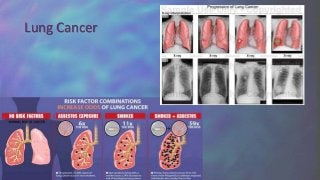
 Accounts for 1/3 of all cancer deaths in the United States
 Increased incidence associated with smoking
 Three common types
 Squamous cell carcinoma
 Adenocarcinoma
 Small cell carcinoma
Lung Cancer
Lung Cancer
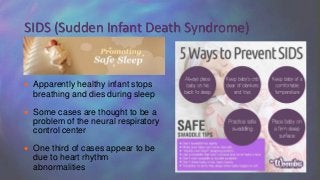
 Apparently healthy infant stops
breathing and dies during sleep
 Some cases are thought to be a
problem of the neural respiratory
control center
 One third of cases appear to be
due to heart rhythm
abnormalities
SIDS (Sudden Infant Death Syndrome)
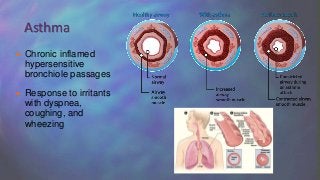
 Chronic inflamed
hypersensitive
bronchiole passages
 Response to irritants
with dyspnea,
coughing, and
wheezing
Asthma
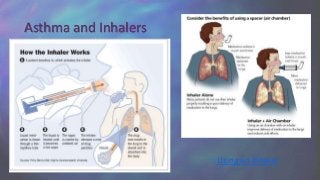
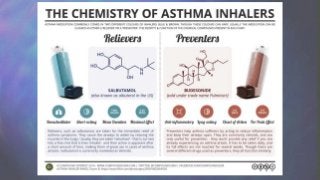
• Using an Inhaler
Asthma and Inhalers
 Lungs are filled with fluid in the fetus
 Lungs are not fully inflated with air until two weeks after birth
 Surfactant that lowers alveolar surface tension is not present
until late in fetal development and may not be present in
premature babies
Developmental Aspects of the Respiratory System
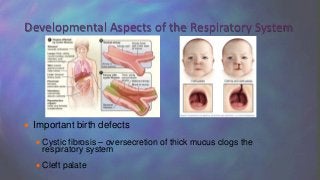
 Important birth defects
 Cystic fibrosis – oversecretion of thick mucus clogs the
respiratory system
 Cleft palate
Developmental Aspects of the Respiratory System
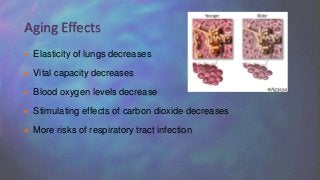
 Elasticity of lungs decreases
 Vital capacity decreases
 Blood oxygen levels decrease
 Stimulating effects of carbon dioxide decreases
 More risks of respiratory tract infection
Aging Effects
 Newborns – 40 to 80 respirations per minute
 Infants – 30 respirations per minute
 Age 5 – 25 respirations per minute
 Adults – 12 to 18 respirations per minute
 Rate often increases somewhat with old age
Respiratory Rate Changes Throughout Life

The Respiratory System

  • 1.
  • 2.
     Oversees gasexchanges (oxygen and carbon dioxide) between the blood and external environment  Exchange of gases takes place within the lungs in the alveoli (only site of gas exchange, other structures passageways  Passageways to the lungs purify, warm, and humidify the incoming air  Shares responsibility with cardiovascular system Function of the Respiratory System
  • 3.
     Nose  Pharynx Larynx  Trachea  Bronchi  Lungs – alveoli Organs of the Respiratory System
  • 4.
  • 5.
    The Nose • Theonly externally visible part of the respiratory system • Air enters the nose through the external nares (nostrils) • The interior of the nose consists of a nasal cavity divided by a nasal septum
  • 6.
     Olfactory receptorsare located in the mucosa on the superior surface  The rest of the cavity is lined with respiratory mucosa Moistens air Traps incoming foreign particles Anatomy of the Nasal Cavity
  • 7.
     Lateral wallshave projections called conchae Increases surface area Increases air turbulence within the nasal cavity  The nasal cavity is separated from the oral cavity by the palate Anterior hard palate (bone) Anatomy of the Nasal Cavity
  • 8.
     Cavities withinbones surrounding the nasal cavity  Frontal bone  Sphenoid bone  Ethmoid bone  Maxillary bone Paranasal Sinuses
  • 9.
    Lighten the skull Actas resonance chambers for speech Produce mucus that drains into the nasal cavity Functions of the Paranasal Sinuses
  • 10.
     Muscular passagefrom nasal cavity to larynx  Three regions of the pharynx  Nasopharynx – superior region behind nasal cavity  Oropharynx – middle region behind mouth  Laryngopharynx – inferior region attached to larynx  The oropharynx and laryngopharynx are common passageways for air and food Pharynx (Throat)
  • 11.
  • 12.
  • 13.
     Auditory tubesenter the nasopharynx  Tonsils of the pharynx  Pharyngeal tonsil (adenoids) in the nasopharynx  Palatine tonsils in the oropharynx  Lingual tonsils at the base of the tongue Structures of the Pharynx
  • 14.
     Routes airand food into proper channels  Plays a role in speech  Made of eight rigid hyaline cartilages and a spoon-shaped flap of elastic cartilage (epiglottis) Larynx (Voice Box)
  • 15.
     Thyroid cartilage Largest hyaline cartilage  Protrudes anteriorly (Adam’s apple)  Epiglottis  Superior opening of the larynx  Routes food to the larynx and air toward the trachea Structures of the Larynx
  • 16.
     Vocal cords(vocal folds)  Vibrate with expelled air to create sound (speech)  Glottis – opening between vocal cords Structures of the Larynx
  • 17.
     Connects larynxwith bronchi  Lined with ciliated mucosa  Beat continuously in the opposite direction of incoming air  Expel mucus loaded with dust and other debris away from lungs  Walls are reinforced with C-shaped hyaline cartilage Trachea (Windpipe)
  • 18.
  • 19.
     Formed bydivision of the trachea  Enters the lung at the hilus (medial depression)  Right bronchus is wider, shorter, and straighter than left  Bronchi subdivide into smaller and smaller branches Primary Bronchi
  • 20.
     Occupy mostof the thoracic cavity  Apex is near the clavicle (superior portion)  Base rests on the diaphragm (inferior portion)  Each lung is divided into lobes by fissures  Left lung – two lobes  Right lung – three lobes Lungs
  • 21.
  • 22.
     Pulmonary (visceral)pleura covers the lung surface  Parietal pleura lines the walls of the thoracic cavity  Pleural fluid fills the area between layers of pleura to allow gliding Coverings of the Lungs
  • 24.
     Primary bronchi Secondary bronchi  Tertiary bronchi  Bronchioli  Terminal bronchioli Respiratory Tree Divisions
  • 25.
  • 26.
    • Smallest branches of thebronchi • All but the smallest branches have reinforcing cartilage • Terminal bronchioles end in alveoli Bronchioles
  • 27.
     Structures  Respiratory bronchioli Alveolar duct  Alveoli  Site of gas exchange Respiratory Zone
  • 28.
     Structure of alveoli Alveolar duct  Alveolar sac  Alveolus  Gas exchange Alveoli
  • 29.
     Thin squamousepithelial layer lining alveolar walls  Pulmonary capillaries cover external surfaces of alveoli Respiratory Membrane (Air-Blood Barrier)
  • 31.
     Gas crossesthe respiratory membrane by diffusion Oxygen enters the blood Carbon dioxide enters the alveoli  Macrophages add protection  Surfactant coats gas-exposed alveolar surfaces Gas Exchange
  • 32.
  • 33.
     Pulmonary ventilation– moving air in and out of the lungs  External respiration – gas exchange between pulmonary blood and alveoli  Respiratory gas transport – transport of oxygen and carbon dioxide via the bloodstream  Internal respiration – gas exchange between blood and tissue cells in systemic capillaries Events of Respiration
  • 34.
     Completely mechanicalprocess  Depends on volume changes in the thoracic cavity  Volume changes lead to pressure changes, which lead to the flow of gases to equalize pressure Mechanics of Breathing (Pulmonary Ventilation)
  • 35.
     Two phases Inspiration– flow of air into lung Expiration – air leaving lung Mechanics of Breathing (Pulmonary Ventilation)
  • 36.
     Diaphragm andintercostal muscles contract  The size of the thoracic cavity increases  External air is pulled into the lungs due to an increase in intrapulmonary volume Inspiration
  • 37.
  • 38.
     Largely apassive process which depends on natural lung elasticity  As muscles relax, air is pushed out of the lungs  Forced expiration can occur mostly by contracting internal intercostal muscles to depress the rib cage Exhalation
  • 39.
  • 40.
     Can becaused by reflexes or voluntary actions  Examples  Cough and sneeze – clears lungs of debris  Laughing  Crying  Yawn  Hiccup Nonrespiratory Air Movements
  • 41.
     Normal breathingmoves about 500 ml of air with each breath (tidal volume [TV])  Many factors that affect respiratory capacity  A person’s size  Sex  Age  Physical condition  Residual volume of air – after exhalation, about 1200 ml of air remains in the lungs Respiratory Volumes and Capacities
  • 42.
     Residual volume Airremaining in lung after expiration About 1200 ml Respiratory Volumes and Capacities
  • 43.
     Vital capacity Thetotal amount of exchangeable air Vital capacity = TV + IRV + ERV Dead space volume  Air that remains in conducting zone and never reaches alveoli  About 150 ml Respiratory Volumes and Capacities
  • 44.
     Functional volume Airthat actually reaches the respiratory zone Usually about 350 ml  Respiratory capacities are measured with a spirometer Respiratory Volumes and Capacities
  • 45.
  • 46.
     Sounds aremonitored with a stethoscope  Bronchial sounds – produced by air rushing through trachea and bronchi  Vesicular breathing sounds – soft sounds of air filling alveoli Respiratory Sounds
  • 47.
     Oxygen movementinto the blood The alveoli always has more oxygen than the blood Oxygen moves by diffusion towards the area of lower concentration Pulmonary capillary blood gains oxygen External Respiration
  • 48.
     Carbon dioxidemovement out of the blood  Blood returning from tissues has higher concentrations of carbon dioxide than air in the alveoli  Pulmonary capillary blood gives up carbon dioxide  Blood leaving the lungs is oxygen-rich and carbon dioxide-poor External Respiration
  • 49.
     Oxygen transportin the blood Inside red blood cells attached to hemoglobin (oxyhemoglobin [HbO2]) A small amount is carried dissolved in the plasma Gas Transport in the Blood
  • 50.
     Carbon dioxidetransport in the blood Most is transported in the plasma as bicarbonate ion (HCO3 –) A small amount is carried inside red blood cells on hemoglobin, but at different binding sites than those of oxygen Gas Transport in the Blood
  • 51.
     Exchange ofgases between blood and body cells  An opposite reaction to what occurs in the lungs Carbon dioxide diffuses out of tissue to blood Oxygen diffuses from blood into tissue Internal Respiration
  • 52.
  • 53.
    A Summary ofExternal Respiration, Gas Transport, and Internal Respiration
  • 54.
     Activity ofrespiratory muscles is transmitted to the brain by the phrenic and intercostal nerves  Neural centers that control rate and depth are located in the medulla  The pons appears to smooth out respiratory rate  Normal respiratory rate (eupnea) is 12–15 respirations per minute  Hypernia is increased respiratory rate often due to extra oxygen needs Neural Regulation of Respiration
  • 55.
  • 56.
     Physical factors Increased body temperature  Exercise  Talking  Coughing  Volition (conscious control)  Emotional factors Factors Influencing Respiratory Rate and Depth
  • 57.
     Chemical factors Carbondioxide levels  Level of carbon dioxide in the blood is the main regulatory chemical for respiration  Increased carbon dioxide increases respiration  Changes in carbon dioxide act directly on the medulla oblongata Factors Influencing Respiratory Rate and Depth
  • 58.
     Chemical factors(continued) Oxygen levels  Changes in oxygen concentration in the blood are detected by chemoreceptors in the aorta and carotid artery  Information is sent to the medulla oblongata Factors Influencing Respiratory Rate and Depth
  • 59.
  • 60.
     Exemplified bychronic bronchitis and emphysema  Major causes of death and disability in the United States Chronic Obstructive Pulmonary Disease (COPD)
  • 61.
     Features ofthese diseases Patients almost always have a history of smoking Labored breathing (dyspnea) becomes progressively more severe Coughing and frequent pulmonary infections are common Chronic Obstructive Pulmonary Disease (COPD)
  • 62.
     Features ofthese diseases (continued) Most victims retain carbon dioxide, are hypoxic and have respiratory acidosis Those infected will ultimately develop respiratory failure Chronic Obstructive Pulmonary Disease (COPD)
  • 63.
     Alveoli enlargeas adjacent chambers break through  Chronic inflammation promotes lung fibrosis  Airways collapse during expiration  Patients use a large amount of energy to exhale  Over inflation of the lungs leads to a permanently expanded barrel chest  Cyanosis appears late in the disease Emphysema
  • 64.
     Mucosa ofthe lower respiratory passages becomes severely inflamed  Mucus production increases  Pooled mucus impairs ventilation and gas exchange  Risk of lung infection increases  Pneumonia is common  Hypoxia and cyanosis occur early Chronic Bronchitis
  • 65.
  • 66.
  • 67.
     Accounts for1/3 of all cancer deaths in the United States  Increased incidence associated with smoking  Three common types  Squamous cell carcinoma  Adenocarcinoma  Small cell carcinoma Lung Cancer
  • 69.
  • 70.
     Apparently healthyinfant stops breathing and dies during sleep  Some cases are thought to be a problem of the neural respiratory control center  One third of cases appear to be due to heart rhythm abnormalities SIDS (Sudden Infant Death Syndrome)
  • 71.
     Chronic inflamed hypersensitive bronchiolepassages  Response to irritants with dyspnea, coughing, and wheezing Asthma
  • 72.
    • Using anInhaler Asthma and Inhalers
  • 74.
     Lungs arefilled with fluid in the fetus  Lungs are not fully inflated with air until two weeks after birth  Surfactant that lowers alveolar surface tension is not present until late in fetal development and may not be present in premature babies Developmental Aspects of the Respiratory System
  • 75.
     Important birthdefects  Cystic fibrosis – oversecretion of thick mucus clogs the respiratory system  Cleft palate Developmental Aspects of the Respiratory System
  • 76.
     Elasticity oflungs decreases  Vital capacity decreases  Blood oxygen levels decrease  Stimulating effects of carbon dioxide decreases  More risks of respiratory tract infection Aging Effects
  • 77.
     Newborns –40 to 80 respirations per minute  Infants – 30 respirations per minute  Age 5 – 25 respirations per minute  Adults – 12 to 18 respirations per minute  Rate often increases somewhat with old age Respiratory Rate Changes Throughout Life