HAEME SYNTHESISHAEME SYNTHESIS
AND CATABOLISMAND CATABOLISM
BYBY
DR MUHAMMADDR MUHAMMAD
MUSTANSARMUSTANSAR
HEME-CONTAINING PROTEINS
• Hemoglobin
• Myoglobin
• Cytochromes
• Catalase
• Some peroxidases
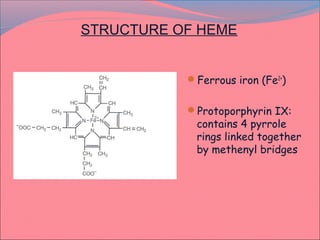
STRUCTURE OF HEME
Ferrous iron (Fe2+
)
Protoporphyrin IX:
contains 4 pyrrole
rings linked together
by methenyl bridges
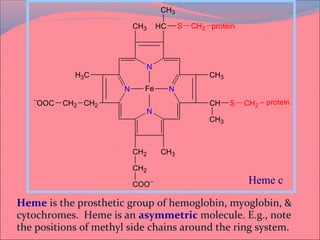
Heme is the prosthetic group of hemoglobin, myoglobin, &
cytochromes. Heme is an asymmetric molecule. E.g., note
the positions of methyl side chains around the ring system.
N
N
N
N
CH3 HC
CH3
S CH2
CH3
CH S CH2
CH3
CH2
CH2
COO−
CH3
H3C
CH2CH2
−
OOC
protein
protein
Fe
Heme c
Heme
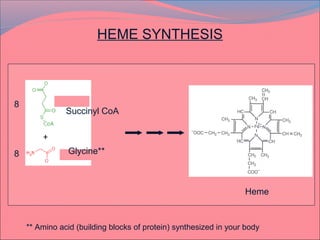
8
8
Succinyl CoA
Glycine**
HEME SYNTHESIS
** Amino acid (building blocks of protein) synthesized in your body
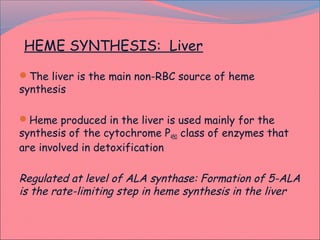
HEME SYNTHESIS: Liver
The liver is the main non-RBC source of heme
synthesis
Heme produced in the liver is used mainly for the
synthesis of the cytochrome P450 class of enzymes that
are involved in detoxification
Regulated at level of ALA synthase: Formation of 5-ALA
is the rate-limiting step in heme synthesis in the liver
HEME SYNTHESIS: Red blood cells
85% of total heme synthesis
occurs in red blood cells (RBC)
Ceases when RBC’s mature
Heme stimulates protein
synthesis in reticulocytes
Synthesis is regulated at the
level of the enzymes
ferrochelatase* and
porphobilinogen deaminase**
The heme ring system is synthesized from glycine
& succinyl-CoA.
Using isotopic tracers, it was initially found that N
& C atoms of heme are derived from glycine and
acetate.
It was later determined that the labeled acetate
enters Krebs Cycle as acetyl-CoA, and the labeled
carbon becomes incorporated into succinyl-CoA,
the more immediate precursor of heme.
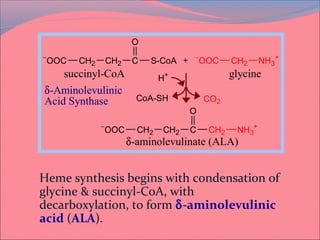
Heme synthesis begins with condensation of
glycine & succinyl-CoA, with
decarboxylation, to form δ-aminolevulinic
acid (ALA).
−
OOC CH2 CH2 C S-CoA
O
+ −
OOC CH2 NH3
+
−
OOC CH2 CH2 C
O
CH2 NH3
+
CO2CoA-SH
H+succinyl-CoA glycine
δ-aminolevulinate (ALA)
δ-Aminolevulinic
Acid Synthase
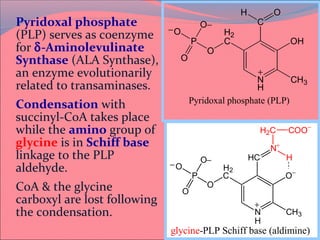
Pyridoxal phosphate
(PLP) serves as coenzyme
for δ-Aminolevulinate
Synthase (ALA Synthase),
an enzyme evolutionarily
related to transaminases.
Condensation with
succinyl-CoA takes place
while the amino group of
glycine is in Schiff base
linkage to the PLP
aldehyde.
CoA & the glycine
carboxyl are lost following
the condensation.
Pyridoxal phosphate (PLP)
N
H
C
O
P
O−
O
O
OH
CH3
C
H O
−
+
H2
N
H
C
O
P
O−
O
O
O−
CH3
HC
−
+
H2
N
H2C
H
+
COO−
glycine-PLP Schiff base (aldimine)
Uroporphyrinogen I Coproporphyrinogen I
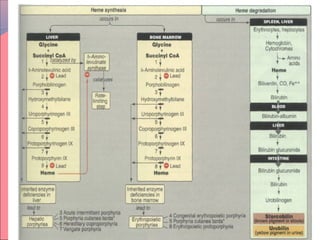
Overview of Heme SynthesisOverview of Heme Synthesis
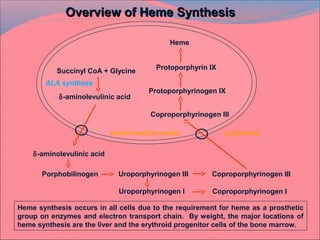
Heme synthesis occurs in all cells due to the requirement for heme as a prosthetic
group on enzymes and electron transport chain. By weight, the major locations of
heme synthesis are the liver and the erythroid progenitor cells of the bone marrow.
Succinyl CoA + Glycine
δ-aminolevulinic acid
Porphobilinogen Uroporphyrinogen III Coproporphyrinogen III
Coproporphyrinogen III
Protoporphyrinogen IX
Protoporphyrin IX
Heme
ALA synthase
cytoplasmmitochondrial matrix
ALA Synthase is the committed step of the
heme synthesis pathway, & is usually rate-
limiting for the overall pathway.
Regulation occurs through control of gene
transcription.
.
Disorders of Heme Synthesis
 Acquired: Lead poisoning
 Congenital: Porphyrias
 Deficiency of heme has far-reaching effects
(hemoglobin, cytochromes, etc.)
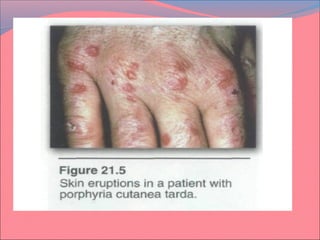
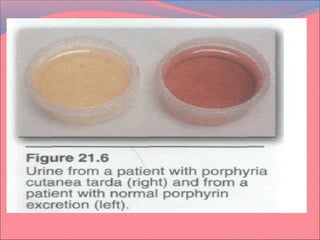
• A group of rare disorders caused by deficiencies of enzymes of the heme
biosynthetic pathway
•The majority of the porphyrias are inherited in a autosomal dominant
fashion - thus, affected individuals have 50% normal levels of the enzymes,
and can still synthesize some heme
•Affected individuals have an accumulation of heme precursors
(porphyrins), which are toxic at high concentrations
•Attacks of the disease are triggered by certain drugs, chemicals, and
foods, and also by exposure to sun
• Treatment involves administration of hemin, which provides negative
feedback for the heme biosynthetic pathway, and therefore, prevents
accumulation of heme precursors
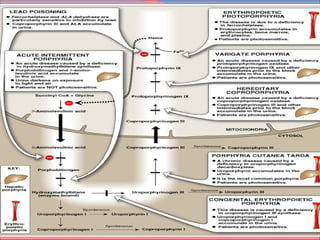
Porphyrias
Caused by hereditary or acquired defects in heme synthesis
- Accumulation and increased excretion of metabolic
precursors (each unique)
- Most porphyrias show a prevalent autosomal dominant
pattern, except congenital eythropoietic porphyria, which is
recessive
Can be hepatic or erythropoietic, reflecting the two major
locations of heme synthesis
- hepatic can be acute or chronic
Those with tetrapyrrole intermediates show photosensitivity
due to extended conjugated double bonds
- Formation of superoxide radicals
- Skin blisters, itches (pruritis)
- Skin may darken, grow hair (hypertrichosis)
Acquired Porphyrias
Lead poisoning
- inhibition of ferrochelatase and ALA dehydratase
- displaces Zn+2
at enzyme active site
Children
- developmental defects
- drop in IQ
- hyperactivity
- insomnia
- many other health problems
Adults
- severe abdominal pain
- mental confusion
- many other symptoms
Most heme from RBCs (85%) - rest from turnover of
cytochromes, p450s, immature erythrocytes.
RBCs last 120 days, degraded by reticuloendothelial
(RE) system [liver and spleen].
Microsomal heme oxygenase hydroxylates methenyl
bridge carbon and oxidizes Fe2+
to Fe3+
. Second
reaction open ring and release methenyl carbon as
CO.
The resulting biliverdin is poorly soluble due to ring
stacking and aggregation.
Serum albumin carries bilirubin in circulation, ligandin
in hepatocytes.
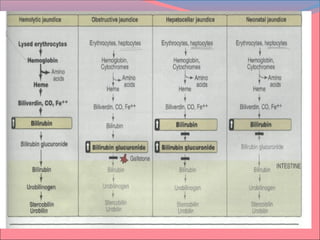
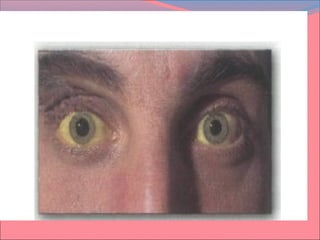
Types of Jaundice
Hemolytic jaundice
- Liver can handle 3000 mg bilirubin/day - normal is 300
- Massive hemolysis causes more than can be processed
- cannot be conjugated
- increased bilirubin excreted into bile, urobilinogen
is increased in blood, urine
- unconjugated bilirubin in blood increases = jaundice
Obstructive jaundice
- Obstruction of the bile duct
- tumor or bile stones
- gastrointestinal pain - nausea
- pale, clay-colored stools
- can lead to liver damage and increased unconjugated
bilirubin
Hepatocellular jaundice
- Liver damage (cirrhosis or hepatitis) cause increased
bilirubin levels in blood due to decreased conjugation
- Conjugated bilirubin not efficiently exported to bile
so diffuses into blood
- Decreased urobilinogen in enterohepatic circulation
so urine is darker and stool is pale, clay-colored
- AST and ALT levels are elevated due to hepatic damage
- Nausea and anorexia
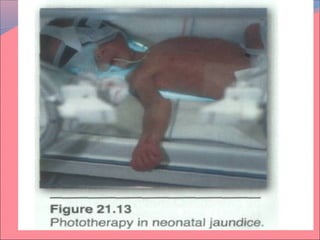
Jaundice in Newborns
Premature babies often accumulate bilirubin due to
late onset of expression of bilirubin glucuronyltransferase
- Maximum expression (adult level) at ~ 4 weeks
- Excess bilirubin can cause toxic encephalopathy
(kernicterus)
- Treated with blue fluorescent light
- converts bilirubin to more polar compound
- can be excreted in bile without conjugation
- Crigler-Najjar syndrome is deficiency in bilirubin
glucuronyltransferase

HEME METABOLISM MUHAMMAD MUSTANSAR

  • 2.
    HAEME SYNTHESISHAEME SYNTHESIS ANDCATABOLISMAND CATABOLISM BYBY DR MUHAMMADDR MUHAMMAD MUSTANSARMUSTANSAR
  • 3.
    HEME-CONTAINING PROTEINS • Hemoglobin •Myoglobin • Cytochromes • Catalase • Some peroxidases
  • 5.
    STRUCTURE OF HEME Ferrousiron (Fe2+ ) Protoporphyrin IX: contains 4 pyrrole rings linked together by methenyl bridges
  • 6.
    Heme is theprosthetic group of hemoglobin, myoglobin, & cytochromes. Heme is an asymmetric molecule. E.g., note the positions of methyl side chains around the ring system. N N N N CH3 HC CH3 S CH2 CH3 CH S CH2 CH3 CH2 CH2 COO− CH3 H3C CH2CH2 − OOC protein protein Fe Heme c
  • 7.
    Heme 8 8 Succinyl CoA Glycine** HEME SYNTHESIS **Amino acid (building blocks of protein) synthesized in your body
  • 8.
    HEME SYNTHESIS: Liver Theliver is the main non-RBC source of heme synthesis Heme produced in the liver is used mainly for the synthesis of the cytochrome P450 class of enzymes that are involved in detoxification Regulated at level of ALA synthase: Formation of 5-ALA is the rate-limiting step in heme synthesis in the liver
  • 9.
    HEME SYNTHESIS: Redblood cells 85% of total heme synthesis occurs in red blood cells (RBC) Ceases when RBC’s mature Heme stimulates protein synthesis in reticulocytes Synthesis is regulated at the level of the enzymes ferrochelatase* and porphobilinogen deaminase**
  • 10.
    The heme ringsystem is synthesized from glycine & succinyl-CoA. Using isotopic tracers, it was initially found that N & C atoms of heme are derived from glycine and acetate. It was later determined that the labeled acetate enters Krebs Cycle as acetyl-CoA, and the labeled carbon becomes incorporated into succinyl-CoA, the more immediate precursor of heme.
  • 11.
    Heme synthesis beginswith condensation of glycine & succinyl-CoA, with decarboxylation, to form δ-aminolevulinic acid (ALA). − OOC CH2 CH2 C S-CoA O + − OOC CH2 NH3 + − OOC CH2 CH2 C O CH2 NH3 + CO2CoA-SH H+succinyl-CoA glycine δ-aminolevulinate (ALA) δ-Aminolevulinic Acid Synthase
  • 12.
    Pyridoxal phosphate (PLP) servesas coenzyme for δ-Aminolevulinate Synthase (ALA Synthase), an enzyme evolutionarily related to transaminases. Condensation with succinyl-CoA takes place while the amino group of glycine is in Schiff base linkage to the PLP aldehyde. CoA & the glycine carboxyl are lost following the condensation. Pyridoxal phosphate (PLP) N H C O P O− O O OH CH3 C H O − + H2 N H C O P O− O O O− CH3 HC − + H2 N H2C H + COO− glycine-PLP Schiff base (aldimine)
  • 14.
    Uroporphyrinogen I CoproporphyrinogenI Overview of Heme SynthesisOverview of Heme Synthesis Heme synthesis occurs in all cells due to the requirement for heme as a prosthetic group on enzymes and electron transport chain. By weight, the major locations of heme synthesis are the liver and the erythroid progenitor cells of the bone marrow. Succinyl CoA + Glycine δ-aminolevulinic acid δ-aminolevulinic acid Porphobilinogen Uroporphyrinogen III Coproporphyrinogen III Coproporphyrinogen III Protoporphyrinogen IX Protoporphyrin IX Heme ALA synthase cytoplasmmitochondrial matrix
  • 16.
    ALA Synthase isthe committed step of the heme synthesis pathway, & is usually rate- limiting for the overall pathway. Regulation occurs through control of gene transcription. .
  • 17.
    Disorders of HemeSynthesis  Acquired: Lead poisoning  Congenital: Porphyrias  Deficiency of heme has far-reaching effects (hemoglobin, cytochromes, etc.)
  • 18.
    • A groupof rare disorders caused by deficiencies of enzymes of the heme biosynthetic pathway •The majority of the porphyrias are inherited in a autosomal dominant fashion - thus, affected individuals have 50% normal levels of the enzymes, and can still synthesize some heme •Affected individuals have an accumulation of heme precursors (porphyrins), which are toxic at high concentrations •Attacks of the disease are triggered by certain drugs, chemicals, and foods, and also by exposure to sun • Treatment involves administration of hemin, which provides negative feedback for the heme biosynthetic pathway, and therefore, prevents accumulation of heme precursors
  • 20.
    Porphyrias Caused by hereditaryor acquired defects in heme synthesis - Accumulation and increased excretion of metabolic precursors (each unique) - Most porphyrias show a prevalent autosomal dominant pattern, except congenital eythropoietic porphyria, which is recessive Can be hepatic or erythropoietic, reflecting the two major locations of heme synthesis - hepatic can be acute or chronic Those with tetrapyrrole intermediates show photosensitivity due to extended conjugated double bonds - Formation of superoxide radicals - Skin blisters, itches (pruritis) - Skin may darken, grow hair (hypertrichosis)
  • 21.
    Acquired Porphyrias Lead poisoning -inhibition of ferrochelatase and ALA dehydratase - displaces Zn+2 at enzyme active site Children - developmental defects - drop in IQ - hyperactivity - insomnia - many other health problems Adults - severe abdominal pain - mental confusion - many other symptoms
  • 24.
    Most heme fromRBCs (85%) - rest from turnover of cytochromes, p450s, immature erythrocytes. RBCs last 120 days, degraded by reticuloendothelial (RE) system [liver and spleen]. Microsomal heme oxygenase hydroxylates methenyl bridge carbon and oxidizes Fe2+ to Fe3+ . Second reaction open ring and release methenyl carbon as CO. The resulting biliverdin is poorly soluble due to ring stacking and aggregation. Serum albumin carries bilirubin in circulation, ligandin in hepatocytes.
  • 33.
    Types of Jaundice Hemolyticjaundice - Liver can handle 3000 mg bilirubin/day - normal is 300 - Massive hemolysis causes more than can be processed - cannot be conjugated - increased bilirubin excreted into bile, urobilinogen is increased in blood, urine - unconjugated bilirubin in blood increases = jaundice Obstructive jaundice - Obstruction of the bile duct - tumor or bile stones - gastrointestinal pain - nausea - pale, clay-colored stools - can lead to liver damage and increased unconjugated bilirubin
  • 34.
    Hepatocellular jaundice - Liverdamage (cirrhosis or hepatitis) cause increased bilirubin levels in blood due to decreased conjugation - Conjugated bilirubin not efficiently exported to bile so diffuses into blood - Decreased urobilinogen in enterohepatic circulation so urine is darker and stool is pale, clay-colored - AST and ALT levels are elevated due to hepatic damage - Nausea and anorexia
  • 35.
    Jaundice in Newborns Prematurebabies often accumulate bilirubin due to late onset of expression of bilirubin glucuronyltransferase - Maximum expression (adult level) at ~ 4 weeks - Excess bilirubin can cause toxic encephalopathy (kernicterus) - Treated with blue fluorescent light - converts bilirubin to more polar compound - can be excreted in bile without conjugation - Crigler-Najjar syndrome is deficiency in bilirubin glucuronyltransferase