Human Anatomy & Physiology
Chapter 8
The Respiratory System
Dr. Zainab Hayder Alkufaishi
M.B.Ch.B F.I.C.M.S. Path.
2nd
Year
Medical Intelligent System
1st
Semester 2023-2024
Function of the Respiratory System
 Oversees gas exchanges (oxygen and carbon
dioxide) between the blood and external
environment
 Exchange of gasses takes place within the lungs
in the alveoli(only site of gas exchange, other
structures passageways
 Passageways to the lungs purify, warm, and
humidify the incoming air
 Shares responsibility with cardiovascular system
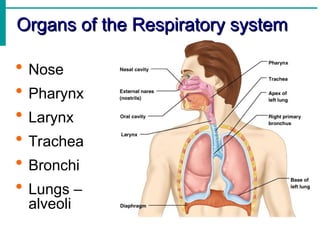
Organs of the Respiratory system
 Nose
 Pharynx
 Larynx
 Trachea
 Bronchi
 Lungs –
alveoli
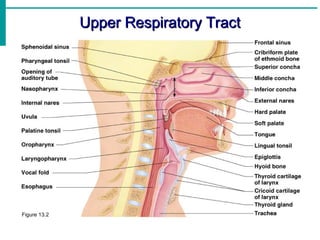
Figure 13.2
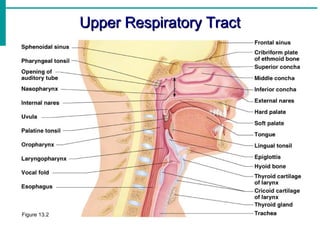
Upper Respiratory Tract
Anatomy of the Nasal Cavity
 Olfactory receptors are located in the
mucosa on the superior surface
 The rest of the cavity is lined with
respiratory mucosa
 Moistens air
 Traps incoming foreign particles
Paranasal Sinuses
Paranasal Sinuses
 Cavities within bones surrounding the
nasal cavity
 Frontal bone
 Sphenoid bone
 Ethmoid bone
 Maxillary bone
Paranasal Sinuses
Paranasal Sinuses
 Function of the sinuses
 Lighten the skull
 Act as resonance chambers for speech
 Produce mucus that drains into the nasal
cavity
Pharynx (Throat)
Pharynx (Throat)
 Muscular passage from nasal cavity to
larynx
 Three regions of the pharynx
 Nasopharynx – superior region behind
nasal cavity
 Oropharynx – middle region behind mouth
 Laryngopharynx – inferior region attached
to larynx
 The oropharynx and laryngopharynx are
common passageways for air and food
Figure 13.2
Upper Respiratory Tract
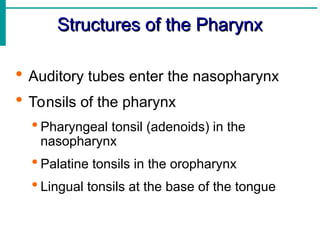
Structures of the Pharynx
 Auditory tubes enter the nasopharynx
 Tonsils of the pharynx
 Pharyngeal tonsil (adenoids) in the
nasopharynx
 Palatine tonsils in the oropharynx
 Lingual tonsils at the base of the tongue
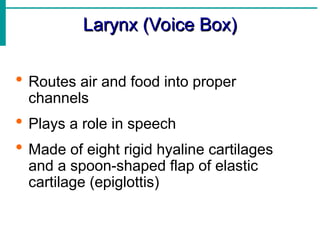
Larynx (Voice Box)
Larynx (Voice Box)
 Routes air and food into proper
channels
 Plays a role in speech
 Made of eight rigid hyaline cartilages
and a spoon-shaped flap of elastic
cartilage (epiglottis)
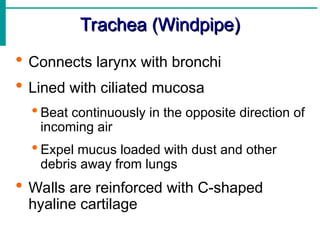
Trachea (Windpipe)
Trachea (Windpipe)
 Connects larynx with bronchi
 Lined with ciliated mucosa
 Beat continuously in the opposite direction of
incoming air
 Expel mucus loaded with dust and other
debris away from lungs
 Walls are reinforced with C-shaped
hyaline cartilage
Primary Bronchi
Primary Bronchi
 Formed by division of the trachea
 Enters the lung at the hilus
(medial depression)
 Right bronchus is wider, shorter,
and straighter than left
 Bronchi subdivide into smaller
and smaller branches
Lungs
Lungs
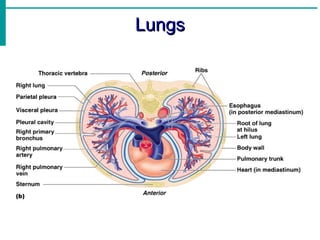
 Occupy most of the thoracic cavity
 Apex is near the clavicle (superior portion)
 Base rests on the diaphragm (inferior
portion)
 Each lung is divided into lobes by fissures
 Left lung – two lobes
 Right lung – three lobes
Lungs
Lungs
Coverings of the Lungs
 Pulmonary (visceral) pleura covers the
lung surface
 Parietal pleura lines the walls of the
thoracic cavity
 Pleural fluid fills the area between layers
of pleura to allow gliding
Respiratory Tree Divisions
 Primary bronchi
 Secondary bronchi
 Tertiary bronchi
 Bronchioli
 Terminal bronchioli
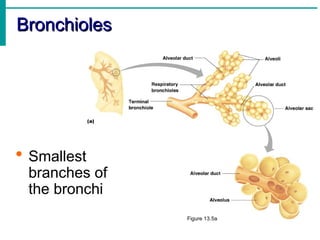
Bronchioles
Bronchioles
Figure 13.5a
 Smallest
branches of
the bronchi
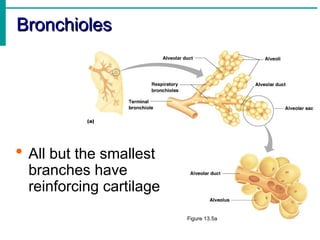
Bronchioles
Bronchioles
Figure 13.5a
 All but the smallest
branches have
reinforcing cartilage
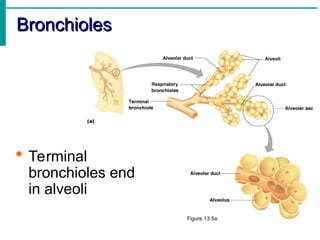
Bronchioles
Bronchioles
 Terminal
bronchioles end
in alveoli
Figure 13.5a
Respiratory Zone
Respiratory Zone
 Structures
 Respiratory bronchioli
 Alveolar duct
 Alveoli
 Site of gas exchange
Alveoli
Alveoli
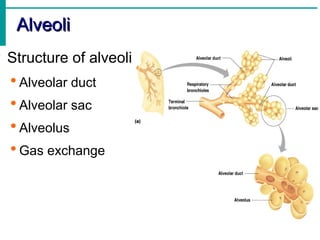
 Structure of alveoli
 Alveolar duct
 Alveolar sac
 Alveolus
 Gas exchange
Respiratory Membrane
(Air-Blood Barrier)
(Air-Blood Barrier)
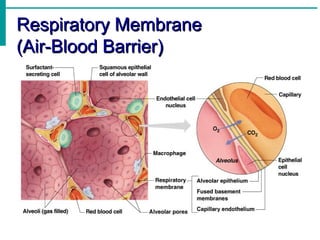
 Thin squamous epithelial layer lining
alveolar walls
 Pulmonary capillaries cover external
surfaces of alveoli
Respiratory Membrane
(Air-Blood Barrier)
(Air-Blood Barrier)
Gas Exchange
Gas Exchange
 Gas crosses the respiratory membrane
by diffusion
 Oxygen enters the blood
 Carbon dioxide enters the alveoli
 Macrophages add protection
 Surfactant coats gas-exposed alveolar
surfaces
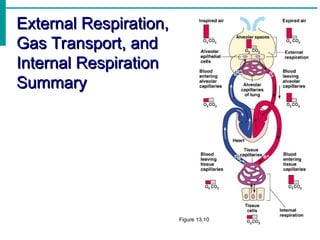
Events of Respiration
 Pulmonary ventilation – moving air in and
out of the lungs
 External respiration – gas exchange
between pulmonary blood and alveoli
Events of Respiration
 Respiratory gas transport – transport of
oxygen and carbon dioxide via the
bloodstream
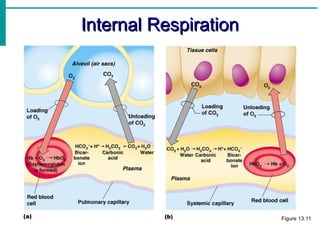
 Internal respiration – gas exchange
between blood and tissue cells in
systemic capillaries
Internal Respiration
Figure 13.11
External Respiration,
Gas Transport, and
Gas Transport, and
Internal Respiration
Summary
Summary
Figure 13.10
Mechanics of Breathing
(Pulmonary Ventilation)
 Completely mechanical process
 Depends on volume changes in the
thoracic cavity
 Volume changes lead to pressure
changes, which lead to the flow of
gases to equalize pressure
Mechanics of Breathing
(Pulmonary Ventilation)
 Two phases
 Inspiration – flow of air into lung
 Expiration – air leaving lung
Inspiration
Inspiration
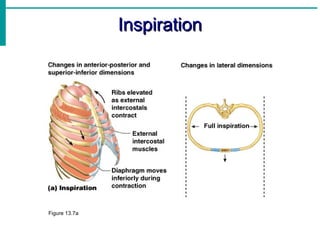
 Diaphragm and intercostal muscles
contract
 The size of the thoracic cavity increases
 External air is pulled into the lungs due to
an increase in intrapulmonary volume
Inspiration
Inspiration
Figure 13.7a
Exhalation
Exhalation
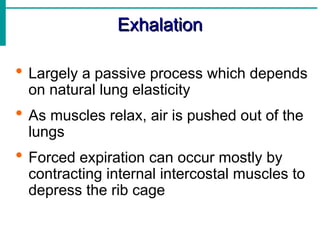
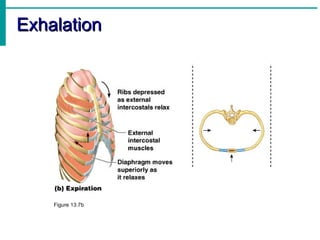
 Largely a passive process which depends
on natural lung elasticity
 As muscles relax, air is pushed out of the
lungs
 Forced expiration can occur mostly by
contracting internal intercostal muscles to
depress the rib cage
Exhalation
Exhalation
Figure 13.7b
Respiratory Volumes and Capacities
Slide 13.26
 Normal breathing moves about 500 ml of air
with each breath (tidal volume [TV])
 Many factors that affect respiratory capacity
 A person’s size
 Sex
 Age
 Physical condition
 Residual volume of air – after exhalation,
about 1200 ml of air remains in the lungs
Factors Influencing Respiratory
Rate and Depth
Rate and Depth
 1. Physical factors
 Increased body temperature
 Exercise
 Talking
 Coughing
 2. Volition (conscious control)
 3. Emotional factors
Factors Influencing Respiratory
Rate and Depth
Rate and Depth
 4. Chemical factors
 Carbon dioxide levels
 Level of carbon dioxide in the blood is the
main regulatory chemical for respiration
 Increased carbon dioxide increases
respiration
 Changes in carbon dioxide act directly on
the medulla oblongata
Factors Influencing Respiratory
Rate and Depth
Rate and Depth
 Chemical factors (continued)
 Oxygen levels
 Changes in oxygen concentration in the
blood are detected by chemoreceptors in
the aorta and carotid artery
 Information is sent to the medulla oblongata
Developmental Aspects of the
Respiratory System
Respiratory System
 Lungs are filled with fluid in the fetus
 Lungs are not fully inflated with air until
two weeks after birth
 Surfactant that lowers alveolar surface
tension is not present until late in fetal
development and may not be present in
premature babies
Aging Effects
Aging Effects
 Elasticity of lungs decreases
 Vital capacity decreases
 Blood oxygen levels decrease
 Stimulating effects of carbon dioxide
decreases
 More risks of respiratory tract infection
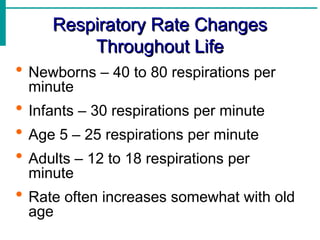
Respiratory Rate Changes
Throughout Life
Throughout Life
 Newborns – 40 to 80 respirations per
minute
 Infants – 30 respirations per minute
 Age 5 – 25 respirations per minute
 Adults – 12 to 18 respirations per
minute
 Rate often increases somewhat with old
age
RESPIRATORY.ppt respiratory systemmmmmmm

RESPIRATORY.ppt respiratory systemmmmmmm

  • 1.
    Human Anatomy &Physiology Chapter 8 The Respiratory System Dr. Zainab Hayder Alkufaishi M.B.Ch.B F.I.C.M.S. Path. 2nd Year Medical Intelligent System 1st Semester 2023-2024
  • 2.
    Function of theRespiratory System Function of the Respiratory System  Oversees gas exchanges (oxygen and carbon dioxide) between the blood and external environment  Exchange of gasses takes place within the lungs in the alveoli(only site of gas exchange, other structures passageways  Passageways to the lungs purify, warm, and humidify the incoming air  Shares responsibility with cardiovascular system
  • 3.
    Organs of theRespiratory system Organs of the Respiratory system  Nose  Pharynx  Larynx  Trachea  Bronchi  Lungs – alveoli
  • 4.
    Figure 13.2 Upper RespiratoryTract Upper Respiratory Tract
  • 5.
    Anatomy of theNasal Cavity Anatomy of the Nasal Cavity  Olfactory receptors are located in the mucosa on the superior surface  The rest of the cavity is lined with respiratory mucosa  Moistens air  Traps incoming foreign particles
  • 6.
    Paranasal Sinuses Paranasal Sinuses Cavities within bones surrounding the nasal cavity  Frontal bone  Sphenoid bone  Ethmoid bone  Maxillary bone
  • 7.
    Paranasal Sinuses Paranasal Sinuses Function of the sinuses  Lighten the skull  Act as resonance chambers for speech  Produce mucus that drains into the nasal cavity
  • 8.
    Pharynx (Throat) Pharynx (Throat) Muscular passage from nasal cavity to larynx  Three regions of the pharynx  Nasopharynx – superior region behind nasal cavity  Oropharynx – middle region behind mouth  Laryngopharynx – inferior region attached to larynx  The oropharynx and laryngopharynx are common passageways for air and food
  • 9.
    Figure 13.2 Upper RespiratoryTract Upper Respiratory Tract
  • 10.
    Structures of thePharynx Structures of the Pharynx  Auditory tubes enter the nasopharynx  Tonsils of the pharynx  Pharyngeal tonsil (adenoids) in the nasopharynx  Palatine tonsils in the oropharynx  Lingual tonsils at the base of the tongue
  • 11.
    Larynx (Voice Box) Larynx(Voice Box)  Routes air and food into proper channels  Plays a role in speech  Made of eight rigid hyaline cartilages and a spoon-shaped flap of elastic cartilage (epiglottis)
  • 12.
    Trachea (Windpipe) Trachea (Windpipe) Connects larynx with bronchi  Lined with ciliated mucosa  Beat continuously in the opposite direction of incoming air  Expel mucus loaded with dust and other debris away from lungs  Walls are reinforced with C-shaped hyaline cartilage
  • 13.
    Primary Bronchi Primary Bronchi Formed by division of the trachea  Enters the lung at the hilus (medial depression)  Right bronchus is wider, shorter, and straighter than left  Bronchi subdivide into smaller and smaller branches
  • 14.
    Lungs Lungs  Occupy mostof the thoracic cavity  Apex is near the clavicle (superior portion)  Base rests on the diaphragm (inferior portion)  Each lung is divided into lobes by fissures  Left lung – two lobes  Right lung – three lobes
  • 15.
  • 16.
    Coverings of theLungs Coverings of the Lungs  Pulmonary (visceral) pleura covers the lung surface  Parietal pleura lines the walls of the thoracic cavity  Pleural fluid fills the area between layers of pleura to allow gliding
  • 17.
    Respiratory Tree Divisions RespiratoryTree Divisions  Primary bronchi  Secondary bronchi  Tertiary bronchi  Bronchioli  Terminal bronchioli
  • 18.
  • 19.
    Bronchioles Bronchioles Figure 13.5a  Allbut the smallest branches have reinforcing cartilage
  • 20.
  • 21.
    Respiratory Zone Respiratory Zone Structures  Respiratory bronchioli  Alveolar duct  Alveoli  Site of gas exchange
  • 22.
    Alveoli Alveoli  Structure ofalveoli  Alveolar duct  Alveolar sac  Alveolus  Gas exchange
  • 23.
    Respiratory Membrane Respiratory Membrane (Air-BloodBarrier) (Air-Blood Barrier)  Thin squamous epithelial layer lining alveolar walls  Pulmonary capillaries cover external surfaces of alveoli
  • 24.
  • 25.
    Gas Exchange Gas Exchange Gas crosses the respiratory membrane by diffusion  Oxygen enters the blood  Carbon dioxide enters the alveoli  Macrophages add protection  Surfactant coats gas-exposed alveolar surfaces
  • 26.
    Events of Respiration Eventsof Respiration  Pulmonary ventilation – moving air in and out of the lungs  External respiration – gas exchange between pulmonary blood and alveoli
  • 27.
    Events of Respiration Eventsof Respiration  Respiratory gas transport – transport of oxygen and carbon dioxide via the bloodstream  Internal respiration – gas exchange between blood and tissue cells in systemic capillaries
  • 28.
  • 29.
    External Respiration, External Respiration, GasTransport, and Gas Transport, and Internal Respiration Internal Respiration Summary Summary Figure 13.10
  • 30.
    Mechanics of Breathing Mechanicsof Breathing (Pulmonary Ventilation) (Pulmonary Ventilation)  Completely mechanical process  Depends on volume changes in the thoracic cavity  Volume changes lead to pressure changes, which lead to the flow of gases to equalize pressure
  • 31.
    Mechanics of Breathing Mechanicsof Breathing (Pulmonary Ventilation) (Pulmonary Ventilation)  Two phases  Inspiration – flow of air into lung  Expiration – air leaving lung
  • 32.
    Inspiration Inspiration  Diaphragm andintercostal muscles contract  The size of the thoracic cavity increases  External air is pulled into the lungs due to an increase in intrapulmonary volume
  • 33.
  • 34.
    Exhalation Exhalation  Largely apassive process which depends on natural lung elasticity  As muscles relax, air is pushed out of the lungs  Forced expiration can occur mostly by contracting internal intercostal muscles to depress the rib cage
  • 35.
  • 36.
    Respiratory Volumes andCapacities Respiratory Volumes and Capacities Slide 13.26  Normal breathing moves about 500 ml of air with each breath (tidal volume [TV])  Many factors that affect respiratory capacity  A person’s size  Sex  Age  Physical condition  Residual volume of air – after exhalation, about 1200 ml of air remains in the lungs
  • 37.
    Factors Influencing Respiratory FactorsInfluencing Respiratory Rate and Depth Rate and Depth  1. Physical factors  Increased body temperature  Exercise  Talking  Coughing  2. Volition (conscious control)  3. Emotional factors
  • 38.
    Factors Influencing Respiratory FactorsInfluencing Respiratory Rate and Depth Rate and Depth  4. Chemical factors  Carbon dioxide levels  Level of carbon dioxide in the blood is the main regulatory chemical for respiration  Increased carbon dioxide increases respiration  Changes in carbon dioxide act directly on the medulla oblongata
  • 39.
    Factors Influencing Respiratory FactorsInfluencing Respiratory Rate and Depth Rate and Depth  Chemical factors (continued)  Oxygen levels  Changes in oxygen concentration in the blood are detected by chemoreceptors in the aorta and carotid artery  Information is sent to the medulla oblongata
  • 40.
    Developmental Aspects ofthe Developmental Aspects of the Respiratory System Respiratory System  Lungs are filled with fluid in the fetus  Lungs are not fully inflated with air until two weeks after birth  Surfactant that lowers alveolar surface tension is not present until late in fetal development and may not be present in premature babies
  • 41.
    Aging Effects Aging Effects Elasticity of lungs decreases  Vital capacity decreases  Blood oxygen levels decrease  Stimulating effects of carbon dioxide decreases  More risks of respiratory tract infection
  • 42.
    Respiratory Rate Changes RespiratoryRate Changes Throughout Life Throughout Life  Newborns – 40 to 80 respirations per minute  Infants – 30 respirations per minute  Age 5 – 25 respirations per minute  Adults – 12 to 18 respirations per minute  Rate often increases somewhat with old age