Lloyd Dean Respiratory System
Lesson Objectives By the end of the lesson you should be able to: Describe the structure and function of the respiratory system Identify, describe and explain the role of the diaphragm and the intercostal muscles in the mechanics of breathing Explain how the transport of gases is achieved from the respiratory system into the cardiovascular system
 
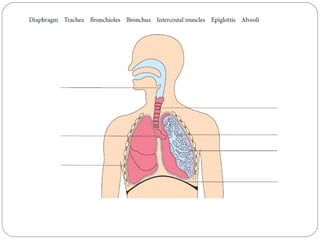
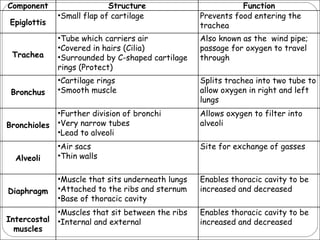
Component Structure Function Epiglottis Small flap of cartilage Prevents food entering the trachea Trachea Tube which carriers air Covered in hairs (Cilia) Surrounded by C-shaped cartilage rings (Protect) Also known as the  wind pipe; passage for oxygen to travel through Bronchus Cartilage rings Smooth muscle Splits trachea into two tube to allow oxygen in right and left lungs Bronchioles Further division of bronchi Very narrow tubes Lead to alveoli Allows oxygen to filter into alveoli Alveoli Air sacs Thin walls Site for exchange of gasses Diaphragm Muscle that sits underneath lungs Attached to the ribs and sternum Base of thoracic cavity Enables thoracic cavity to be increased and decreased Intercostal muscles Muscles that sit between the ribs Internal and external Enables thoracic cavity to be increased and decreased
Breathing Mechanics Four things need to happen in order for respiratory system to fulfil its function: Inspiration External Respiration Internal Respiration Expiration
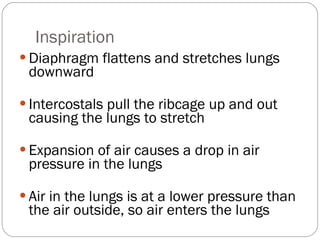
Inspiration Diaphragm flattens and stretches lungs downward Intercostals pull the ribcage up and out causing the lungs to stretch  Expansion of air causes a drop in air pressure in the lungs Air in the lungs is at a lower pressure than the air outside, so air enters the lungs
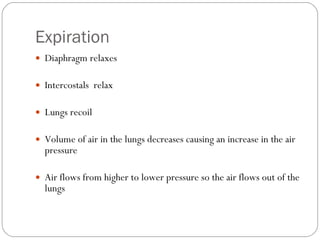
Expiration Diaphragm relaxes Intercostals  relax Lungs recoil  Volume of air in the lungs decreases causing an increase in the air pressure Air flows from higher to lower pressure so the air flows out of the lungs
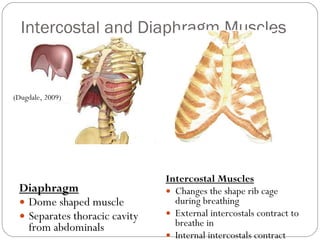
Intercostal and Diaphragm Muscles Diaphragm Dome shaped muscle Separates thoracic cavity from abdominals Intercostal Muscles Changes the shape rib cage during breathing  External intercostals contract to breathe in  Internal intercostals contract during forced breathing out  (Author Unknown, Date Unknown) (Dugdale, 2009)
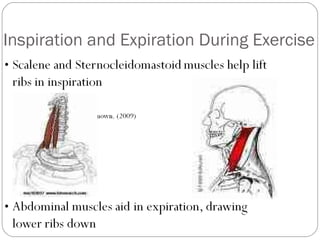
Inspiration and Expiration During Exercise
Inhalation and Exhalation
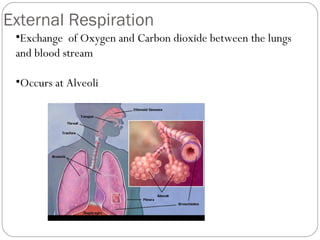
External Respiration (WebMD, 2009) Exchange  of Oxygen and Carbon dioxide between the lungs and blood stream Occurs at Alveoli
Diffusion Oxygen (0 2 ) is required in tissues Carbon dioxide (CO 2 ) has to be removed Exchange occurs through Diffusion Movement of particles from a high concentration area, to a low concentration area Rule  = Diffusion only occurs down a concentration gradient Concentration (pressure ) oxygen   in lungs must be higher than concentration (pressure) in capillaries
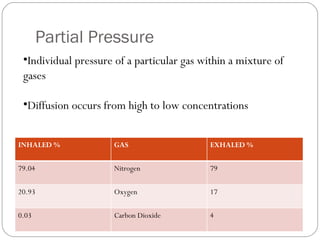
Partial Pressure Individual pressure of a particular gas within a mixture of gases Diffusion occurs from high to low concentrations INHALED % GAS EXHALED % 79.04  Nitrogen 79 20.93 Oxygen 17 0.03 Carbon Dioxide 4
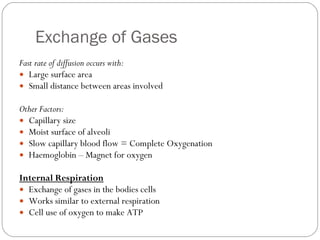
Exchange of Gases Fast rate of diffusion occurs with: Large surface area Small distance between areas involved Other Factors: Capillary size Moist surface of alveoli Slow capillary blood flow = Complete Oxygenation Haemoglobin – Magnet for oxygen Internal Respiration Exchange of gases in the bodies cells Works similar to external respiration Cell use of oxygen to make ATP
Gas Exchange
Gas Exchange

Structure and function of the lungs

  • 1.
  • 2.
    Lesson Objectives Bythe end of the lesson you should be able to: Describe the structure and function of the respiratory system Identify, describe and explain the role of the diaphragm and the intercostal muscles in the mechanics of breathing Explain how the transport of gases is achieved from the respiratory system into the cardiovascular system
  • 3.
  • 4.
    Component Structure FunctionEpiglottis Small flap of cartilage Prevents food entering the trachea Trachea Tube which carriers air Covered in hairs (Cilia) Surrounded by C-shaped cartilage rings (Protect) Also known as the wind pipe; passage for oxygen to travel through Bronchus Cartilage rings Smooth muscle Splits trachea into two tube to allow oxygen in right and left lungs Bronchioles Further division of bronchi Very narrow tubes Lead to alveoli Allows oxygen to filter into alveoli Alveoli Air sacs Thin walls Site for exchange of gasses Diaphragm Muscle that sits underneath lungs Attached to the ribs and sternum Base of thoracic cavity Enables thoracic cavity to be increased and decreased Intercostal muscles Muscles that sit between the ribs Internal and external Enables thoracic cavity to be increased and decreased
  • 5.
    Breathing Mechanics Fourthings need to happen in order for respiratory system to fulfil its function: Inspiration External Respiration Internal Respiration Expiration
  • 6.
    Inspiration Diaphragm flattensand stretches lungs downward Intercostals pull the ribcage up and out causing the lungs to stretch Expansion of air causes a drop in air pressure in the lungs Air in the lungs is at a lower pressure than the air outside, so air enters the lungs
  • 7.
    Expiration Diaphragm relaxesIntercostals relax Lungs recoil Volume of air in the lungs decreases causing an increase in the air pressure Air flows from higher to lower pressure so the air flows out of the lungs
  • 8.
    Intercostal and DiaphragmMuscles Diaphragm Dome shaped muscle Separates thoracic cavity from abdominals Intercostal Muscles Changes the shape rib cage during breathing External intercostals contract to breathe in Internal intercostals contract during forced breathing out (Author Unknown, Date Unknown) (Dugdale, 2009)
  • 9.
  • 10.
  • 11.
    External Respiration (WebMD,2009) Exchange of Oxygen and Carbon dioxide between the lungs and blood stream Occurs at Alveoli
  • 12.
    Diffusion Oxygen (02 ) is required in tissues Carbon dioxide (CO 2 ) has to be removed Exchange occurs through Diffusion Movement of particles from a high concentration area, to a low concentration area Rule = Diffusion only occurs down a concentration gradient Concentration (pressure ) oxygen in lungs must be higher than concentration (pressure) in capillaries
  • 13.
    Partial Pressure Individualpressure of a particular gas within a mixture of gases Diffusion occurs from high to low concentrations INHALED % GAS EXHALED % 79.04 Nitrogen 79 20.93 Oxygen 17 0.03 Carbon Dioxide 4
  • 14.
    Exchange of GasesFast rate of diffusion occurs with: Large surface area Small distance between areas involved Other Factors: Capillary size Moist surface of alveoli Slow capillary blood flow = Complete Oxygenation Haemoglobin – Magnet for oxygen Internal Respiration Exchange of gases in the bodies cells Works similar to external respiration Cell use of oxygen to make ATP
  • 15.
  • 16.

Editor's Notes

  • #6 Explain difference between inspiration, expiration and respiration Page 5 in Books
  • #7 Page 6 in Books
  • #8 Page 6 in Books
  • #9 Page 6 in Books
  • #12 Link Breathing to Gaseous exchange. Where does it occur? How Does it occur?
  • #13 Page 7 in Books
  • #14 Page 7 in Books ACTIVITY - Turn Two Tables Upside Down Table 1 (ALVEOLI) 3 Students being “Oxygen” 1 Student being “Carbon Dioxide” Table 2 (CAPILLARIES) 3 Students being “Carbon Dioxide” 1 Student being “Oxygen” Which partial pressure of Carbon Dioxide and Oxygen has highest concentration? Let them diffuse Link to oxygenated and deoxygenated blood
  • #15 Page 7 in Books