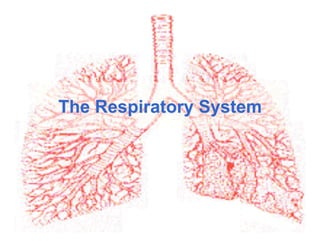
The Respiratory System
Function of the Respiratory System
•  To provide a constant supply of
oxygen (O2) to keep your body cells
functioning
•  To remove carbon dioxide (CO2) from
the body cells
Structure of the Respiratory
System are the Organs
•  Nose
•  Mouth
•  Nasal cavity
•  Pharynx
•  Epiglottis
•  Larynx
•  Trachea
•  Bronchus (bronchi)
•  Bronchioles
•  Alveoli
•  Pleura
•  Diaphragm
Lungs
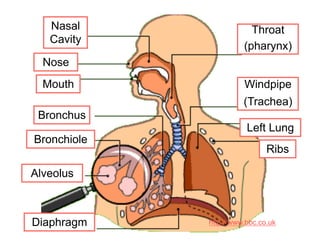
http://www.bbc.co.uk
Nasal
Cavity
Nose
Mouth
Bronchus
Bronchiole
Alveolus
Diaphragm
Throat
(pharynx)
Windpipe
(Trachea)
Left Lung
Ribs
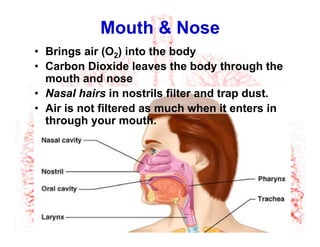
Mouth & Nose
•  Brings air (O2) into the body
•  Carbon Dioxide leaves the body through the
mouth and nose
•  Nasal hairs in nostrils filter and trap dust.
•  Air is not filtered as much when it enters in
through your mouth.
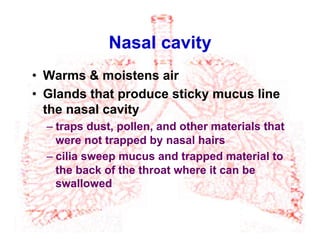
Nasal cavity
•  Warms & moistens air
•  Glands that produce sticky mucus line
the nasal cavity
– traps dust, pollen, and other materials that
were not trapped by nasal hairs
– cilia sweep mucus and trapped material to
the back of the throat where it can be
swallowed
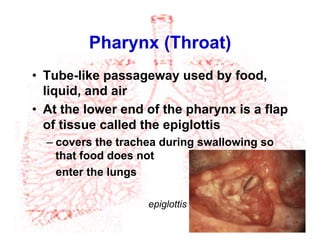
Pharynx (Throat)
•  Tube-like passageway used by food,
liquid, and air
•  At the lower end of the pharynx is a flap
of tissue called the epiglottis
– covers the trachea during swallowing so
that food does not
enter the lungs
epiglottis
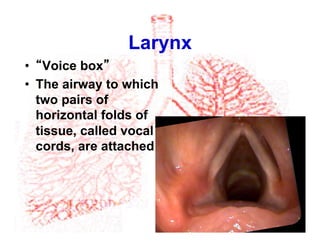
Larynx
•  “Voice box”
•  The airway to which
two pairs of
horizontal folds of
tissue, called vocal
cords, are attached
Trachea (Windpipe)
•  Air-conducting tube
•  Connects the larynx with the bronchi
•  Lined with mucous membranes and
cilia
•  Contains strong cartilage rings which
hold the trachea open. Without these
rings your trachea might close off and
air would not be able to get to and from
your lungs.
Bronchi
•  Two short tubes that branch off the
lower end of the trachea
•  Carry air into the lungs.
•  Singular - bronchus
Bronchioles
•  bronchi tubes split up, like tree
branches, and get smaller and smaller
inside your lungs.
•  The tiny branches of air tubes in the
lungs are bronchioles
•  Connect bronchi to alveoli
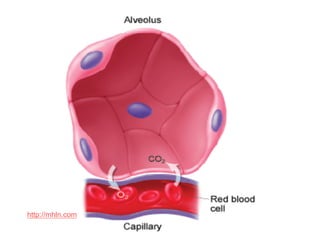
Alveoli
•  Tiny, thin-walled, grapelike clusters at
the end of each bronchiole
•  Surrounded by capillaries
•  Where carbon dioxide and oxygen
exchange take place
•  Singular - alveolus
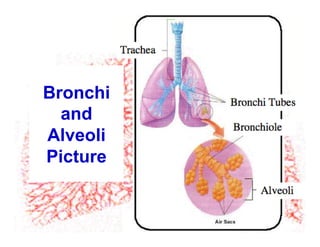
Bronchi
and
Alveoli
Picture
http://mhln.com
Pleura
•  Membrane lining the lungs and chest
cavity
Diaphragm
•  Muscle wall between the chest and the
abdomen that the body uses for breathing
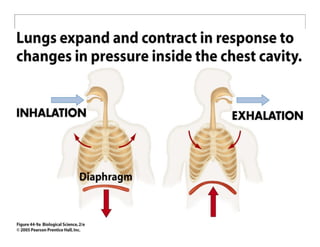
•  Lungs expand and contract in response to
changes in pressure inside the chest cavity.
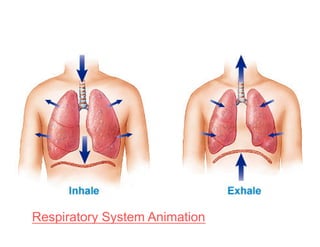
•  The diaphragm flattens to cause the chest to
expand and air is pulled into the lungs.
•  When the diaphragm relaxes, the chest
collapses and the air in the lungs is forced out.
Diagram of Diaphram
Respiratory System Animation
Inhalation
•  Breathing in
•  Body gets oxygen from the air
•  Rib muscles contract to pull ribs up and
out
•  Diaphragm muscle contracts to pull down
the lungs
•  Tissue expands to force (pull) in air.
Exhalation
•  Breathing out
•  Get rid of carbon dioxide
•  Rib muscles relax
•  Diaphragm muscle relaxes
•  Tissue returns to resting position and
forces (pushes) air out
Breathing and Respiration are
NOT the same thing!
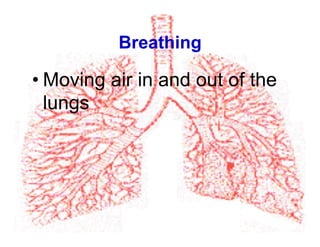
Breathing
• Moving air in and out of the
lungs
Respiration
•  Chemical reaction that releases energy
C6H12O6 + 6O2 à 6CO2 + 6 H2O + Energy
Relationship to Digestive System
•  Cellular respiration requires glucose
and oxygen to release energy to the
body
•  C6H12O6 + 6O2 à 6CO2 + 6 H2O + Energy
•  Oxygen is provided by the respiratory
system
•  Glucose is provided by the digestive system
•  (glucose is made during photosynthesis)
Relationship to Nervous System
•  The respiratory system is under control of
the involuntary and voluntary nervous
system.
—We don’t think about breathing.
—The autonomic nervous system controls
breathing in response to the amount of
carbon dioxide in the blood.
Relationship to Nervous System
•  The respiratory system is under control of
the involuntary and voluntary nervous
system.
—We don’t think about breathing.
—The autonomic nervous system controls
breathing in response to the amount of
carbon dioxide in the blood.
Relationship to Nervous System
—Humans can decide to hold their breath.
—The respiratory system is then controlled
by the somatic nervous system.
—If you pass out from holding your breath,
your autonomic nervous system will take
over and return the blood gasses to
normal.
Respiratory Information
Each lung is about the size of a football.
The lungs fill the area from the collarbone to
the bottom of the ribs.
Lungs are the only organ in the body light
enough to float.
There are 300-500 million alveoli having a
total surface area or about 75 m2 in adults
(about the size of three living rooms).
Respiratory Information
•  If all the capillaries that surround the
alveoli were unwound and laid end to end
they would extend about 620 miles.
•  At rest, the body takes in and breathes out
about 10 liters of air each minute.
•  The right lung is slightly larger than the
left.
•  The highest recorded "sneeze speed" is
165 km per hour.
Respiratory Information
•  The surface area of the lungs is roughly
the same size as a tennis court.
•  We lose half a liter of water a day through
breathing. This is the water vapor we see
when we breathe onto glass.
•  A person at rest usually breathes between
12 and 15 times a minute.
•  The breathing rate is faster in children
and women than in men.

2013 respiratory system pdf

  • 1.
  • 2.
    Function of theRespiratory System •  To provide a constant supply of oxygen (O2) to keep your body cells functioning •  To remove carbon dioxide (CO2) from the body cells
  • 3.
    Structure of theRespiratory System are the Organs •  Nose •  Mouth •  Nasal cavity •  Pharynx •  Epiglottis •  Larynx •  Trachea •  Bronchus (bronchi) •  Bronchioles •  Alveoli •  Pleura •  Diaphragm Lungs
  • 4.
  • 5.
    Mouth & Nose • Brings air (O2) into the body •  Carbon Dioxide leaves the body through the mouth and nose •  Nasal hairs in nostrils filter and trap dust. •  Air is not filtered as much when it enters in through your mouth.
  • 6.
    Nasal cavity •  Warms& moistens air •  Glands that produce sticky mucus line the nasal cavity – traps dust, pollen, and other materials that were not trapped by nasal hairs – cilia sweep mucus and trapped material to the back of the throat where it can be swallowed
  • 7.
    Pharynx (Throat) •  Tube-likepassageway used by food, liquid, and air •  At the lower end of the pharynx is a flap of tissue called the epiglottis – covers the trachea during swallowing so that food does not enter the lungs epiglottis
  • 8.
    Larynx •  “Voice box” • The airway to which two pairs of horizontal folds of tissue, called vocal cords, are attached
  • 9.
    Trachea (Windpipe) •  Air-conductingtube •  Connects the larynx with the bronchi •  Lined with mucous membranes and cilia •  Contains strong cartilage rings which hold the trachea open. Without these rings your trachea might close off and air would not be able to get to and from your lungs.
  • 10.
    Bronchi •  Two shorttubes that branch off the lower end of the trachea •  Carry air into the lungs. •  Singular - bronchus
  • 11.
    Bronchioles •  bronchi tubessplit up, like tree branches, and get smaller and smaller inside your lungs. •  The tiny branches of air tubes in the lungs are bronchioles •  Connect bronchi to alveoli
  • 12.
    Alveoli •  Tiny, thin-walled,grapelike clusters at the end of each bronchiole •  Surrounded by capillaries •  Where carbon dioxide and oxygen exchange take place •  Singular - alveolus
  • 13.
  • 14.
  • 15.
    Pleura •  Membrane liningthe lungs and chest cavity
  • 16.
    Diaphragm •  Muscle wallbetween the chest and the abdomen that the body uses for breathing •  Lungs expand and contract in response to changes in pressure inside the chest cavity. •  The diaphragm flattens to cause the chest to expand and air is pulled into the lungs. •  When the diaphragm relaxes, the chest collapses and the air in the lungs is forced out.
  • 17.
  • 18.
  • 19.
    Inhalation •  Breathing in • Body gets oxygen from the air •  Rib muscles contract to pull ribs up and out •  Diaphragm muscle contracts to pull down the lungs •  Tissue expands to force (pull) in air.
  • 20.
    Exhalation •  Breathing out • Get rid of carbon dioxide •  Rib muscles relax •  Diaphragm muscle relaxes •  Tissue returns to resting position and forces (pushes) air out
  • 21.
    Breathing and Respirationare NOT the same thing!
  • 22.
    Breathing • Moving air inand out of the lungs
  • 23.
    Respiration •  Chemical reactionthat releases energy C6H12O6 + 6O2 à 6CO2 + 6 H2O + Energy
  • 24.
    Relationship to DigestiveSystem •  Cellular respiration requires glucose and oxygen to release energy to the body •  C6H12O6 + 6O2 à 6CO2 + 6 H2O + Energy •  Oxygen is provided by the respiratory system •  Glucose is provided by the digestive system •  (glucose is made during photosynthesis)
  • 25.
    Relationship to NervousSystem •  The respiratory system is under control of the involuntary and voluntary nervous system. —We don’t think about breathing. —The autonomic nervous system controls breathing in response to the amount of carbon dioxide in the blood.
  • 26.
    Relationship to NervousSystem •  The respiratory system is under control of the involuntary and voluntary nervous system. —We don’t think about breathing. —The autonomic nervous system controls breathing in response to the amount of carbon dioxide in the blood.
  • 27.
    Relationship to NervousSystem —Humans can decide to hold their breath. —The respiratory system is then controlled by the somatic nervous system. —If you pass out from holding your breath, your autonomic nervous system will take over and return the blood gasses to normal.
  • 28.
    Respiratory Information Each lungis about the size of a football. The lungs fill the area from the collarbone to the bottom of the ribs. Lungs are the only organ in the body light enough to float. There are 300-500 million alveoli having a total surface area or about 75 m2 in adults (about the size of three living rooms).
  • 29.
    Respiratory Information •  Ifall the capillaries that surround the alveoli were unwound and laid end to end they would extend about 620 miles. •  At rest, the body takes in and breathes out about 10 liters of air each minute. •  The right lung is slightly larger than the left. •  The highest recorded "sneeze speed" is 165 km per hour.
  • 30.
    Respiratory Information •  Thesurface area of the lungs is roughly the same size as a tennis court. •  We lose half a liter of water a day through breathing. This is the water vapor we see when we breathe onto glass. •  A person at rest usually breathes between 12 and 15 times a minute. •  The breathing rate is faster in children and women than in men.