PRESENTATION ON
TYPES OF ABSORPTION BANDS
11/16/2017 1
PRESENTED BY:
Khondaker Afrina Hoque .
ID: 1114015 , Reg:900048
Sesssion: 2011-2012.
Department of chemistry.
Comilla University.
11/16/2017 2
THE ABSORPTION BAND
An absorption band is a range of wavelength ,
frequencies , or energies in the electromagnetic
spectrum which are characteristic of a particular
transition from initial to final state in a substance.
11/16/2017
3
TYPES OF ABSORPTION BANDS.
Following types of bands originates as a result of the
possible transition in a compound.
•K* Bands.
•R* Bands.
•B- Bands.
•E- Bands.
11/16/2017 4
K* BANDS.
Transition   *.
Examples:
1) dienes, polyenes, enones etc conjugated system containing
compounds.
2) Aromatic compounds substituted by chromophores.
Intensity: 104 .
Solvent effect:
‘enes’ and ‘enones’ are effected differently by changing the
polarity of the solvent.
Enones show red shift with increasing the polarity of the
solvent.
11/16/2017
5
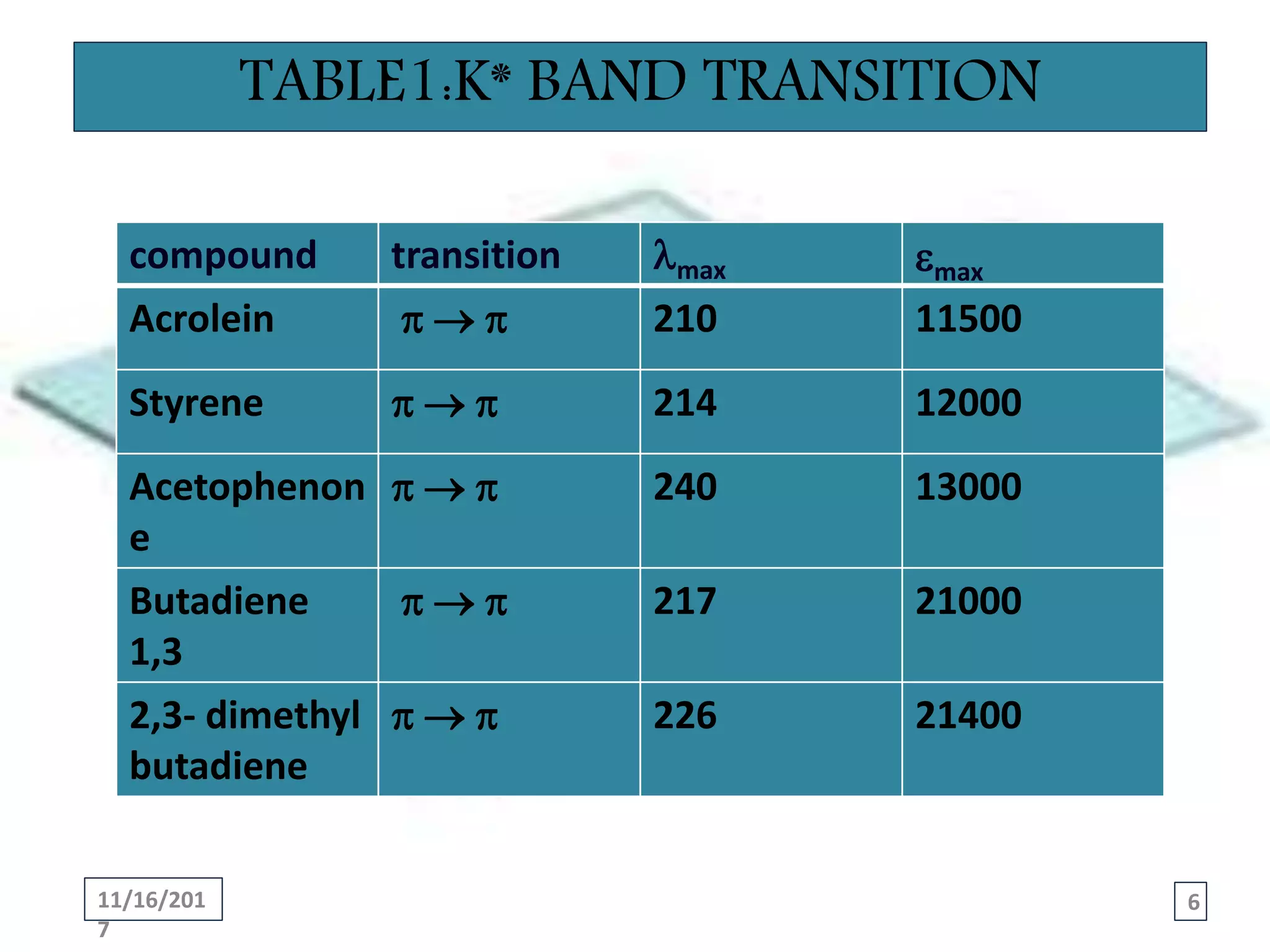
TABLE1:K* BAND TRANSITION
compound transition max max
Acrolein    210 11500
Styrene    214 12000
Acetophenon
e
   240 13000
Butadiene
1,3
   217 21000
2,3- dimethyl
butadiene
   226 21400
11/16/201
7
6
R* BANDS
Transition: n  *.
Cause: unsaturated compounds containing
heteroatoms.
Intensity: less ( below 100).
•Also called forbidden bands.
Solvent effect:
with increase in polarity of the solvent shifts to
shorter wavelength.( blue shift)
11/16/2017
7
TABLE 2:R-BAND TRANSITION
Compound Transition max max
Acetone n  * 270 15
Acetaldehyde n  * 293 12
Acrolein n  * 315 14
Acetophenone n  * 319 50
11/16/201
7
8
B-BAND.
Transition:   *.
Cause: double bond containing aromatic or hetero-
aromatic molecules.
Intensity: more than R-band.
Solvent effect: hyperchromic shift in heterocyclic
aromatic compounds.
Examples: benzene, styrene phenol etc.
11/16/201
7
9
TABLE 3:B-BAND TRANSITION
compound transition max max
Benzene   * 255 215
Styrene   * 282 450
Toluene   * 262 174
Phenol   * 270 1450
Acetophenone   * 278 1110
11/16/2017 10
E-BANDS.
Transition:   *.
Cause: double bonds in benzenoids.
Characterised by E1 and E2 bands.
• E1-lower wavelength.
• E2-longer wavelenth.
11/16/201
7
11
TABLE 4: E-BAND TRANSITION.
max
(mm)
max max
(mm)
max
Benzene 184 50000 204 7900
Napthalene 221 133000 286 9300
Anthracene 256 180000 375 9000
Pyrrole 234 10800 288 760
Thiophene 270 6300 294 600
compounds E1-band E2-band
11/16/201
7
12
Summary of UV- Absorption Bands.
Band Transition Example Cause/Source  (m) log max
---   * hexane alkanes (sat’d HC’s) < 200
E   * C2H4, 1,4-
pentadiene
unconjugated, unsaturated
cpds.
<200 variable
K   * 1,3-pentadiene conjugated systems 210 -250 3.7 - 4.7
B   * benzenes double bonds in benzenoids 230 -280 2.3 - 3.3
E1   * benzenes double bonds in benzenoids 180 -
190
variable
E2   * benzenes double bonds in benzenoids ~ 200 variable
--- n  * CH3NH2, CH3OH,
CCl4
most heteroatoms in
saturated cpds.
160 -
190
2.3 - 4.0
R n  * acetone, MEK heteroatoms in unsaturated
cpds.
> 250 1.0 -1.7
11/16/201
7
13
THANKS TO ALL……..
11/16/2017
14

The absorption band

  • 1.
    PRESENTATION ON TYPES OFABSORPTION BANDS 11/16/2017 1
  • 2.
    PRESENTED BY: Khondaker AfrinaHoque . ID: 1114015 , Reg:900048 Sesssion: 2011-2012. Department of chemistry. Comilla University. 11/16/2017 2
  • 3.
    THE ABSORPTION BAND Anabsorption band is a range of wavelength , frequencies , or energies in the electromagnetic spectrum which are characteristic of a particular transition from initial to final state in a substance. 11/16/2017 3
  • 4.
    TYPES OF ABSORPTIONBANDS. Following types of bands originates as a result of the possible transition in a compound. •K* Bands. •R* Bands. •B- Bands. •E- Bands. 11/16/2017 4
  • 5.
    K* BANDS. Transition  *. Examples: 1) dienes, polyenes, enones etc conjugated system containing compounds. 2) Aromatic compounds substituted by chromophores. Intensity: 104 . Solvent effect: ‘enes’ and ‘enones’ are effected differently by changing the polarity of the solvent. Enones show red shift with increasing the polarity of the solvent. 11/16/2017 5
  • 6.
    TABLE1:K* BAND TRANSITION compoundtransition max max Acrolein    210 11500 Styrene    214 12000 Acetophenon e    240 13000 Butadiene 1,3    217 21000 2,3- dimethyl butadiene    226 21400 11/16/201 7 6
  • 7.
    R* BANDS Transition: n *. Cause: unsaturated compounds containing heteroatoms. Intensity: less ( below 100). •Also called forbidden bands. Solvent effect: with increase in polarity of the solvent shifts to shorter wavelength.( blue shift) 11/16/2017 7
  • 8.
    TABLE 2:R-BAND TRANSITION CompoundTransition max max Acetone n  * 270 15 Acetaldehyde n  * 293 12 Acrolein n  * 315 14 Acetophenone n  * 319 50 11/16/201 7 8
  • 9.
    B-BAND. Transition:  *. Cause: double bond containing aromatic or hetero- aromatic molecules. Intensity: more than R-band. Solvent effect: hyperchromic shift in heterocyclic aromatic compounds. Examples: benzene, styrene phenol etc. 11/16/201 7 9
  • 10.
    TABLE 3:B-BAND TRANSITION compoundtransition max max Benzene   * 255 215 Styrene   * 282 450 Toluene   * 262 174 Phenol   * 270 1450 Acetophenone   * 278 1110 11/16/2017 10
  • 11.
    E-BANDS. Transition:  *. Cause: double bonds in benzenoids. Characterised by E1 and E2 bands. • E1-lower wavelength. • E2-longer wavelenth. 11/16/201 7 11
  • 12.
    TABLE 4: E-BANDTRANSITION. max (mm) max max (mm) max Benzene 184 50000 204 7900 Napthalene 221 133000 286 9300 Anthracene 256 180000 375 9000 Pyrrole 234 10800 288 760 Thiophene 270 6300 294 600 compounds E1-band E2-band 11/16/201 7 12
  • 13.
    Summary of UV-Absorption Bands. Band Transition Example Cause/Source  (m) log max ---   * hexane alkanes (sat’d HC’s) < 200 E   * C2H4, 1,4- pentadiene unconjugated, unsaturated cpds. <200 variable K   * 1,3-pentadiene conjugated systems 210 -250 3.7 - 4.7 B   * benzenes double bonds in benzenoids 230 -280 2.3 - 3.3 E1   * benzenes double bonds in benzenoids 180 - 190 variable E2   * benzenes double bonds in benzenoids ~ 200 variable --- n  * CH3NH2, CH3OH, CCl4 most heteroatoms in saturated cpds. 160 - 190 2.3 - 4.0 R n  * acetone, MEK heteroatoms in unsaturated cpds. > 250 1.0 -1.7 11/16/201 7 13
  • 14.