BASIC CONCEPTS OF
ORGANIC SPECTROSCOPY
DR. BASAVARAJAIAH S. M.
M. SC., PH.D.
COORDINATOR
PG DEPARTMENT OF CHEMISTRY
VIJAYA COLLEGE
BENGALURU-56000.
Spectroscopy
Spectroscopy is a general term referring to the interactions of
various types of electromagnetic radiation with matter.
Exactly how the radiation interacts with matter is directly
dependent on the energy of the radiation.
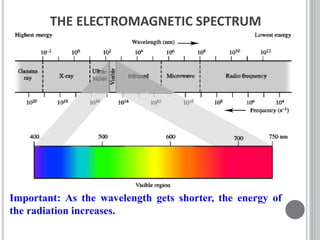
THE ELECTROMAGNETIC SPECTRUM
Important: As the wavelength gets shorter, the energy of
the radiation increases.
1. Electromagnetic radiation displays the properties of both
particles and waves
2. The particle component is called a photon
3. The energy (E) component of a photon is proportional to the
frequency . Where h is Planck’s constant and n is the
frequency in Hertz (cycles per second)
E = hν
4. The term “photon” is implied to mean a small, massless
particle that contains a small wave-packet of EM
radiation/light – we will use this terminology in the course
Spectroscopy
The higher energy ultraviolet and visible wavelengths affect the
energy levels of the outer electrons.
Radio waves are used in nuclear magnetic Resonance and affect the
spin of nuclei in a magnetic field.
Infrared radiation is absorbed by matter resulting in rotation
and/or vibration of molecules.
Ultraviolet radiation stimulates molecular vibrations and
electronic transitions.
Absorption spectroscopy from 160 nm to 780 nm.
Measurement absorption or transmittance.
Identification of inorganic and organic species.
UV-Vis Spectroscopy
UV/VIS SPECTROSCOPY
Visible (380-780 nanometers).
Ultraviolet (UV) (10 – 380 nanometers).
Below about 200 nm, air absorbs the UV light
and instruments must be operated under a vacuum
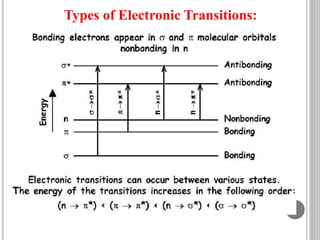
Types of Electronic Transitions:
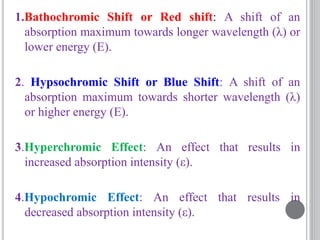
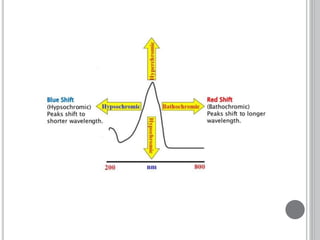
1.Bathochromic Shift or Red shift: A shift of an
absorption maximum towards longer wavelength (λ) or
lower energy (E).
2. Hypsochromic Shift or Blue Shift: A shift of an
absorption maximum towards shorter wavelength (λ)
or higher energy (E).
3.Hyperchromic Effect: An effect that results in
increased absorption intensity (ε).
4.Hypochromic Effect: An effect that results in
decreased absorption intensity (ε).
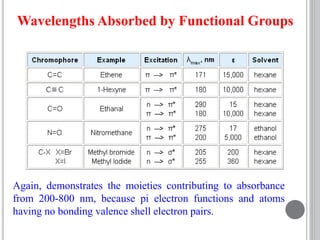
Wavelengths Absorbed by Functional Groups
Again, demonstrates the moieties contributing to absorbance
from 200-800 nm, because pi electron functions and atoms
having no bonding valence shell electron pairs.
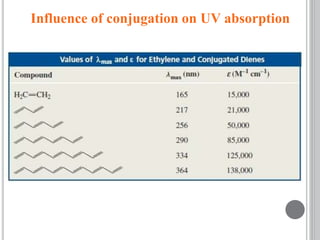
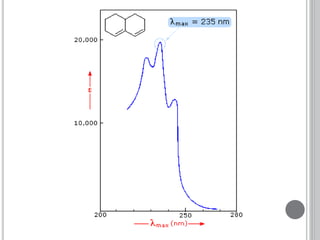
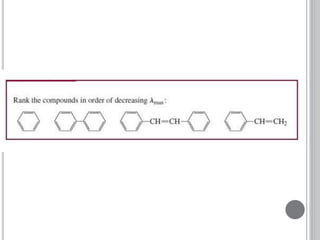
Influence of conjugation on UV absorption
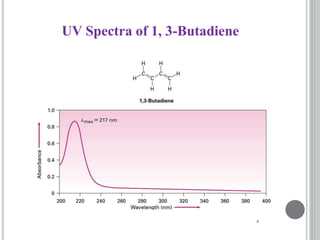
UV Spectra of 1, 3-Butadiene
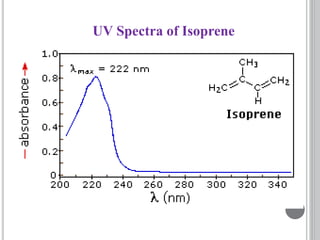
UV Spectra of Isoprene
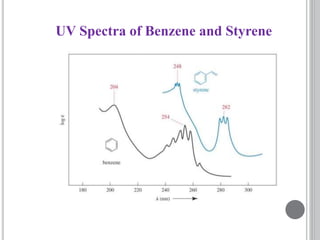
UV Spectra of Benzene and Styrene
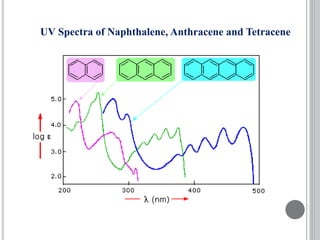
UV Spectra of Naphthalene, Anthracene and Tetracene
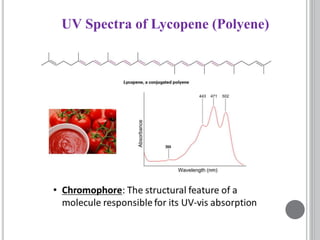
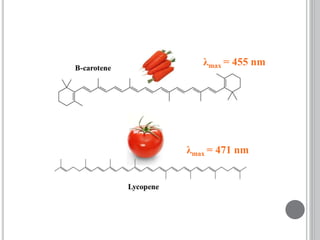
UV Spectra of Lycopene (Polyene)
λmax = 455 nm
λmax = 471 nm
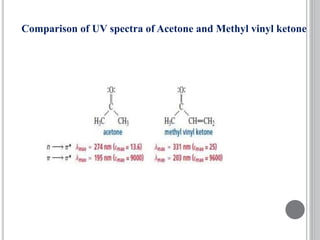
Comparison of UV spectra of Acetone and Methyl vinyl ketone
INFRARED SPECTROSCOPY
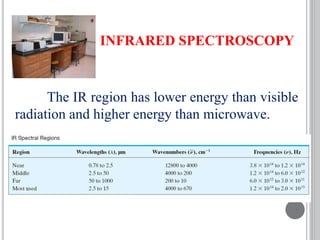
The IR region has lower energy than visible
radiation and higher energy than microwave.
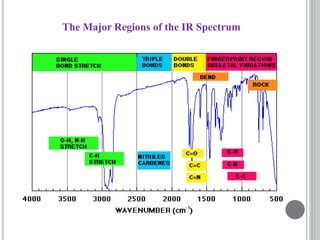
The Major Regions of the IR Spectrum
IR ABSORPTION BY MOLECULES
 Molecules with covalent bonds may absorb IR radiation
 Absorption is quantized
 Molecules move to a higher energy state
 IR radiation is sufficient enough to cause rotation and
vibration
 Radiation between 1 and 100 µm will cause excitation to
higher vibrational states
 Radiation higher than 100 µm will cause excitation to
higher rotational states
IR ABSORPTION BY MOLECULES
 Absorption spectrum is composed of broad vibrational
Absorption bands
 Molecules absorb radiation when a bond in the molecule vibrates
at the same frequency as the incident radiant energy
 Molecules vibrate at higher amplitude after absorption
 A molecule must have a change in dipole moment during
vibration in order to absorb IR radiation
IR ABSORPTION BY MOLECULES
Absorption frequency depends on
- Masses of atoms in the bonds
- Geometry of the molecule
- Strength of bond
- Other contributing factors
DIPOLE MOMENT (µ)
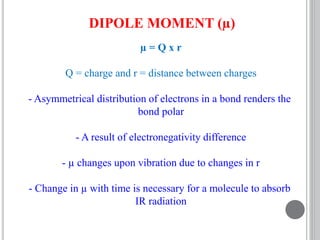
µ = Q x r
Q = charge and r = distance between charges
- Asymmetrical distribution of electrons in a bond renders the
bond polar
- A result of electronegativity difference
- µ changes upon vibration due to changes in r
- Change in µ with time is necessary for a molecule to absorb
IR radiation
DIPOLE MOMENT (µ)
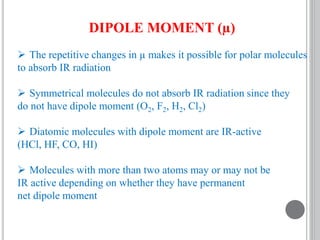
 The repetitive changes in µ makes it possible for polar molecules
to absorb IR radiation
 Symmetrical molecules do not absorb IR radiation since they
do not have dipole moment (O2, F2, H2, Cl2)
 Diatomic molecules with dipole moment are IR-active
(HCl, HF, CO, HI)
 Molecules with more than two atoms may or may not be
IR active depending on whether they have permanent
net dipole moment
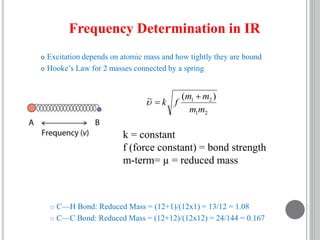
 Excitation depends on atomic mass and how tightly they are bound
 Hooke’s Law for 2 masses connected by a spring
 C—H Bond: Reduced Mass = (12+1)/(12x1) = 13/12 = 1.08
 C—C Bond: Reduced Mass = (12+12)/(12x12) = 24/144 = 0.167
21
21 )(~
mm
mm
fk


k = constant
f (force constant) = bond strength
m-term= µ = reduced mass
Frequency Determination in IR
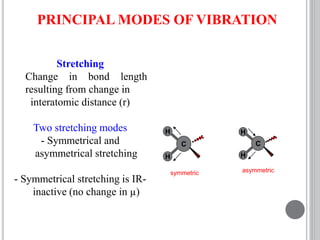
PRINCIPAL MODES OF VIBRATION
Stretching
Change in bond length
resulting from change in
interatomic distance (r)
Two stretching modes
- Symmetrical and
asymmetrical stretching
- Symmetrical stretching is IR-
inactive (no change in µ)
H
H
C
H
H
C
asymmetricsymmetric
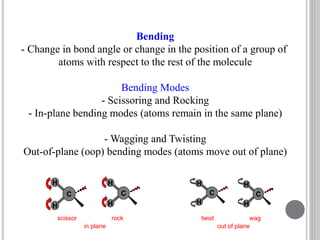
Bending
- Change in bond angle or change in the position of a group of
atoms with respect to the rest of the molecule
Bending Modes
- Scissoring and Rocking
- In-plane bending modes (atoms remain in the same plane)
- Wagging and Twisting
Out-of-plane (oop) bending modes (atoms move out of plane)
scissor
H
H
CC
H
H
CC
H
H
CC
H
H
CC
rock twist wag
in plane out of plane
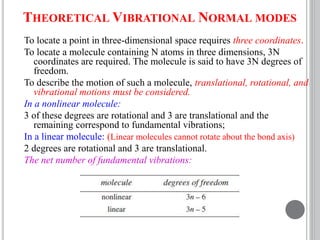
To locate a point in three-dimensional space requires three coordinates.
To locate a molecule containing N atoms in three dimensions, 3N
coordinates are required. The molecule is said to have 3N degrees of
freedom.
To describe the motion of such a molecule, translational, rotational, and
vibrational motions must be considered.
In a nonlinear molecule:
3 of these degrees are rotational and 3 are translational and the
remaining correspond to fundamental vibrations;
In a linear molecule: (Linear molecules cannot rotate about the bond axis)
2 degrees are rotational and 3 are translational.
The net number of fundamental vibrations:
THEORETICAL VIBRATIONAL NORMAL MODES
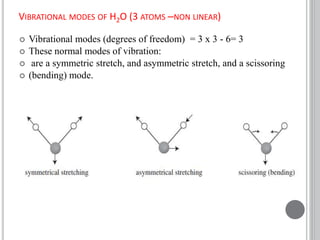
VIBRATIONAL MODES OF H2O (3 ATOMS –NON LINEAR)
 Vibrational modes (degrees of freedom) = 3 x 3 - 6= 3
 These normal modes of vibration:
 are a symmetric stretch, and asymmetric stretch, and a scissoring
 (bending) mode.
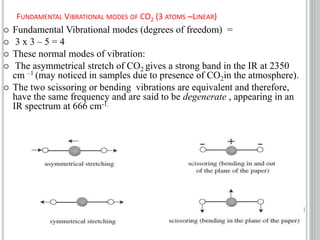
 Fundamental Vibrational modes (degrees of freedom) =
 3 x 3 – 5 = 4
 These normal modes of vibration:
 The asymmetrical stretch of CO2 gives a strong band in the IR at 2350
cm –1 (may noticed in samples due to presence of CO2in the atmosphere).
 The two scissoring or bending vibrations are equivalent and therefore,
have the same frequency and are said to be degenerate , appearing in an
IR spectrum at 666 cm-1.
FUNDAMENTAL VIBRATIONAL MODES OF CO2 (3 ATOMS –LINEAR)
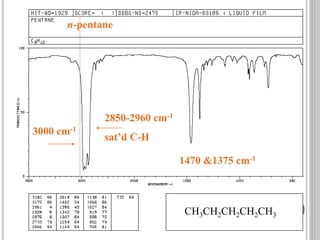
n-pentane
CH3CH2CH2CH2CH3
3000 cm-1
1470 &1375 cm-1
2850-2960 cm-1
sat’d C-H
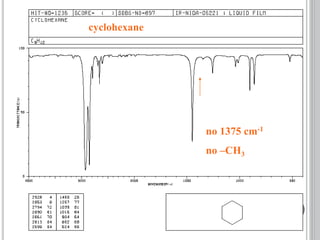
cyclohexane
no 1375 cm-1
no –CH3
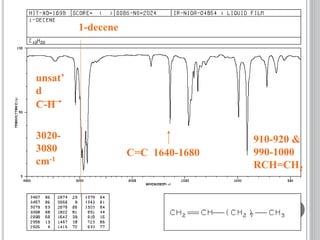
1-decene
C=C 1640-1680
unsat’
d
C-H
3020-
3080
cm-1
910-920 &
990-1000
RCH=CH2
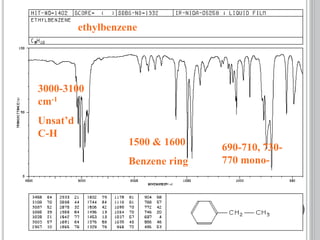
ethylbenzene
690-710, 730-
770 mono-
1500 & 1600
Benzene ring
3000-3100
cm-1
Unsat’d
C-H
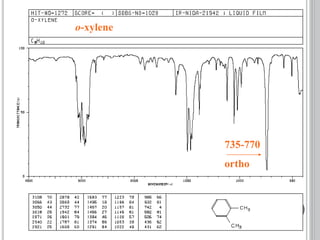
o-xylene
735-770
ortho
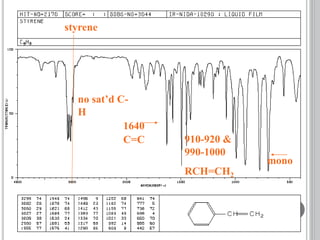
styrene
no sat’d C-
H
910-920 &
990-1000
RCH=CH2
mono
1640
C=C
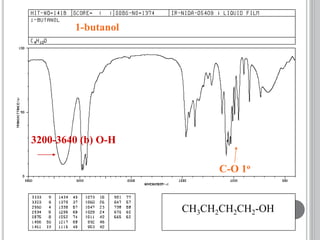
1-butanol
CH3CH2CH2CH2-OH
C-O 1o
3200-3640 (b) O-H
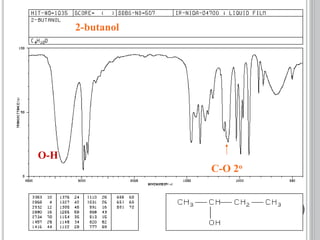
2-butanol
C-O 2o
O-H
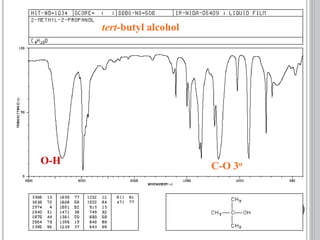
tert-butyl alcohol
C-O 3oO-H
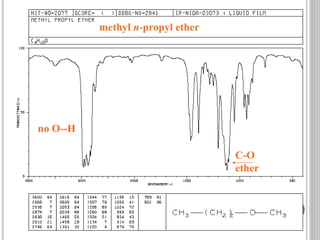
methyl n-propyl ether
no O--H
C-O
ether
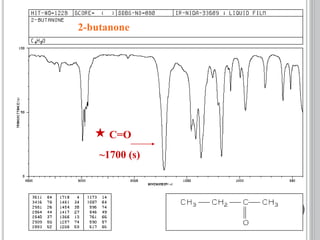
2-butanone
 C=O
~1700 (s)
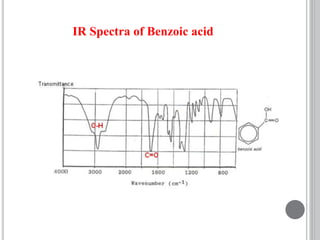
IR Spectra of Benzoic acid
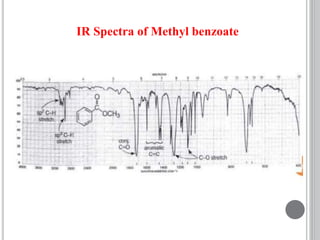
IR Spectra of Methyl benzoate
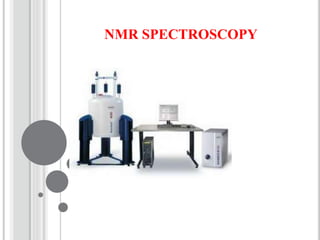
NMR SPECTROSCOPY
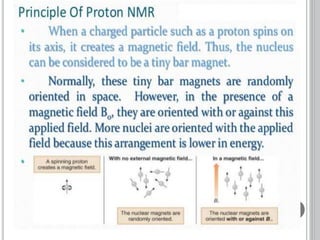
Nuclear magnetic resonance spectrometry (NMR) is based on the
absorption of electromagnetic radiation in the radio-frequency
region of the spectrum resulting in changes in the orientation of
spinning nuclei in a magnetic field.
NMR SPECTROSCOPY
NMR Energies 0.1 J/mol
IR Energies 6000 to 42,000 J/mol
UV/Vis Energies >100,000 J/mol
INTRODUCTION
 NMR is the most powerful tool available for
organic structure determination.
 It is used to study a wide variety of nuclei:
 1H
 13C
 15N
 19F
 31P
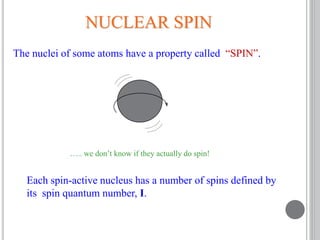
The nuclei of some atoms have a property called “SPIN”.
NUCLEAR SPIN
Each spin-active nucleus has a number of spins defined by
its spin quantum number, I.
….. we don’t know if they actually do spin!
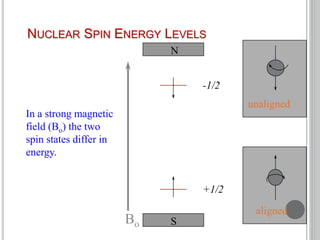
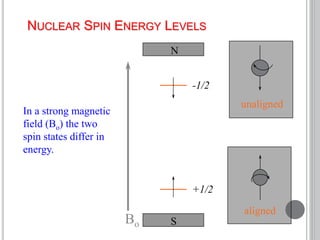
NUCLEAR SPIN ENERGY LEVELS
Bo
+1/2
-1/2
In a strong magnetic
field (Bo) the two
spin states differ in
energy.
aligned
unaligned
N
S
NUCLEAR SPIN ENERGY LEVELS
Bo
+1/2
-1/2
In a strong magnetic
field (Bo) the two
spin states differ in
energy.
aligned
unaligned
N
S
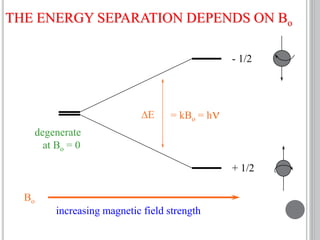
Bo
DE
+ 1/2
- 1/2
= kBo = hn
degenerate
at Bo = 0
increasing magnetic field strength
THE ENERGY SEPARATION DEPENDS ON Bo
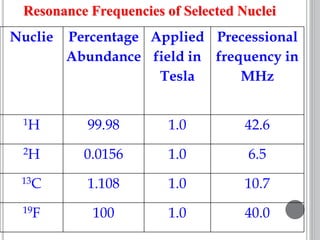
Resonance Frequencies of Selected Nuclei
Nuclie Percentage
Abundance
Applied
field in
Tesla
Precessional
frequency in
MHz
1H 99.98 1.0 42.6
2H 0.0156 1.0 6.5
13C 1.108 1.0 10.7
19F 100 1.0 40.0
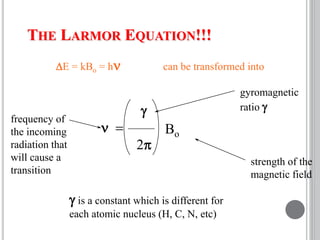
THE LARMOR EQUATION!!!
g
n 
2p
Bo
g is a constant which is different for
each atomic nucleus (H, C, N, etc)
DE = kBo = hn can be transformed into
gyromagnetic
ratio g
strength of the
magnetic field
frequency of
the incoming
radiation that
will cause a
transition
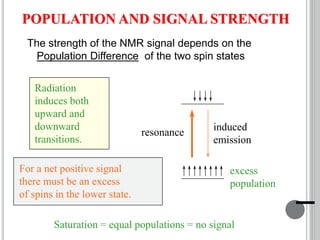
The strength of the NMR signal depends on the
Population Difference of the two spin states
resonance
induced
emission
excess
population
Radiation
induces both
upward and
downward
transitions.
For a net positive signal
there must be an excess
of spins in the lower state.
Saturation = equal populations = no signal
POPULATION AND SIGNAL STRENGTH
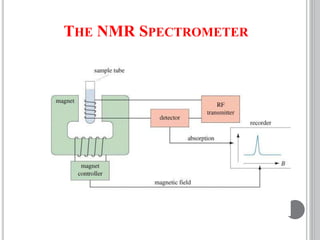
THE NMR SPECTROMETER
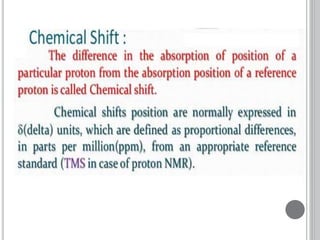
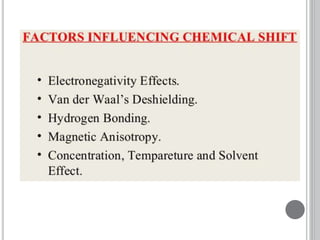
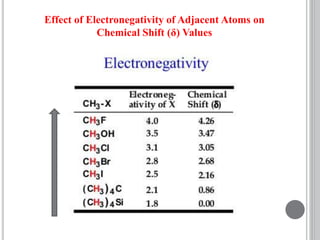
Effect of Electronegativity of Adjacent Atoms on
Chemical Shift (δ) Values
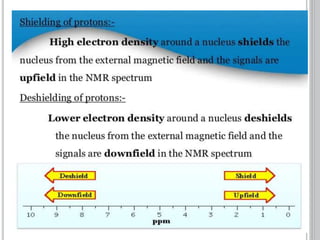
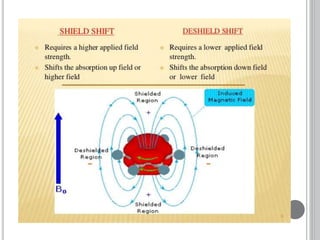
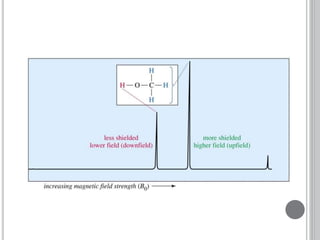
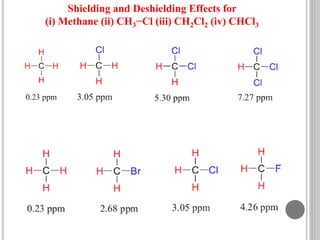
Shielding and Deshielding Effects for
(i) Methane (ii) CH3−Cl (iii) CH2Cl2 (iv) CHCl3
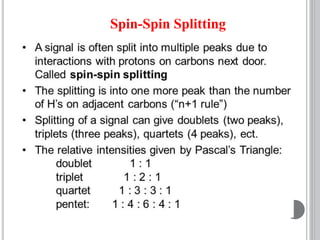
Spin-Spin Splitting
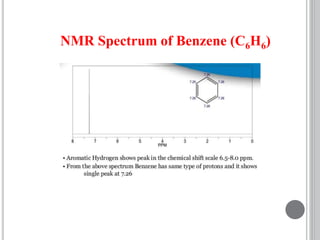
NMR Spectrum of Benzene (C6H6)
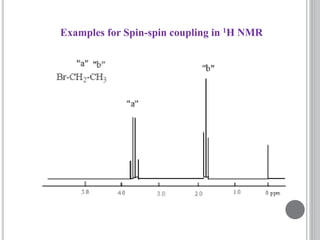
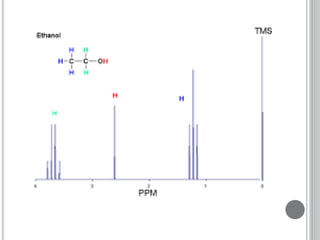
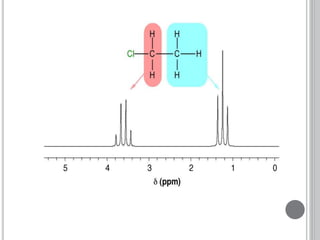
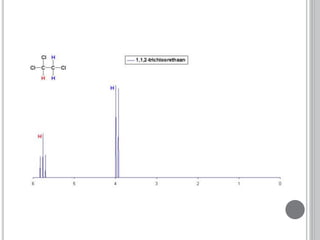
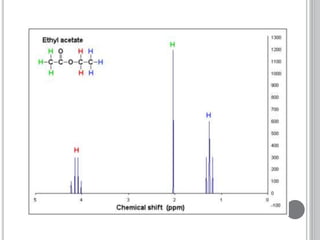
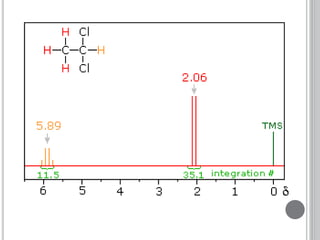
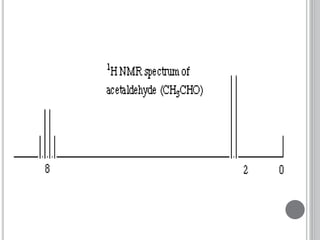
Examples for Spin-spin coupling in 1H NMR
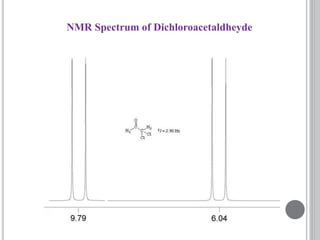
NMR Spectrum of Dichloroacetaldheyde
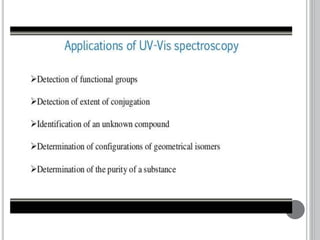
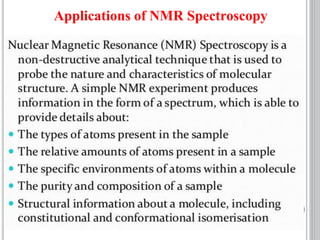
Applications of NMR Spectroscopy
Spectroscopy Learning Websites
1. http://www.rsc.org/learn-
chemistry/collections/spectroscopy.
2. http://www.rsc.org/learn-
chemistry/resource/res00001041/spectroscopy-videos.
3. http://www.spectroscopyonline.com
4. https://www.khanacademy.org/science/organic-
chemistry/spectroscopy.
5. http://chem.sci.ubu.ac.th/e-learning.
Basic concepts of organic spectroscopy

Basic concepts of organic spectroscopy

  • 1.
    BASIC CONCEPTS OF ORGANICSPECTROSCOPY DR. BASAVARAJAIAH S. M. M. SC., PH.D. COORDINATOR PG DEPARTMENT OF CHEMISTRY VIJAYA COLLEGE BENGALURU-56000.
  • 2.
    Spectroscopy Spectroscopy is ageneral term referring to the interactions of various types of electromagnetic radiation with matter. Exactly how the radiation interacts with matter is directly dependent on the energy of the radiation.
  • 3.
    THE ELECTROMAGNETIC SPECTRUM Important:As the wavelength gets shorter, the energy of the radiation increases.
  • 4.
    1. Electromagnetic radiationdisplays the properties of both particles and waves 2. The particle component is called a photon 3. The energy (E) component of a photon is proportional to the frequency . Where h is Planck’s constant and n is the frequency in Hertz (cycles per second) E = hν 4. The term “photon” is implied to mean a small, massless particle that contains a small wave-packet of EM radiation/light – we will use this terminology in the course
  • 5.
    Spectroscopy The higher energyultraviolet and visible wavelengths affect the energy levels of the outer electrons. Radio waves are used in nuclear magnetic Resonance and affect the spin of nuclei in a magnetic field. Infrared radiation is absorbed by matter resulting in rotation and/or vibration of molecules.
  • 6.
    Ultraviolet radiation stimulatesmolecular vibrations and electronic transitions. Absorption spectroscopy from 160 nm to 780 nm. Measurement absorption or transmittance. Identification of inorganic and organic species. UV-Vis Spectroscopy
  • 7.
    UV/VIS SPECTROSCOPY Visible (380-780nanometers). Ultraviolet (UV) (10 – 380 nanometers). Below about 200 nm, air absorbs the UV light and instruments must be operated under a vacuum
  • 8.
    Types of ElectronicTransitions:
  • 11.
    1.Bathochromic Shift orRed shift: A shift of an absorption maximum towards longer wavelength (λ) or lower energy (E). 2. Hypsochromic Shift or Blue Shift: A shift of an absorption maximum towards shorter wavelength (λ) or higher energy (E). 3.Hyperchromic Effect: An effect that results in increased absorption intensity (ε). 4.Hypochromic Effect: An effect that results in decreased absorption intensity (ε).
  • 13.
    Wavelengths Absorbed byFunctional Groups Again, demonstrates the moieties contributing to absorbance from 200-800 nm, because pi electron functions and atoms having no bonding valence shell electron pairs.
  • 14.
    Influence of conjugationon UV absorption
  • 15.
    UV Spectra of1, 3-Butadiene
  • 16.
    UV Spectra ofIsoprene
  • 18.
    UV Spectra ofBenzene and Styrene
  • 19.
    UV Spectra ofNaphthalene, Anthracene and Tetracene
  • 20.
    UV Spectra ofLycopene (Polyene)
  • 21.
    λmax = 455nm λmax = 471 nm
  • 22.
    Comparison of UVspectra of Acetone and Methyl vinyl ketone
  • 25.
    INFRARED SPECTROSCOPY The IRregion has lower energy than visible radiation and higher energy than microwave.
  • 26.
    The Major Regionsof the IR Spectrum
  • 27.
    IR ABSORPTION BYMOLECULES  Molecules with covalent bonds may absorb IR radiation  Absorption is quantized  Molecules move to a higher energy state  IR radiation is sufficient enough to cause rotation and vibration  Radiation between 1 and 100 µm will cause excitation to higher vibrational states  Radiation higher than 100 µm will cause excitation to higher rotational states
  • 28.
    IR ABSORPTION BYMOLECULES  Absorption spectrum is composed of broad vibrational Absorption bands  Molecules absorb radiation when a bond in the molecule vibrates at the same frequency as the incident radiant energy  Molecules vibrate at higher amplitude after absorption  A molecule must have a change in dipole moment during vibration in order to absorb IR radiation
  • 29.
    IR ABSORPTION BYMOLECULES Absorption frequency depends on - Masses of atoms in the bonds - Geometry of the molecule - Strength of bond - Other contributing factors
  • 30.
    DIPOLE MOMENT (µ) µ= Q x r Q = charge and r = distance between charges - Asymmetrical distribution of electrons in a bond renders the bond polar - A result of electronegativity difference - µ changes upon vibration due to changes in r - Change in µ with time is necessary for a molecule to absorb IR radiation
  • 31.
    DIPOLE MOMENT (µ) The repetitive changes in µ makes it possible for polar molecules to absorb IR radiation  Symmetrical molecules do not absorb IR radiation since they do not have dipole moment (O2, F2, H2, Cl2)  Diatomic molecules with dipole moment are IR-active (HCl, HF, CO, HI)  Molecules with more than two atoms may or may not be IR active depending on whether they have permanent net dipole moment
  • 32.
     Excitation dependson atomic mass and how tightly they are bound  Hooke’s Law for 2 masses connected by a spring  C—H Bond: Reduced Mass = (12+1)/(12x1) = 13/12 = 1.08  C—C Bond: Reduced Mass = (12+12)/(12x12) = 24/144 = 0.167 21 21 )(~ mm mm fk   k = constant f (force constant) = bond strength m-term= µ = reduced mass Frequency Determination in IR
  • 33.
    PRINCIPAL MODES OFVIBRATION Stretching Change in bond length resulting from change in interatomic distance (r) Two stretching modes - Symmetrical and asymmetrical stretching - Symmetrical stretching is IR- inactive (no change in µ) H H C H H C asymmetricsymmetric
  • 34.
    Bending - Change inbond angle or change in the position of a group of atoms with respect to the rest of the molecule Bending Modes - Scissoring and Rocking - In-plane bending modes (atoms remain in the same plane) - Wagging and Twisting Out-of-plane (oop) bending modes (atoms move out of plane) scissor H H CC H H CC H H CC H H CC rock twist wag in plane out of plane
  • 35.
    To locate apoint in three-dimensional space requires three coordinates. To locate a molecule containing N atoms in three dimensions, 3N coordinates are required. The molecule is said to have 3N degrees of freedom. To describe the motion of such a molecule, translational, rotational, and vibrational motions must be considered. In a nonlinear molecule: 3 of these degrees are rotational and 3 are translational and the remaining correspond to fundamental vibrations; In a linear molecule: (Linear molecules cannot rotate about the bond axis) 2 degrees are rotational and 3 are translational. The net number of fundamental vibrations: THEORETICAL VIBRATIONAL NORMAL MODES
  • 36.
    VIBRATIONAL MODES OFH2O (3 ATOMS –NON LINEAR)  Vibrational modes (degrees of freedom) = 3 x 3 - 6= 3  These normal modes of vibration:  are a symmetric stretch, and asymmetric stretch, and a scissoring  (bending) mode.
  • 37.
     Fundamental Vibrationalmodes (degrees of freedom) =  3 x 3 – 5 = 4  These normal modes of vibration:  The asymmetrical stretch of CO2 gives a strong band in the IR at 2350 cm –1 (may noticed in samples due to presence of CO2in the atmosphere).  The two scissoring or bending vibrations are equivalent and therefore, have the same frequency and are said to be degenerate , appearing in an IR spectrum at 666 cm-1. FUNDAMENTAL VIBRATIONAL MODES OF CO2 (3 ATOMS –LINEAR)
  • 38.
    n-pentane CH3CH2CH2CH2CH3 3000 cm-1 1470 &1375cm-1 2850-2960 cm-1 sat’d C-H
  • 39.
  • 40.
  • 41.
    ethylbenzene 690-710, 730- 770 mono- 1500& 1600 Benzene ring 3000-3100 cm-1 Unsat’d C-H
  • 42.
  • 43.
    styrene no sat’d C- H 910-920& 990-1000 RCH=CH2 mono 1640 C=C
  • 44.
  • 45.
  • 46.
  • 47.
  • 48.
  • 49.
    IR Spectra ofBenzoic acid
  • 50.
    IR Spectra ofMethyl benzoate
  • 51.
  • 52.
    Nuclear magnetic resonancespectrometry (NMR) is based on the absorption of electromagnetic radiation in the radio-frequency region of the spectrum resulting in changes in the orientation of spinning nuclei in a magnetic field. NMR SPECTROSCOPY NMR Energies 0.1 J/mol IR Energies 6000 to 42,000 J/mol UV/Vis Energies >100,000 J/mol
  • 53.
    INTRODUCTION  NMR isthe most powerful tool available for organic structure determination.  It is used to study a wide variety of nuclei:  1H  13C  15N  19F  31P
  • 54.
    The nuclei ofsome atoms have a property called “SPIN”. NUCLEAR SPIN Each spin-active nucleus has a number of spins defined by its spin quantum number, I. ….. we don’t know if they actually do spin!
  • 55.
    NUCLEAR SPIN ENERGYLEVELS Bo +1/2 -1/2 In a strong magnetic field (Bo) the two spin states differ in energy. aligned unaligned N S
  • 57.
    NUCLEAR SPIN ENERGYLEVELS Bo +1/2 -1/2 In a strong magnetic field (Bo) the two spin states differ in energy. aligned unaligned N S
  • 58.
    Bo DE + 1/2 - 1/2 =kBo = hn degenerate at Bo = 0 increasing magnetic field strength THE ENERGY SEPARATION DEPENDS ON Bo
  • 59.
    Resonance Frequencies ofSelected Nuclei Nuclie Percentage Abundance Applied field in Tesla Precessional frequency in MHz 1H 99.98 1.0 42.6 2H 0.0156 1.0 6.5 13C 1.108 1.0 10.7 19F 100 1.0 40.0
  • 60.
    THE LARMOR EQUATION!!! g n 2p Bo g is a constant which is different for each atomic nucleus (H, C, N, etc) DE = kBo = hn can be transformed into gyromagnetic ratio g strength of the magnetic field frequency of the incoming radiation that will cause a transition
  • 61.
    The strength ofthe NMR signal depends on the Population Difference of the two spin states resonance induced emission excess population Radiation induces both upward and downward transitions. For a net positive signal there must be an excess of spins in the lower state. Saturation = equal populations = no signal POPULATION AND SIGNAL STRENGTH
  • 62.
  • 71.
    Effect of Electronegativityof Adjacent Atoms on Chemical Shift (δ) Values
  • 72.
    Shielding and DeshieldingEffects for (i) Methane (ii) CH3−Cl (iii) CH2Cl2 (iv) CHCl3
  • 73.
  • 74.
    NMR Spectrum ofBenzene (C6H6)
  • 75.
    Examples for Spin-spincoupling in 1H NMR
  • 82.
    NMR Spectrum ofDichloroacetaldheyde
  • 83.
    Applications of NMRSpectroscopy
  • 84.
    Spectroscopy Learning Websites 1.http://www.rsc.org/learn- chemistry/collections/spectroscopy. 2. http://www.rsc.org/learn- chemistry/resource/res00001041/spectroscopy-videos. 3. http://www.spectroscopyonline.com 4. https://www.khanacademy.org/science/organic- chemistry/spectroscopy. 5. http://chem.sci.ubu.ac.th/e-learning.