SPECTROSCOPY |
INTRODUCTION TO
SPECTROSCOPY
 Spectroscopy is the measurement and
interpretation of Electro Magnetic Radiation
(EMR) absorbed or emitted when the molecules
or atoms or ions of a sample move from one
energy state to another energy state.
 This change may be from Ground State to excited
state or excited state to Ground state. At ground
state, the energy of a molecule is the sum total of
rotational, vibrational and electronic energies.
 In other words, spectroscopy measures the
changes in rotational, vibrational and/or
electronic energies.
ELECTROMAGNETIC
RADIATIONS
Electro Magnetic Radiation is
made up of discrete particles
called Photons. EMR has got
both wave characteristic as well
as particle characteristics. This
means that it can travel in
vacuum also.
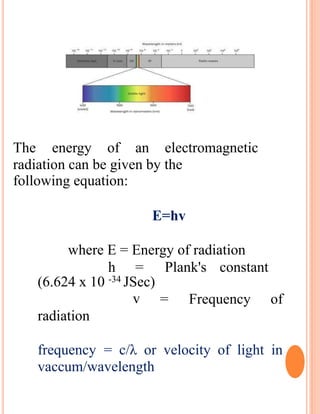
The different types of EMR are
Visible radiation, UV radiation,
IR radiation, Microwaves,
Radiowaves, X-rays, y-rays or
Cosmic rays. As these radiations
have different wavelength or
frequency or energy, they are
conveniently named so.
The energy of an electromagnetic
radiation can be given by the
following equation:
E=hv
where E = Energy of radiation
h = Plank's constant
(6.624 x 10 -34 JSec)
v
radiation
= Frequency of
frequency = c/λ or velocity of light in
vaccum/wavelength
hence E = H√
= hc/λ
= hc√-
where √- = wave number
Therefore the energy of a radiation
depends upon frequency and
wavelength of the radiation.
Theory of Spectroscopy
When EMR travelsthrough a
medium containing atoms,
ions, any one of the following may
take
place.
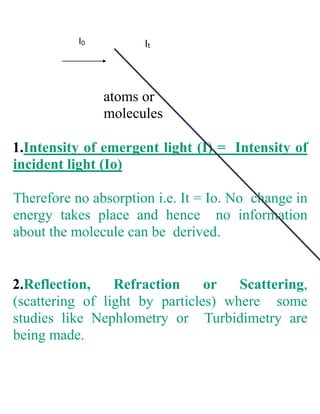
atoms or
molecules
1.Intensity of emergent light (I) = Intensity of
incident light (Io)
Therefore no absorption i.e. It = Io. No change in
energy takes place and hence no information
about the molecule can be derived.
2.Reflection, Refraction or Scattering,
(scattering of light by particles) where some
studies like Nephlometry or Turbidimetry are
being made.
I0 It
3.Intensityof emergent light <
Incident light, where there is absorption of
energy. Here some information can be derived.
UV VISIBLE SPEPCTROSCOPY
PRINCIPLE
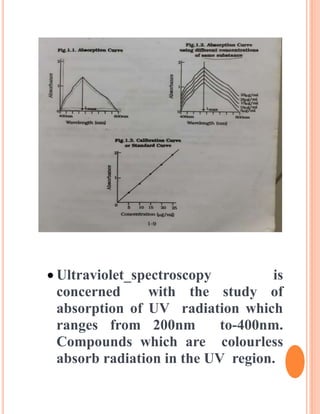
 Colorimetry is concerned with the
study of absorption Of visible
radiation whosewavelength ranges
fom 400nm-800nm. Any coloured
substance will absorb radiation in this
wavelength region. Coloured
substances, absorb light of different
wavelength in different_manner and
hence we get an absorption curve
(Absorbance Vs Wavelength - Fig
1.1.).
The wavelength at which max
absorption of radiation takes
place is called λmax. This
λmaxis characteristic for every
coloured substances and is
the qualitative aspects. λmax is
not affected by concentration
of substances.
 Ultraviolet_spectroscopy is
concerned with the study of
absorption of UV radiation which
ranges from 200nm to-400nm.
Compounds which are colourless
absorb radiation in the UV region.
The types of
electrons present in any molecule
may be conveniently classified
as,
 ‘σ’
electrons: These are the ones
present in saturated compounds.
Such electrons do not absorb
near UV, but absorb vacuum UV
radiation (<200nm).
 ‘π’
electrons: These electrons are
present in unsaturated
compounds. (eg) double or triple
bonds (eg) >C= C<, -C≡C-.
 ‘n’
electrons: These are non bonded
electrons which are not involved
in any bonding (eg) lone pair of
Any molecule has
either n, π, σ or a combination of these-
electrons. These bonding (π & σ ) and non-
bonding (n) electrons absorb the
characteristic radiation and undergoes
transition from ground state to excited state.
By the characteristic absorption peak, nature
of the electrons present and hence the
molecular structure can be elucidated.
ELECTRONIC
TRANSITIONS AND EXCITATION
PROCESS
It was stated earlier
that σ, n and π electrons are present
in a
molecule and can
be excited from the
ground state by the
absorption of UV radiation. The
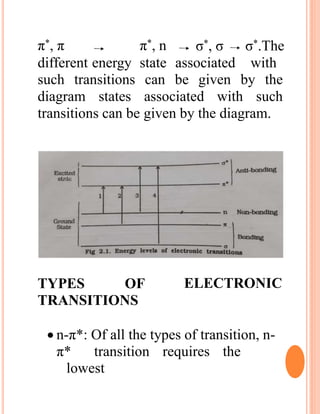
various transitions aren
σ*, σ σ*.Theπ*, π
different energy
π*, n
state associated with
such transitions can be given by the
diagram states associated with such
transitions can be given by the diagram.
TYPES OF
TRANSITIONS
ELECTRONIC
 n-π*: Of all the types of transition, n-
π* transition requires the
lowest
energy (longer wavelength). The peaks due
to this transition is also called as R-bands.
This type of peak can be seen in compounds
where ‘n' electron (present in S, O, N or
halogen) is present in a compound
containing double bond or triple bond (eg)
aldehydes or ketones, nitrocompounds, etc.
The presence of n—π* transition can be
identified easily by comparing the UV
spectrum of the substance with the
spectrum recorded in the acid solution of
the same substance. In an acid solution, the
band disappears if n-π* has been present
Peak.
The presence of other hetero atoms can be
identified by comparison with a
similar compound without hetero atom.
These technique can be used in structure
elucidation.
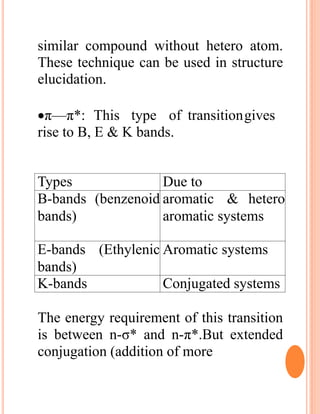
π—π*: This type of transitiongives
rise to B, E & K bands.
Types Due to
B-bands (benzenoid
bands)
aromatic & hetero
aromatic systems
E-bands (Ethylenic
bands)
Aromatic systems
K-bands Conjugated systems
The energy requirement of this transition
is between n-σ* and n-π*.But extended
conjugation (addition of more
bonds)double/triple
substituents shift
and alkyl
theλmax towards
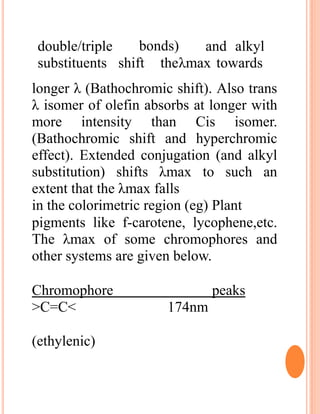
longer λ (Bathochromic shift). Also trans
λ isomer of olefin absorbs at longer with
more intensity than Cis isomer.
(Bathochromic shift and hyperchromic
effect). Extended conjugation (and alkyl
substitution) shifts λmax to such an
extent that the λmax falls
in the colorimetric region (eg) Plant
pigments like f-carotene, lycophene,etc.
The λmax of some chromophores and
other systems are given below.
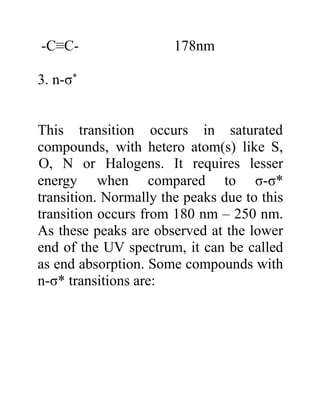
Chromophore peaks
>C=C< 174nm
(ethylenic)
-C≡C- 178nm
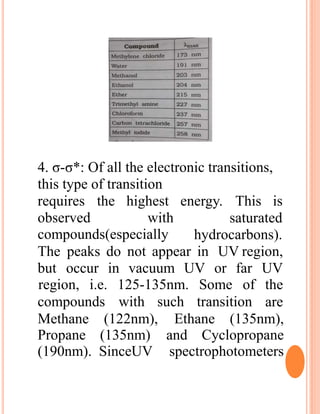
3. n-σ*
This transition occurs in saturated
compounds, with hetero atom(s) like S,
energy when compared to
O, N or Halogens. It requires lesser
σ-σ*
transition. Normally the peaks due to this
transition occurs from 180 nm – 250 nm.
As these peaks are observed at the lower
end of the UV spectrum, it can be called
as end absorption. Some compounds with
n-σ* transitions are:
4. σ-σ*: Of all the electronic transitions,
this type of transition
requires the highest energy. This is
observed with
compounds(especially
saturated
hydrocarbons).
The peaks do not appear in UV region,
but occur in vacuum UV or far UV
compounds with such transition
region, i.e. 125-135nm. Some of the
are
Methane (122nm), Ethane (135nm),
Propane (135nm) and Cyclopropane
(190nm). SinceUV spectrophotometers
are operated above 200nm. saturated
hydrocarbons lke cyclohexane (195nm)
can be used as nonpolar solvents, as it
does not give solvent peak.
CHROMOPHORE AND RELATED
TERMS
 Chromophore is defined as any group
electromagnetic radiations in
which exhibits absorption of
the
visible or ultraviolet region. some of
the important chromophores are
ethylenic, acetylenic, carbonyls, acids,
acids, esters, nitrile etc.
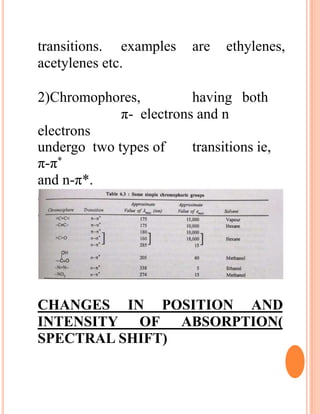
Two types of chromophores are
known:
1)chromophores in whichthegroup
is having π electrons undergoes
π-π*
transitions. examples are ethylenes,
acetylenes etc.
2)Chromophores, having both
π- electrons and n
electrons
undergo two types of transitions ie,
π-π*
and n-π*.
examples include carbonyls, nitriles, azo
compounds,nitro compounds etc.
CHANGES IN POSITION AND
INTENSITY OF ABSORPTION(
SPECTRAL SHIFT)
For isolated chromophore groups such as
>C=C< and -C≡C-, absorption takes
place in far ultraviolet region which
cannot be easily studied. But the position
of absorption maximum and the intensity
of absorption
Different ways
can be modified in by
some structural
changes or change of solvent as
given below.
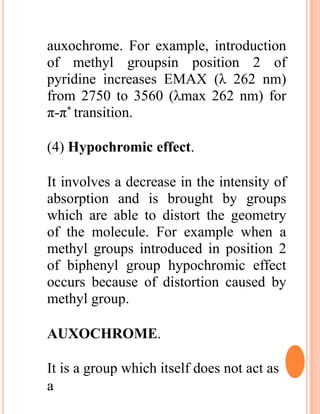
(1) Bathochromic shift or red shift.
It involves the shift of absorption
maximum towards longerwavelength
because of the presence of certain groups
such as OH and NH2, called
auxochromes or by change of solvents.
example:
1)decreasing thepolarity of solvent
causes a re shift in the n-π* absorption of
carbonyl compounds.
2) Red shift also produced when 2 or
more chromophore are present in
conjugation in a molecule. for example
ethylene shows a π-π* transitionat 170nm
where 1,3-butadiene shows λmax at 217
nm.
(2) Hypsochromic shift or blue shift.
it involves the shift of absorption
maximum towards shorter wavelength
and may be caused by removal of
conjugation in a system or by change of
solvent. In the case of aniline, absorption
maximum takes place at 280 mμ because
the pair of electrons on nitrogen atom is
in conjugation with the πbond system of
the benzene ring. In acidic solution blue
shift is caused and absorption takes place
at shorter wave length.
(3) Hyperchromic effect.
This effect involves an increase in the
intensity of absorption and usually
brought about by introduction of an
auxochrome. For example, introduction
of methyl groupsin position 2 of
pyridine increases EMAX (λ 262 nm)
from 2750 to 3560 (λmax 262 nm) for
π-π* transition.
(4) Hypochromic effect.
It involves a decrease in the intensity of
absorption and is brought by groups
which are able to distort the geometry
of the molecule. For example when a
methyl groups introduced in position 2
of biphenyl group hypochromic effect
occurs because of distortion caused by
methyl group.
AUXOCHROME.
It is a group which itself does not act as
a
chromophore but when attached to a
chromophore it shifis the
maximum towards longer
adsorption
wavelength
along with an increase in the intensity of
commonly knownabsorption.
auxochromic
Some
groups are—OH,-NH,,-
OR,-NHR and –NR2.
For example when the auxochrome —
NH, group is attached to benzene ting, its
absorption changes from λmax 255
(Emax 203) to λmax 280 (Emax 1430).
All auxochromes have one or more non-
bonding pair of electrons. If
an auxochromeis attached to a
chromophore, it helps is extending the
conjugation by sharing of non-bonding
pair of electrons as shown below.
CH2=CH-NR2
-CH2-CH=NR2
+
The extended conjugation has been
responsible for bathochromic effect of
auxochrome.
SOLVENT EFFECTS
A most suitable solvent is one that does
not itself absorb in the region under
investigation, A solution of the sample is
always prepared for spectral analysis.
Most commonly used_solvent is ethanol.
Ethanol is a best solvent as it is cheap
and is transparent down to 210 mμ.
Commercial Should not be used because
it is having benzene which absorbs
strongly in the ultra-violet region, other
solvents which are transparent above 210
mμ are n-hexane, methyl alcohol,
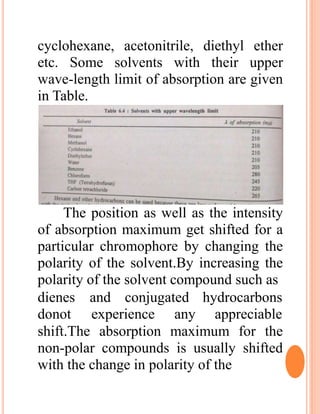
cyclohexane, acetonitrile, diethyl ether
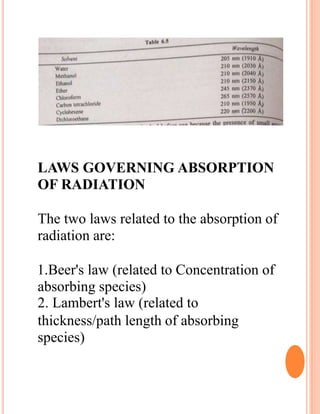
etc. Some solvents with their upper
wave-length limit of absorption are given
in Table.
The position as well as the intensity
of absorption maximum get shifted for a
particular chromophore by changing the
polarity of the solvent.By increasing the
polarity of the solvent compound such as
dienes and conjugated
donot experience any
hydrocarbons
appreciable
shift.The absorption maximum for the
non-polar compounds is usually shifted
with the change in polarity of the
solvents.
(1)n-π* transition (less intense), For such a
case the absorption band moves to
shorter wavelength by increasing the
polarity of the solvent.In n-π* transition,
the ground state is more polar as to the
excited state, The hydrogen bonding with
solvent molecules occurs to lesser extent
with the carbonyl group in the excited
state.For example, absorption maximum
of acetone is at 279 mμ in hexane as
compared to 264 mμ in water.
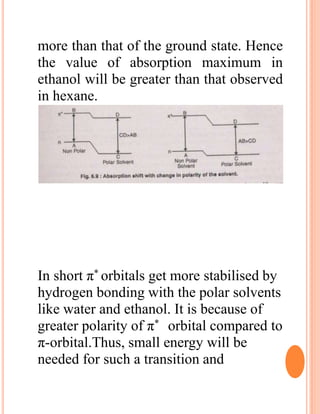
(2)π- π* transitions (intense), In such a
case, the absorption band moves to
longer wavelength by increasing the
polarity of the solvent.The dipole-dipole
interactions with the solvent molecules
lower the energy of the excited state
more than that of the ground state. Hence
the value of absorption maximum in
ethanol will be greater than that observed
in hexane.
In short π* orbitals get more stabilised by
hydrogen bonding with the polar solvents
like water and ethanol. It is because of
greater polarity of π* orbital compared to
π-orbital.Thus, small energy will be
needed for such a transition and
absorption shows a red shift.
n-σ* transitions are also very sensitive to
hydrogen bonding. Alcohols as well as
amines form hydrogen bonding with the
solvent molecules. Such associations
occur because of the presence of non-
bonding electrons on the hetero atom and
thus, transition requires greater energy.
In general, we say that
(a)When a group (say, carbonyl) is more
polar in the ground state than in the
excited state than increasing polarity of
the solvent stabilises the non-bonding
electrons in the ground state because of
hydrogen bonding. Thus, absorption is
shifted to lower wave-length.
(a)When the group is more polar in the
excited state, then absorption gets shifted
to longer wave length with increase in
polarity of the solvent which helps in
stabilising the non-bonding electrons in
the excited state.
The increase in polarity of the solvent
generally shifts n-π* and n- σ* bands to
shorter wave lengths and π — π * bands
to longer wave-lengths.
Choice of Solvent
A suitable solvent for ultraviolet
spectroscopy should meet the following
requirements.
(i)It should not itself absorb radiations in
the region under investigation.
(ii)It should be less polar so that it has
minimum interaction with the solute
molecules.
The most commonly employed solvent
is 95% ethanol. It is cheap, has good
dissolving power and does not absorb
radiations above 210 nm. In other words
it is transparent above 210 nm.
Commercial ethanol should not be used
as it contains some benzene which
undergoes absorption in the UV range at
about 280.Some other solvents which are
transparent above 210 nm are n-hexane,
cyclohexane, methanol, water and ether.
Benzene, chloroform and carbon
tetrachloride cannot be used because they
absorb in the range about 240-280 nm.
Hexane and other hydrocarbons are
sometimes preferred to polar solvents
because they have minimum interactions
with the solute molecules.
LAWS GOVERNING ABSORPTION
OF RADIATION
The two laws related to the absorption of
radiation are:
1.Beer's law (related to Concentration of
absorbing species)
2. Lambert's law (related to
thickness/path length of absorbing
species)
These two laws are applicable under the
following condition:
I=Ia + It
I = Intensity of incident light
la = Intensity of absorbed light >“
It = Intensity of transmitted light and No
reflection/scattering of light takes place
Beer's Law
Beer's law states that “The intensity of a
beam of monochromatic light
decreases exponentially with increase
in the concentration of absorbing
species arithmetically”
Accordingly, -dI/dc  I
[The decrease in the intensity of incident
light (I) with concentration (C) is
proportional to the intensity of incident
light(I)]
-dI/dc = kI
(removing and introducing the constant
of proporationality ‘k’)
- dI/I =k dc
rearranging
terms
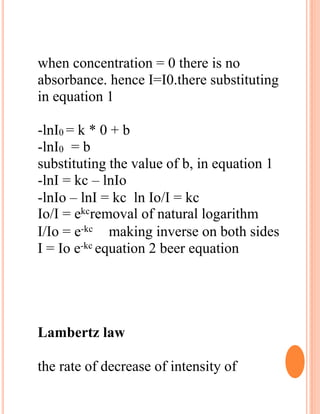
-ln I = kc + b equation 1
on integration, b is constant of
integration
when concentration = 0 there is no
absorbance. hence I=I0.there substituting
in equation 1
-lnI0 = k * 0 + b
-lnI0 = b
substituting the value of b, in equation 1
-lnI = kc – lnIo
-lnIo – lnI = kc ln Io/I = kc
Io/I = ekcremoval of natural logarithm
I/Io = e-kc making inverse on both sides
I = Io e-kc equation 2 beer equation
Lambertz law
the rate of decrease of intensity of
monochromatic light with the thickness
of the medium is directly proportional to
the intensity of incident light.
Accordingly, -dI/dt  I
[The decrease in the intensity of incident
light (I) with concentration (C) is
proportional to the intensity of incident
light(I)]
-dI/dt = kl
(removing and introducing the constant
of proporationality ‘k’)
- dI/I =k dt
rearranging
terms
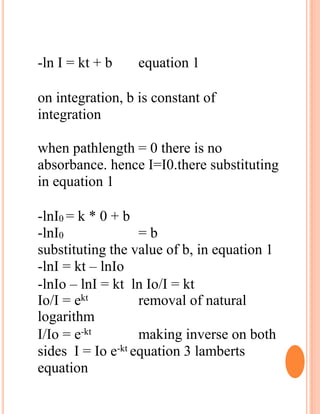
-ln I = kt + b equation 1
on integration, b is constant of
integration
when pathlength = 0 there is no
absorbance. hence I=I0.there substituting
in equation 1
-lnI0 = k * 0 + b
-lnI0 = b
substituting the value of b, in equation 1
-lnI = kt – lnIo
-lnIo – lnI = kt ln Io/I = kt
Io/I = ekt removal of natural
logarithm
I/Io = e-kt making inverse on both
sides I = Io e-kt equation 3 lamberts
equation
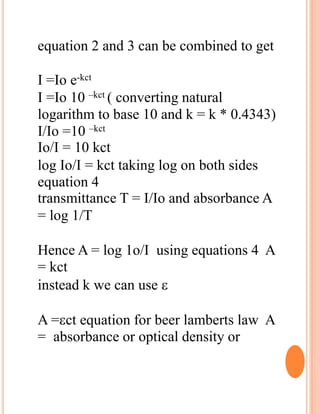
equation 2 and 3 can be combined to get
I =Io e-kct
I =Io 10 –kct ( converting natural
logarithm to base 10 and k = k * 0.4343)
I/Io =10 –kct
Io/I = 10 kct
log Io/I = kct taking log on both sides
equation 4
transmittance T = I/Io and absorbance A
= log 1/T
Hence A = log 1o/I using equations 4 A
= kct
instead k we can use 
A =ct equation for beer lamberts law A
= absorbance or optical density or
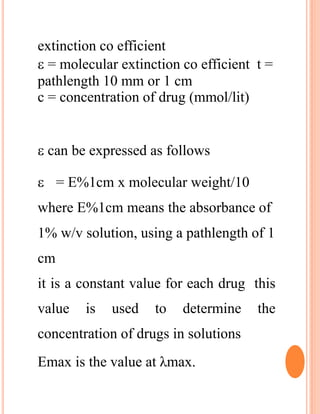
extinction co efficient
 = molecular extinction co efficient t =
pathlength 10 mm or 1 cm
c = concentration of drug (mmol/lit)
 can be expressed as follows
 = E%1cm x molecular weight/10
where E%1cm means the absorbance of
1% w/v solution, using a pathlength of 1
cm
it is a constant value for each drug this
value is used to determine the
concentration of drugs in solutions
Emax is the value at λmax.
DEVIATIONS FROM BEER'S LAW
A system is said to obey Beer's law,
when a plot of Concentration Vs
Absorbance gives a Straight line.’ The
straight line is obtained by using line of
best fit or method of least squares or by
joining the maximum no. of points in
such a way that positive and negative
errors are balanced or minimised, The
regression line can also be used for
determining concentration of a solution
whose absorbance is obtained using a
colorimeter/spectrophotometer. When a
straight line is not obtained, i.e. a non-
linear curve_is obtained in a plot of
Concentration Vs Absorbance, thé
system is said to undergo deviation from
Beer's Law. Such devtation can be
positive deviation or negative deviation.
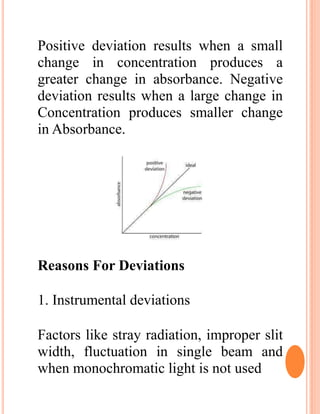
Positive deviation results when a small
change in concentration produces a
greater change in absorbance. Negative
deviation results when a large change in
Concentration produces smaller change
in Absorbance.
Reasons For Deviations
1. Instrumental deviations
Factors like stray radiation, improper slit
width, fluctuation in single beam and
when monochromatic light is not used
can influence the deviation.
2. Physicochemical changes in solution.
Factors like Association, Dissociation,
lonisation (Change in PH) , faulty
development of colour (incompletion of
reactions) refractive index
at
high
can influencesuchconcentrations
deviations.
Examples:
Association:
Methylene blue at concentrations of
10- 5M exists as monomerand has
λmax of 660nm. But Methylene
concentration above 10-4M
dimer or trimer, but has a λmax of
600nm. Hence when the shift of λmax is
Blue at
Exist as
not observed for absorbance
measurements, deviations occur.
Dissociation
2H* + 2CrO4 Cr2O7 2- + H2O
Orange yellow
Potassium dichromate in high concentration
exists as orange solution (λmax - 450nm). But
on dilution, dichromate ions are dissociated
into chromate ions which is yellow coloured
(λmax - 410nm). Hence when 450nm is used
for absorbance measurements,
deviation from Beer's law is seen.
Incomplete reaction
When sufficient time is not allowed for
making absorbance measurements or
when the readings are made when the
colour has faded away due to instability
of colour, deviations can occur (eg.)
Determination of iron using thioglycollic
acid before completion of reaction.
INSTRUMENTATION
The different components are
A. SOURCE OF LIGHT: The visible
spectrum ranges from 400nm to 800nm.
Hence any lamp source which gives
adequate intensity of radiation over the
entire wavelength region can be used.
The requirements of a source of light for
colorimeter are
i.It should provide continuous radiation
from 400nm - 800nm
i. It should provide adequate intensity
ili. It should be stable and free
from fluctuations
The following arethesources of
light
used commonly.
a. Tungsten lamp: As it satisfies the
above criteria, this lamp finds its place in
most of colorimeter and
spectrophotometer. The lamp consists of
a tungsten filament in a vacuum bulb
similar to the ones used domestically.
But it offers sufficient intensity.
b. Carbon _arc lamp: For a source of
very high intensity, carbon are lamp can
be used. It also provides an entire range
of visible spectrum.
B. FILTERS AND
_MONOCHROMATORS: The source
of light gives radiations from 400 nm to
800 nm. This is polychromatic
several wavelength).in
colorimeter
(heterochromatic) in nature (light of
/
spectrophotometer, we require only
monochromaticlight (light of single
wavelength). ~ Hence a filter or
monochromator is used which converts
polychromatic light into monochromatic
light, though the efficiency of each
differs considerably.
FILTERS
two kinds. They are: 1)absorption filters
2)interference filters
monochromators are 2 types
1)prism type(dispersive and littrow
type)
2) grating type (diffraction and
transmission)
a. FILTERS
(i) Absorption filters
These filters are made up of glass, coated
are made up of glass, coatedwith
pigments or they are made up of dyed _
gelatin. They absorb the unwanted
radiation and transmit the rest of the
radiation which is required for
colorimetry.
These filters can be selected according to
the procedure given below:
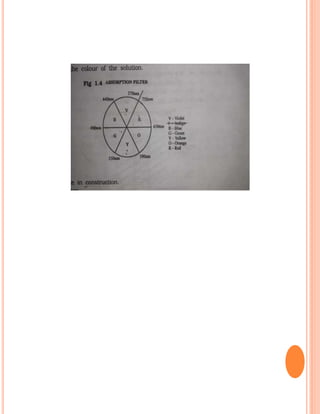
1.Draw a filter wheel (circle with 6
parts).
2.Write_the colours (VIBGYOR) in
clockwise or anticlockwise manner,
omitting Indigo.
3. If the colour of the solution is Red, we
have to_use Green filter and if the colour
of the solution is green, we have to use
Red filter. (The colour of the filter is
opposite to the colour of the solution i.e.
complimentary in nature)
4.Similarly, we can select the required
filter in a colorimeter, based
upon the colour of the solution.
Merits
1. Simple in construction.
2. Cheaper.
3. Selection of filter is easy.
Demerits
1.Less accurate since band pass is more
(+-30nm) (i.e. if we have to measure at
500nm, radiation ranging from 470nm to
530nm falls on the sample). (Band pass
is the difference in wavelength between
the points where the transmittance is one-
half the maximum)
1.Intensity of radiation becomes less due
to absorption by filters.
(ii) Interference Filter
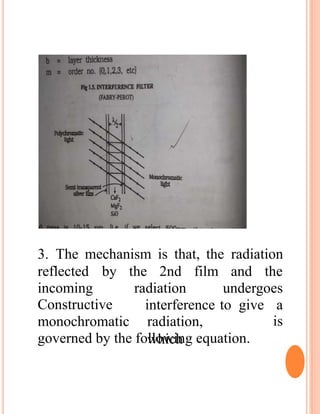
This filter is otherwise known as Fabry-
Perot filter (Fig). The
features are:
1.It has dielectric spacer film made up of
CaF2, MgF2 or SiO, between
two parallel reflecting silver films.
2.The thickness of dielectric spacer film
can be 1/2 λ(1st order),
2 λ/2 (2nd order), 3 λ/2 (3rd order), etc.
3. The mechanism is that, the radiation
reflected by the 2nd film and the
incoming
Constructive
monochromatic radiation,
which
radiation undergoes
interference to give a
is
governed by the following equation.
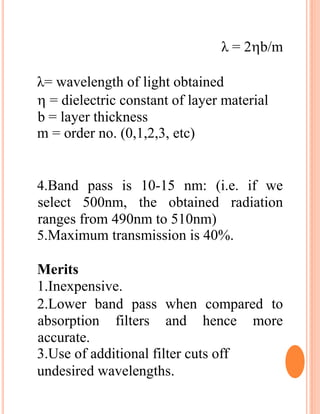
λ = 2b/m
λ= wavelength of light obtained
 = dielectric constant of layer material
b = layer thickness
m = order no. (0,1,2,3, etc)
4.Band pass is 10-15 nm: (i.e. if we
select 500nm, the obtained radiation
ranges from 490nm to 510nm)
5.Maximum transmission is 40%.
Merits
1.Inexpensive.
2.Lower band pass when compared to
absorption filters and hence more
accurate.
3.Use of additional filter cuts off
undesired wavelengths.
Demerits
1, Peak transmission is low and becomes
so when additional filters are used to cut
off undesired wavelength.
2. The band pass is only 10-15nm and
hence higher resolution obtained
with monochromators or gratings cannot
be achieved.
b. Monochromators
Monochromators are better and more
efficient than filters in converting a
polychromatic light or heterochromatic
light into monochromatic light. A
monochromator has the following units:
1)Entrance slit (to get narrow source).
2)Coilimator (to render light parallel).
3)Grating or prism (to disperse
radiation).
4)Collimator (to reform the images of
entrance slit).
5)Exit slit (to fall on sample cell).
1. Prisms
The prisms disperse the light radiation
into individual colours or wavelengths.
These-are found in inexpensive
instruments. The Band pass is lower than
that of filters and hence it has better
resolution. The resolution depends on the
size and refractive index of the prism.
The material of the prism is normally
glass.
The two types prisms available are.
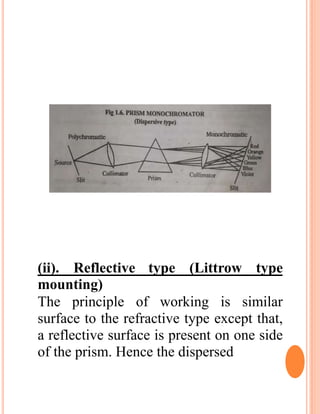
i)Refractive type:
where the source of
The following figure shows a
light,
prism,
through
entrance slit falls on a collimator. The
parallel radiations from collimator are
dispersed into different colours or
wavelengths, and by using another
collimator, the images of entrance slit are
reformed. The reformed ones will be
either Violet, Indigo, Blue, Green,
Yellow, Orange or Red. The required
radiation on exit slit can be selected by
rotating the prism or by keeping the
prism stationary and moving the exit slit.
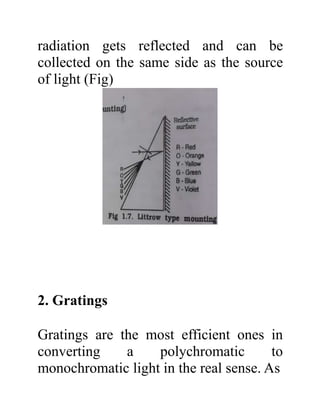
(ii). Reflective type (Littrow type
mounting)
The principle of working is similar
surface to the refractive type except that,
a reflective surface is present on one side
of the prism. Hence the dispersed
radiation gets reflected and can be
collected on the same side as the source
of light (Fig)
2. Gratings
Gratings are the most efficient ones in
converting a polychromatic to
monochromatic light in the real sense. As
a resolution of + 0.l1nm
achieved by using gratings
could be
they
ar
e
commonly used in spectrophotometers.
Gratings are of two types: (i).Diffraction
grating (i). Transmission gratings.
(i). Diffraction grating
Gratings are nothing but rulings made on
alkylhalides depending upon
some material like glass, quartz or
the
instrument, whether it is visible / UV / IR
spectrophotometer. The number of
rulings per mm also ranges from 20
grooves or lines per mm for IR
spectrophotometer to 3600 grooves or
more per mm for UV/visible
spectrophotometer.
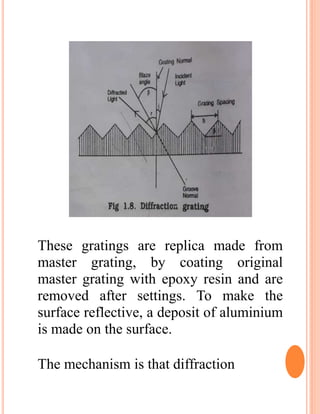
These gratings are replica made from
master grating, by coating original
master grating with epoxy resin and are
removed after settings. To make the
surface reflective, a deposit of aluminium
is made on the surface.
The mechanism is that diffraction
produces reinforcement. The rays which
are incident upon the grating gets
reinforced with the reflected rays.
and hence the resulting radiation has
wavelength which is governed by the
equation:
mλ = b (sin i + sin
r)
λ = wavelength of light produced b =
grating spacing
i = angle of incidence
r = angle of reflection
m = order (0, 1, 2, 3 etc)
The band pass of these gratings are
+0.1nm, whichmeansthey aremost
efficient and hence gratings are preferred.
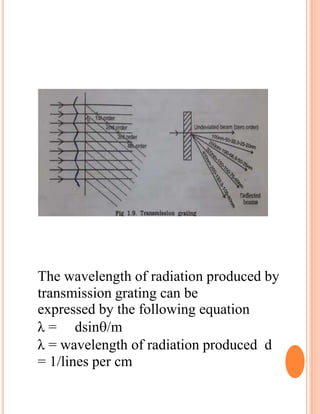
(ii). Transmission grating
Transmission grating is similar to
diffraction grating, but refraction takes
place instead of reflection. Refraction
produces reinforcement. This
when
grating
radiation transmitted
reinforces with
the
occurs
through
partially
refracted radiation.
The wavelength of radiation produced by
transmission grating can be
expressed by the following equation
λ = dsin/m
λ = wavelength of radiation produced d
= 1/lines per cm
m = order No. (0, 1, 2, 3, etc)
 = angle of deflection / diffraction
Thus a lght radiation at any angle () or
any order can be collected and used in
the instrument by either moving the
grating and fixing slit or moving the slit
and keeping the grating constant.
C. Sample cells
Sample cells or cuvettes are used to hold
a sample solution. The sample cell
should not absorb at the wavelength beng
observed
Parameters are:
Sample volume - Small volume
cells (0.5ml or less) and large volume
cells(5-10ml).
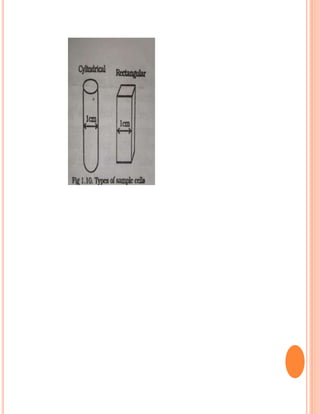
Shape of cell -Cylindrical (like test
tube) or rectangular.
Path length(internal distance) -1cm
(normally), upto 10cm (long
pathlength)Imm or 2mm (short path
length) cells are available.
MATERIAL-Colour corrected fused
glass for visible region. Polystyrene cells
are available for use with aqueous
solvents but cannot be used with organic
solvents. For UV region, these cells must
be made up of quartz since, glass
absorbs UVradiation.
DETECTORS
Detectors used in uv visible spectroscopy called as photometric
detectors. The radiation falls on the detector and the intensity of
absorbed radiation is determined. In these detectors the light
energy is converted to electrical signals which can be read or
recorded
1. Phototubes / photo emissive cells
2. Barrier layer cell or photo voltaic cell
3. Photo multiplier tube
4. Silicon photodiode
Phototubes / photo emissive cells
 A phototube or photoelectric cell is a type of
gas filled or vacuum tube that is sensitive to light.
 Called a 'photoemissive cell'
Principle
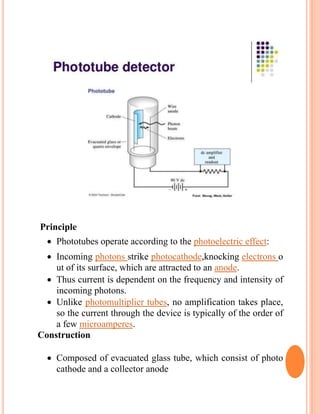
 Phototubes operate according to the photoelectric effect:
 Incoming photons strike photocathode,knocking electrons o
ut of its surface, which are attracted to an anode.
 Thus current is dependent on the frequency and intensity of
incoming photons.
 Unlike photomultiplier tubes, no amplification takes place,
so the current through the device is typically of the order of
a few microamperes.
Construction
 Composed of evacuated glass tube, which consist of photo
cathode and a collector anode
 The light wavelength range over which the device is
sensitive depends on the material used for the
photoemissive cathode.
 A caesium-antimony cathode gives a device that is very
sensitive in the violet to ultra-violet region with sensitivity
falling off to blindness to red light.
 Caesium on oxidised silver gives a cathode that is most
sensitive to infra-red to red light, falling off towards blue,
where the sensitivity is low but not zero.
MERITS
 Better sensitivity than photovoltaic cells
 widely used
Barrier layer cell of photo voltaic cell
also known as barrier layer or Photovoltaic cell is photronic cell.
Construction
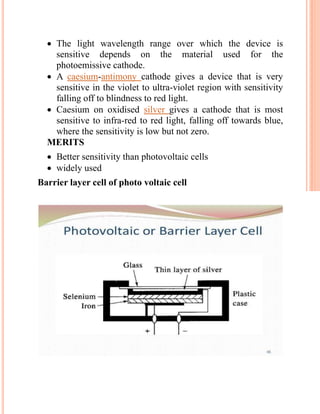
 It consists of a metallic base plate like iron or aluminium
which acts as one electrode. On its surface, a thin layer of a
semiconductor metal like selenium is deposited. Then the
surface of selenium is covered by a very thin layer of silver
or gold which acts as a second collector tube.
Principle
 When the radiation is incident upon the surface of
selenium, electrons are generated at the selenium- silver
surface and the electrons are collected by the silver. This
accumulation at the silver surface creates an electric
voltage difference between the silver surface and the basis
of the cell.
Demerit
 amplification of the signal is not possible
because the resisitance of the external circuit has to
be low.
 fatigue effect
 lesser response to the light other than blue and red.
Photo multiplier tube Construction
 Photomultipliers are typically constructed with an
evacuated glass housing (using an extremely tight and
durable glass-to-metal seal like other vacuum tubes).
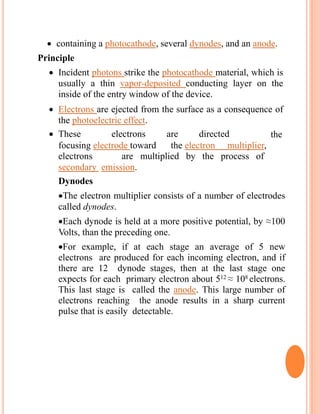
 containing a photocathode, several dynodes, and an anode.
Principle
 Incident photons strike the photocathode material, which is
usually a thin vapor-deposited conducting layer on the
inside of the entry window of the device.
 Electrons are ejected from the surface as a consequence of
the photoelectric effect.
 These electrons are directed
by
the
focusing electrode toward the electron multiplier,
whereelectrons are multiplied by the process of
secondary emission.
Dynodes
The electron multiplier consists of a number of electrodes
called dynodes.
Each dynode is held at a more positive potential, by ≈100
Volts, than the preceding one.
For example, if at each stage an average of 5 new
electrons are produced for each incoming electron, and if
there are 12 dynode stages, then at the last stage one
expects for each primary electron about 512 ≈ 108 electrons.
This last stage is called the anode. This large number of
electrons reaching the anode results in a sharp current
pulse that is easily detectable.
Silicon Photodiode
 A silicon
photodiode
utilizes the internal
photoelectric effect, thethe phenomenon whereby
electrical properties of the detector itself change
when light strikes it.
 As the name
suggests,
a silicon photodiode is
asemiconductor.
Principle
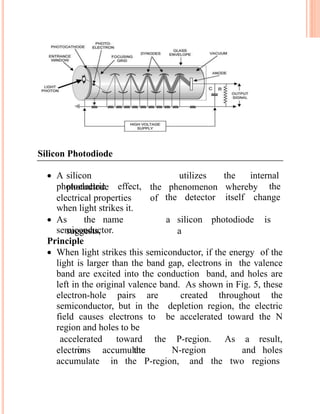
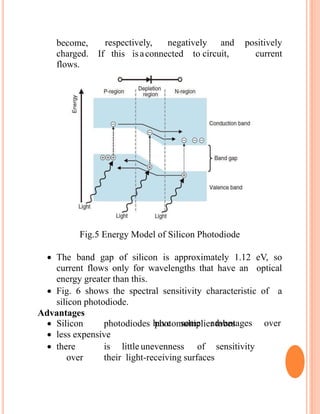
 When light strikes this semiconductor, if the energy of the
light is larger than the band gap, electrons in the valence
band are excited into the conduction band, and holes are
left in the original valence band. As shown in Fig. 5, these
electron-hole pairs are created throughout the
semiconductor, but in the depletion region, the electric
field causes electrons to be accelerated toward the N
region and holes to be
electrons accumulate
accelerated toward the P-region. As a result,
in the N-region and holes
accumulate in the P-region, and the two regions
become,
charged.
flows.
If this is connected to
respectively, negatively and positively
a circuit, current
Fig.5 Energy Model of Silicon Photodiode
 The band gap of silicon is approximately 1.12 eV, so
current flows only for wavelengths that have an optical
energy greater than this.
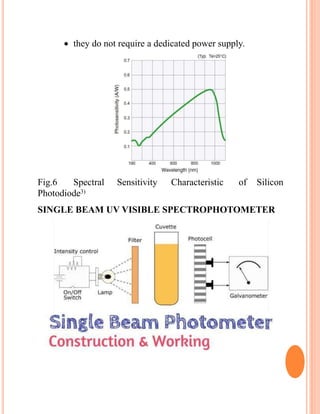
 Fig. 6 shows the spectral sensitivity characteristic of a
silicon photodiode.
Advantages
have some advantages over Silicon photodiodes photomultiplier tubes
 less expensive
 there is little unevenness of sensitivity
over their light-receiving surfaces
 they do not require a dedicated power supply.
Fig.6 Spectral Sensitivity Characteristic of Silicon
Photodiode3)
SINGLE BEAM UV VISIBLE SPECTROPHOTOMETER
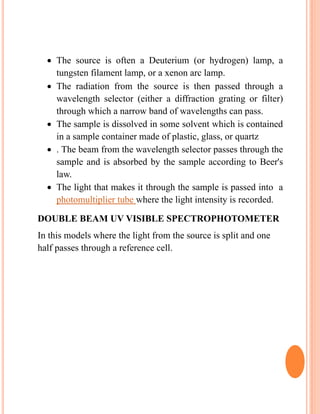
 The source is often a Deuterium (or hydrogen) lamp, a
tungsten filament lamp, or a xenon arc lamp.
 The radiation from the source is then passed through a
wavelength selector (either a diffraction grating or filter)
through which a narrow band of wavelengths can pass.
 The sample is dissolved in some solvent which is contained
in a sample container made of plastic, glass, or quartz
 . The beam from the wavelength selector passes through the
sample and is absorbed by the sample according to Beer's
law.
 The light that makes it through the sample is passed into a
photomultiplier tube where the light intensity is recorded.
DOUBLE BEAM UV VISIBLE SPECTROPHOTOMETER
In this models where the light from the source is split and one
half passes through a reference cell.
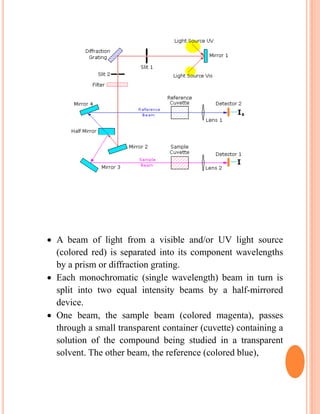
 A beam of light from a visible and/or UV light source
(colored red) is separated into its component wavelengths
by a prism or diffraction grating.
 Each monochromatic (single wavelength) beam in turn is
split into two equal intensity beams by a half-mirrored
device.
 One beam, the sample beam (colored magenta), passes
through a small transparent container (cuvette) containing a
solution of the compound being studied in a transparent
solvent. The other beam, the reference (colored blue),
passes through an identical cuvette containing only the
solvent.
 The intensities of these light beams are then measured by
electronic detectors and compared. The intensity of the
reference beam, which should have suffered little or no light
absorption, is defined as I0. The intensity of the sample
beam is defined as I. Over a short period of time, the
spectrometer automatically scans all the component
wavelengths in the manner described.
 The ultraviolet (UV) region scanned is normally from 200
to 400 nm, and the visible portion is from 400 to 800 nm.
APPLICATIONS
1. Detection of Impurities
UV absorption spectroscopy is one of the best methods for
determination of impurities in organic molecules. Additional
peaks can be observed due to impurities in the sample and it
can be compared with that of standard raw material. By also
measuring the absorbance at specific wavelength, the
impurities can be detected.
Benzene appears as a common impurity in cyclohexane. Its
presence can be easily detected by its absorption at 255 nm.
2. Structure elucidation of organic compounds.
UV spectroscopy is useful in the structure elucidation of organic
molecules, the presence or absence of unsaturation, the
presence
of hetero atoms.
From the location of peaks and combination of peaks, it can be
concluded that whether the compound is saturated or
unsaturated, hetero atoms are present or not etc.
3. Quantitative analysis
UV absorption spectroscopy can be used for the quantitative
determination of compounds that absorb UV radiation. This
determination is based on Beer’s law which is as follows.
A = log I0 / It = log 1/ T = – log T = abc = εbc
Where ε is extinction co-efficient, c is concentration, and b is the
length of the cell that is used in UV spectrophotometer.
Other methods for quantitative analysis are as follows.
a. calibration curve method
b. simultaneous multicomponent method
c. difference spectrophotometric method
d. derivative spectrophotometric method
Quantitative analysis aims to determine the concentration and
amount of drug in sample solution and thus the percentage
purity can be determined.
For the quantitative analysis of drugs by colorimetry, the
following characteristics must be known.
1.Light absorption characteristics - i.e. λmax to be known. This
wavelength has to be used because of high sensitivity,
specificity & accuracy.
2.Validity of Beer’s law - i.e. Concentration range in which the
system obeys linearity (e.g) 10-50μg/ml, 2-10μg/ml, etc.1%
3.Solvent, reagent, other conditions, E1cm - if available from
literature etc.
The several quantitative methods are:
a. Using E1cm
1%
values
This method can be used for estimations from formulations or
raw
material, when Reference standard is not available.
eg. E1c
1% for Paracetamol at 257nm is 715. (obtained fromm
Pharmacopoeia or Journals or text books)
To find the % purity of paracetamol tablets, the following
formula
can be used.
% Purity = observed absorbance/E value x100/concentration
B. E1cm
1%
is not available but reference standard is available
In this case E1cm
1% value can be determined by observing
absorbance at different standard solutions and the average E
value is taken.After calculating the E value, the method as in (a)
can be followed.
Alternatively we can use any of the following methods:
(1) Single standard or Direct comparison method
In this method, the absorbance of a standard solution of known
concentration and a sample solution is measured. The
concentration of unknown can be calculated using the formula
A1 = c1t A2 = c2t
A2,A1 - Absorbance of standard and sample
C1,C2 - Concentration of standard and sample
- Mol. ext. coefficient t - pathlength (1
cm)
On dividing, we get A1/A2 = c1t/c2t
therefore c2 = c1 x A2/A1
when c1 A2 A1 are known we can calculate the concentration of u
known sample.
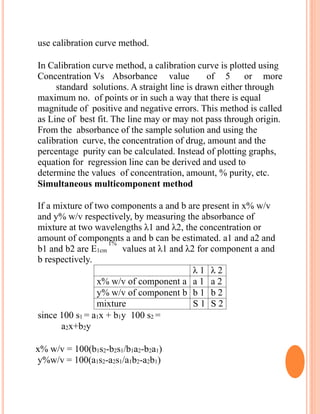
(ii) Calibration curve method or Multiple standard method
In a single standard method, when erroris
introduced in preparing
the solution or measurement of Absorbance, the error in results
would be greater. To eliminate or to minimize this error, we can
use calibration curve method.
In Calibration curve method, a calibration curve is plotted using
Concentration Vs Absorbance value of 5 or more
standard solutions. A straight line is drawn either through
maximum no. of points or in such a way that there is equal
magnitude of positive and negative errors. This method is called
as Line of best fit. The line may or may not pass through origin.
From the absorbance of the sample solution and using the
calibration curve, the concentration of drug, amount and the
percentage purity can be calculated. Instead of plotting graphs,
equation for regression line can be derived and used to
determine the values of concentration, amount, % purity, etc.
Simultaneous multicomponent method
If a mixture of two components a and b are present in x% w/v
and y% w/v respectively, by measuring the absorbance of
mixture at two wavelengths λ1 and λ2, the concentration or
amount of components a and b can be estimated. a1 and a2 and
values at λ1 and λ2 for component a and
1%
b1 and b2 are E1cm
b respectively.
λ 1 λ 2
x% w/v of component a a 1 a 2
y% w/v of component b b 1 b 2
mixture S 1 S 2
since 100 s1 = a1x + b1y 100 s2 =
a2x+b2y
x% w/v = 100(b1s2-b2s1/b1a2-b2a1)
y%w/v = 100(a1s2-a2s1/a1b2-a2b1)
(ii) Derivative spectrophotometric method
In this method, spectral isolation is achieved rather than
chromatographic isolation. In derivative spectrum the change in
absorbance with respect to wavelength (vs) wavelength is
Recorded first and second derivative spectrum is recorded and
the characteristic peak for the individual components can be
identified and quantified, using a calibration curve of pure
substance.
(iii) Difference Spectrophotometric method
This method is especially useful to quantify a substance when
interfering species are present. The principle is that absorbance
difference between two forms of the same drug is measured.
This method is used to quantify drugs in biological fluid.
4. Qualitative analysis
UVabsorption spectroscopy can characterize those types of
compounds which absorbs UV radiation. Identification is done
by comparing the absorption spectrum with the spectra of
known compounds.
UV absorption spectroscopy is generally used for characterizing
aromatic compounds and aromatic olefins.
Dissociation constants of acids and bases.
PH = PKa + log [A-] / [HA]
From the above equation, the PKa value can be calculated if the
ratio of [A-] / [HA] is known at a particular PH. and the ratio of
[A-] / [HA] can be determined spectrophotometrically from the
graph plotted between absorbance and wavelength at different
PH values.
6. Chemical kinetics
Kinetics of reaction can also be studied using UV spectroscopy.
The UV radiation is passed through the reaction cell and the
absorbance changes can be observed.
7. Quantitative analysis of pharmaceutical substances
Many drugs are either in the form of raw material or in the form
of formulation. They can be assayed by making a suitable
solution of the drug in a solvent and measuring the
absorbance at specific wavelength.
Diazepam tablet can be analyzed by 0.5% H2SO4 in methanol at
the wavelength 284 nm.
8. Molecular weight determination
Molecular weights of compounds can be measured
spectrophotometrically by preparing the suitable derivatives
of these compounds.
For example, if we want to determine the molecular weight of
amine then it is converted in to amine picrate. Then known
concentration of amine picrate is dissolved in a litre of
solution
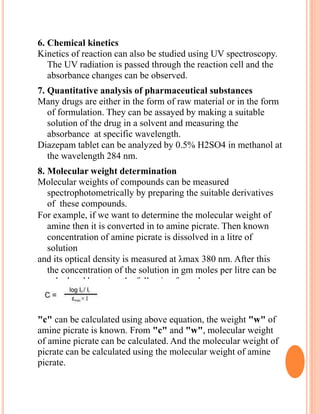
and its optical density is measured at λmax 380 nm. After this
the concentration of the solution in gm moles per litre can be
calculated by using the following formula.
"c" can be calculated using above equation, the weight "w" of
amine picrate is known. From "c" and "w", molecular weight
of amine picrate can be calculated. And the molecular weight of
picrate can be calculated using the molecular weight of amine
picrate.
9. As HPLC detector
A UV/Vis spectrophotometer may be used as a detector for
HPLC. The presence of an analyte gives a response which can
be assumed to be proportional to the concentration. For more
accurate results, the instrument's response to the analyte in the
unknown should be compared with the response to a standard; as
in the case of calibration curve.
THANK YOU

Uv visible sprctroscopy ppt

  • 1.
    SPECTROSCOPY | INTRODUCTION TO SPECTROSCOPY Spectroscopy is the measurement and interpretation of Electro Magnetic Radiation (EMR) absorbed or emitted when the molecules or atoms or ions of a sample move from one energy state to another energy state.  This change may be from Ground State to excited state or excited state to Ground state. At ground state, the energy of a molecule is the sum total of rotational, vibrational and electronic energies.  In other words, spectroscopy measures the changes in rotational, vibrational and/or electronic energies.
  • 2.
    ELECTROMAGNETIC RADIATIONS Electro Magnetic Radiationis made up of discrete particles called Photons. EMR has got both wave characteristic as well as particle characteristics. This means that it can travel in vacuum also. The different types of EMR are Visible radiation, UV radiation, IR radiation, Microwaves, Radiowaves, X-rays, y-rays or Cosmic rays. As these radiations have different wavelength or frequency or energy, they are conveniently named so.
  • 3.
    The energy ofan electromagnetic radiation can be given by the following equation: E=hv where E = Energy of radiation h = Plank's constant (6.624 x 10 -34 JSec) v radiation = Frequency of frequency = c/λ or velocity of light in vaccum/wavelength
  • 4.
    hence E =H√ = hc/λ = hc√- where √- = wave number Therefore the energy of a radiation depends upon frequency and wavelength of the radiation. Theory of Spectroscopy When EMR travelsthrough a medium containing atoms, ions, any one of the following may take place.
  • 5.
    atoms or molecules 1.Intensity ofemergent light (I) = Intensity of incident light (Io) Therefore no absorption i.e. It = Io. No change in energy takes place and hence no information about the molecule can be derived. 2.Reflection, Refraction or Scattering, (scattering of light by particles) where some studies like Nephlometry or Turbidimetry are being made. I0 It
  • 6.
    3.Intensityof emergent light< Incident light, where there is absorption of energy. Here some information can be derived. UV VISIBLE SPEPCTROSCOPY PRINCIPLE  Colorimetry is concerned with the study of absorption Of visible radiation whosewavelength ranges fom 400nm-800nm. Any coloured substance will absorb radiation in this wavelength region. Coloured substances, absorb light of different wavelength in different_manner and hence we get an absorption curve (Absorbance Vs Wavelength - Fig 1.1.).
  • 7.
    The wavelength atwhich max absorption of radiation takes place is called λmax. This λmaxis characteristic for every coloured substances and is the qualitative aspects. λmax is not affected by concentration of substances.
  • 8.
     Ultraviolet_spectroscopy is concernedwith the study of absorption of UV radiation which ranges from 200nm to-400nm. Compounds which are colourless absorb radiation in the UV region.
  • 9.
    The types of electronspresent in any molecule may be conveniently classified as,  ‘σ’ electrons: These are the ones present in saturated compounds. Such electrons do not absorb near UV, but absorb vacuum UV radiation (<200nm).  ‘π’ electrons: These electrons are present in unsaturated compounds. (eg) double or triple bonds (eg) >C= C<, -C≡C-.  ‘n’ electrons: These are non bonded electrons which are not involved in any bonding (eg) lone pair of
  • 10.
    Any molecule has eithern, π, σ or a combination of these- electrons. These bonding (π & σ ) and non- bonding (n) electrons absorb the characteristic radiation and undergoes transition from ground state to excited state. By the characteristic absorption peak, nature of the electrons present and hence the molecular structure can be elucidated. ELECTRONIC TRANSITIONS AND EXCITATION PROCESS It was stated earlier that σ, n and π electrons are present in a molecule and can be excited from the ground state by the absorption of UV radiation. The various transitions aren
  • 11.
    σ*, σ σ*.Theπ*,π different energy π*, n state associated with such transitions can be given by the diagram states associated with such transitions can be given by the diagram. TYPES OF TRANSITIONS ELECTRONIC  n-π*: Of all the types of transition, n- π* transition requires the lowest
  • 12.
    energy (longer wavelength).The peaks due to this transition is also called as R-bands. This type of peak can be seen in compounds where ‘n' electron (present in S, O, N or halogen) is present in a compound containing double bond or triple bond (eg) aldehydes or ketones, nitrocompounds, etc. The presence of n—π* transition can be identified easily by comparing the UV spectrum of the substance with the spectrum recorded in the acid solution of the same substance. In an acid solution, the band disappears if n-π* has been present Peak. The presence of other hetero atoms can be identified by comparison with a
  • 13.
    similar compound withouthetero atom. These technique can be used in structure elucidation. π—π*: This type of transitiongives rise to B, E & K bands. Types Due to B-bands (benzenoid bands) aromatic & hetero aromatic systems E-bands (Ethylenic bands) Aromatic systems K-bands Conjugated systems The energy requirement of this transition is between n-σ* and n-π*.But extended conjugation (addition of more
  • 14.
    bonds)double/triple substituents shift and alkyl theλmaxtowards longer λ (Bathochromic shift). Also trans λ isomer of olefin absorbs at longer with more intensity than Cis isomer. (Bathochromic shift and hyperchromic effect). Extended conjugation (and alkyl substitution) shifts λmax to such an extent that the λmax falls in the colorimetric region (eg) Plant pigments like f-carotene, lycophene,etc. The λmax of some chromophores and other systems are given below. Chromophore peaks >C=C< 174nm (ethylenic)
  • 15.
    -C≡C- 178nm 3. n-σ* Thistransition occurs in saturated compounds, with hetero atom(s) like S, energy when compared to O, N or Halogens. It requires lesser σ-σ* transition. Normally the peaks due to this transition occurs from 180 nm – 250 nm. As these peaks are observed at the lower end of the UV spectrum, it can be called as end absorption. Some compounds with n-σ* transitions are:
  • 16.
    4. σ-σ*: Ofall the electronic transitions, this type of transition requires the highest energy. This is observed with compounds(especially saturated hydrocarbons). The peaks do not appear in UV region, but occur in vacuum UV or far UV compounds with such transition region, i.e. 125-135nm. Some of the are Methane (122nm), Ethane (135nm), Propane (135nm) and Cyclopropane (190nm). SinceUV spectrophotometers
  • 17.
    are operated above200nm. saturated hydrocarbons lke cyclohexane (195nm) can be used as nonpolar solvents, as it does not give solvent peak. CHROMOPHORE AND RELATED TERMS  Chromophore is defined as any group electromagnetic radiations in which exhibits absorption of the visible or ultraviolet region. some of the important chromophores are ethylenic, acetylenic, carbonyls, acids, acids, esters, nitrile etc. Two types of chromophores are known: 1)chromophores in whichthegroup is having π electrons undergoes π-π*
  • 18.
    transitions. examples areethylenes, acetylenes etc. 2)Chromophores, having both π- electrons and n electrons undergo two types of transitions ie, π-π* and n-π*. examples include carbonyls, nitriles, azo compounds,nitro compounds etc. CHANGES IN POSITION AND INTENSITY OF ABSORPTION( SPECTRAL SHIFT)
  • 19.
    For isolated chromophoregroups such as >C=C< and -C≡C-, absorption takes place in far ultraviolet region which cannot be easily studied. But the position of absorption maximum and the intensity of absorption Different ways can be modified in by some structural changes or change of solvent as given below. (1) Bathochromic shift or red shift. It involves the shift of absorption maximum towards longerwavelength because of the presence of certain groups such as OH and NH2, called auxochromes or by change of solvents. example: 1)decreasing thepolarity of solvent
  • 20.
    causes a reshift in the n-π* absorption of carbonyl compounds. 2) Red shift also produced when 2 or more chromophore are present in conjugation in a molecule. for example ethylene shows a π-π* transitionat 170nm where 1,3-butadiene shows λmax at 217 nm. (2) Hypsochromic shift or blue shift. it involves the shift of absorption maximum towards shorter wavelength and may be caused by removal of conjugation in a system or by change of solvent. In the case of aniline, absorption maximum takes place at 280 mμ because the pair of electrons on nitrogen atom is
  • 21.
    in conjugation withthe πbond system of the benzene ring. In acidic solution blue shift is caused and absorption takes place at shorter wave length. (3) Hyperchromic effect. This effect involves an increase in the intensity of absorption and usually brought about by introduction of an
  • 22.
    auxochrome. For example,introduction of methyl groupsin position 2 of pyridine increases EMAX (λ 262 nm) from 2750 to 3560 (λmax 262 nm) for π-π* transition. (4) Hypochromic effect. It involves a decrease in the intensity of absorption and is brought by groups which are able to distort the geometry of the molecule. For example when a methyl groups introduced in position 2 of biphenyl group hypochromic effect occurs because of distortion caused by methyl group. AUXOCHROME. It is a group which itself does not act as a
  • 23.
    chromophore but whenattached to a chromophore it shifis the maximum towards longer adsorption wavelength along with an increase in the intensity of commonly knownabsorption. auxochromic Some groups are—OH,-NH,,- OR,-NHR and –NR2. For example when the auxochrome — NH, group is attached to benzene ting, its absorption changes from λmax 255 (Emax 203) to λmax 280 (Emax 1430). All auxochromes have one or more non- bonding pair of electrons. If an auxochromeis attached to a chromophore, it helps is extending the conjugation by sharing of non-bonding pair of electrons as shown below.
  • 24.
    CH2=CH-NR2 -CH2-CH=NR2 + The extended conjugationhas been responsible for bathochromic effect of auxochrome. SOLVENT EFFECTS A most suitable solvent is one that does not itself absorb in the region under investigation, A solution of the sample is always prepared for spectral analysis. Most commonly used_solvent is ethanol. Ethanol is a best solvent as it is cheap and is transparent down to 210 mμ. Commercial Should not be used because it is having benzene which absorbs strongly in the ultra-violet region, other solvents which are transparent above 210 mμ are n-hexane, methyl alcohol,
  • 25.
    cyclohexane, acetonitrile, diethylether etc. Some solvents with their upper wave-length limit of absorption are given in Table. The position as well as the intensity of absorption maximum get shifted for a particular chromophore by changing the polarity of the solvent.By increasing the polarity of the solvent compound such as dienes and conjugated donot experience any hydrocarbons appreciable shift.The absorption maximum for the non-polar compounds is usually shifted with the change in polarity of the
  • 26.
    solvents. (1)n-π* transition (lessintense), For such a case the absorption band moves to shorter wavelength by increasing the polarity of the solvent.In n-π* transition, the ground state is more polar as to the excited state, The hydrogen bonding with solvent molecules occurs to lesser extent with the carbonyl group in the excited state.For example, absorption maximum of acetone is at 279 mμ in hexane as compared to 264 mμ in water. (2)π- π* transitions (intense), In such a case, the absorption band moves to longer wavelength by increasing the polarity of the solvent.The dipole-dipole interactions with the solvent molecules lower the energy of the excited state
  • 27.
    more than thatof the ground state. Hence the value of absorption maximum in ethanol will be greater than that observed in hexane. In short π* orbitals get more stabilised by hydrogen bonding with the polar solvents like water and ethanol. It is because of greater polarity of π* orbital compared to π-orbital.Thus, small energy will be needed for such a transition and
  • 28.
    absorption shows ared shift. n-σ* transitions are also very sensitive to hydrogen bonding. Alcohols as well as amines form hydrogen bonding with the solvent molecules. Such associations occur because of the presence of non- bonding electrons on the hetero atom and thus, transition requires greater energy. In general, we say that (a)When a group (say, carbonyl) is more polar in the ground state than in the excited state than increasing polarity of the solvent stabilises the non-bonding electrons in the ground state because of hydrogen bonding. Thus, absorption is shifted to lower wave-length. (a)When the group is more polar in the excited state, then absorption gets shifted
  • 29.
    to longer wavelength with increase in polarity of the solvent which helps in stabilising the non-bonding electrons in the excited state. The increase in polarity of the solvent generally shifts n-π* and n- σ* bands to shorter wave lengths and π — π * bands to longer wave-lengths. Choice of Solvent A suitable solvent for ultraviolet spectroscopy should meet the following requirements. (i)It should not itself absorb radiations in the region under investigation. (ii)It should be less polar so that it has minimum interaction with the solute molecules.
  • 30.
    The most commonlyemployed solvent is 95% ethanol. It is cheap, has good dissolving power and does not absorb radiations above 210 nm. In other words it is transparent above 210 nm. Commercial ethanol should not be used as it contains some benzene which undergoes absorption in the UV range at about 280.Some other solvents which are transparent above 210 nm are n-hexane, cyclohexane, methanol, water and ether. Benzene, chloroform and carbon tetrachloride cannot be used because they absorb in the range about 240-280 nm. Hexane and other hydrocarbons are sometimes preferred to polar solvents because they have minimum interactions with the solute molecules.
  • 31.
    LAWS GOVERNING ABSORPTION OFRADIATION The two laws related to the absorption of radiation are: 1.Beer's law (related to Concentration of absorbing species) 2. Lambert's law (related to thickness/path length of absorbing species)
  • 32.
    These two lawsare applicable under the following condition: I=Ia + It I = Intensity of incident light la = Intensity of absorbed light >“ It = Intensity of transmitted light and No reflection/scattering of light takes place Beer's Law Beer's law states that “The intensity of a beam of monochromatic light decreases exponentially with increase in the concentration of absorbing species arithmetically” Accordingly, -dI/dc  I
  • 33.
    [The decrease inthe intensity of incident light (I) with concentration (C) is proportional to the intensity of incident light(I)] -dI/dc = kI (removing and introducing the constant of proporationality ‘k’) - dI/I =k dc rearranging terms -ln I = kc + b equation 1 on integration, b is constant of integration
  • 34.
    when concentration =0 there is no absorbance. hence I=I0.there substituting in equation 1 -lnI0 = k * 0 + b -lnI0 = b substituting the value of b, in equation 1 -lnI = kc – lnIo -lnIo – lnI = kc ln Io/I = kc Io/I = ekcremoval of natural logarithm I/Io = e-kc making inverse on both sides I = Io e-kc equation 2 beer equation Lambertz law the rate of decrease of intensity of
  • 35.
    monochromatic light withthe thickness of the medium is directly proportional to the intensity of incident light. Accordingly, -dI/dt  I [The decrease in the intensity of incident light (I) with concentration (C) is proportional to the intensity of incident light(I)] -dI/dt = kl (removing and introducing the constant of proporationality ‘k’) - dI/I =k dt rearranging terms
  • 36.
    -ln I =kt + b equation 1 on integration, b is constant of integration when pathlength = 0 there is no absorbance. hence I=I0.there substituting in equation 1 -lnI0 = k * 0 + b -lnI0 = b substituting the value of b, in equation 1 -lnI = kt – lnIo -lnIo – lnI = kt ln Io/I = kt Io/I = ekt removal of natural logarithm I/Io = e-kt making inverse on both sides I = Io e-kt equation 3 lamberts equation
  • 37.
    equation 2 and3 can be combined to get I =Io e-kct I =Io 10 –kct ( converting natural logarithm to base 10 and k = k * 0.4343) I/Io =10 –kct Io/I = 10 kct log Io/I = kct taking log on both sides equation 4 transmittance T = I/Io and absorbance A = log 1/T Hence A = log 1o/I using equations 4 A = kct instead k we can use  A =ct equation for beer lamberts law A = absorbance or optical density or
  • 38.
    extinction co efficient = molecular extinction co efficient t = pathlength 10 mm or 1 cm c = concentration of drug (mmol/lit)  can be expressed as follows  = E%1cm x molecular weight/10 where E%1cm means the absorbance of 1% w/v solution, using a pathlength of 1 cm it is a constant value for each drug this value is used to determine the concentration of drugs in solutions Emax is the value at λmax.
  • 39.
    DEVIATIONS FROM BEER'SLAW A system is said to obey Beer's law, when a plot of Concentration Vs Absorbance gives a Straight line.’ The straight line is obtained by using line of best fit or method of least squares or by joining the maximum no. of points in such a way that positive and negative errors are balanced or minimised, The regression line can also be used for determining concentration of a solution whose absorbance is obtained using a colorimeter/spectrophotometer. When a straight line is not obtained, i.e. a non- linear curve_is obtained in a plot of Concentration Vs Absorbance, thé system is said to undergo deviation from Beer's Law. Such devtation can be positive deviation or negative deviation.
  • 40.
    Positive deviation resultswhen a small change in concentration produces a greater change in absorbance. Negative deviation results when a large change in Concentration produces smaller change in Absorbance. Reasons For Deviations 1. Instrumental deviations Factors like stray radiation, improper slit width, fluctuation in single beam and when monochromatic light is not used
  • 41.
    can influence thedeviation. 2. Physicochemical changes in solution. Factors like Association, Dissociation, lonisation (Change in PH) , faulty development of colour (incompletion of reactions) refractive index at high can influencesuchconcentrations deviations. Examples: Association: Methylene blue at concentrations of 10- 5M exists as monomerand has λmax of 660nm. But Methylene concentration above 10-4M dimer or trimer, but has a λmax of 600nm. Hence when the shift of λmax is Blue at Exist as
  • 42.
    not observed forabsorbance measurements, deviations occur. Dissociation 2H* + 2CrO4 Cr2O7 2- + H2O Orange yellow Potassium dichromate in high concentration exists as orange solution (λmax - 450nm). But on dilution, dichromate ions are dissociated into chromate ions which is yellow coloured (λmax - 410nm). Hence when 450nm is used for absorbance measurements,
  • 43.
    deviation from Beer'slaw is seen. Incomplete reaction When sufficient time is not allowed for making absorbance measurements or when the readings are made when the colour has faded away due to instability of colour, deviations can occur (eg.) Determination of iron using thioglycollic acid before completion of reaction. INSTRUMENTATION The different components are A. SOURCE OF LIGHT: The visible
  • 44.
    spectrum ranges from400nm to 800nm. Hence any lamp source which gives adequate intensity of radiation over the entire wavelength region can be used. The requirements of a source of light for colorimeter are i.It should provide continuous radiation from 400nm - 800nm i. It should provide adequate intensity ili. It should be stable and free from fluctuations The following arethesources of light used commonly. a. Tungsten lamp: As it satisfies the above criteria, this lamp finds its place in most of colorimeter and
  • 45.
    spectrophotometer. The lampconsists of a tungsten filament in a vacuum bulb similar to the ones used domestically. But it offers sufficient intensity. b. Carbon _arc lamp: For a source of very high intensity, carbon are lamp can be used. It also provides an entire range of visible spectrum. B. FILTERS AND _MONOCHROMATORS: The source of light gives radiations from 400 nm to 800 nm. This is polychromatic several wavelength).in colorimeter (heterochromatic) in nature (light of / spectrophotometer, we require only monochromaticlight (light of single wavelength). ~ Hence a filter or
  • 46.
    monochromator is usedwhich converts polychromatic light into monochromatic light, though the efficiency of each differs considerably. FILTERS two kinds. They are: 1)absorption filters 2)interference filters monochromators are 2 types 1)prism type(dispersive and littrow type) 2) grating type (diffraction and transmission) a. FILTERS
  • 47.
    (i) Absorption filters Thesefilters are made up of glass, coated are made up of glass, coatedwith pigments or they are made up of dyed _ gelatin. They absorb the unwanted radiation and transmit the rest of the radiation which is required for colorimetry. These filters can be selected according to the procedure given below: 1.Draw a filter wheel (circle with 6 parts).
  • 49.
    2.Write_the colours (VIBGYOR)in clockwise or anticlockwise manner, omitting Indigo. 3. If the colour of the solution is Red, we have to_use Green filter and if the colour of the solution is green, we have to use Red filter. (The colour of the filter is opposite to the colour of the solution i.e. complimentary in nature) 4.Similarly, we can select the required filter in a colorimeter, based upon the colour of the solution. Merits 1. Simple in construction.
  • 50.
    2. Cheaper. 3. Selectionof filter is easy. Demerits 1.Less accurate since band pass is more (+-30nm) (i.e. if we have to measure at 500nm, radiation ranging from 470nm to 530nm falls on the sample). (Band pass is the difference in wavelength between the points where the transmittance is one- half the maximum) 1.Intensity of radiation becomes less due to absorption by filters. (ii) Interference Filter This filter is otherwise known as Fabry- Perot filter (Fig). The
  • 51.
    features are: 1.It hasdielectric spacer film made up of CaF2, MgF2 or SiO, between two parallel reflecting silver films. 2.The thickness of dielectric spacer film can be 1/2 λ(1st order), 2 λ/2 (2nd order), 3 λ/2 (3rd order), etc.
  • 52.
    3. The mechanismis that, the radiation reflected by the 2nd film and the incoming Constructive monochromatic radiation, which radiation undergoes interference to give a is governed by the following equation.
  • 53.
    λ = 2b/m λ=wavelength of light obtained  = dielectric constant of layer material b = layer thickness m = order no. (0,1,2,3, etc) 4.Band pass is 10-15 nm: (i.e. if we select 500nm, the obtained radiation ranges from 490nm to 510nm) 5.Maximum transmission is 40%. Merits 1.Inexpensive. 2.Lower band pass when compared to absorption filters and hence more accurate. 3.Use of additional filter cuts off undesired wavelengths.
  • 54.
    Demerits 1, Peak transmissionis low and becomes so when additional filters are used to cut off undesired wavelength. 2. The band pass is only 10-15nm and hence higher resolution obtained with monochromators or gratings cannot be achieved. b. Monochromators Monochromators are better and more efficient than filters in converting a polychromatic light or heterochromatic light into monochromatic light. A monochromator has the following units: 1)Entrance slit (to get narrow source).
  • 55.
    2)Coilimator (to renderlight parallel). 3)Grating or prism (to disperse radiation). 4)Collimator (to reform the images of entrance slit). 5)Exit slit (to fall on sample cell). 1. Prisms The prisms disperse the light radiation into individual colours or wavelengths. These-are found in inexpensive instruments. The Band pass is lower than that of filters and hence it has better resolution. The resolution depends on the size and refractive index of the prism. The material of the prism is normally
  • 56.
    glass. The two typesprisms available are. i)Refractive type: where the source of The following figure shows a light, prism, through entrance slit falls on a collimator. The parallel radiations from collimator are dispersed into different colours or wavelengths, and by using another collimator, the images of entrance slit are reformed. The reformed ones will be either Violet, Indigo, Blue, Green, Yellow, Orange or Red. The required radiation on exit slit can be selected by rotating the prism or by keeping the prism stationary and moving the exit slit.
  • 57.
    (ii). Reflective type(Littrow type mounting) The principle of working is similar surface to the refractive type except that, a reflective surface is present on one side of the prism. Hence the dispersed
  • 58.
    radiation gets reflectedand can be collected on the same side as the source of light (Fig) 2. Gratings Gratings are the most efficient ones in converting a polychromatic to monochromatic light in the real sense. As
  • 59.
    a resolution of+ 0.l1nm achieved by using gratings could be they ar e commonly used in spectrophotometers. Gratings are of two types: (i).Diffraction grating (i). Transmission gratings. (i). Diffraction grating Gratings are nothing but rulings made on alkylhalides depending upon some material like glass, quartz or the instrument, whether it is visible / UV / IR spectrophotometer. The number of rulings per mm also ranges from 20 grooves or lines per mm for IR spectrophotometer to 3600 grooves or more per mm for UV/visible spectrophotometer.
  • 60.
    These gratings arereplica made from master grating, by coating original master grating with epoxy resin and are removed after settings. To make the surface reflective, a deposit of aluminium is made on the surface. The mechanism is that diffraction
  • 61.
    produces reinforcement. Therays which are incident upon the grating gets reinforced with the reflected rays. and hence the resulting radiation has wavelength which is governed by the equation: mλ = b (sin i + sin r) λ = wavelength of light produced b = grating spacing i = angle of incidence r = angle of reflection m = order (0, 1, 2, 3 etc) The band pass of these gratings are +0.1nm, whichmeansthey aremost efficient and hence gratings are preferred.
  • 62.
    (ii). Transmission grating Transmissiongrating is similar to diffraction grating, but refraction takes place instead of reflection. Refraction produces reinforcement. This when grating radiation transmitted reinforces with the occurs through partially refracted radiation.
  • 63.
    The wavelength ofradiation produced by transmission grating can be expressed by the following equation λ = dsin/m λ = wavelength of radiation produced d = 1/lines per cm
  • 64.
    m = orderNo. (0, 1, 2, 3, etc)  = angle of deflection / diffraction Thus a lght radiation at any angle () or any order can be collected and used in the instrument by either moving the grating and fixing slit or moving the slit and keeping the grating constant. C. Sample cells Sample cells or cuvettes are used to hold a sample solution. The sample cell should not absorb at the wavelength beng observed Parameters are: Sample volume - Small volume
  • 65.
    cells (0.5ml orless) and large volume cells(5-10ml). Shape of cell -Cylindrical (like test tube) or rectangular. Path length(internal distance) -1cm (normally), upto 10cm (long pathlength)Imm or 2mm (short path length) cells are available. MATERIAL-Colour corrected fused glass for visible region. Polystyrene cells are available for use with aqueous solvents but cannot be used with organic solvents. For UV region, these cells must be made up of quartz since, glass absorbs UVradiation.
  • 67.
    DETECTORS Detectors used inuv visible spectroscopy called as photometric detectors. The radiation falls on the detector and the intensity of absorbed radiation is determined. In these detectors the light energy is converted to electrical signals which can be read or recorded 1. Phototubes / photo emissive cells 2. Barrier layer cell or photo voltaic cell 3. Photo multiplier tube 4. Silicon photodiode Phototubes / photo emissive cells  A phototube or photoelectric cell is a type of gas filled or vacuum tube that is sensitive to light.  Called a 'photoemissive cell'
  • 68.
    Principle  Phototubes operateaccording to the photoelectric effect:  Incoming photons strike photocathode,knocking electrons o ut of its surface, which are attracted to an anode.  Thus current is dependent on the frequency and intensity of incoming photons.  Unlike photomultiplier tubes, no amplification takes place, so the current through the device is typically of the order of a few microamperes. Construction  Composed of evacuated glass tube, which consist of photo cathode and a collector anode
  • 69.
     The lightwavelength range over which the device is sensitive depends on the material used for the photoemissive cathode.  A caesium-antimony cathode gives a device that is very sensitive in the violet to ultra-violet region with sensitivity falling off to blindness to red light.  Caesium on oxidised silver gives a cathode that is most sensitive to infra-red to red light, falling off towards blue, where the sensitivity is low but not zero. MERITS  Better sensitivity than photovoltaic cells  widely used Barrier layer cell of photo voltaic cell
  • 70.
    also known asbarrier layer or Photovoltaic cell is photronic cell. Construction  It consists of a metallic base plate like iron or aluminium which acts as one electrode. On its surface, a thin layer of a semiconductor metal like selenium is deposited. Then the surface of selenium is covered by a very thin layer of silver or gold which acts as a second collector tube. Principle  When the radiation is incident upon the surface of selenium, electrons are generated at the selenium- silver surface and the electrons are collected by the silver. This accumulation at the silver surface creates an electric voltage difference between the silver surface and the basis of the cell. Demerit  amplification of the signal is not possible because the resisitance of the external circuit has to be low.  fatigue effect  lesser response to the light other than blue and red. Photo multiplier tube Construction  Photomultipliers are typically constructed with an evacuated glass housing (using an extremely tight and durable glass-to-metal seal like other vacuum tubes).
  • 71.
     containing aphotocathode, several dynodes, and an anode. Principle  Incident photons strike the photocathode material, which is usually a thin vapor-deposited conducting layer on the inside of the entry window of the device.  Electrons are ejected from the surface as a consequence of the photoelectric effect.  These electrons are directed by the focusing electrode toward the electron multiplier, whereelectrons are multiplied by the process of secondary emission. Dynodes The electron multiplier consists of a number of electrodes called dynodes. Each dynode is held at a more positive potential, by ≈100 Volts, than the preceding one. For example, if at each stage an average of 5 new electrons are produced for each incoming electron, and if there are 12 dynode stages, then at the last stage one expects for each primary electron about 512 ≈ 108 electrons. This last stage is called the anode. This large number of electrons reaching the anode results in a sharp current pulse that is easily detectable.
  • 72.
    Silicon Photodiode  Asilicon photodiode utilizes the internal photoelectric effect, thethe phenomenon whereby electrical properties of the detector itself change when light strikes it.  As the name suggests, a silicon photodiode is asemiconductor. Principle  When light strikes this semiconductor, if the energy of the light is larger than the band gap, electrons in the valence band are excited into the conduction band, and holes are left in the original valence band. As shown in Fig. 5, these electron-hole pairs are created throughout the semiconductor, but in the depletion region, the electric field causes electrons to be accelerated toward the N region and holes to be electrons accumulate accelerated toward the P-region. As a result, in the N-region and holes accumulate in the P-region, and the two regions
  • 73.
    become, charged. flows. If this isconnected to respectively, negatively and positively a circuit, current Fig.5 Energy Model of Silicon Photodiode  The band gap of silicon is approximately 1.12 eV, so current flows only for wavelengths that have an optical energy greater than this.  Fig. 6 shows the spectral sensitivity characteristic of a silicon photodiode. Advantages have some advantages over Silicon photodiodes photomultiplier tubes  less expensive  there is little unevenness of sensitivity over their light-receiving surfaces
  • 74.
     they donot require a dedicated power supply. Fig.6 Spectral Sensitivity Characteristic of Silicon Photodiode3) SINGLE BEAM UV VISIBLE SPECTROPHOTOMETER
  • 75.
     The sourceis often a Deuterium (or hydrogen) lamp, a tungsten filament lamp, or a xenon arc lamp.  The radiation from the source is then passed through a wavelength selector (either a diffraction grating or filter) through which a narrow band of wavelengths can pass.  The sample is dissolved in some solvent which is contained in a sample container made of plastic, glass, or quartz  . The beam from the wavelength selector passes through the sample and is absorbed by the sample according to Beer's law.  The light that makes it through the sample is passed into a photomultiplier tube where the light intensity is recorded. DOUBLE BEAM UV VISIBLE SPECTROPHOTOMETER In this models where the light from the source is split and one half passes through a reference cell.
  • 76.
     A beamof light from a visible and/or UV light source (colored red) is separated into its component wavelengths by a prism or diffraction grating.  Each monochromatic (single wavelength) beam in turn is split into two equal intensity beams by a half-mirrored device.  One beam, the sample beam (colored magenta), passes through a small transparent container (cuvette) containing a solution of the compound being studied in a transparent solvent. The other beam, the reference (colored blue),
  • 77.
    passes through anidentical cuvette containing only the solvent.  The intensities of these light beams are then measured by electronic detectors and compared. The intensity of the reference beam, which should have suffered little or no light absorption, is defined as I0. The intensity of the sample beam is defined as I. Over a short period of time, the spectrometer automatically scans all the component wavelengths in the manner described.  The ultraviolet (UV) region scanned is normally from 200 to 400 nm, and the visible portion is from 400 to 800 nm. APPLICATIONS 1. Detection of Impurities UV absorption spectroscopy is one of the best methods for determination of impurities in organic molecules. Additional peaks can be observed due to impurities in the sample and it can be compared with that of standard raw material. By also measuring the absorbance at specific wavelength, the impurities can be detected. Benzene appears as a common impurity in cyclohexane. Its presence can be easily detected by its absorption at 255 nm.
  • 78.
    2. Structure elucidationof organic compounds. UV spectroscopy is useful in the structure elucidation of organic molecules, the presence or absence of unsaturation, the presence of hetero atoms. From the location of peaks and combination of peaks, it can be concluded that whether the compound is saturated or unsaturated, hetero atoms are present or not etc. 3. Quantitative analysis UV absorption spectroscopy can be used for the quantitative determination of compounds that absorb UV radiation. This determination is based on Beer’s law which is as follows. A = log I0 / It = log 1/ T = – log T = abc = εbc Where ε is extinction co-efficient, c is concentration, and b is the length of the cell that is used in UV spectrophotometer. Other methods for quantitative analysis are as follows. a. calibration curve method b. simultaneous multicomponent method c. difference spectrophotometric method d. derivative spectrophotometric method Quantitative analysis aims to determine the concentration and amount of drug in sample solution and thus the percentage purity can be determined. For the quantitative analysis of drugs by colorimetry, the following characteristics must be known.
  • 79.
    1.Light absorption characteristics- i.e. λmax to be known. This wavelength has to be used because of high sensitivity, specificity & accuracy. 2.Validity of Beer’s law - i.e. Concentration range in which the system obeys linearity (e.g) 10-50μg/ml, 2-10μg/ml, etc.1% 3.Solvent, reagent, other conditions, E1cm - if available from literature etc. The several quantitative methods are: a. Using E1cm 1% values This method can be used for estimations from formulations or raw material, when Reference standard is not available. eg. E1c 1% for Paracetamol at 257nm is 715. (obtained fromm Pharmacopoeia or Journals or text books) To find the % purity of paracetamol tablets, the following formula can be used. % Purity = observed absorbance/E value x100/concentration B. E1cm 1% is not available but reference standard is available In this case E1cm 1% value can be determined by observing absorbance at different standard solutions and the average E value is taken.After calculating the E value, the method as in (a) can be followed.
  • 80.
    Alternatively we canuse any of the following methods: (1) Single standard or Direct comparison method In this method, the absorbance of a standard solution of known concentration and a sample solution is measured. The concentration of unknown can be calculated using the formula A1 = c1t A2 = c2t A2,A1 - Absorbance of standard and sample C1,C2 - Concentration of standard and sample - Mol. ext. coefficient t - pathlength (1 cm) On dividing, we get A1/A2 = c1t/c2t therefore c2 = c1 x A2/A1 when c1 A2 A1 are known we can calculate the concentration of u known sample. (ii) Calibration curve method or Multiple standard method In a single standard method, when erroris introduced in preparing the solution or measurement of Absorbance, the error in results would be greater. To eliminate or to minimize this error, we can
  • 81.
    use calibration curvemethod. In Calibration curve method, a calibration curve is plotted using Concentration Vs Absorbance value of 5 or more standard solutions. A straight line is drawn either through maximum no. of points or in such a way that there is equal magnitude of positive and negative errors. This method is called as Line of best fit. The line may or may not pass through origin. From the absorbance of the sample solution and using the calibration curve, the concentration of drug, amount and the percentage purity can be calculated. Instead of plotting graphs, equation for regression line can be derived and used to determine the values of concentration, amount, % purity, etc. Simultaneous multicomponent method If a mixture of two components a and b are present in x% w/v and y% w/v respectively, by measuring the absorbance of mixture at two wavelengths λ1 and λ2, the concentration or amount of components a and b can be estimated. a1 and a2 and values at λ1 and λ2 for component a and 1% b1 and b2 are E1cm b respectively. λ 1 λ 2 x% w/v of component a a 1 a 2 y% w/v of component b b 1 b 2 mixture S 1 S 2 since 100 s1 = a1x + b1y 100 s2 = a2x+b2y x% w/v = 100(b1s2-b2s1/b1a2-b2a1) y%w/v = 100(a1s2-a2s1/a1b2-a2b1)
  • 82.
    (ii) Derivative spectrophotometricmethod In this method, spectral isolation is achieved rather than chromatographic isolation. In derivative spectrum the change in absorbance with respect to wavelength (vs) wavelength is Recorded first and second derivative spectrum is recorded and the characteristic peak for the individual components can be identified and quantified, using a calibration curve of pure substance. (iii) Difference Spectrophotometric method This method is especially useful to quantify a substance when interfering species are present. The principle is that absorbance difference between two forms of the same drug is measured. This method is used to quantify drugs in biological fluid. 4. Qualitative analysis UVabsorption spectroscopy can characterize those types of compounds which absorbs UV radiation. Identification is done by comparing the absorption spectrum with the spectra of known compounds. UV absorption spectroscopy is generally used for characterizing aromatic compounds and aromatic olefins. Dissociation constants of acids and bases. PH = PKa + log [A-] / [HA] From the above equation, the PKa value can be calculated if the ratio of [A-] / [HA] is known at a particular PH. and the ratio of [A-] / [HA] can be determined spectrophotometrically from the graph plotted between absorbance and wavelength at different PH values.
  • 83.
    6. Chemical kinetics Kineticsof reaction can also be studied using UV spectroscopy. The UV radiation is passed through the reaction cell and the absorbance changes can be observed. 7. Quantitative analysis of pharmaceutical substances Many drugs are either in the form of raw material or in the form of formulation. They can be assayed by making a suitable solution of the drug in a solvent and measuring the absorbance at specific wavelength. Diazepam tablet can be analyzed by 0.5% H2SO4 in methanol at the wavelength 284 nm. 8. Molecular weight determination Molecular weights of compounds can be measured spectrophotometrically by preparing the suitable derivatives of these compounds. For example, if we want to determine the molecular weight of amine then it is converted in to amine picrate. Then known concentration of amine picrate is dissolved in a litre of solution and its optical density is measured at λmax 380 nm. After this the concentration of the solution in gm moles per litre can be calculated by using the following formula. "c" can be calculated using above equation, the weight "w" of amine picrate is known. From "c" and "w", molecular weight of amine picrate can be calculated. And the molecular weight of picrate can be calculated using the molecular weight of amine picrate.
  • 84.
    9. As HPLCdetector A UV/Vis spectrophotometer may be used as a detector for HPLC. The presence of an analyte gives a response which can be assumed to be proportional to the concentration. For more accurate results, the instrument's response to the analyte in the unknown should be compared with the response to a standard; as in the case of calibration curve.
  • 85.