PRESENTED BY:
KHONDAKER AFRINA HOQUE
ID:1114015 , REG:900048
Department of chemistry
Comilla university.
12/14/2018 1
PRESENTATION ON
ZETA POTENTIAL & ITS DETERMINATION
12/14/2018 2
Overview
Introduction
Determination of zeta potential
Application of zeta potential.
Stability of colloid & zeta potential.
12/14/2018 3
Introduction
Definition:
Zeta potential is the potential difference
between the dispersion medium and the
stationary layer of fluid attached to the
dispersed particle.
12/14/2018 4
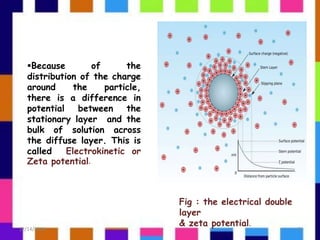
Because of the
distribution of the charge
around the particle,
there is a difference in
potential between the
stationary layer and the
bulk of solution across
the diffuse layer. This is
called Electrokinetic or
Zeta potential.
Fig : the electrical double
layer
& zeta potential.
12/14/2018 5
Determination of zeta potential
The zeta potential of a particle is calculated from
electrokinetic phenomena such as :
electrophoresis,
Streaming potential
electro-osmosis
and sedimentation potential
12/14/2018 6
Electrophoresis
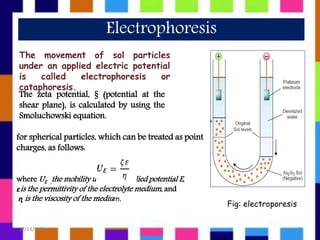
The zeta potential, § (potential at the
shear plane), is calculated by using the
Smoluchowski equation.
for spherical particles, which can be treated as point
charges, as follows:
where UE ,the mobility under an applied potential E,
εis the permittivity of the electrolyte medium, and
ɳ is the viscosity of the medium.
The movement of sol particles
under an applied electric potential
is called electrophoresis or
cataphoresis.
Fig: electroporesis
12/14/2018 7
Streaming potential
When the liquid is forced to flow through the capillary or
the plug, by an applied pressure , an E.M.F is developed
which is called the streaming potential.
If E is the potential difference developed across a capillary of radius
a and length /, for an applied pressure difference p, we can write
the following:
Where,
ε is the permittivity of the medium,
ζ is the zeta potential,
ɳ is the viscosity of the liquid, and
K0is the conductivity of the electrolyte solution.
12/14/2018 8
Electro-osmosis
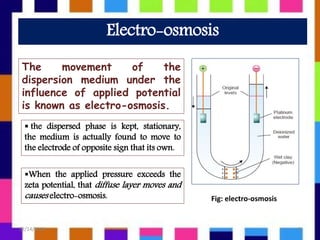
The movement of the
dispersion medium under the
influence of applied potential
is known as electro-osmosis.
Fig: electro-osmosis
 the dispersed phase is kept, stationary,
the medium is actually found to move to
the electrode of opposite sign that its own.
When the applied pressure exceeds the
zeta potential, that diffuse layer moves and
causes electro-osmosis.
12/14/2018 9
When sedimentation of suspend colloids occurs,
this rise a potential difference
This technique is the least commonly used for the determination of
zeta potential, because of several limitations associated with the
measurement and calculation of the zeta potential.
Sedimentation potential
12/14/2018 10
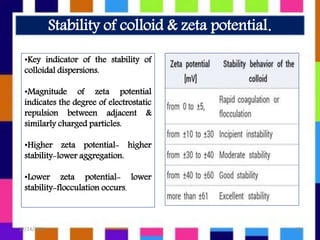
Stability of colloid & zeta potential.
•Key indicator of the stability of
colloidal dispersions.
•Magnitude of zeta potential
indicates the degree of electrostatic
repulsion between adjacent &
similarly charged particles.
•Higher zeta potential- higher
stability-lower aggregation.
•Lower zeta potential- lower
stability-flocculation occurs.
12/14/2018 11
Application of zeta potential.
Water purification & industrial waste.
Minerals and ore flotation.
Emulsions.
Detergency.
Paints.
Pharmaceuticals.
Biomedicals ….etc.
12/14/2018 12
Thanks To All
12/14/2018 13
Question?
12/14/2018 14

Zeta ppt

  • 1.
    PRESENTED BY: KHONDAKER AFRINAHOQUE ID:1114015 , REG:900048 Department of chemistry Comilla university. 12/14/2018 1
  • 2.
    PRESENTATION ON ZETA POTENTIAL& ITS DETERMINATION 12/14/2018 2
  • 3.
    Overview Introduction Determination of zetapotential Application of zeta potential. Stability of colloid & zeta potential. 12/14/2018 3
  • 4.
    Introduction Definition: Zeta potential isthe potential difference between the dispersion medium and the stationary layer of fluid attached to the dispersed particle. 12/14/2018 4
  • 5.
    Because of the distributionof the charge around the particle, there is a difference in potential between the stationary layer and the bulk of solution across the diffuse layer. This is called Electrokinetic or Zeta potential. Fig : the electrical double layer & zeta potential. 12/14/2018 5
  • 6.
    Determination of zetapotential The zeta potential of a particle is calculated from electrokinetic phenomena such as : electrophoresis, Streaming potential electro-osmosis and sedimentation potential 12/14/2018 6
  • 7.
    Electrophoresis The zeta potential,§ (potential at the shear plane), is calculated by using the Smoluchowski equation. for spherical particles, which can be treated as point charges, as follows: where UE ,the mobility under an applied potential E, εis the permittivity of the electrolyte medium, and ɳ is the viscosity of the medium. The movement of sol particles under an applied electric potential is called electrophoresis or cataphoresis. Fig: electroporesis 12/14/2018 7
  • 8.
    Streaming potential When theliquid is forced to flow through the capillary or the plug, by an applied pressure , an E.M.F is developed which is called the streaming potential. If E is the potential difference developed across a capillary of radius a and length /, for an applied pressure difference p, we can write the following: Where, ε is the permittivity of the medium, ζ is the zeta potential, ɳ is the viscosity of the liquid, and K0is the conductivity of the electrolyte solution. 12/14/2018 8
  • 9.
    Electro-osmosis The movement ofthe dispersion medium under the influence of applied potential is known as electro-osmosis. Fig: electro-osmosis  the dispersed phase is kept, stationary, the medium is actually found to move to the electrode of opposite sign that its own. When the applied pressure exceeds the zeta potential, that diffuse layer moves and causes electro-osmosis. 12/14/2018 9
  • 10.
    When sedimentation ofsuspend colloids occurs, this rise a potential difference This technique is the least commonly used for the determination of zeta potential, because of several limitations associated with the measurement and calculation of the zeta potential. Sedimentation potential 12/14/2018 10
  • 11.
    Stability of colloid& zeta potential. •Key indicator of the stability of colloidal dispersions. •Magnitude of zeta potential indicates the degree of electrostatic repulsion between adjacent & similarly charged particles. •Higher zeta potential- higher stability-lower aggregation. •Lower zeta potential- lower stability-flocculation occurs. 12/14/2018 11
  • 12.
    Application of zetapotential. Water purification & industrial waste. Minerals and ore flotation. Emulsions. Detergency. Paints. Pharmaceuticals. Biomedicals ….etc. 12/14/2018 12
  • 13.
  • 14.