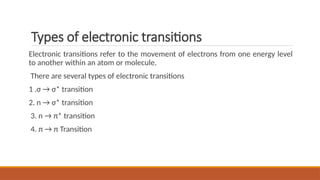
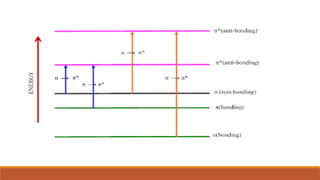
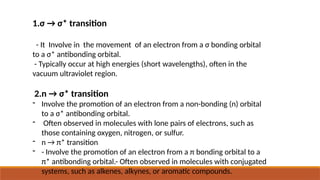
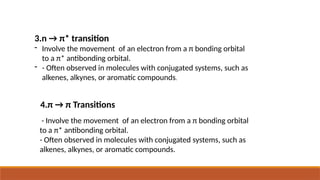
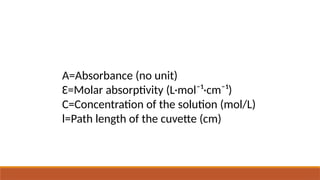
UV spectroscopy explores electronic transitions within molecules, where absorbed ultraviolet or visible light promotes electrons to higher energy levels. These transitions involve the movement of electrons between different molecular orbitals, and the specific types of transitions depend on the molecule's structure and the presence of chromophores (light-absorbing groups). Common transitions include sigma-sigma* (σ-σ*), pi-pi* (π-π*), and n-pi* (n-σ*), each associated with characteristic absorption wavelengths.